DIN 763 chains set the benchmark for durability and performance in marine and engineering environments. You rely on DIN standards to maintain safety and ensure consistent quality across typical applications. Powerful Machinery delivers certified DIN solutions, giving you confidence in every chain used on your project.
Trust in DIN means you secure equipment and uphold safety where it matters most.
Key Takeaways
DIN 763 chains are made from high-quality steel, ensuring strength and durability for marine and engineering applications.
Always check the working load limit before using DIN 763 chains to maintain safety and prevent accidents.
Regular inspection and maintenance of chains are crucial for longevity; look for signs of wear and corrosion.
Powerful Machinery offers certified DIN 763 chains that meet international standards, providing reliability for your projects.
Use reference tables to select the right chain size and specifications based on your specific load requirements.
DIN 763 Chains and Standards
What Is DIN 763?
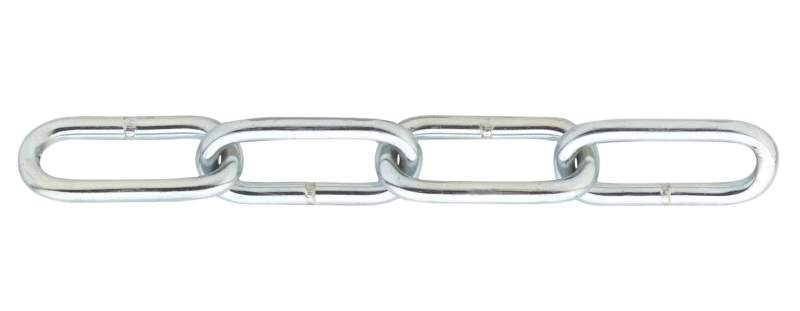
You encounter DIN 763 chains in many marine and engineering projects. This standard defines a specific type of long link chain made from high-quality steel. DIN 763 chains stand out because they follow strict standards for dimensions and load-bearing capacity.
These chains offer you reliable performance in demanding environments. You can use them for suspension, anchoring, mooring, lifting, and securing cargo. Their robust design and corrosion resistance make them a popular choice in Europe and the marine industry.
DIN 763 chains use high-quality steel for strength.
The standard ensures precise dimensions for compatibility.
Load-bearing capabilities meet rigorous requirements.
You find these chains in industrial, marine, and construction sectors.
Their design supports versatility and long-term use.
Importance of DIN Standards in Industry
DIN standards play a vital role in your daily operations. They create a common language for manufacturers and users, ensuring that every product meets the same high expectations.
When you choose products built to DIN standards, you gain confidence in their safety and reliability. These standards also help you work with partners across borders, making it easier to source materials and equipment globally.
Benefit Category | Specific Benefits |
|---|---|
Safety & Reliability | Reduces risk of mechanical failure, Enhances user and operator safety, Builds long-term reliability, Increases consumer trust |
International Cooperation | Facilitates global supply chains, Improves cross-border compatibility, Encourages joint R&D initiatives, Strengthens EU technical leadership |
Sustainability Drive | Promotes circular economy principles, Supports EU climate targets, Appeals to eco-conscious consumers, Encourages green innovation |
Economic Implications | Increases export potential, builds brand reputation, reduces product liability risks, and supports SMEs in global markets |
You benefit from these advantages every time you select DIN 763 chains for your projects.
Powerful Machinery’s Commitment to Quality
Powerful Machinery sets the bar high for quality and compliance. You receive DIN 763 chains that meet or exceed international standards. The company holds certifications from ISO, TUV Rheinland, and other respected organizations.
Every chain undergoes proof testing to ensure it meets strict safety and performance criteria. You can trust Powerful Machinery to deliver products that support your operations and protect your reputation.
DIN 763 Chain Link Construction
Materials and Manufacturing
You depend on DIN 763 chains for consistent performance in marine and engineering environments. Manufacturers use high-quality carbon steel to produce DIN 763 chain link products. This material offers strength and durability, especially when zinc-plated or hot-dipped galvanized for outdoor use.
Stainless steel grades 304 and 316 are also common for DIN applications in aquaculture and corrosive maritime settings. You select the right material based on your project’s requirements and environmental conditions.
Material Type | Description |
|---|---|
Carbon Steel | Available in zinc-plated or hot-dipped galvanized for outdoor durability. |
Stainless Steel | Grades 304 and 316 are standard for aquaculture and corrosive maritime environments. |
Powerful Machinery uses advanced manufacturing processes to ensure every DIN 763 chain link meets strict din standards. You receive chains with precise dimensions, uniform welds, and reliable finishes.
Long Link Design Features
You notice the unique long link design in DIN 763 long link chain products. This feature increases flexibility and allows easier handling compared to short link chains. The welded construction ensures each chain maintains its shape and strength under tension.
You benefit from more even load distribution, which reduces stress on individual links and improves overall safety.
Chain Type | Flexibility | Load Distribution | Safety Factor Design |
|---|---|---|---|
din 763 long link chain | Higher | More even | None |
DIN 766 Short Link | Lower | Less even | None |
You rely on the long link design for applications where you need adjustable dimensions and versatile connections. The DIN 763 chains adapt to various tasks in marine and engineering projects.
Proof Testing and Reliability
You trust Din 763 chain link products because they undergo rigorous proof testing. Powerful Machinery subjects each din 763 long link chain to procedures that verify reliability and performance. Proof load testing exposes chains to loads two to two-and-a-half times their working load limit.
Tensile testing determines breaking strength, ensuring compliance with DIN and ISO requirements. Elongation and fatigue testing simulate repeated use, while impact testing evaluates performance under sudden loads.
Testing Procedure | Description |
|---|---|
Proof Load Testing | Chains are subjected to 2–2.5 times the WLL to ensure no permanent deformation occurs. |
Tensile (Break) Testing | Determines the ultimate breaking strength, ensuring it meets or exceeds DIN/ISO requirements. |
Elongation and Fatigue Testing | Measures stretch and endurance under repeated loading cycles to simulate long-term use. |
Impact Testing | Evaluates performance under sudden or dynamic loads, crucial for crane and hoist applications. |
You gain confidence knowing every DIN 763 chain link meets strict din standards for dimensions and reliability. Powerful Machinery’s commitment to quality ensures you receive chains ready for demanding environments.
DIN 763 Chain Dimensions & Load Ratings
Key Dimensions and Sizing
You need to understand the specifications for din 763 chains before selecting the right chain for your project. The specifications cover pitch, link diameter, and width. These measurements determine compatibility and load-bearing capacity.
Pitch refers to the distance between two consecutive links. Link diameter affects strength and durability. Width impacts flexibility and handling. You find a range of sizes to match different load requirements and applications.
Size (mm) | Pitch (mm) | Width (mm) |
|---|---|---|
2.0 | 22 | 8 |
2.5 | 24 | 10 |
3.0 | 26 | 12 |
3.5 | 28 | 14 |
4.0 | 32 | 16 |
4.5 | 34 | 18 |
5.0 | 35 | 20 |
5.5 | 38.5 | 22 |
6.0 | 42 | 24 |
7.0 | 49 | 28 |
8.0 | 52 | 32 |
8.5 | 56 | 34 |
9.0 | 59 | 36 |
10.0 | 65 | 40 |
11.0 | 72 | 44 |
12.0 | 78 | 48 |
13.0 | 82 | 52 |
16.0 | 100 | 64 |
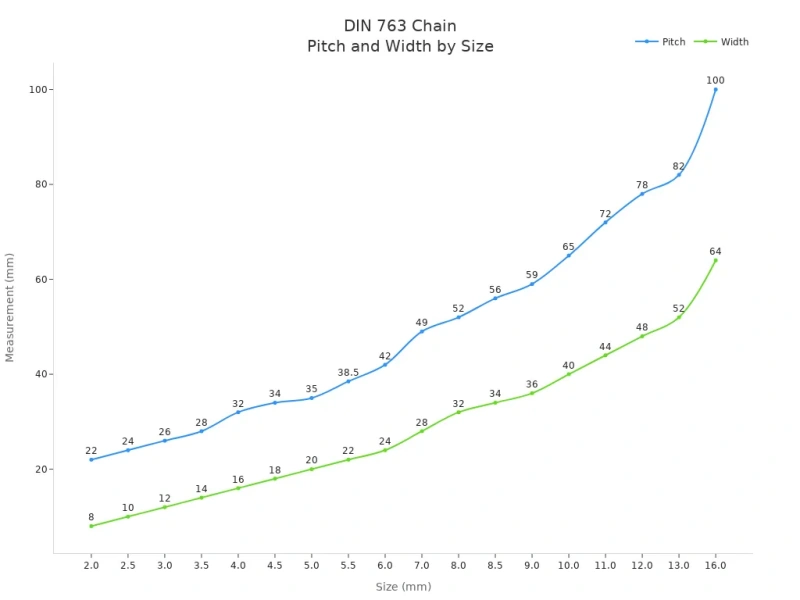
You see that specifications vary across sizes. Larger chains offer greater load-bearing capacity. Smaller chains suit lighter applications. You must check specifications to ensure the chain fits your equipment and meets load requirements.
Working Loads and Test Loads
You rely on specifications for working load limit, test load, and breaking load to ensure safety. Working load limit defines the maximum load you can apply during regular use. Test load verifies the chain’s load-bearing capacity under controlled conditions.
Breaking load measures the ultimate load the chain can withstand before failure. You must never exceed the working load limit to maintain safety and prevent accidents.
Chain Size (mm) | Working Load Limit (N) | Test Load (N) |
|---|---|---|
2 | 800 | 1250 |
2.5 | 800 | 2000 |
3 | 1050 | 3200 |
3.5 | 1540 | 3850 |
4 | 2500 | 6500 |
4.5 | 3000 | 8000 |
5 | 4000 | 10000 |
5.5 | 4200 | 10500 |
6 | 5000 | 12000 |
7 | 7500 | 19000 |
8 | 10000 | 25000 |
8.5 | 10200 | 25500 |
9 | 10500 | 32000 |
10 | 16000 | 40000 |
11 | 15800 | 47500 |
12 | 18800 | 56500 |
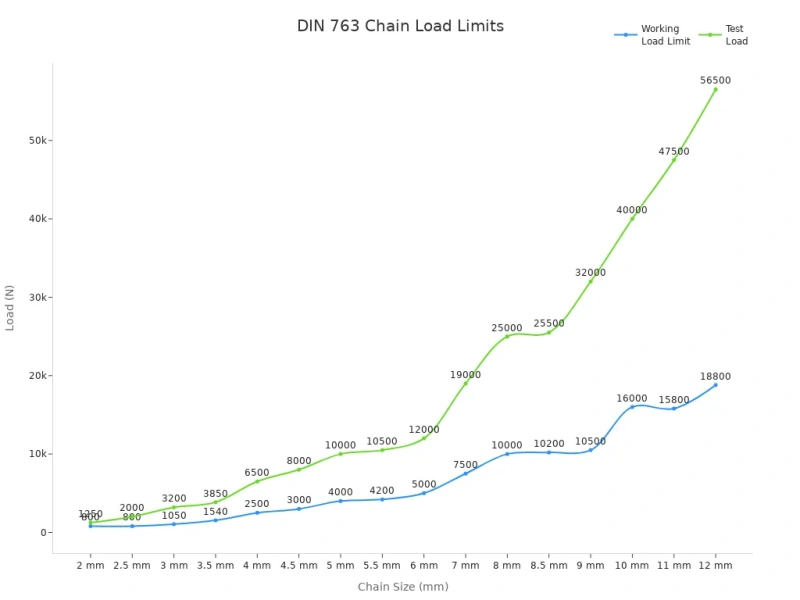
You must review specifications for load-bearing capacity before installation. You select the chain size based on the load you expect to handle. You also consider test load and breaking load for extra assurance. Specifications help you avoid overloading and maintain safety.
Tip: Always use chains within their rated working load limit. Exceeding specifications can compromise safety and reduce chain lifespan.
Reference Tables for Selection
You use reference tables to match chain specifications to your application. Vessel length, vessel weight, and recommended chain diameter guide your selection. You also consider chain grade for load-bearing capacity and durability. Specifications help you choose the right chain for marine, engineering, or industrial tasks.
Vessel Length (ft/m) | Vessel Weight (lbs/tons) | Recommended Chain Diameter (inch/mm) | Suggested Chain Grade |
|---|---|---|---|
20–25 / 6–7.5 | 2,500 / 1.1 | 1/4″ (6 mm) | G40/HT |
26–30 / 8–9 | 5,000 / 2.2 | 5/16″ (8 mm) | G40/HT, G70 |
31–35 / 9–10.5 | 10,000 / 4.5 | 3/8″ (10 mm) | G70, G80 |
You find customization options for din 763 chains to meet unique engineering requirements. You select usage type, material, surface treatment, and features based on specifications and load-bearing capacity.
Customization Options | Details |
|---|---|
Usage | Transmission Chain, Drag Chain, Conveyor Chain, Dedicated Special Chain, Link Chain |
Material | Carbon Steel or Alloy |
Surface Treatment | Polishing |
Feature | Heat Resistant |
Samples | US$10 / Piece (1 Piece Min. Order) |
You contact Powerful Machinery for custom solutions. You specify load-bearing capacity, chain size, and surface treatment to match your project’s specifications. You receive chains that meet international standards and deliver reliable performance.
Note: Powerful Machinery offers a wide range of din 763 chains with specifications tailored to your needs. You benefit from expert support and certified products for every application.
Applications of DIN 763 Chains
Marine and Engineering Uses
You encounter DIN 763 chains in a wide range of marine and engineering applications. These chains play a vital role in environments where you need predictable load performance and long-term reliability. In marine settings, you use them as anchor chains for commercial vessels, yachts, and offshore platforms.
You rely on them for mooring systems that secure floating docks, buoys, and navigation markers. They also help you stabilize floating wind turbines and aquaculture installations. When you need to perform salvage or underwater lifting operations, these chains provide consistent load handling.
In engineering projects, you depend on DIN 763 chains for lifting, securing, and structural support. The following table highlights key applications and features:
Application Area | Key Features |
|---|---|
Lifting and Hoisting | High tensile strength, lightweight design, consistent dimensional accuracy. |
Securing Cargo | Robust construction ensures the stability of heavy or irregularly shaped loads. |
Structural Support | Versatile configurations tailored for specific needs. |
Industrial Applications | Engineered to meet rigorous DIN standards for safety and durability. |
Marine and Construction | Suitable for heavy-duty operations in harsh environments. |
Industrial and Agricultural Applications
You find DIN 763 chains essential in industrial applications and agricultural operations. In construction, you use them for lifting and securing heavy loads. Their resistance to corrosion makes them ideal for high-moisture and corrosive environments.
You also see these chains in conveyor systems for grain handling and crop processing. They serve as reliable drive systems for tractors, harvesters, and balers, where you need dependable power transmission under varying load conditions.
You benefit from the following advantages in industrial and agricultural applications:
Advantage | Description |
|---|---|
Durability | High-strength round steel link chains withstand harsh conditions. |
Resistance to Wear | Engineered to resist abrasion and mechanical stress, ensuring longevity. |
Performance Under Extreme Loads | Maintains excellent performance even with heavy loads and fluctuating conditions. |
Corrosion Resistance | Galvanized or coated finishes protect against rust, extending service life. |
Why Choose Powerful Machinery DIN 763 Chain?
You choose Powerful Machinery DIN 763 chains because they deliver unmatched versatility and value across all applications. You receive chains crafted from high-quality carbon steel, proof tested for safety and reliability.
Powerful Machinery offers a wide range of sizes and finishes, allowing you to select the right chain for your specific load and environmental requirements. You benefit from products that meet international DIN standards, ensuring consistent performance in marine, engineering, industrial, and agricultural applications.
When you need a chain solution that adapts to diverse applications and delivers proven load handling, Powerful Machinery stands as your trusted partner.
Chain Safety and Maintenance
Safe Use and Installation
You must prioritize safety every time you handle DIN 763 chains. Proper installation and use protect both your equipment and your team. Always follow safety protocols and never exceed the working load limit.
Before you install any chain, check the chain specifications and confirm that the chain matches your application’s requirements for strength and corrosion resistance. Use only compatible hardware to maintain compliance with safety standards.
The table below outlines essential safety practices for installing and using DIN 763 chains in marine and engineering environments:
Safety Practice | Description |
|---|---|
Pre-Use Inspection | Always inspect DIN 763 chains before use for signs of wear, cracks, or distortion. |
Load Limits | Never exceed the working load limit (WLL), and ensure compatibility with connected hardware. |
Regular Maintenance | Regular inspection and timely replacement are critical to maintaining safety and compliance. |
Storage | Store din 763 chains coiled or hung in a dry, clean area away from chemicals and moisture. |
You should always store chains in a dry, clean place to prevent corrosion. Proper storage maintains the strength and corrosion resistance of your heavy-duty welded chain. When you follow these safety measures, you reduce the risk of accidents and ensure compliance with industry regulations.
Routine Inspection and Lubrication
Routine inspection and maintenance practices are critical for maximizing the lifespan and reliability of din 763 chains. You need to check for signs of wear, corrosion, and deformation.
Look for thinning of the chain walls, increased pitch, or any visible rust. These symptoms can signal potential failure and compromise lifting operations.
The table below highlights the most common causes of chain failure and how you can prevent them:
Cause | Symptoms | Impact | Prevention Strategies |
|---|---|---|---|
Wear Failure | Gradual increase in chain pitch, thinning of walls | Reduced service life, increased energy consumption | Proper lubrication, use of protective covers, and selection of hardened components for abrasive environments. |
Fatigue Fracture | Characteristic fatigue striations on fracture | Sudden breakage, potential catastrophic failures | Ensure proper tensioning, alignment, and selection of chains with high fatigue resistance. |
Corrosion Failure | Visible rust, pitting on surfaces | Deteriorated properties, potential contamination | Use corrosion-resistant materials and regular cleaning to prevent the buildup of corrosive substances. |
Overload Fracture | Rough, uneven fracture surfaces | Instant equipment shutdown, safety risks | Match chain load capacity to application needs and avoid unexpected peak loads. |
You must perform regular inspections to detect early signs of damage. Replace any chain that shows cracks, excessive wear, or loss of high tensile strength. Maintenance also includes routine lubrication. When you lubricate DIN 763 chains, you reduce friction at the pivot points and prevent internal rust.
This process enhances corrosion resistance and ensures smooth operation. Regular lubrication improves the lifespan and reliability of your chain, especially in marine and engineering environments where moisture and salt can accelerate corrosion.
Tip: Schedule maintenance checks and lubrication at regular intervals. Use only approved lubricants to maintain compliance with safety protocols and maximize corrosion resistance.
Training and Safety Devices
You need proper training to ensure safe lifting and handling of DIN 763 chains. Training helps you understand chain specifications, load limits, and the importance of compliance with safety standards.
You should learn how to identify early signs of wear, corrosion, and fatigue. Training also covers correct installation, safe lifting techniques, and emergency procedures.
Safety devices play a key role in protecting both personnel and equipment. Use load indicators, chain tensioners, and protective covers to monitor chain strength and prevent overload. These devices help you maintain high tensile strength and compliance with safety protocols.
You should also use corrosion-resistant coatings and hardware to extend the service life of your chain in harsh environments.
Powerful Machinery supports your commitment to safety by providing detailed product documentation, technical support, and training resources. You can rely on their expertise to help you implement best maintenance practices and meet all compliance requirements.
Their customer support team stands ready to answer your questions and provide guidance on safety measures, maintenance, and lifting operations.
Note: Investing in ongoing training and using the right safety devices ensures you maintain the highest level of safety, strength, and compliance in every application.
Conclusion
You secure long-term value when you choose certified DIN 763 chains for marine and engineering projects. High-quality materials and adherence to standards reduce maintenance and downtime, supporting safety and reliability.
Powerful Machinery offers expert support and custom chain solutions, including special lengths, sizes, and finishes.
Customization Options | Description |
|---|---|
Length | Tailored to your needs |
Size | Wide range available |
Finishes | Functional or aesthetic |
Follow best practices for inspection and maintenance to maximize performance and service life.
FAQ
What materials do DIN 763 chains use?
You receive DIN 763 chains made from high-quality carbon steel. Powerful Machinery also offers stainless steel options for enhanced corrosion resistance in marine environments.
Can you use DIN 763 chains for lifting heavy loads?
You should not use DIN 763 chains for lifting or hoisting heavy loads. These chains suit pull or tension applications, such as securing equipment or mooring.
What finishes are available for DIN 763 chains?
You can select zinc-plated or black-painted finishes. Powerful Machinery provides custom surface treatments to match your project’s requirements and environmental conditions.
How do you maintain DIN 763 chains?
You inspect chains regularly for wear, corrosion, or deformation. Lubricate pivot points and store chains in a dry, clean area. Replace any chain showing signs of damage.
Where can you find technical support or custom solutions?
You contact Powerful Machinery for expert guidance, technical documentation, and custom chain solutions. Visit Powerful Machinery’s official website for support and product details.