Before using a pallet truck, check the truck, pallet, load, and route. Lower and align the forks, then insert them far enough to support the pallet properly. Pump the handle until the pallet just clears the floor, check that the load is stable, and move at a controlled walking pace. At the destination, stop, lower the pallet completely, withdraw the forks, and park the empty truck with its forks down.
A manual hydraulic pallet truck is also called a pallet jack, hand pallet truck, or pump truck. This guide covers the manual type only. Electric pallet jacks have powered travel and different controls; use their own operating instructions and site procedures.
Before Using a Pallet Truck
Read the instructions and capacity marking for the truck you are using. Follow your site’s operating procedure and make sure you have been instructed in the task, especially where people, dock edges, or vehicle traffic share the route. If the truck, pallet, or route is unsuitable, fix the problem before you start.
Inspect the Pallet Truck
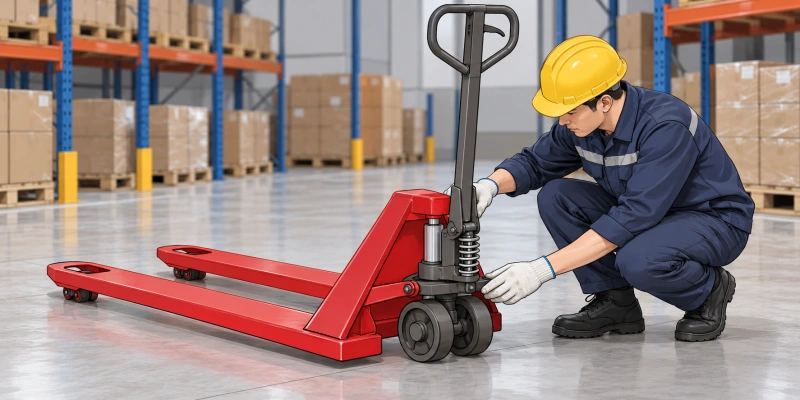
Look along both forks and their tips for bends, cracks, or damage. Check the frame and visible welds, the steer wheels and load rollers for wear or string, film, or debris caught around them, and the handle and control lever for damage or abnormal movement.
Look for hydraulic leakage. On an unloaded truck, confirm that lifting, lowering, and steering respond as the model instructions describe. Make sure its rated-capacity marking is readable. Do not assume that every model has the same lever positions or a brake.
Remove a truck with damaged forks or wheels, leaking hydraulics, a missing or unreadable capacity marking, or faulty controls from service and report it under the site procedure. For a more detailed record, use the pallet jack inspection checklist. This quick check does not replace model-specific inspection requirements.
Check the Pallet and Load
Inspect the pallet’s boards, entry openings, and bottom deck. Broken boards or blocked openings can stop the load rollers or leave the pallet poorly supported. Make sure the forks fit the entry openings, and the pallet is suitable for handling by a pallet truck.
Secure loose items, correct any leaning stack, and determine the total weight of the goods, packaging, and pallet. Compare that weight with the rating shown on the actual truck; do not judge capacity by how easily the handle pumps. If the pallet opening or fork dimensions are uncertain, check pallet truck sizes before using the truck.
Center the Load and Check Fork Support
Position the weight as evenly as practical across both forks. The load’s center of gravity is the point through which its weight acts. A pallet may weigh less than the truck’s rated capacity yet still handle poorly if most of the weight sits on one side or near the fork tips.
Keep heavier items low, secure tall or top-heavy cargo, and avoid a pallet with obvious overhang or movement. Insert both forks far enough to support the pallet evenly, with a clear path for the load rollers through the pallet openings. Do not use just the fork tips to lift.
In equipment specifications, load center is the horizontal distance from a specified point on the truck to the load’s center of gravity. Do not assume that a forklift load-center figure or a single rated distance applies to every manual pallet truck.
Follow the capacity marking and model instructions. If the weight is unknown or the distribution is uneven, verify the weight and correct the load before lifting; choose other equipment if needed.
Check the Route
Check floor condition before moving: debris, spilled oil or water, holes, damaged joints, and thresholds can stop a small roller or shift a load. Confirm aisle and doorway clearance, turning room, pedestrian crossings, blind corners, and the destination. Keep clear of dock edges and other places where a rolling truck could leave the travel surface.
At a dock or trailer transition, use only an approved route with the relevant dock equipment and vehicle secured under site procedures. If the load blocks your view, stop and use the site’s approved method to restore visibility or obtain assistance. Plan an alternative to any slope that the truck or site procedure does not permit.
How to Use a Manual Pallet Truck in 6 Steps?
Pumping the handle raises the forks through the hydraulic unit, but the control lever arrangement varies by model. Check the label or instructions on the truck before lifting or lowering.
Step 1 — Lower and Align the Forks
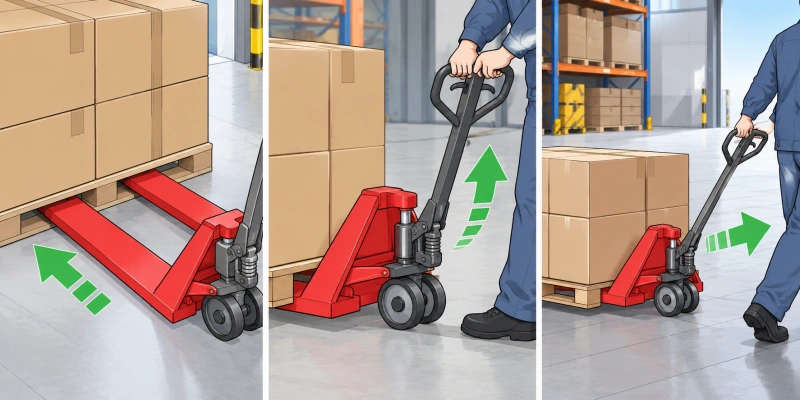
Lower the empty forks according to the truck’s instructions. Approach the pallet squarely at a compatible entry side and line up each fork with its opening. Check the bottom boards and roller path as you approach. Do not strike the pallet to force alignment or push the tips against a board that blocks entry.
Step 2 — Insert Both Forks Beneath the Pallet
Move the truck straight forward until both forks reach far enough beneath the pallet to support the load evenly. Check that the load rollers can move freely through the pallet openings and that the fork tips do not strike another pallet or an obstruction. If a bottom board blocks a roller, stop, withdraw, and check whether the pallet and entry side suit this truck. Do not lift on the fork tips or with only part of the load supported.
Step 3 — Raise the Pallet Just Enough
Use the model’s lift control and pump the handle in smooth strokes. Stop when the pallet clears the floor and will not drag along the approved route. Do not raise it higher simply because the truck has more lift travel available. If it rises unevenly, the handle becomes unusually hard to pump, or the load will not clear, lower it and find the cause. Do not use extra force to lift a load of unknown weight.
Step 4 — Check Load Stability
Pause before walking. Check that the pallet rests evenly on both forks, the goods have not shifted, nothing is dragging, and the load remains stable. Look in the intended direction of travel. If the pallet leans or the view is blocked, lower it on a suitable surface and correct the problem or follow the approved visibility procedure. Never try to steady a moving load by hand.
Step 5 — Move the Pallet at a Controlled Pace
Move only as fast as you can steer and stop without losing control. Keep the load low enough to clear the floor, look along the route, and leave space around pedestrians and fixed structures. Slow before doorways, turns, floor transitions, and blind intersections. Make wide, deliberate turns where space allows; abrupt turns or stops can move the cargo.
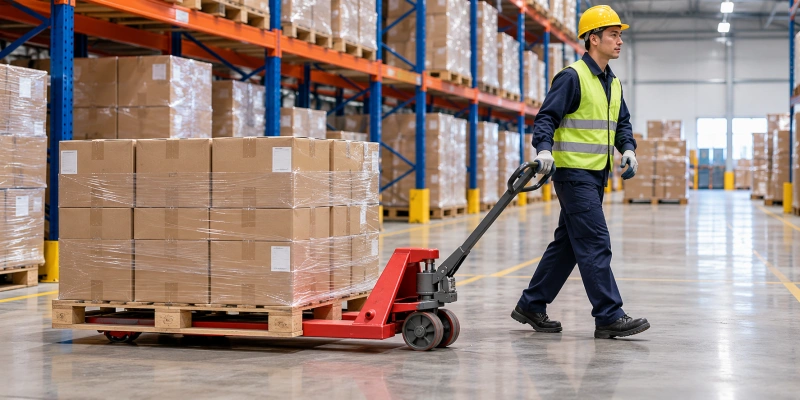
Keep your feet clear of the steer wheels, hold the handle securely, and keep your hands away from the pallet and fixed structures. Never ride the truck or carry a person on its forks.
Step 6 — Stop, Lower, and Withdraw
Position the load on a firm, level surface with enough room to remove the truck. Stop fully. Keep people and feet clear of the pallet and forks, then operate the model’s lowering control gradually. Check that the pallet is fully supported by the floor or approved receiving surface and the forks no longer bear the load. Withdraw the forks straight when practical. If they catch on a board, stop and reassess rather than dragging or tipping the pallet.
Should You Push or Pull a Pallet Jack?
Choose the direction and your position according to the truck’s instructions, the load, the floor, visibility, and the site’s procedure. On a clear, level route, pushing may keep the pallet ahead and in view. A short, controlled pull may help with positioning when you have a clear path behind you. Neither direction makes an unsuitable route safe.
Avoid forceful pulling or twisting your torso, and keep out of any space where the truck or load could pin you against a wall, rack, or doorway. If you cannot maintain control and a clear view, stop and change the method or equipment.
Corners, Blind Spots, and Ramps
Reduce speed before a corner and maintain control throughout the turn. Check clearance for the entire pallet, use the site’s warning procedure at blind intersections, and watch for people entering from doorways or cross aisles.
Do not squeeze between a moving load and a fixed structure. If a tall load blocks your view, use an approved spotter or different arrangement; do not continue at normal travel speed while guessing whether the path is clear.
A slope can cause a manual truck to roll or make the load difficult to control. Use a ramp or slope only if the model instructions permit it and the site has approved the route, load, and method. At a dock plate or lift platform, follow the site’s specific procedure and check that the transition and vehicle or platform are secured for the move.
Check traction, gaps, edges, and pedestrian access. Keep out of any downhill position where the load could trap you. If the route or method is uncertain, choose another route or suitable equipment. For more on the decision, see whether a pallet jack can go up a ramp.
How to Park a Manual Pallet Truck Safely?
Set down the load before parking. Move the empty truck to its designated storage place on firm, level ground, then lower the forks completely. Leave it unloaded, with its handle and forks clear of aisles, exits, emergency routes, and equipment access.
Report a leak, damaged roller, or control problem and mark the truck out of service under the site’s procedure. Do not leave a loaded truck unattended as a storage platform.
Pallet Truck Travel and Parking Checklist
| Before Moving | Before Parking |
| Truck serviceable; capacity marking readable | Load fully lowered and supported |
| Total load within actual rated capacity | Truck unloaded; forks fully down |
| Forks adequately inserted; load centered and stable | Firm, level, designated parking place |
| Floor, turns, visibility, and pedestrians checked | Aisle, exits, and emergency access clear |
| Pallet lifted only enough to clear the route | Defects reported and truck isolated if needed |
Common Pallet Jack Operating Mistakes
| Mistake | Why It Is a Problem | Better Practice |
| Guessing the weight or exceeding capacity | The truck or load may become unstable or fail to lift as intended. | Check the total weight against the actual capacity marking. |
| Lifting on partly inserted fork tips | Support is uneven, and the pallet may shift. | Insert both forks adequately and check the rollers are clear of bottom boards. |
| Carrying an off-center or loose load | Weight can shift during a turn or stop. | Center and secure the goods before travel. |
| Moving with the pallet raised unnecessarily high | Less stable travel and less clearance. | Raise only enough for the pallet to clear the route. |
| Rushing through a blind corner or past pedestrians | Too little time or space to stop. | Slow early and use site warning and visibility controls. |
| Using a slope without approval | The truck can roll or become hard to control. | Follow manufacturer and site limits; choose another method if uncertain. |
| Continuing with a damaged truck | A defect may worsen during the move. | Stop, report it, and remove the truck from service. |
| Parking with raised forks or a load aboard | Trip, obstruction, and unintended movement hazards. | Unload and lower the forks in a designated level area. |
Is a Manual Pallet Truck Operated Like an Electric Pallet Jack?
No. With a manual hydraulic truck, you pump the handle to lift the forks and supply the force to move the load. Electric models use powered travel and model-specific controls, braking systems, and operating instructions. Do not apply these six manual steps as an electric operating procedure. The manual and electric pallet jack comparison explains the equipment differences.
Need a Truck Matched to Your Pallets?
If your pallet openings, load weight, floor, or travel distance call for a different configuration, review Powerful Machinery’s manual pallet truck range. Send the pallet dimensions and entry direction, maximum load including the pallet, floor conditions, and intended travel route so the team can confirm a suitable specification. This operating guide does not replace the instructions for the truck you select.
FAQs
Is a pallet truck the same as a pallet jack?
Usually. In everyday use, both terms often refer to a truck with forks that lift a pallet slightly for horizontal movement. “Pallet jack” is common in the United States. Check whether someone means a manual or powered model, since the controls and procedures differ.
How do you use a pallet jack step by step?
For a manual jack, inspect the truck, pallet, load, and route. Lower and align the forks, insert them adequately, pump until the pallet just clears the floor, check the load, move under control, then stop, lower fully, and withdraw the forks. Park the unloaded truck with its forks down.
Should you push or pull a pallet jack?
Use the method your model instructions and workplace procedure allow for that route. Visibility, available space, load size, floor condition, and your body position all matter. Never stand where the truck or load could pin you; stop if you cannot keep it under control.
How high should you lift a pallet when moving it?
Only high enough for the pallet and bottom boards to clear the floor and the approved route without dragging. There is no fixed travel clearance for all trucks and floors. A manual pallet truck is intended for low-level transport, not stacking loads at height.
Can you use a manual pallet jack on a ramp?
Do not assume you can. Check whether the manufacturer permits it and whether your workplace has an approved procedure for the exact slope, surface, load, and truck. If either is missing, use another route or suitable equipment. Keep out of any downhill crush zone.
What if a pallet jack will not lift?
Stop pumping. With the pallet supported on a firm, level surface, check the model’s control setting, the known load weight and position, and whether the pallet or forks are obstructed. If it still does not lift normally or you see a leak, remove it from service and have qualified personnel inspect it. Do not open or adjust the hydraulic unit as part of routine operation.