A chain hoist does not have one universal length or service life. If you mean lifting distance, check the hoist’s rated lift: the usable vertical travel of the load hook specified for that model. If you mean working life, there is no reliable fixed number of years. Continued use depends on the hoist’s condition, service history, inspection results, and the manufacturer’s limits.
This guide covers manual hand chain hoists, also called chain blocks or chain falls. It explains the measurements needed to order the correct lift and the factors that determine how long the equipment can remain in service.
What Does Chain Hoist Length Mean?
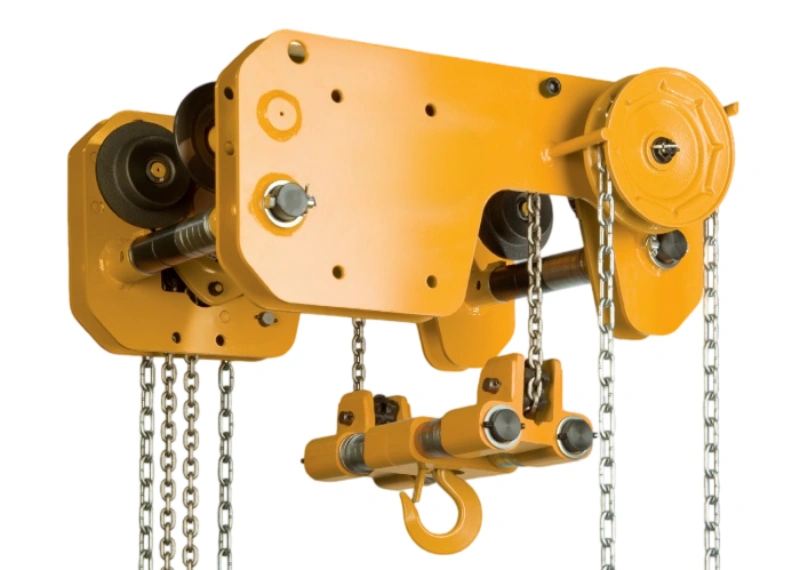
“Chain hoist length” can refer to several different measurements. Mixing them up can result in a hoist that cannot reach the load or cannot raise it high enough.
| Term | What It Describes | Why It Matters |
| Rated Lift | The specified vertical travel available at the load hook | This is the main value used to match the hoist to the required movement. |
| Load-Chain Amount | The approved load chain installed in the hoist | It is not always equal to the rated lift because the number of load-chain falls and the hoist design affect the required amount. |
| Hand-Chain Drop | How far the operating hand-chain loop hangs below the hoist | It must suit the operator’s safe working position. It does not determine load-hook travel. |
| Headroom | The minimum closed distance occupied by the hoist between the suspension and load connections | Headroom determines how high the load hook can rise beneath the support. |
| Load-Chain Tail Clearance or Chain-Container Capacity | The space required for unloaded chain as the hook moves | A longer lift may require more clear tail space or a different approved chain container. |
If you need a diagram of the body, hand chain, load chain, and hooks, see the chain block components guide.
How to Determine the Required Rated Lift?
Start with the two positions the bottom hook must reach. The required hook travel is the vertical difference between the lowest pickup position and the highest position needed to place or clear the load. That travel is the lift requirement; it is not a field calculation for how much load chain to install.
1. Record the elevation and rated capacity of the intended suspension point. Confirm that the support and any trolley, clamp, or attachment are approved for the load.
2. Identify the lowest bottom-hook position required to connect the rigging without side pull or unsafe access.
3. Identify the highest bottom-hook position required after allowing for load height, rigging length, and the necessary clearance.
4. Subtract the lower hook elevation from the upper hook elevation to determine the minimum hook travel. If the required travel falls between available options, ask the supplier to confirm the next suitable standard or custom lift.
5. Check headroom separately. At the highest hook position, the hoist body and minimum closed distance must fit between the support and the required hook position.
6. State where the operator will stand so the hand-chain drop can be specified without requiring work from an unsafe level.
Example: if the bottom hook must move from 0.6 m above the floor to 4.1 m above the floor, the minimum hook travel is 3.5 m. The final order still has to account for available headroom, rigging, the exact model, hand-chain drop, and any manufacturer-required allowance.
How Much Load Chain Is Needed?
Do not convert hook travel directly into a cut length of load chain. A single-fall hoist and a multiple-fall hoist use different amounts of chain for the same hook travel. The hoist also requires the correct end connection, unloaded tail, and chain path. The manufacturer or a qualified supplier should specify and install the approved chain for the exact model and lift.
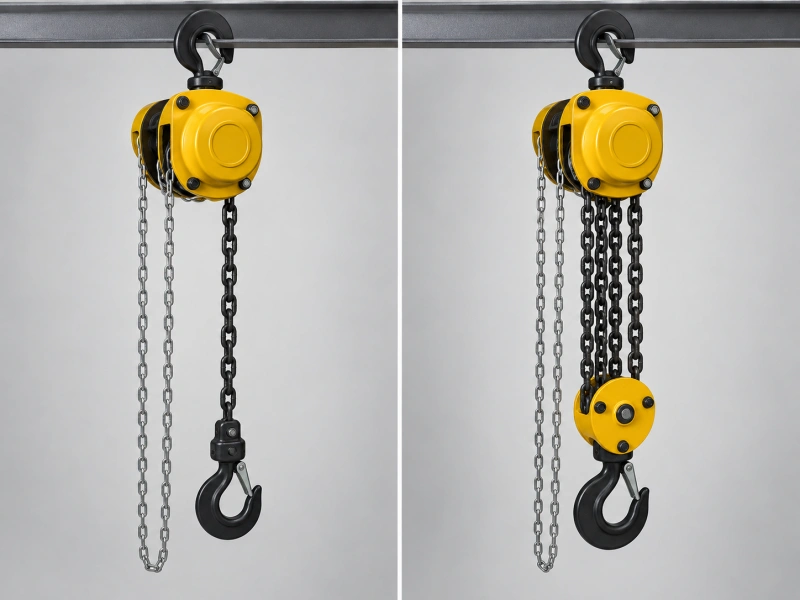
Never lengthen a hoist by welding chain, connecting extra links, or adding an improvised connector. Load chain is calibrated to engage the load sheave, and its material, dimensions, and heat treatment must match the hoist specification. If an existing unit requires more lift, identify its model, serial or lot reference, and follow the current manufacturer procedure for replacement or modification.
What Changes When You Order a Longer Lift?
- More load chain increases the total hoist weight and the amount of chain that must be managed.
- A chain container, when used, must be sized for the hoist capacity and approved lift. A longer chain may require a larger container.
- The hand-chain drop may need to change if the operator stands farther below the suspension point.
- The load chain must remain correctly reeved, untwisted, and clear of obstructions throughout the full travel.
- Longer travel increases the operating distance. Confirm that the manual operating method remains practical for the lifting frequency.
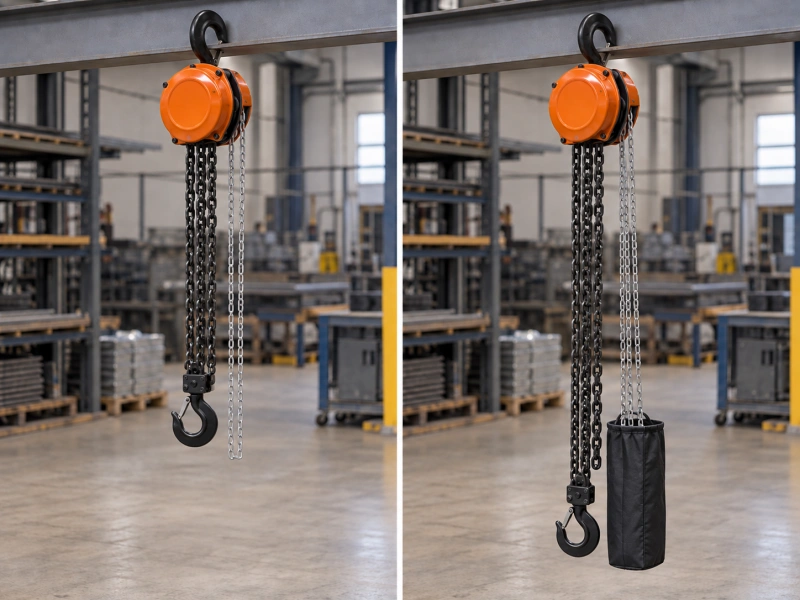
Do not apply a generic capacity reduction simply because the lift is longer. Ask the supplier to confirm the rated load for the complete long-lift configuration, including the chain, suspension, container, and intended environment.
Powerful Machinery Chain Block Lift Examples
At the time of this review, the Powerful Machinery chain block category lists selected standard lifts from 2 m to 3.5 m across MINI, SK, and HS-VL examples. The listed lift varies by model and capacity, which is why “10 ft” or “20 ft” should not be presented as a universal chain-hoist length.
Use the live manual chain block range and specification tables to compare current model data. Before ordering, confirm the exact model, rated capacity, rated lift, headroom, hand-chain drop, number of load-chain falls, load-chain size, unit weight, and required documentation in the quotation.
A product-category table is a selection aid; it is not permission to modify an installed hoist. If the required lift is not shown, request a model-specific quotation rather than assuming that extra chain can be added.
How Long Does a Chain Hoist Last?
A manual chain hoist does not have a universal service life in years. Two units of the same age can have very different remaining condition because their loads, operating frequency, environment, storage, and maintenance history differ. Age alone is not an acceptance criterion, and a recently purchased hoist is not automatically safe if it has been overloaded, damaged, or used incorrectly.
Continued use should be based on the inspection and discard criteria for the exact model, together with applicable site rules and legal requirements. Keep identification and inspection records so a competent person can review wear, damage, unusual operation, repairs, and changes in service.
What Affects Chain Hoist Service Life?
| Factor | Effect on Condition | Control |
| Load and Frequency | Frequent operation, a high load spectrum, and heavy service increase wear. | Select a suitable model and set inspection intervals for the actual service. |
| Misuse | Overloading, shock loading, side pulling, twisting, and using the load chain as a sling can damage components. | Use the hoist only for its approved task and remove it from service after abnormal events. |
| Environment | Water, salt, chemicals, dust, and temperature extremes can accelerate corrosion or contamination. | Confirm environmental suitability, clean the hoist correctly, and inspect more often when conditions require it. |
| Lubrication and Maintenance | Poor or incorrect lubrication can increase wear; lubricant on dry brake friction surfaces can impair function. | Follow the exact manual and keep maintenance within qualified-person boundaries. |
| Storage | Moisture, dirt, tangled chain, and impact damage can shorten usable life between jobs. | Store the unit clean, dry, unloaded, and protected; inspect it before service return. |
| Parts and Repair | Unapproved chain or incorrect parts can disrupt fit, strength, and brake operation. | Use approved parts and qualified service for the exact model. |
Use the chain block inspection checklist to plan condition checks, and follow the chain block maintenance guide for preventive-care boundaries. The chain block storage guide covers storage and return-to-service planning.
When to Stop Using the Hoist?
Remove the hoist from service if identification or rated-load markings are missing, the load chain is twisted or visibly damaged, hooks or latches are deformed or damaged, the brake does not hold as expected, the hand chain binds, the hoist makes unusual noises, operation changes suddenly, or any applicable inspection criterion is not met. Tag the unit to prevent use and have its condition evaluated through the approved technical route.
Do not publish or apply universal wear limits from another brand’s manual. Hook opening, chain pitch, chain diameter, and brake measurements are model-specific. A qualified reviewer must use the current manual and controlled data for the hoist being inspected.
Questions to Include in a Long-Lift Enquiry
- Maximum total suspended load and required rated capacity, with units.
- Lowest and highest required bottom-hook positions and the resulting hook travel.
- Available headroom at the highest load position.
- Suspension type, supporting structure, and trolley or beam details, when applicable.
- Operator position and required hand-chain drop.
- Lifting frequency, usual load spectrum, and working environment.
- Quantity by capacity and lift, destination, required documents, markings, and packaging.
Send Powerful Machinery the application measurements so the quoted model and complete chain configuration can be checked before ordering.
Chain Hoist Length FAQ
What Is the Standard Length of a Chain Hoist?
There is no single standard length for every chain hoist. Manufacturers offer model-specific standard lifts and may offer longer configurations. Compare rated lift, headroom, and hand-chain drop for the exact capacity and model.
Is Rated Lift the Same as Load-Chain Length?
No. Rated lift is the load hook’s specified travel. The actual amount of load chain depends on the hoist design, number of load-chain falls, end allowance, and other model details.
Can I Add Chain to Make a Chain Hoist Longer?
Do not splice, weld, or connect extra links to extend the load chain. Use the chain and modification procedure approved for the exact model, completed by qualified personnel when required.
Does a Longer Lift Reduce Chain Hoist Capacity?
Not automatically. The rated load of an approved long-lift configuration must be confirmed by the manufacturer or supplier. Do not invent a derating percentage or assume that an unapproved extension retains the original rating.
How Many Years Does a Manual Chain Hoist Last?
A universal number of years cannot be confirmed. Service life depends on condition, use, environment, inspection results, maintenance, repair history, and manufacturer limits. Retire or repair the hoist when the applicable criteria require it, regardless of age.
Does the Hand Chain Determine the Lifting Height?
No. The hand chain is the operator’s control loop. Rated lift is provided by the load-chain configuration. Hand-chain drop should be selected for safe access from the operator’s position.