When you select lifting eye bolts and lifting points, you protect yourself and your team from costly accidents. The right lifting accessories ensure stability and safety during every lift. Improper choices increase the risk of dropped loads and equipment damage.
Certified products from Powerful Machinery deliver proven reliability in demanding environments. You build confidence in your operations when you prioritize quality and compliance with international standards.
Key Takeaways
Always check the lifting angle before starting. A small change can greatly affect load capacity and safety.
Use shoulder eyebolts for angular loads. They reduce bending forces and improve safety during lifts.
Inspect lifting eye bolts regularly. Look for wear, corrosion, or damage to maintain safety and reliability.
Avoid lifting at angles greater than 45 degrees. This can lead to significant load capacity reduction and increase risk.
Select the right eye bolt type based on your lifting needs. Collared eyebolts are versatile for both vertical and angular lifts.
Safe Use at Different Lifting Angles
Why Angle Matters?

You must always consider the angle when using lifting eye bolts and lifting points. The angle of the lift directly affects the load capacity and the safety factor. When you lift at an angle, the force on the eye bolt increases, which reduces the working load limit. Even a small change in angle can have a big impact on safety.
Tip: Always check the angle before starting any lift. Never assume the load capacity remains the same as a straight, vertical lift.
The following table shows how the angle affects the weight capacity reduction:
Angle (Degrees) | Weight Capacity Reduction |
|---|---|
15° | 20% |
30° | 35% |
45° | 70% |
As you can see, a 45-degree angle can reduce the load capacity by up to 70%. This means you must select larger lifting points or use alternative lifting accessories for angled lifts. If you ignore these reductions, you risk dangerous working conditions and equipment failure.
Safety Principles for Angular Loads
You need to follow strict safety principles when handling angular loads. International standards recommend several key practices to keep you and your team safe:
Safety Principle | Description |
|---|---|
Avoid Angular Loading | Do not apply loads at an angle greater than 45 degrees. This can cause the eye bolt to fail unexpectedly. |
Use of Spreader Bars or Lifting Beams | Use spreader bars or lifting beams to keep the load vertical and eliminate angular loading. |
Apply Load in the Plane of the Eye | Always apply the load in the same plane as the eye to reduce bending forces. |
Use Shouldered Eyebolts | Only use shoulder eyebolts for angular loads. Make sure the shoulder is tight and aligned with the load. |
Adjust Load Limits Based on Angle | Always check the manufacturer’s derating charts and adjust the load limit as the angle increases. |
The angle of load application changes the safe working load of the eye bolt.
For small angles (up to 30 degrees), the load capacity remains high but is still reduced.
Beyond 45 degrees, the load capacity drops sharply. You may need to use larger lifting points or different hardware to maintain the safety factor.
Common Mistakes to Avoid
Many accidents happen because users overlook basic safety rules. You can prevent most incidents by avoiding these common mistakes:
Mistake | Consequence |
|---|---|
Ignoring WLL Reduction on Angular Lifts | Overloading lifting points, leading to sudden failure. |
Side-Loading a Non-Shouldered Eye Bolt | Bending or shearing of the bolt, resulting in catastrophic failure. |
Failing to Seat the Shoulder Completely Flush | Transferring the side load to threads creates hazardous conditions similar to side-loading. |
Using a Bolt with Insufficient Thread Engagement | Compromised holding power, increasing risk of threads stripping under load. |
Lifting with a Damaged or Corroded Eye Bolt | Unreliable load-bearing capacity poses a significant safety risk. |
Load alignment matters. Always apply the load in line with the lift and parallel to the eye axis. This prevents bending or breaking of the bolt.
Avoid slinging between eyebolts. Running a sling from one eye bolt to another creates an angular force, which can greatly reduce the working load limit.
Prevent shock loading. Sudden changes in load direction or rapid acceleration increase tension and can cause the eye bolt to fail.
You must always check the condition of your lifting points before each use. Never use a damaged or corroded eye bolt. Always ensure the shoulder sits flush and the threads are fully engaged. These steps help you maintain the safety factor and avoid dangerous working conditions.
Types of Lifting Eye Bolts and Lifting Points

Dynamo and Right-Angle Eye Bolts
You often see dynamo eyebolts in power generation and industrial settings. These eye bolts feature a small collar and are designed for axial loading only. You should use dynamo eyebolts when you need a high safety factor and certified performance.
Right-angle eye bolts serve similar purposes but are less common in modern lifting points. The table below helps you compare their main features:
Feature | Dynamo Eyebolts |
|---|---|
Design | Small collar, axial loading only |
Applications | Used in power generators |
Material | Hardened and tempered steel |
Safety | High safety factor, certified |
You must select dynamo eyebolts for applications that demand reliability and strict compliance with safety standards.
Collared and Shoulder Eye Bolts
Collared eyebolts give you flexibility for both vertical and angular lifts. You can use collared eyebolts in a wide range of scenarios, including side loading. Shoulder eye bolts, a type of collared eyebolts, reduce bending stresses and improve safety.
Non-shouldered eye bolts are only safe for vertical lifts. The table below shows the differences:
Type of Eye Bolt | Safety Considerations | Recommended Usage Scenarios |
|---|---|---|
Collared/Shoulder Eye Bolt | Designed for angular lifting; reduces bending stresses | Suitable for a wider range, including side loading |
Non-Shouldered Eye Bolt | Only safe for vertical lifts; not for angular loads | Should only be used for in-line or vertical lifts |
Shouldered eye bolts work for both vertical and angular lifts.
Non-shouldered eye bolts should only be used for vertical lifts.
Always make sure the shoulder sits flush with the load for side or angular lifting.
When you choose an eye bolt, consider the type and the direction of force. Collared eyebolts offer the best safety for most lifting points.
Eye Bolts with Link
Eyebolts with a link provide secure attachment points for heavy lifting operations. You benefit from their versatility and strength, especially when you need to lift loads at angles.
These eye bolts handle harsh conditions and require little maintenance. You can rely on them for safe lifting and rigging in demanding environments.
DIN 580 and DIN 582 Eye Bolts and Nuts
DIN 580 and DIN 582 eye bolts and nuts set the standard for load capacity and compliance. You find these products marked with their maximum load, making selection straightforward. The table below lists typical load capacities:
Size | Max Load (N) | Max Load (lbf) |
|---|---|---|
M 6 | 750 | 169 |
M 8 | 1400 | 315 |
M 10 | 2300 | 517 |
M 12 | 3400 | 764 |
M 16 | 7000 | 1574 |
M 20 | 12000 | 2698 |
M 24 | 18000 | 4047 |
M 30 | 32000 | 7194 |
M 36 | 46000 | 10341 |
You should always check the markings and select the right size for your lifting points.
High Tensile Eye Nuts and Bow Nuts
High tensile eye nuts and bow nuts give you strong and reliable connections for heavy loads. You can trust bow nuts to withstand significant stress without failure. These nuts use rust-resistant steel and offer a minimum breaking load five times greater than the safe working load limit.
Swivel eye nuts allow better positioning when the force direction changes. Fixed eye nuts provide a rigid connection for stable lifting.
Swivel eye nuts enhance safety when the force direction varies.
Fixed eye nuts work best for applications needing a stable connection.
You improve safety and efficiency by choosing high tensile eye nuts and bow nuts for your lifting eye bolts and lifting points.
Powerful Machinery Stainless Steel Eye Bolts
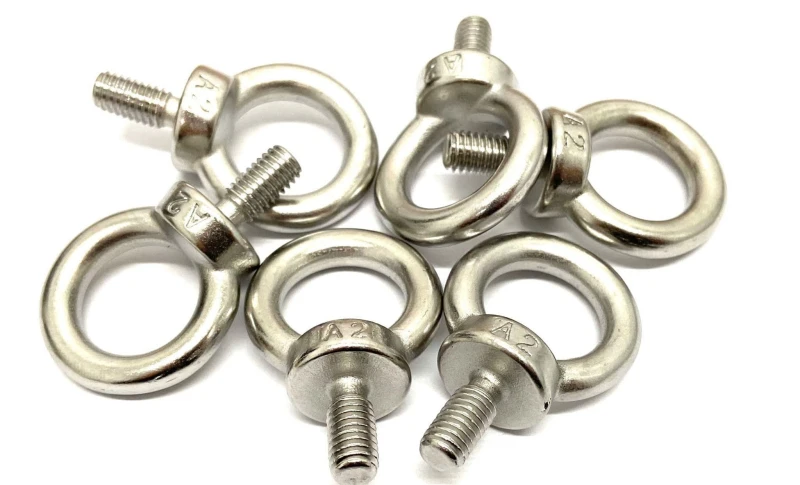
Powerful Machinery offers stainless steel eye bolts that meet strict international standards. You can select from grades like AISI 304, AISI 316, and Duplex 2205, each designed for specific environments.
These eye bolts resist corrosion and provide high strength for marine, construction, and industrial use. The table below shows the grades and standards:
Grade | Description | International Standards |
|---|---|---|
AISI 304 | Austenitic, corrosion-resistant | ASTM A193, EN 10088, JIS G4303 |
AISI 316 | Marine-grade, Mo-alloyed SS | ASTM A276, BS 970, DIN 17440 |
AISI 316L | Low carbon, high weldability | ASTM A240, ISO 3506 |
AISI 410 | Martensitic, magnetic | ASTM A276, JIS SUS410 |
AISI 431 | Heat-treatable, high-strength | ASTM A276, DIN 1.4057 |
Duplex 2205 | High strength, chloride resistance | ASTM A479, EN 1.4462 |
You gain peace of mind knowing that Powerful Machinery stainless steel eye bolts comply with ASTM, DIN, ISO, and JIS standards. You can use these products in harsh environments and trust their performance for all your lifting points.
Load Capacity and Angle Reduction
General Reduction Table
You must understand how the load capacity of lifting eye bolts and lifting points changes as the lifting angle increases. The working load limit drops quickly when you move away from a vertical lift. Use the following table to see how the angle affects the weight capacity:
Angle (Degrees) | Weight Capacity Reduction |
|---|---|
5° | 100% (full capacity) |
15° | 20% reduction |
30° | 35% reduction |
45° | 70% reduction |
46°+ | Not safe to use |
Always check the working load limit before lifting at any angle. Never use an eye bolt at angles above 45 degrees.
Collared Eyebolt Factors
Collared eyebolts give you flexibility for both vertical and angular lifts. You must apply reduction factors to the working load limit when lifting at an angle. The table below shows the reduction factors for collared eyebolts:
Angle to Vertical | Reduction Factor |
|---|---|
Up to 15º | 0.63 |
Up to 30º | 0.4 |
Up to 45º | 0.25 |
You should always multiply the rated load capacity by the reduction factor to find the safe working load. Collared eyebolts help you maintain a safety factor, but you must follow these limits.
Eye Bolt with Link Factors
Eye bolts with a link offer extra strength for angular lifts. Shoulder eye bolts can handle angled loads, but their working load limit drops sharply as the angle increases. Screw eye bolts must never be loaded at an angle. Use the table below to compare reduction factors:
Angle | Reduction Factor for Shoulder Eye Bolts | Reduction Factor for Screw Eye Bolts |
|---|---|---|
0° | 100% | 100% |
45° | 30% | 0% |
90° | 0% | 0% |
Standard eye bolts are not rated for angular loads.
Dynamo eyebolts and collared eyebolts provide better safety for angled lifts.
Always check manufacturer data for specific products like Powerful Machinery’s eye bolts.
Practical Load Calculation Examples
You must calculate the safe working load for each lift. For example, if you use a 4.75-ton shackle with collared eyebolts at a 15-degree angle, you only get 55% of the rated capacity. The table below shows how the required eye bolt size changes:
Angle from Vertical | Capacity Percentage | Required Eye Bolt Size (for 4.75-ton shackle) |
|---|---|---|
0 degrees | 100% | 4.75 tons |
5 to 15 degrees | 55% | Minimum 2″ eye bolt (rated for 32,500 lbs) |
Beyond 15 degrees | 25% | Larger eye bolt needed (8,125 lbs) |
You must always use the correct eye bolt and maintain the safety factor. Reference manufacturer charts and product data to confirm the working load limit for your application.
Selecting and Installing Lifting Points
Axial vs Angular Loading
You need to understand the difference between axial and angular loading before choosing lifting points. Axial loading means the force pulls straight along the axis of the eye bolt, which gives you the highest safety factor and working load limit.
Angular loading happens when the force pulls at an angle, which reduces the load capacity and increases risk. The table below shows how different lifting gear handles these loads:
Type of Lifting Gear | Load Handling Type | Description |
|---|---|---|
Eye Bolts | Axial | Best for vertical lifts with static loads. |
Collared Eyebolts | Angular | Suitable for angular lifting when properly seated. |
Shouldered Eye Bolts | Angular | Designed for more effective angled lifts. |
Swivel Hoist Rings | Angular | Allows for dynamic lifting with 360° rotation. |
Center-Pull Hoist Rings | Axial | Standard for vertical lifts with central alignment. |
You should always match the lifting points to the type of load and direction of force.
Thread and Material Selection
Choosing the right thread and material ensures the safety and longevity of your lifting points. Consider these factors:
Select the correct thread type and size for your mounting surface. Incorrect threading can cause failure.
Use stainless steel in corrosive or marine environments to prevent rust and extend service life.
For dynamic loads, choose eye bolts with a higher safety factor.
Always check that the eye bolt fits the application and matches the load type.
Proper selection prevents accidents and keeps your lifting operations reliable.
Markings and Standards
You must check the markings and standards on every eye bolt before installation. These markings guarantee compliance and traceability. Look for:
Marking/Standard | Description |
|---|---|
Manufacturer’s mark | Identifies the maker of the eye bolt. |
Working load limit (WLL) | The maximum load the eye bolt can safely lift. |
Traceability code | Ensures quality certification and traceability. |
Nominal size | Specifies the thread diameter. |
Grade | Indicates the material grade. |
Regulatory marking (e.g., CE) | Shows compliance with safety regulations. |
ISO 3266 | International standard for eye bolts. |
DIN 580 | German standard for lifting eye bolts. |
Always verify these markings to ensure you meet safety and regulatory requirements.
Powerful Machinery Product Selection Tips
Powerful Machinery helps you choose the right lifting eye bolts and lifting points for your needs. Use these tips:
Key Factor | Description |
|---|---|
Load Capacity | Match the eye bolt to the weight you need to lift. |
Material and Durability | Choose stainless steel for moisture or chemical exposure. |
Surface Treatments | Select hot-dip galvanizing for rust protection in harsh environments. |
Thread Type and Size | Ensure compatibility with your equipment and mounting surface. |
You should always select certified products and follow installation instructions closely. Proper installation and regular inspection maintain the safety factor and prevent exceeding the limit. Powerful Machinery’s certified products, including collared eyebolts and dynamo eyebolts, give you confidence in every lift.
Advanced Lifting Points
Swivel Hoist Rings and Modern Solutions
You face new challenges when lifting loads that require movement in multiple directions. Swivel hoist rings and other advanced lifting points solve these problems. Unlike a standard eye bolt, a swivel hoist ring rotates 360° and pivots 180°, letting you lift from any angle without losing capacity.
This flexibility means you can handle complex lifts, such as moving molds or heavy machinery, with less risk of failure. Swivel hoist rings maintain their full working load limit, even during side pulls, while collared eyebolts lose capacity at an angle. You gain extra safety and efficiency for dynamic or multi-directional lifts.
Feature | Hoist Rings | Standard Eye Bolts |
|---|---|---|
Load Direction | Any angle | Vertical only |
Working Load Limit | 100% at any angle | Reduced at an angle |
Articulation | Swivels 360°, pivots 180° | Fixed |
Safety Risk | Low in angular lifts | High in side loads |
Tip: Use swivel hoist rings for heavy-duty applications like moving turbines, generators, or CNC machines. These tools keep your team safer and your equipment protected.
Comparison of Leading Brands
You want the best safety features and certifications when choosing advanced lifting points. Leading brands invest in engineering and testing to meet strict standards. The table below compares some top brands:
Brand | Safety Features | Certifications |
|---|---|---|
RUD | German engineering meets global safety standards | International standards |
Jungheinrich | ISO-certified safety | ISO certifications |
Genie Industries | Proven durability through independent load testing | N/A |
Lift Products Inc. | Focus on safety and long-term durability | N/A |
Powerful Machinery stands out by combining innovation, rigorous testing, and full compliance with international standards. You benefit from products that deliver both reliability and peace of mind.
When to Upgrade?
You should consider upgrading to advanced lifting points when your lifts involve frequent angle changes, rotating loads, or require maximum safety. If you use collared eyebolts but notice frequent side loading or complex rigging, it is time to switch.
Swivel hoist rings and similar solutions reduce the risk of accidents and equipment damage. Powerful Machinery continues to innovate, offering advanced lifting points that meet or exceed global standards. You ensure safer, more efficient lifts by choosing the right equipment for your evolving needs.
Inspection, Maintenance, and Storage
Regulatory Requirements
You must follow strict regulatory requirements to keep your lifting eye bolts and lifting points safe. Regular inspections help you maintain reliability and prevent accidents. Always check that identification markings are clear and easy to read. These markings confirm the origin and rated load of each component.
Inspect threads and holes for cleanliness and damage. Remove any eye bolts that show deformation, damage, or signs of overloading. Make sure each eye bolt aligns properly and sits on a clean surface. These steps help you maintain the safety factor in every lift.
Perform regular inspections for all lifting points.
Confirm that identification markings are legible.
Check threads and holes for cleanliness and damage.
Remove any eye bolts with deformation or signs of overloading.
Ensure proper alignment and surface condition during inspections.
Powerful Machinery’s products meet international standards and come with full certification, giving you confidence in every operation.
Inspection Checklist
You need a thorough inspection checklist to keep your lifting equipment in top condition. Use this list before every use:
Make sure the lifting eye bolts show no heavy wear.
Check for heavy corrosion.
Inspect threads for damage or distortion.
Look for signs of heat damage, weld spatter, or arc strikes.
Avoid using eye bolts that have been altered or repaired by grinding, machining, welding, notching, or stamping.
Clean and inspect tapped receiving holes for thread wear or deterioration.
Confirm that all lifting eye bolts meet performance requirements for your application.
By following this checklist, you protect your team and maintain a strong safety factor.
Markings and Removal
Proper markings help you identify and track each lifting eye bolt. You should remove any eye bolt from service if markings become unreadable or if you find any damage. The table below shows the recommended markings:
Marking Requirement | Description |
|---|---|
Manufacturer’s identification mark or symbol | A unique mark or symbol identifying the manufacturer. |
Working load limit (SWL) | The maximum load that the eyebolt can safely lift, e.g., 2.5 t. |
Traceability code | A code that allows identification of the specific eyebolt/shackle or batch. |
Nominal size | The nominal diameter of the thread for eyebolts. |
Grade | The grade of the shackle, if applicable. |
Regulatory mandatory marking | Additional markings like CE marking as required by regulations. |
If you cannot read the markings or if you see any sign of damage, remove the eye bolt immediately. This action keeps your safety factor high and prevents accidents.
Storage Best Practices
You extend the life of your lifting eye bolts by storing them correctly. Keep all lifting points in a dry, clean area away from chemicals and moisture. Use racks or bins to prevent contact with hard surfaces that could cause damage. Label storage areas to make it easy to find the right size and type.
Regularly inspect stored items for rust or wear before use. Powerful Machinery’s quality assurance and certifications ensure that your equipment remains reliable, even after long periods in storage.
Tip: Good storage practices help you maintain the safety factor and ensure every lift meets the highest standards.
Conclusion
You improve safety and efficiency when you match the right lifting eye bolts and lifting points to your specific lifting angle and load. Always select the correct eye bolt for the job and follow manufacturer guidelines. Regular inspection and adherence to standards help prevent accidents.
For complex lifts, consult experts to ensure you meet all safety requirements. Remember these key points:
Choose the right lifting points for each application.
Inspect lifting points for wear or damage before every use.
Follow international standards and consult professionals for challenging lifts.
Visit Powerful Machinery’s website for more information and to explore certified solutions for your lifting needs.
FAQ
What is the safest angle for lifting with eye bolts?
You achieve the highest safety when you lift vertically at 0°. Angles above 45° are unsafe. Always check the manufacturer’s reduction charts before lifting at any angle.
How do you select the right eye bolt size for your load?
You must match the eye bolt’s working load limit to your load weight. Always factor in any angle reduction. Refer to manufacturer charts for accurate sizing.
Can you use stainless steel eye bolts outdoors?
Yes. Stainless steel eye bolts from Powerful Machinery resist corrosion and work well in outdoor or marine environments. You get long-lasting performance and safety.
How often should you inspect lifting eye bolts?
You should inspect eye bolts before every use. Look for wear, corrosion, or damage. Remove any bolt that shows signs of failure to maintain safety.