You need to select electric hoist parts with care to maximize operational safety and efficiency in industrial environments. Powerful Machinery offers certified electric hoist solutions that meet strict international standards. Proper alignment and lubrication minimize mechanical stress and improve safety.
The right parts reduce downtime and lower energy costs. Refer to the table below for key benefits:
Benefit | Impact on Efficiency and Safety |
|---|---|
Fewer unplanned repairs | Reduces downtime and enhances operational safety |
Proper alignment and lubrication | Improves safety and reliability |
Lower energy costs | Boosts efficiency and reduces expenses |
Key Takeaways
Select electric hoist parts carefully to enhance safety and efficiency in industrial settings.
Always verify the rated load capacity of your hoist to prevent overloading and ensure safe operation.
Regular maintenance, including daily inspections and annual checks, extends the lifespan of your electric hoist.
Choose the right mounting option based on your facility’s structure and load requirements for optimal performance.
Electric Hoist Parts Overview
Key Components And Functions
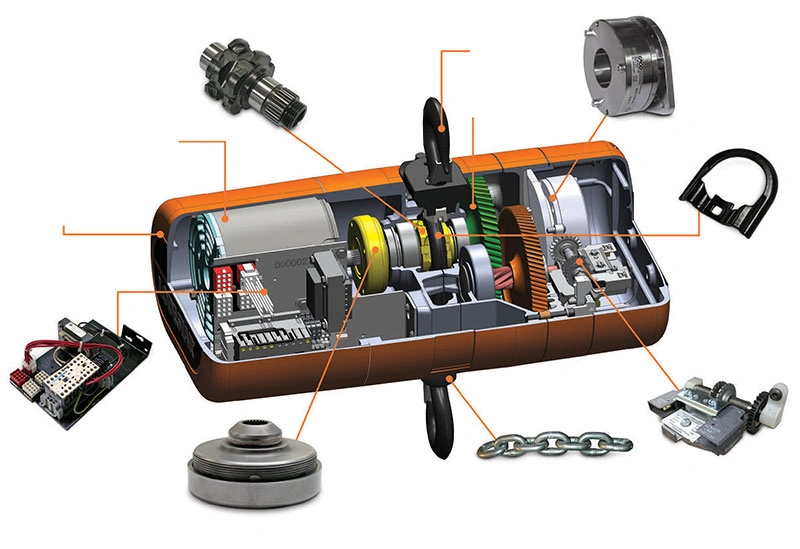
You need to understand the main electric hoist parts before selecting the right electric hoist and trolley for your operation. Each part plays a vital role in safety and performance. Here is a breakdown of the essential components:
Motor: Drives the lifting system and provides mechanical force.
Chain: Connects the load hook to the hoist body, made from high-strength alloy steel.
Load Hook: Secures the load and includes a safety latch.
Hoist Body: Houses internal parts and ensures durability.
Gearbox: Reduces motor speed and increases torque for heavy lifting.
Brake: Holds the load in place and prevents accidental movement.
Control Panel: Lets you operate the electric hoist and trolley, including emergency stop functions.
Chain Container: Protects unused chain and prevents tangling.
Push Button Pendant or Remote Control: Allows safe operation from a distance.
Limit Switches: Prevents overtravel and protects against accidents.
You must check each electric hoist part for compatibility and reliability. These components work together to deliver safe and efficient lifting, especially when you use electric hoist and trolley systems in demanding environments.
Powerful Machinery Product Features
Powerful Machinery designs electric hoist parts with industry-leading materials and certifications. You benefit from products built with alloy steel, aluminum, and corrosion-resistant components. These materials increase durability and extend the lifespan of your electric hoist and trolley.
Material | Effect on Durability |
|---|---|
Alloy Steel | High strength and resistance to wear and tear |
Aluminum | Lightweight and corrosion-resistant |
Corrosion-Resistant Components | Protects against environmental damage and extends lifespan |
You gain peace of mind knowing that Powerful Machinery electric hoist and trolley solutions meet strict international standards.
Certification/Standard | Description |
|---|---|
CE | Meets EU safety standards. |
ISO9001:2000 | Ensures quality management. |
ASME 30.5 | Mobile crane safety. |
ASME 30.4 | Pedestal and portal crane safety. |
ANSI/ASME 30.2 | Overhead and gantry crane safety. |
OSHA 1926.1400 | Construction crane safety. |
Powerful Machinery electric hoist parts offer robust construction, advanced safety features, and reliable performance. You can trust these electric hoist and trolley systems to handle heavy loads and operate efficiently in industrial settings.
Buyer’s Guide To Electric Hoist And Trolley Selection
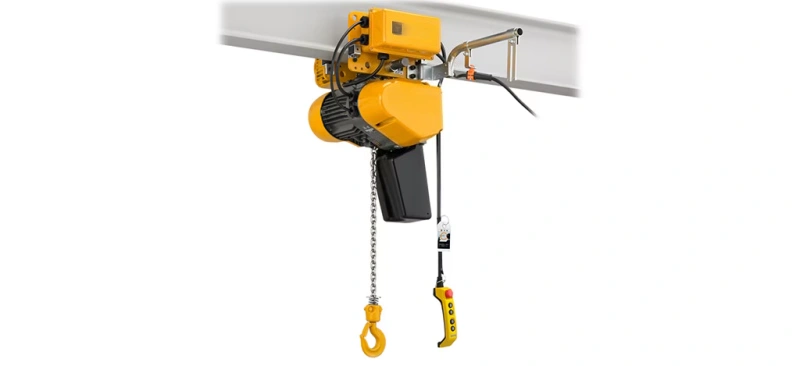
Choosing the right electric hoist and trolley system is essential for safe and efficient lifting in industrial environments. Powerful Machinery offers a comprehensive range of electric hoists and trolley solutions designed for various applications.
This buyer’s guide will help you navigate the selection process, ensuring you match your operational needs with the best electric chain hoists and electric hoist parts.
Load Capacity And Application Needs
Start your selection by evaluating the load characteristics and rated load capacity required for your operation. You must know the precise weight, dimensions, and center of gravity for every load you plan to lift.
The rated capacity of the electric hoist and trolley must always exceed the heaviest load you expect to handle. Consider the following factors:
Weight of the heaviest load
Mean Effective Load (MEL)
Duty cycle and frequency of lifts
Lifting speed requirements
Environmental conditions such as moisture, dust, or hazardous atmospheres
You should analyze your operational environment for hazards and ensure the support structure can safely bear the full weight of the system. For specialized applications, Powerful Machinery provides electric chain hoists with a wide range of lifting capacities, from light-duty to heavy-duty industrial use.
Tip: Always verify the rated load capacity and rated capacity of your electric hoist and trolley system before installation. Overloading can compromise safety and lead to equipment failure.
Lifting Height And Speed Considerations
The lifting height, or height of lift (HOL), defines the vertical distance your electric hoist and trolley must cover. You need to measure the distance from the lowest to the highest point the hook will travel.
Add extra clearance for safe operation. In facilities with limited headroom, select low-headroom electric chain hoists to maximize your lifting range.
Lifting speed is another critical factor. Faster lifting speeds improve productivity but may require more robust electric hoist parts and control systems. Match the lifting speed to your application needs to avoid unnecessary wear or safety risks.
Parameter | Recommendation |
|---|---|
Lifting Height | Measure the required lift distance plus clearance |
Headroom | Choose low-headroom hoists for tight spaces |
Lifting Speed | Select speed based on load type and production rate |
Powerful Machinery offers electric hoist and trolley models with variable lifting speeds and customizable lifting heights, ensuring you can choose the right electric hoist for any application.
Duty Cycle And Work Intensity
Duty cycle measures how long and how often your electric hoist and trolley system operates within a given period. This specification is crucial for selecting the best electric chain hoists for your workload.
The duty cycle classification ensures your hoist can handle the intensity of your lifting operations without overheating or excessive wear.
Duty Cycle Classification | Description | Implications for Use |
|---|---|---|
H4 | Heavy-duty, near-continuous operation | Ideal for high-volume production lines |
Light-duty (25%) | 2.5 minutes of operation per 10 minutes | Not suitable for constant lifting tasks |
Manufacturers like Powerful Machinery specify duty cycles according to international standards. You must match the duty cycle and rated capacity of your electric hoist and trolley to your production demands. Selecting the wrong classification can lead to equipment failure and safety hazards.
Note: Training your team on proper use and understanding of duty cycles is essential. Well-trained operators extend the lifespan of your electric hoist and trolley system and maintain safety standards.
Suspension And Mounting Options
The way you mount your electric hoist and trolley system affects both safety and operational flexibility. Powerful Machinery provides several suspension and mounting options to suit different environments and load characteristics.
Hook Mount: Quick and flexible installation, ideal for portable or lighter-duty setups.
Lug Mount: Stable and permanent, reduces frame wear for heavy-duty lifting.
Trolley Types: Choose from push, geared, or motorized trolleys based on load weight and movement needs.
Mounting Type | Advantages | Disadvantages |
|---|---|---|
Ceiling Mount | Handles heavier loads, clean vertical lifting path | Requires a strong ceiling structure |
Wall Mount | Fits tight spaces, fewer structural modifications | Lower rated load capacity than ceiling mounts |
Proper alignment of your electric hoist and trolley system is vital. Misalignment can increase wear and create safety risks. Always ensure the mounting point can handle both static and dynamic loads. Training your installation team on correct mounting procedures further enhances safety and performance.
Recommendation: Consult Powerful Machinery’s experts for recommendations on the best suspension and mounting options for your specific application. Their team can provide site assessments and training to ensure optimal installation and operation.
By following this buyer’s guide, you can make informed decisions about electric hoist and trolley selection. Assess your lifting capacity, application needs, lifting height, speed, duty cycle, and mounting options.
Powerful Machinery’s electric hoist and trolley solutions deliver reliability, safety, and performance for every industrial lifting challenge.
Safety Features In Electric Hoist Parts
Overload Protection And Emergency Stop
You must prioritize safety features when selecting electric hoist parts for industrial use. Overload protection prevents the electric hoist from lifting loads that exceed the maximum load weight. This feature automatically shuts down the hoist if the maximum load is surpassed, protecting both equipment and operators.
Emergency stop systems allow you to halt all operations instantly during hazardous situations. These systems override regular controls, providing a rapid and controlled stop that prevents accidents and equipment damage.
Feature | Description |
|---|---|
Overload Protection | Prevents lifting loads beyond maximum load weight, ensuring operator safety |
Emergency Stop | Instantly halts all motion in critical situations |
Smart Brake Technology | Reduces wear and provides maintenance-free operation |
Real-Time Monitoring | Provides immediate feedback on equipment status |
The immediate activation of an emergency stop switch can make the difference between a minor incident and a catastrophic accident.
Limit Switches And Safety Hooks
Limit switches play a crucial role in preventing over-travel and restricting lifting motion. They ensure the electric hoist stops before reaching unsafe positions, avoiding potential accidents and equipment damage.
You will find two main types: operational limit switches, which slow upward travel as the hoist approaches the crane, and final/over travel limit switches, which stop the hoist before it contacts the structure. Safety hooks with secure latches prevent load drops and ensure the load remains attached during lifting.
Role of Limit Switches | Description |
|---|---|
Prevent Over-Travel | Stops chain movement beyond safe limits, avoiding accidents |
Backup Safety Feature | Acts as a backup to manual control |
Types | Operational and final/over-travel limit switches |
Limit switches restrict lifting motion and help avoid two-blocking, which can damage equipment and cause load drops.
Safety hooks provide secure attachment, reducing the risk of accidental release.
Compliance With International Standards
You must ensure that electric hoist parts comply with recognized safety standards for industrial applications. Powerful Machinery meets strict safety and compliance requirements, including ASME B30.21 for lever hoists and ASME B30.10 for inspecting hooks.
Compliance with standards like ISO, CE, and EAC demonstrates robust quality management and enhances reliability.
Compliance Standard | Impact on Reliability and Acceptance |
|---|---|
ASME | Ensures rigorous safety and performance criteria |
ISO | Indicates robust quality management processes |
CE Mark | Demonstrates compliance with European safety regulations |
EAC Mark | Signifies adherence to Eurasian Economic Union safety regulations |
You gain confidence knowing your electric hoist meets international safety standards and can handle the maximum load weight safely. These certifications reflect Powerful Machinery’s dedication to safety and compliance, making their electric hoist parts a trusted choice for demanding industrial environments.
Ensuring Compatibility And Performance
Power Supply And Control Systems
You must select electric hoist parts that match your facility’s power supply and control systems. Compatibility ensures reliable performance and prevents electrical issues. Most industrial electric hoists operate on three-phase power, with voltage options such as 208V, 230V, 460V, or 575V.
Control systems range from single-speed to advanced variable frequency drives (VFD) with PLC integration. Review your local voltage, phase, and frequency standards before installation.
Power Supply Type | Voltage Options | Control Types |
|---|---|---|
Electric Hoists | 120/230 VAC (single-phase) | Single-speed, Two-speed contactor, VFD, Closed-loop VFD |
Industrial Facilities | 208/230/460/575 V (three-phase) | VFD with PLC integration |
You must ensure the control system supports your load requirement and operational needs. Operator training helps your team understand control functions and troubleshoot issues quickly.
Support Structure Integration
Proper integration with your facility’s support structure is essential for safety and performance. You need to verify mounting compatibility, beam deflection, and working load limit. The table below highlights key factors for compatibility:
Key Factor | Description |
|---|---|
Rated Capacity | The maximum load the hoist can safely lift. |
Working Load Limit (WLL) | The maximum weight that can be safely handled by the hoist. |
Duty Cycle | The frequency and duration of use affect the hoist’s performance and lifespan. |
Beam Deflection | The amount of bending that occurs in the beam under load must be within safe limits. |
Mounting Compatibility | Ensures that the hoist can be securely attached to the existing structure without issues. |
You must match the electric hoist to your load requirement and operational environment. Operator training ensures your team installs and operates the hoist safely, reducing downtime and preventing accidents.
Maintenance And Longevity Tips
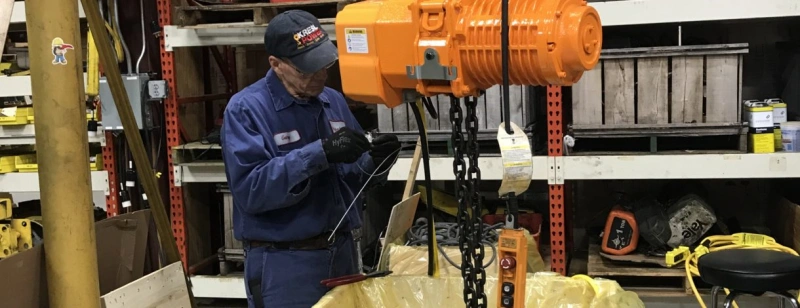
Routine maintenance maximizes the lifespan of your electric hoist and prevents unexpected failures. You should conduct daily visual inspections, listen for abnormal noises, and test controls. Monthly checks include detailed inspections, lubrication, and reviewing logs.
Annual maintenance involves disassembly, load testing, and replacing worn parts.
Maintenance Frequency | Performed By | Key Tasks | Purpose |
|---|---|---|---|
Daily (Pre-Shift) | Operator | Visual check of hook, latch, chain/rope. Functional test of controls, brakes, and limit switches. Listen for abnormal noises. | Identify and report obvious defects or malfunctions before use. |
Frequent (Weekly/Monthly) | Trained Personnel | Detailed inspection, lubrication, minor adjustments, and review logs. | Catch developing issues before they become serious. Ensure proper lubrication. |
Periodic (Annual) | Specialist | Complete disassembly, inspection, load testing, and replace wear parts. | Certify the hoist for another year of service. |
Regular maintenance and operator training protect your investment and ensure safe lifting. Always operate within the rated capacity and load requirement to avoid overheating and electrical issues.
Conclusion
You can select electric hoist parts for industrial needs by following these essential steps:
Identify your application requirements.
Assess the lifting capacity and choose between chain or wire rope hoists.
Verify power supply compatibility.
Understand duty cycle limitations.
Evaluate lifting speed and height.
Decide on the mounting method.
Consider ambient conditions.
Consulting Powerful Machinery experts gives you access to structured guidance that addresses load assessment, safety compliance, and economic factors. Their support helps you make informed decisions that improve operational safety and efficiency.
Take action by:
Scheduling regular safety training for your team.
Performing thorough pre-lift inspections.
Using proper personal protective equipment.
Following manufacturer’s instructions for operation and maintenance.
FAQ
What is the maximum load capacity for Powerful Machinery electric hoists?
You can select electric hoists with capacities ranging from 0.5 tons to 20 tons. Check the product specifications for your application.
Model Type | Capacity Range |
|---|---|
Standard | 0.5–10 tons |
Heavy Duty | 10–20 tons |
How do you ensure electric hoist parts meet safety standards?
You should verify certifications like CE, ISO9001, and ASME. Powerful Machinery electric hoist parts meet international safety requirements.
Always request documentation before purchase.
Can you use electric hoists outdoors?
You can use many Powerful Machinery electric hoists outdoors. Review the model’s weather resistance rating and follow maintenance guidelines.
Check for IP ratings
Inspect regularly for corrosion
What maintenance tasks should you perform on electric hoist parts?
You need to inspect hooks, chains, and controls daily. Lubricate moving parts monthly. Schedule annual load testing and part replacement.
Regular maintenance extends product lifespan and ensures safe operation.
How do you choose the right mounting option for your electric hoist?
You must assess your facility’s structure and load requirements.
Hook mount suits portable setups
Lug mount fits permanent installations
Trolley mount enables horizontal movement