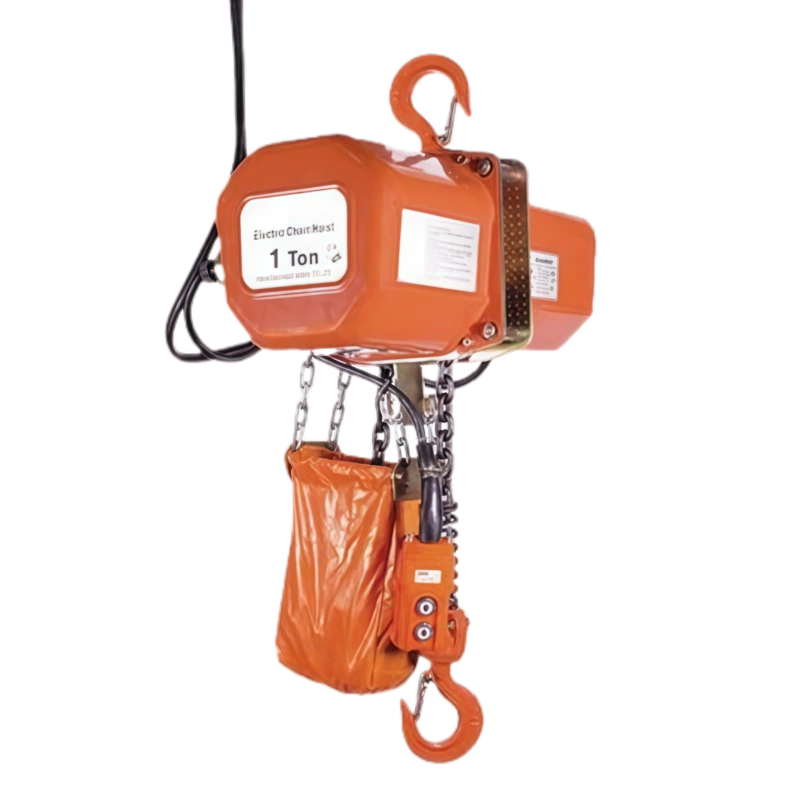
Powerful Machinery supplies electric hoists for repeated vertical lifting in workshops, warehouses, production lines, maintenance areas, and crane systems. Start with the load, required lift, operating frequency, available power, mounting method, and headroom. We will review the application, identify a suitable product family, and confirm model-specific dimensions, electrical data, documentation, and lead time before quotation.
If you are still comparing equipment types, browse our industrial lifting equipment range first. If the lifting method is already defined, continue below to compare chain and wire rope configurations.
The lifting medium changes the hoist’s size, lifting path, maintenance points, and most suitable working conditions. Use the two product families below as a starting point, then confirm the exact configuration against your application.
Electric chain hoists use a load chain and sprocket for powered vertical lifting. They are a practical starting point for workstations, assembly areas, workshops, and material-handling tasks where compact installation and repeatable lifting are important. Compare capacity, lift height, chain falls, lifting speed, mounting, control method, and available headroom before selecting a model.
Electric wire rope hoists raise and lower the hook by winding wire rope on a drum. They are commonly considered for crane systems, longer lifting distances, higher travel speeds, or applications with more demanding duty requirements. The correct choice depends on the load spectrum, reeving, drum and rope arrangement, headroom, crane structure, and required lifting and travel speeds.
Chain and wire rope hoists can overlap in capacity, so capacity alone is not enough to make the decision. Review our chain hoist vs wire rope hoist comparison for a closer look at headroom, lifting height, speed, duty, maintenance, and typical applications.
Select the suspension and travel arrangement after confirming how the load must move:
For powered horizontal travel, review the electric hoist with trolley and provide the beam profile, flange width, curve or straight-track requirement, travel distance, travel speed, and available clearance.
| Application / Condition | Recommended Starting Point | Confirm Before Quotation |
|---|---|---|
| Workstation or assembly lift | Electric chain hoist | Load, lift, cycles/hour, mounting, headroom, power |
| Crane or monorail system | Trolley chain hoist or wire rope hoist | Beam/crane data, travel, speeds, duty, control |
| Long lift or demanding duty | Electric wire rope hoist | Lift, duty class, reeving, drum/rope, headroom |
| Limited vertical clearance | Low-headroom arrangement | Beam size, hook approach, top/bottom clearance |
| Accurate load positioning | Dual-speed or variable-speed option | Required speeds, control method, stopping accuracy |
| Outdoor, dusty, humid, hot, corrosive, or hazardous area | Project-specific configuration | Environment, temperature, protection, classification, local requirements |
The matrix is an initial routing tool, not a rated-capacity recommendation. Final selection must be based on the technical data and documentation for the exact model supplied.
Send your load, lift, duty, power supply, mounting, travel, headroom, working environment, documentation, quantity, and destination. Contact Powerful Machinery to request a model-specific technical schedule and quotation.
Send the details below with your inquiry. If an item is unknown, include a drawing or site photo and mark the missing value for review.
Use the individual product pages for model-level specifications. The VKL electric chain block hoist page lists 0.5 t to 5 t models with a standard 3 m lift and model-specific motor, chain, speed, and weight data. Confirm every option and document it against the exact model quoted.
The HHSY electric chain hoist page also provides model-level capacity, lift, test-load, motor, chain, speed, and weight information for comparison.
For drum-and-rope lifting, review the CD1/MD1 electric wire rope hoist and send the required capacity, lift, duty, trolley arrangement, speeds, power supply, and crane or beam information.
A useful quotation should make the proposed configuration easy to review. Our process starts with the application rather than a model number alone:
Hoist selection does not end with the purchase order. The supporting structure, beam or crane, electrical supply, installation method, commissioning checks, operating instructions, and inspection program must suit the selected equipment. Use the electric hoist installation guide to prepare the site, then build the model instructions and local requirements into the installation plan.
After commissioning, use an electric hoist inspection checklist as a planning aid for controls, brakes, hooks, load chain or wire rope, limit devices, electrical components, trolley parts, labels, and records. Inspection frequency and rejection decisions must follow the manufacturer’s instructions and the rules that apply at the place of use.
Send the maximum load, required capacity, lift height, duty, lifting and travel speeds, voltage, phase, frequency, suspension or trolley type, beam or crane details, headroom, control method, operating environment, required documents, quantity, and delivery destination.
Begin with the full application rather than capacity alone. Electric chain hoists are often considered for compact workstation and production lifting, while wire rope hoists are often considered for crane systems, longer lifts, faster operation, or more demanding duty. Headroom, duty, lift, speed, maintenance, and crane integration should be reviewed together.
Yes, when the hoist is paired with a compatible manual or motorized trolley. The trolley capacity, wheel profile, flange-width range, travel speed, beam curve, end stops, controls, and available clearance must match the beam and application.
Power requirements vary by model and market. State the available voltage, phase, and frequency in the RFQ. The quotation should confirm the motor supply, control voltage, plug or cable arrangement, and any required electrical protection for the selected model.
Project options can be reviewed when you provide the technical and commercial requirements. Depending on the selected model, the discussion may cover lift height, trolley arrangement, speeds, controls, power supply, paint, nameplate, packaging, and documentation. Availability must be confirmed in the quotation.
After downloading the product catalogue, our dedicated technical experts will provide you with one-on-one service.