You start with high-grade steel wire and shape it into precise links. Powerful Machinery uses advanced equipment and strict quality control to create certified chains for demanding industries.
The chain manufacturing process includes material preparation, link formation, welding, testing, finishing, and shipment. Every chain-making step meets international standards, so you can trust the final product for safety and reliability.
Key Takeaways
Start with high-grade steel to ensure strength and durability in chains. Choose the right material based on the intended application.
Use advanced machinery for precise wire drawing and link formation. This ensures uniformity and quality in every chain produced.
Implement rigorous testing and quality control measures. This guarantees that each chain meets international safety standards and performs reliably.
Apply specialized heat treatments and surface coatings to enhance chain performance. These processes improve strength, wear resistance, and longevity.
Select the appropriate chain type for your specific needs. Matching the chain grade and configuration to your application ensures safety and efficiency.
Chain Manufacturing Process Overview
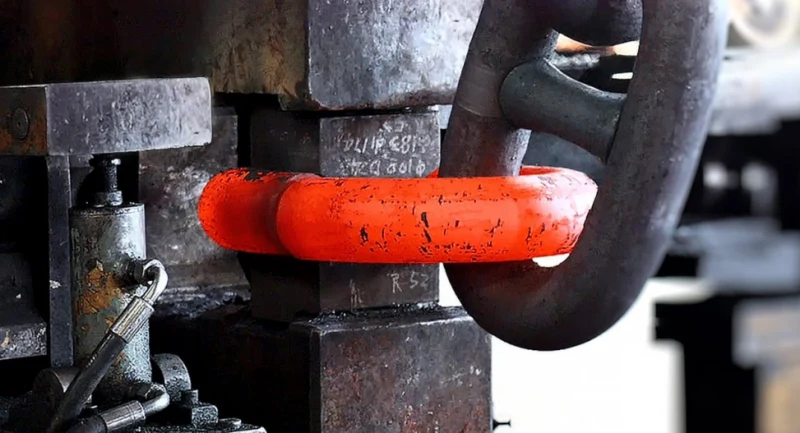
Powerful Machinery sets the standard in the chain manufacturing process by focusing on quality, safety, and strict adherence to international standards. You benefit from this commitment because every chain produced meets the highest expectations for performance and reliability.
The chain manufacturing process begins with careful selection of raw materials and precise wire preparation.
Raw Material Selection
You start the chain manufacturing process by choosing the right steel. Powerful Machinery sources high-grade steel from trusted suppliers. The steel type you select determines the strength, durability, and application of the finished chain. You can see the differences in the table below:
Chain Type | Material Type | Features | Applications |
|---|---|---|---|
Low-carbon steel | Soft, easy to shape, economical; lowest strength grade | General-purpose, decorative, barrier, light binding | |
Medium carbon steel | Approximately twice as strong as G30; available in heat-treated versions | Heavy pulling, safety chains, industrial binding | |
Alloy Steel (G70, G80, G100) | Heat-treated high-carbon steel | High abrasion resistance; special alloy steel with Molybdenum, Nickel, Chromium | G70 for transport; G80/G100 for lifting |
You select alloy steel for chains that require maximum strength and abrasion resistance. This choice ensures that the chain will perform reliably in demanding environments such as lifting, transport, and rigging.
Powerful Machinery uses only certified steel grades to guarantee consistent quality throughout the chain manufacturing process.
Wire Drawing & Marking
You move to wire drawing after selecting the steel. Powerful Machinery uses advanced machinery to draw the steel into precise wire diameters. This step is critical because it sets the foundation for uniform chain links.
You monitor the wire for consistency and surface quality, ensuring that every meter meets strict specifications.
You then mark the wire for traceability. Powerful Machinery integrates laser marking technology with automated production systems. You assign unique identifiers to each batch, allowing you to track every chain from raw material to finished product.
The system verifies part supply, inspects accuracy, and retrieves serial numbers. After marking, you transmit process information and quality assessments to production control. This approach ensures that you can trace every chain back to its origin, supporting safety and compliance with international standards.
You complete these initial steps with precision and care. The chain manufacturing process relies on your attention to detail, setting the stage for forming, welding, and finishing the chain to meet the needs of industries worldwide.
Chain Link Formation & Welding
Cutting & Shaping Links
You begin the chain link formation stage by cutting steel wire into precise lengths. Powerful Machinery uses advanced equipment to ensure every segment matches exact specifications.
The slip ring system enables seamless operation of clamps and pneumatic fixtures, while the LFA100 system delivers high-speed performance for consistent results. You benefit from robust machine bases and precision indexing, which guarantee accurate alignment during the manufacturing process.
The table below highlights the features of Powerful Machinery’s equipment:
Feature | Description |
|---|---|
Slip Ring System | Enables seamless operation of clamps and pneumatic fixtures on conveyor links. |
High-Speed Design | The LFA100 system ensures precision in high-speed applications. |
Customization | Pre-machined bases allow easy integration of auxiliary equipment. |
Robust Design | Handles automotive manufacturing demands with durability. |
Precision Indexing | Ensures accurate alignment with tooling. |
Environmental Protection | Protects against airborne dust and particulates. |
Interconnecting & Welding
You shape each wire segment into links and interconnect them to form the chain. Powerful Machinery relies on two main welding methods to ensure weld integrity:
Flash Butt Welding: You heat the ends of the links until they melt, then press them together under high pressure. This method creates strong bonds, making it ideal for chains used in heavy lifting.
Electric Resistance Welding: You use high current to generate localized heat at the junction of the links. This technique suits medium-duty chains and prioritizes production speed.
You verify weld quality through a series of checks:
Welding invigilation to witness qualification records and tests.
Visual welding inspection by certified inspectors.
Metallurgical testing for microstructural analysis.
Mechanical testing for evaluating welded samples.
You follow strict weld codes and standards, such as ASME, AWS, and ISO 3834, to ensure every chain meets international requirements.
Trimming Excess Material
You trim excess material from each welded joint. This step eliminates weak points and enhances the overall strength and durability of the finished chain. You ensure that every link is smooth and free from defects, which supports long-term reliability in demanding environments.
Tip: Consistent trimming and inspection help you maintain the highest safety standards for every chain.
Chains Testing & Quality Control
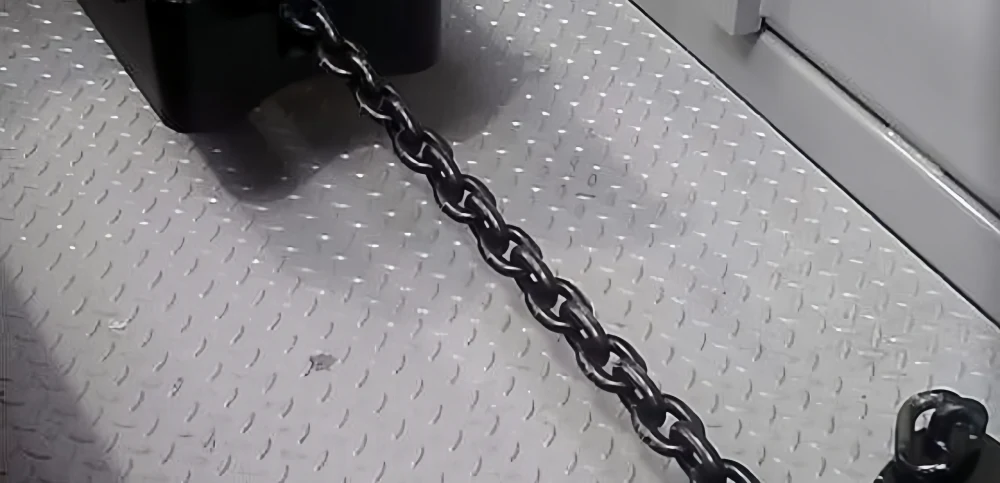
You rely on rigorous testing and quality control to ensure every chain meets the highest standards. Powerful Machinery designs its processes to catch defects early and guarantee that each product performs reliably in demanding environments.
You benefit from a system that combines advanced calibration, thorough proof testing, and state-of-the-art electronic data tracking.
Calibration for Consistency
You start by calibrating all testing equipment before evaluating any chains. This step ensures that every measurement remains accurate and repeatable. Powerful Machinery uses certified calibration blocks and reference chains to verify the precision of testing machines.
You check load cells, tensile testers, and dimensional gauges against known standards. This approach eliminates measurement errors and provides a reliable baseline for all subsequent tests.
You also monitor environmental conditions in the testing facility. Temperature, humidity, and air quality can affect the results. By controlling these variables, you maintain consistency across all batches. This attention to detail helps you detect even minor deviations in chain quality.
Strength & Proof Testing
You subject each chain to a series of strength and proof tests. These tests confirm that the links can handle the loads specified for their grade and application. Powerful Machinery follows international standards such as ISO, ASTM, and NACM2010 during this process.
You place the chain in a hydraulic testing machine and apply a controlled force. The machine stretches the chain to its proof load, which is typically twice the working load limit. You watch for any signs of deformation, cracking, or failure. If the chain passes, you know it can perform safely in the field.
During proof testing, you often identify common failure modes, including:
Fatigue cracking on the side plates
Wear on the pins due to high bearing pressures
Tensile overload
Corrosion-induced weakening
Wear and abrasion
Fatigue leading to metal fracture
You also look for issues such as inadequate lubrication, misalignment, and environmental damage. By catching these problems early, you prevent faulty chains from reaching your customers.
Note: Proof testing not only verifies the strength of each chain but also helps you identify trends in failure modes. This information guides future improvements in the manufacturing process.
Electronic Data Tracking
You use electronic data tracking to enhance quality control throughout the production cycle. Powerful Machinery integrates traceability systems that follow each chain from raw material sourcing to final delivery.
You record data points such as inventory levels, quality metrics, and supply chain performance. This information helps you monitor every stage of the process.
You benefit from features like defect categorization, which classifies issues and sets clear pass criteria. High-quality data allows you to make better decisions, optimize costs, and reduce waste. You also track energy consumption, equipment downtime, and facility conditions to maintain efficiency and product quality.
A typical electronic tracking system records:
Inventory levels for raw materials, work-in-progress, and finished chains
Quality metrics, including defect rates and adherence to specifications
Supply chain performance indicators
Energy consumption data
Equipment downtime and predictive maintenance schedules
Facility conditions, such as temperature and humidity
You use this real-time data to adjust production schedules and respond quickly to demand changes. By monitoring material specifications and quality checks, you prevent compliance issues and reduce the risk of recalls or fines.
Tip: Electronic data tracking gives you complete traceability for every chain, supporting compliance with international standards and providing peace of mind for your customers.
You can trust Powerful Machinery’s commitment to quality control. Every chain undergoes a comprehensive series of tests and inspections, ensuring that only the best products reach your hands.
Chain Finishing & Assembly
Heat Treatment for Alloy Chains
You enhance the strength and durability of alloy chains through specialized heat treatment processes. You follow a sequence that includes solution heat treatment, quenching, and aging.
You heat the chain material to allow alloying elements to dissolve fully.
You rapidly cool the chain to lock these elements in place, preventing unwanted precipitation.
You reheat the chain at a controlled temperature, which enables the formation of strengthening particles.
These steps increase hardness, improve wear resistance, and stabilize dimensions. You also relieve internal stresses and boost toughness.
Heat treatment modifies the microstructure of the chain, reducing stress concentration and improving fatigue life. You achieve greater elasticity and ensure the chain performs reliably under repeated loading.
Surface Treatments & Coatings
You protect chains from corrosion and wear by applying advanced surface treatments. Powerful Machinery uses processes such as galvanizing and shot blasting to create a durable finish. You may select from several coating options, each offering unique benefits:
Treatment Method | Description | Benefits |
|---|---|---|
Epoxy Coatings | Forms a barrier against moisture and chemicals. | Prevents corrosion and extends chain lifespan. |
Shot Peening | Bombards the chain surface with small particles. | Improves fatigue resistance and cleans the links. |
Phosphating | Adds a phosphate layer to the chain surface. | Enhances coating adhesion and provides protection. |
Electroless nickel plating offers high resistance to corrosion and excellent adhesion. You can choose CRF-coated chains for harsh environments or nickel plating for humid conditions.
Zinc-coated and black oxide-coated chains resist moisture and abrasion, extending service life. These processes ensure your chains withstand tough industrial settings.
Final Assembly & Packaging
You complete the chain manufacturing process with careful assembly and packaging. You prepare all components, assemble the links, and inspect each chain for accuracy. You compile chains into kits and conduct final quality checks.
You use robust packaging materials to shield chains from moisture, temperature changes, and shocks during shipment. Effective packaging acts as a protective barrier, maintaining chain integrity and reducing damage. Smart packaging solutions also improve traceability and operational efficiency.
You receive chains that arrive in pristine condition, ready for use in demanding applications.
Tip: You can select from a variety of chain grades and link configurations to match your specific needs. Powerful Machinery offers options for lifting, transport, and rigging, ensuring you find the right chain for every job.
Chain Types & Applications
Round Link Chains
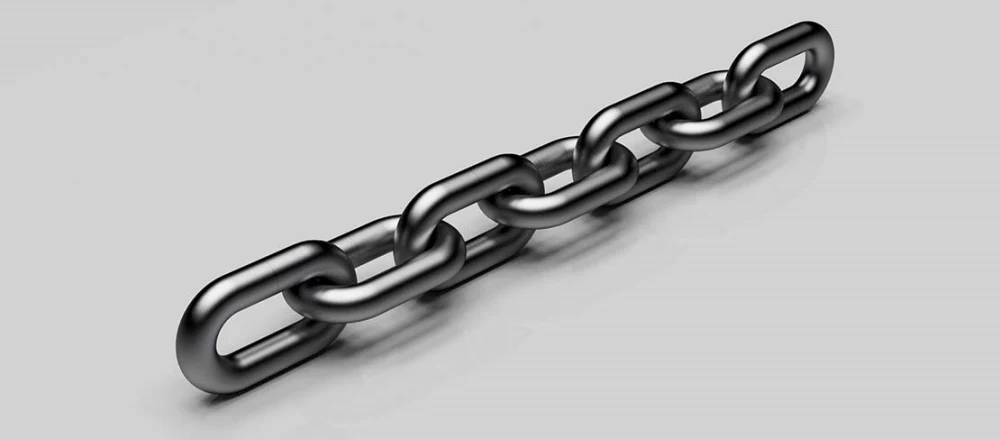
You rely on round link chains for lifting, securing, and transporting materials across many industries. These chains offer flexibility and strength, making them ideal for construction and mining operations. You benefit from their ability to handle heavy loads and resist wear in tough environments.
Powerful Machinery manufactures round link chains using high-grade alloy steel, ensuring consistent performance and long service life.
You use round link chains for overhead lifting and mooring.
You choose them for mining, construction, and cargo handling.
You trust their flexibility for complex rigging tasks.
You select the right chain grade and link configuration to match your application, whether you need short, medium, or long links.
Roller Chains
You depend on roller chains for power transmission and conveyor systems. Roller chain design features interconnected links with rollers that reduce friction and improve efficiency.
You see roller chains in automotive, food, beverage, agricultural, and material handling industries. These chains deliver reliable performance and support cost-effective production.
You use roller chains in machinery and conveyor belts.
You rely on roller chains for agricultural equipment and packaging lines.
You choose roller chain for automated assembly and transport systems.
You benefit from the versatility of roller chain, which adapts to different speeds and loads. Powerful Machinery produces roller chains with precision processes, ensuring smooth operation and minimal maintenance.
Specialty Chains by Powerful Machinery
You find specialty chains from Powerful Machinery that meet the highest safety and performance standards. These chains feature advanced materials and manufacturing processes, setting them apart from standard chains.
Powerful Machinery’s Grade 80 chain offers high ultimate breaking strength and clear identification markings for traceability. Proof Coil chain provides reliable utility and towing solutions, while chain slings support heavy loads with flexibility for complex lifting tasks.
Feature | Specialty Chains (Grade 80) | Standard Chains (Grade 70) |
|---|---|---|
Material Composition | Alloy steel with manganese, silicon | Heat-treated carbon steel |
Strength | Higher tensile strength, durability | Lower strength, not for overhead lifting |
Approved Uses | Overhead lifting, heavy-duty recovery | Securing loads during transport |
Safety Standards | Meets OSHA, ASTM, and ASME standards | Not suitable for overhead lifting |
You trust Powerful Machinery’s specialty chains because each product undergoes a meticulous certification process. You benefit from inspection of raw materials, comprehensive testing, and full traceability from sourcing to shipment.
You choose from a wide range of chains for lifting, transport, and rigging, knowing that Powerful Machinery delivers reliability and safety for every application.
Conclusion
You see every step in chain manufacturing, from raw steel to final inspection, reflects Powerful Machinery’s dedication to quality and safety. Certified chains deliver real advantages in industrial settings:
Benefit | Description |
|---|---|
Safety | Compliance with strict standards reduces liability risks. |
Durability | Extended service life lowers maintenance costs and downtime. |
Performance | Reliable operation under heavy loads ensures productivity. |
Traceability | Unique identification supports maintenance and compliance. |
Cost-effectiveness | Fewer replacements and repairs save money over time. |
Selecting the right chain type matters:
You match load capacity to your application for safe lifting.
You choose the correct grade for efficiency and reliability.
You avoid accidents by never mixing or misusing chain grades.
Explore Powerful Machinery’s certified chains for dependable lifting and securing solutions in your toughest jobs.
FAQ
What chain grades does Powerful Machinery offer?
You can choose from G43, G70, G80, and G100 chain grades. Each grade provides different strength levels and suits specific lifting, transport, or rigging needs. Powerful Machinery ensures every grade meets international standards for safety and reliability.
How do you select the right chain for your application?
You match the chain grade and link configuration to your load requirements. Consider the working environment, required strength, and application type. If you need help, Powerful Machinery’s experts can guide you to the best solution.
Are the Powerful Machinery chains certified?
Yes. You receive chains that meet or exceed major international certifications, including ISO, ASTM, and NACM2010. Powerful Machinery tests every product to guarantee compliance and performance in demanding industries.
Can you use these chains outdoors?
You can use Powerful Machinery chains both indoors and outdoors. The chains feature advanced coatings and corrosion-resistant materials. These features protect against harsh weather, moisture, and abrasion, ensuring long service life.