Mechanical jacks help you lift heavy loads safely and efficiently. You find them everywhere, from car repair shops to large construction sites. The global market for these tools reached over $344 million in 2024 and continues to grow.
When you choose the right mechanical jack from the many types, you protect both equipment and workers. Powerful Machinery stands out as a trusted source for certified lifting solutions that meet strict industry standards.
Key Takeaways
Mechanical jacks are essential tools for safely lifting heavy loads. They convert manual force into lifting power, making tasks like changing tires and lifting machinery easier.
Different types of jacks serve specific purposes. For example, scissor jacks are great for emergency tire changes, while hydraulic jacks excel in heavy-duty lifting.
Always check the load capacity and safety features before using a jack. This practice helps prevent accidents and ensures equipment longevity.
Using jack stands after lifting adds an extra layer of safety. Never rely solely on the jack to support a load.
Regular maintenance of jacks, such as lubricating moving parts and inspecting for damage, keeps them reliable and safe for use.
What Are Mechanical Jacks?

Basic Function and Operation
Mechanical jacks help you lift heavy objects by turning manual force into powerful lifting action. You often use lifting jacks in places like car repair shops, factories, and construction sites. These tools make it possible for you to raise vehicles, machinery, and even parts of buildings.
When you use a mechanical jack, you usually turn a handle or crank. This action moves a screw or gear inside the jack. The screw threads give you a mechanical advantage, so you can lift loads that would be impossible to move by hand.
Here are some common ways you use lifting jacks in daily work:
Changing tires on cars and trucks
Lifting heavy machinery in factories and workshops
Supporting structures during foundation repairs
Leveling and adjusting equipment for stability
You find different types of lifting jacks for different jobs. Scissor jacks work best for emergency tire changes. Bottle jacks help you lift heavy-duty vehicles. Floor jacks are popular in garages and workshops. Hydraulic jacks give you more power and precision.
Pneumatic jacks use compressed air for lifting, while electric jack models suit high-frequency tasks.
Mechanism Type | Functionality | Application |
|---|---|---|
Screw Jack | Converts rotary motion into linear motion using screw threads for mechanical advantage | Used in various industries for lifting and positioning loads |
Mechanical vs Hydraulic Jacks
You need to know the difference between mechanical jacks and hydraulic jacks before you choose the right tool. Mechanical jacks rely on manual force and simple mechanisms like screws or gears.
Hydraulic jacks use fluid pressure to lift heavier loads with less effort. Pneumatic jacks use compressed air, and electric jack models use motors for lifting.
Here is a quick comparison:
Feature | Hydraulic Jacks | Mechanical Jacks |
|---|---|---|
Lifting Capacity | Superior lifting capacity for heavy loads | Lower lifting capacity |
Efficiency | High efficiency with less input force | Lower efficiency requires more effort |
Maintenance | Requires regular maintenance to prevent leaks | Easier to maintain, no fluid required |
Cost | Generally ,more expensive due to complexity | Generally less expensive |
Applications | Suitable for heavy-duty industrial tasks | Ideal for less demanding tasks |
Hydraulic jacks work best for heavy-duty lifting in industrial settings. Mechanical jacks offer simple operation and easy maintenance. Pneumatic jacks and electric jack models provide extra options for specialized tasks. You should match the lifting jack to your job for safe and efficient results.
Tip: Always check the load capacity and safety features before you use any lifting jack. This helps you avoid accidents and keeps your equipment in good condition.
Types of Mechanical Jacks
You encounter many types of mechanical jacks in your daily work, each designed for specific lifting tasks. Understanding the differences helps you choose the right tool for safety and efficiency. Here is a detailed look at the main types of jacks you may use.
Screw Jack
A screw jack uses a threaded screw to convert your turning motion into a powerful lifting force. You operate it by rotating a handle, which moves the screw up or down. This mechanism gives you precise control over the lifting process. You find screw jacks in industrial settings where stability and accuracy matter most.
Operation Description | Industrial Applications |
|---|---|
Converts rotational motion into linear motion using a worm gearbox mechanism. | Lifting heavy machinery, adjusting work platform heights, and positioning large structures like bridges and buildings. |
Screw jacks offer high load-bearing capacity and reliability. You benefit from their self-locking mechanism, which keeps loads secure. These types of mechanical jacks require minimal maintenance and provide excellent stability during lifting. You often use them for heavy machinery, bridge construction, and platform adjustments.
Note: Screw jacks are ideal when you need stable lifting and precise positioning. Their self-locking feature adds an extra layer of safety.
Scissor Jack
A scissor jack features a crisscross metal frame that expands and contracts as you turn the handle. You often find this type in the trunk of compact cars for emergency tire changes. Scissor jacks are lightweight and easy to store, making them a popular choice for roadside repairs.
You use scissor jacks for:
Emergency tire changes
Brake work in garages
Lifting compact vehicles
Scissor Jack Model | Lifting Range | Weight Capacity |
|---|---|---|
Grey Scissor Jack | 3-3/4″ to 15-1/8″ | 3,000 lb |
TruLift Scissor Jack | 4″ to 17-1/2″ | 4,000 lb |
Scissor jacks provide decent lifting capacity and height for most cars. You should not use them for extensive under-car work. These types of car jacks are best for quick, temporary lifts.
Bottle Jack
A bottle jack stands out for its compact, vertical design. You operate it by pumping a handle, which pushes hydraulic fluid through a piston to lift heavy loads. The bottle jack is popular in automotive repair shops and construction sites.
Feature | Bottle Jack | Other Jacks |
|---|---|---|
Design | Compact and portable | Varies, often larger and bulkier |
Suitability | Ideal for tight spaces | Generally less suitable for tight spaces |
Load Capacity | Can lift heavier loads | Varies, often less capable |
Stability | A smaller base may compromise stability | Typically more stable |
Maintenance | Easier to maintain | Varies, may require more upkeep |
Cost | Generally more affordable | Often more expensive |
You use bottle jacks for lifting trucks, SUVs, and heavy machinery. Their compact size makes them easy to store in vehicles. You find bottle jacks in automotive repairs, construction, and emergency services. These types of mechanical jacks are known for their high lifting capacity and portability.
Tip: Always place a bottle jack on a stable surface to prevent tipping. Use jack stands for added safety.
Ratchet Jack
A ratchet jack uses a lever and ratchet mechanism to lift loads in small increments. You operate it by moving the handle back and forth, which raises the load step by step. Ratchet jacks are common in railway construction and industrial settings.
Application/Benefit | Description |
|---|---|
Railway Construction | Lifts and adjusts heavy rails, track panels, and bridges, ideal for track laying and repairs. |
Industrial Handling | Suitable for lifting heavy equipment in factories, mines, ports, and docks. |
Bridge and Track Adjustment | Supports temporary lifting of abutments and track foundations. |
Emergency Repair | Provides rapid response for railway fault repairs, ensuring high efficiency and safety. |
Easy Operation | Compact lever design enables operation by a single person without specialized training. |
Fast and Efficient | Lifting distance of 127mm per stroke allows smooth, rapid operation, saving construction time. |
Strong Load Capacity | Constructed from high-strength steel, providing stability under heavy loads. |
Low Maintenance | Fewer parts and stable structure ensure long lifespan and minimal maintenance costs. |
You rely on ratchet jacks for lifting rails, adjusting bridges, and handling heavy equipment. Their compact design allows you to operate them in tight spaces with minimal effort.
Toe Jack
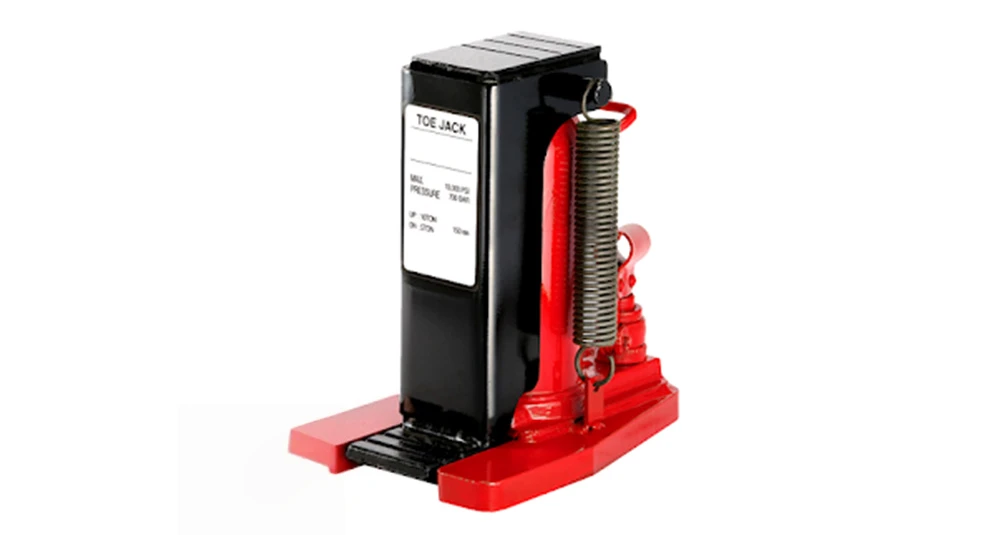
A toe jack features a low-profile base and a lifting toe that slides under heavy machinery. You use it to lift loads from the bottom, making it perfect for industrial applications where clearance is limited.
Applications | Advantages |
|---|---|
Construction, house lifting, renovations | Quick and easy setup |
Cargo loading | Safe and efficient lifting methods |
Lifting fabricated steel structures | Invaluable tools for heavy machinery lifting |
Installation of general engineering equipment | Plays an important role in work sites |
Toe jacks are essential for lifting and moving heavy equipment in factories, warehouses, and construction sites. You benefit from their quick setup and safe operation. These types of jacks excel in confined spaces where other jacks cannot fit.
Toe jacks lift loads from the base, while bottle jacks lift vertically using hydraulic pressure.
You choose toe jacks for machinery and cargo loading, especially when space is tight.
Hydraulic Jack

A hydraulic jack uses fluid pressure to amplify your lifting force. You pump a handle, which moves hydraulic fluid through a cylinder, raising the load. Hydraulic jacks include bottle jacks, floor jacks, and specialized models for different tasks.
Feature | Hydraulic Jacks | Mechanical Jacks |
|---|---|---|
Operation Principle | Operate based on Pascal’s Principle, using hydraulic fluid to amplify force. | Rely on mechanical advantage through leverage, gears, or screw threads. |
Load Capacity | Can lift substantially heavier loads due to fluid pressure transmission. | Lift loads using mechanical advantage, but generally less than hydraulic jacks. |
Maintenance Requirements | Require regular maintenance to prevent leaks and ensure fluid quality. | Require less maintenance but need regular lubrication and inspection. |
You use hydraulic jacks for lifting vehicles, machinery, and even buildings. These types of mechanical jacks offer high lifting capacity and smooth operation. You must maintain hydraulic jacks regularly to prevent leaks and ensure safety.
Trolley Jack
A trolley jack features wheels and a long handle for easy movement around your workshop. You roll it under the vehicle and pump the handle to lift. Trolley jacks are popular in automotive repair shops because they combine mobility with stability.
Trolley jacks help you lift cars and trucks for repairs and maintenance. You benefit from their stable construction and easy positioning. These types of car jacks are ideal for frequent use in busy garages.
Feature | Trolley Jack | Floor Jack |
|---|---|---|
Lift Range & Ground Clearance | Higher maximum lift height, suitable for trucks and SUVs | Lower lift, ideal for sports cars with minimal clearance |
Weight Capacity & Pump Type | Max capacity around 3 tons with a single-piston system | Higher capacity (2–5 tons) with single or dual-piston pumps |
Portability & Size | Lighter (20–50 lb), easy to carry | Heavier (60–100 lb), more stable with swivel wheels |
Setup & Ease of Use | Requires alignment, can be trickier to position | Simple setup, just roll under and pump |
Price | Cheaper (US$40–80) | More expensive (US$100–300+) |
Stability | Needs level ground, narrower saddle | Wider saddle, stable base, overload protection |
Floor Jack
A floor jack is a heavy-duty tool with a wide base and long handle. You use it for lifting vehicles and equipment in garages and workshops. Floor jacks provide high weight capacity and stability, making them suitable for extended jobs.
You use floor jacks for:
Lifting cars, trucks, and SUVs
Supporting vehicles during repairs
Handling heavy loads in professional settings
Type of Jack | Load Capacity (lbs) |
|---|---|
Floor Jack | 24,000 – 28,000 |
Fast Lube Jack | 6,000 – 9,000 |
Rolling Bridge Jack | 6,000 – 50,000 |
Pit Jack | 12,000 – 35,000 |
Floor jacks are among the most common types of car jacks in automotive shops. You rely on them for their versatility and strength.
Pallet Jack

A pallet jack is designed for moving pallets and heavy loads in warehouses. You operate it by pumping the handle, which raises the forks slightly off the ground. Pallet jacks are not intended for stacking but excel at ground-level transportation.
Specification | Value |
|---|---|
Lift Height | 6 to 8 inches |
Load Capacity | 3,000 to 5,500 pounds |
You use pallet jacks for:
Moving pallets within warehouses
Loading and unloading trucks
Transporting heavy items over short distances
Standard manual pallet jacks are easy to operate and maintain. These types of jacks help you improve efficiency in material handling.
Transmission Jack
A transmission jack is a specialized tool for installing and removing vehicle transmissions. You use it to lift and position the transmission safely during repairs.
Use | Description |
|---|---|
Safety | Provides stability and control when lifting heavy transmissions, reducing accident risks. |
Easy Positioning | Allows for precise alignment of the driveline with the engine and mounts. |
Load-bearing capacity | Designed to safely lift the heavy transmission system, ensuring efficient handling. |
Saves time | Speeds up the process of transmission removal or installation, reducing overall repair time. |
Improved Access | Enhances access to the transmission and surrounding components for easier repairs or replacements. |
You find transmission jacks in professional automotive shops. These types of car jacks make the transmission work safer and faster.
Tip: Always use the right jack for your specific task. Matching the jack type to your job improves safety and efficiency.
How to Use a Jack Safely?
Mechanical jacks make heavy lifting possible, but you must follow the right steps to stay safe. Powerful Machinery recommends strict safety standards for every lifting job. Knowing how to use a jack correctly protects you and your equipment.
Preparation and Setup
Before you start, always prepare your workspace and equipment. Begin by wearing personal protective equipment like work gloves and safety glasses. Place the jack on a flat, stable surface.
Never use a jack on uneven or slippery ground. Check the jack for leaks, worn seals, or any visible damage. Make sure the load sits at the center of the jack for balanced weight. For extra security, always use jack stands to support the load after lifting.
Safety Check | Description |
|---|---|
Work Gloves | Protect your hands from sharp edges and hot surfaces. |
Safety Glasses | Shield your eyes from debris and fluid splashes. |
Load Balance | Double-check that the load is centered and secure before lifting. |
Jack Stands | Use these to support the load after lifting for added safety. |
Avoid Standing Under Load | Never stand directly under a raised load, even if it looks stable. |
Step-by-Step Usage Guide
Follow these steps to learn how to use a jack safely:
Park the vehicle or place the equipment on a level surface.
Engage the parking brake if you are changing a tire.
Position the jack under the manufacturer’s recommended lifting point.
Turn or pump the handle slowly to raise the load. Avoid sudden movements.
Once lifted, slide the jack stands under the load for support.
Lower the jack gently until the load rests on the stands.
When finished, reverse the process to lower the load safely.
Tip: For emergency tire changes, always keep your tools organized and within reach.
Safety Tips and Best Practices
Jack’s safety starts with careful checks and smart habits. Inspect your jack before every use. Never exceed the rated capacity. Always keep your hands and feet clear of moving parts.
Avoid standing under a raised load. Use jack stands for every job, even quick repairs. If you work in wet or icy conditions, take extra care to prevent slips. For heavy lifting, double-check the load balance and secure all tie-downs.
Cause of Accident | Prevention Strategy |
|---|---|
Poor Load Distribution | Balance the load and follow proper procedures. |
Slick Surfaces | Work slowly and use extra caution in wet or icy areas. |
Improper Securement | Use enough tie-downs and check them regularly. |
Learning how to use a jack the right way keeps you safe during every job, from emergency tire changes to heavy lifting in the workshop.
Comparing Types of Jacks
Key Differences
When you compare jack types, you notice that each one works best for a specific job. Some jacks use manual screws, while others use hydraulic power. For example, scissor jacks use a manual screw mechanism and are great for emergency tire changes.
Bottle jacks use hydraulic pressure and can lift heavier loads, making them better for home repairs or heavy-duty lifting. Screw jacks give you precise control and are often used in industrial settings.
Here is a quick comparison of common jack types:
Jack Type | Mechanism | Lifting Capacity | Ideal Use Case |
|---|---|---|---|
Scissor Jack | Manual screw | Up to 3000 lbs | Emergency tire changes |
Bottle Jack | Hydraulic | Up to 4000 lbs | Heavy-duty lifting, home repairs |
Screw Jack | Manual screw | High (varies) | Industrial lifting, positioning |
You see that jack types differ in how much weight they can lift, how fast they work, and where you use them. Powerful Machinery offers a wide range of jack types, so you can always find the right tool for your job.
Pros and Cons
Each jack type has its own strengths and weaknesses. You should know these before you choose.
Scissor jacks are compact and easy to store. They work well for quick tire changes, but lift slowly and have lower capacity.
Bottle jacks lift heavier loads and work faster. They fit well in tight spaces but may not be as stable on uneven ground.
Screw jacks give you precise control and high stability. They require more effort but last a long time.
Hydraulic jacks can lift very heavy things. They need regular maintenance and may not suit smaller vehicles.
Pros of Hydraulic Jacks | Cons of Hydraulic Jacks |
|---|---|
Lift heavy things easily | Not ideal for lifting normal vehicles |
When you use Powerful Machinery’s jack types, you get products built for safety, durability, and efficiency.
Choosing the Right Jack for Your Needs
To pick the best jack types, think about your main tasks. If you need to change tires on the road, a scissor jack works well. For lifting trucks or heavy equipment, a bottle jack or hydraulic jack gives you more power.
If you work in a factory or construction site, screw jacks or toe jacks offer stability and control. Always check the lifting capacity and make sure the jack fits your workspace.
Powerful Machinery helps you match jack types to your needs. Their certified products give you peace of mind, whether you work in automotive repair, construction, or industry. When you choose the right jack, you make your job safer and more efficient.
Tip: Always read the user manual and follow safety guidelines for all jack types.
Conclusion
You now know the main types of mechanical jacks and how each fits specific lifting tasks. Choosing the right jack keeps your work safe and efficient. Powerful Machinery offers certified solutions you can trust for any job. For long-term performance, remember:
Lubricate screw threads and gears regularly.
Watch for wear or cracks in the frame.
Inspect load limits and never exceed them.
To stay safe:
Wear proper safety gear.
Keep your workspace clear.
Always block loads after lifting.
With these habits, you ensure reliable lifting every time.
FAQ
What is the safest way to use a mechanical jack?
You should place the jack on a flat surface. Always use jack stands for support. Never exceed the rated capacity. Wear gloves and safety glasses. Inspect the jack before each use.
How do you choose the right type of jack for your job?
Check the weight of your load. Match the jack’s lifting capacity to your needs. Consider the workspace and lifting height. Use screw or toe jacks for precision. Use a bottle or hydraulic jacks for heavy lifting.
Can you repair a mechanical jack if it stops working?
You can repair most mechanical jacks. Clean and lubricate moving parts. Replace worn screws or gears. If you see cracks or major damage, replace the jack for safety.
How often should you inspect your jack?
Inspect your jack before every use. Look for wear, cracks, or leaks. Test the handle and lifting mechanism. Regular checks help you prevent accidents and keep your equipment reliable.