Rigging hooks connect a load or sling assembly to other lifting components. Their shape, attachment method, locking mechanism, grade, and working load limit (WLL) all affect how and where they may be used. A hook that appears suitable may still be incompatible with the chain size, load path, or service conditions.
This guide explains the main rigging hook types, how eye and clevis attachments differ, what a latch can and cannot do, and which details to confirm before use. If you are ready to compare available products, review the lifting hook range.
What Is a Rigging Hook?
A rigging hook is a load-bearing connector used in a lifting or load-handling assembly. Depending on the design, it may connect to chain, a master link, a sling leg, a lifting point, or another compatible component. Hooks are part of the wider rigging hardware range, which also includes shackles, master links, turnbuckles, wire rope fittings, and other connectors. For broader terminology, see what rigging hardware includes.
Select a hook using its identification and technical data rather than appearance alone. Confirm the manufacturer, model, grade, size, WLL, attachment style, and permitted loading direction. The complete assembly must also be compatible; the rating of one component does not increase the rating of another.
The Main Parts of a Rigging Hook
Terminology varies slightly by design, but most lifting hooks include several recognizable areas:
- Bowl or saddle: the curved load-bearing area where the connected component should seat.
- Point or tip: the end of the hook opening. It is not normally intended to carry the load.
- Throat: the opening between the tip and the body of the hook. A change in throat opening can be a sign of deformation.
- Attachment: an eye, clevis, swivel connection, or another purpose-designed interface.
- Latch or locking mechanism: a device intended to help retain a compatible component in the hook. It is not a substitute for correct loading or connection.
- Markings: identification such as grade, size, traceability code, and WLL where required by the product specification.
Types of Rigging Hooks
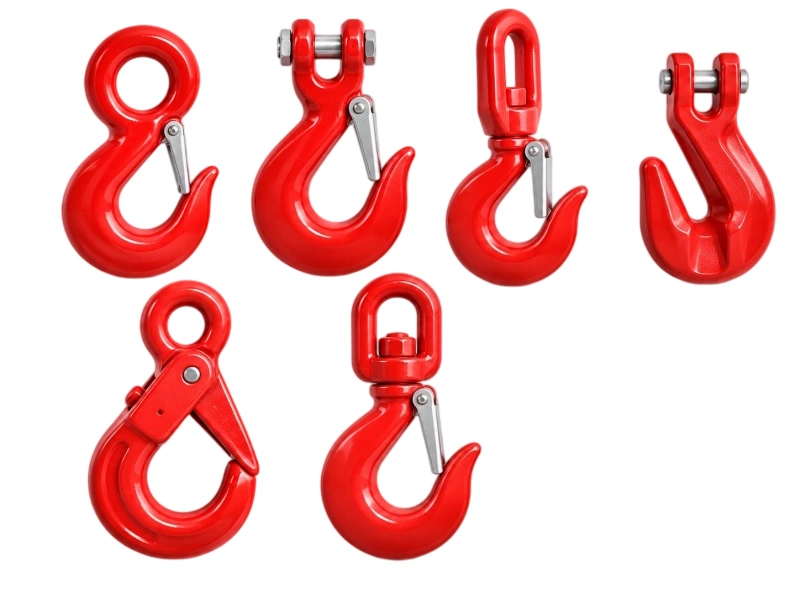
Hook names often combine two separate features. “Eye” and “clevis” describe how the hook attaches to the assembly. “Sling,” “grab,” “self-locking,” and “foundry” describe the working form or intended function. A product can therefore be both an eye hook and a self-locking hook, or both a clevis hook and a sling hook.
Eye Hooks
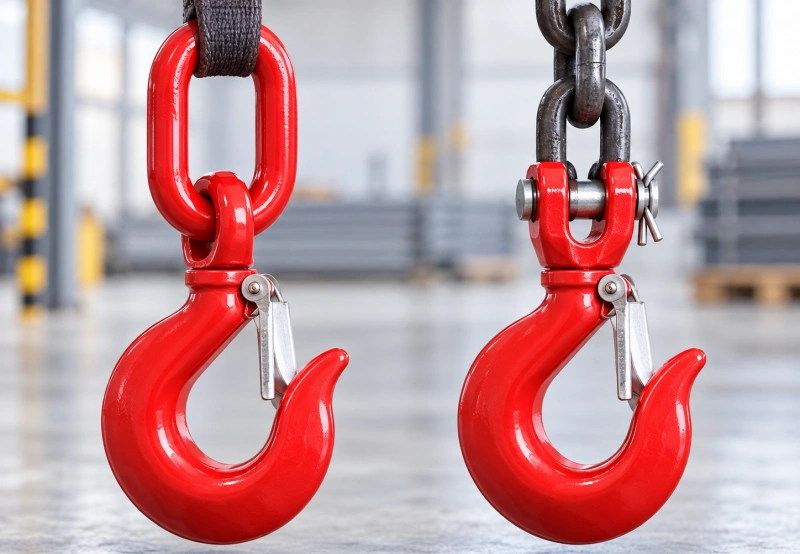
An eye hook has a closed eye at the attachment end. The eye can be connected through a compatible link or other approved component. This arrangement can allow articulation at the connection, but the eye and mating component still require adequate internal clearance and compatible dimensions. Do not assume that every eye hook can connect directly to every chain or sling fitting.
Clevis Hooks
A clevis hook uses two ears and a pin to connect to compatible chain or another component. When the product is designed for direct chain connection, the clevis can reduce the number of separate connectors in the assembly. The pin, retaining device, and chain size must match the hook. A substitute pin or improvised retainer can alter the fit and load path.
Sling Hooks and Slip Hooks
Sling hooks have a broad bowl designed to receive a compatible link, lifting point, or fitting. Many designs use a spring latch across the throat. In some catalogues, “slip hook” is used for a similar open-throat hook with a latch, especially in North American chain terminology. The product name alone does not establish suitability for overhead lifting; check the markings and technical data for the exact model.
Grab Hooks and Shortening Hooks
Grab hooks engage a chain link so that a chain leg can be shortened or restrained as permitted by the assembly design. The chain must seat correctly in the hook pocket.
Some shortening hooks are designed to preserve the rated capacity of a compatible chain system, while other combinations may have a reduced rating. Use only the chain grade and diameter specified for the hook, and use the assembly rating stated by the manufacturer.
Self-Locking Hooks
A self-locking hook closes and locks through its designed mechanism. Depending on the design, the mechanism may close and lock as the load is applied and require a deliberate action to open. This can provide positive retention, but the mechanism still requires inspection and correct operation. A locked hook can still be misused through side loading, tip loading, or connection to an incompatible fitting.
Swivel Hooks
A swivel connection can help orient the hook during connection. Rotation capability under load varies by product. Some swivel hooks are intended only for positioning before the lift, while others are specifically rated for rotation under load. Confirm the instructions for the exact hook rather than treating every swivel as a rotating bearing.
Foundry Hooks
Foundry hooks have a wide throat and are commonly associated with material handling in foundries, steel plants, and similar operations. They may be supplied without a conventional latch because the application and load interface differ from those of a general sling hook. That does not make them interchangeable with other hooks. The intended service, loading method, environmental limits, and inspection criteria must be confirmed for the selected model.
Sorting Hooks
Sorting hooks are used to handle or position certain materials where a wide, open hook shape is useful. They should not be treated as general-purpose sling hooks. Before using one for lifting, confirm that the specific product is rated and intended for that operation, including the permitted loading direction and how the load bears in the hook.
Choke Hooks and Other Special Designs
Choke hooks are shaped to engage chain in a defined choke arrangement or other specified configuration. Other special designs include twist-eye hooks, sliding-eye hooks, and hooks made for a particular chain system. Select these products using their specific instructions because the connection geometry and permitted use can differ substantially from those of a standard sling hook.
Eye vs. Clevis Attachment
| Question | Eye Attachment | Clevis Attachment |
| How does it connect? | Through a compatible link or connector. | By a clevis pin to the compatible chain or fitting. |
| What must be checked? | Chain grade and diameter, pin, retainer, fit, and assembly rating. | Chain grade and diameter, pin, retainer, fit and assembly rating. |
| Main practical difference | More connection options, but may require an additional component. | Can connect directly where the hook is designed for the chain system. |
| Can appearance confirm compatibility? | No. | No. |
Choose the attachment that creates the intended load path with no unnecessary components. Do not modify the eye, clevis, pin, or chain link to make incompatible parts fit.
Grade 80 and Grade 100 Hooks
Powerful Machinery’s catalogue includes Grade 80 and Grade 100 hook families. The Grade 80 range includes clevis and eye foundry hooks, sling hooks with latches, self-locking hooks, swivel self-locking hooks, choke hooks, and grab hooks.
The Grade 100 range includes shortening grab hooks, clevis and eye sling hooks with latches, and eye and swivel self-locking hooks. Buyers can compare Grade 80 lifting hooks and Grade 100 lifting hooks on the relevant product pages.
A higher grade does not eliminate the need to check the exact WLL and dimensions. Do not substitute Grade 100 components into a Grade 80 assembly, or vice versa, solely because the parts appear to fit. The chain, hook, and connecting components must form an approved, correctly rated system.
How to Select a Rigging Hook?
Start with the Intended Operation
Define what the hook must do before choosing its shape. A sling hook receives a compatible lifting point or connector. A grab or shortening hook engages chain. A self-locking hook provides a positive locking action. A foundry or sorting hook serves a more specialized handling task. If the operation cannot be defined clearly, the hook cannot be selected reliably.
Confirm the Working Load Limit
Use the WLL marked on the hook and stated in the current product documentation. The WLL applies only under the conditions defined for that product. Shock loading, side loading, tip loading, elevated temperature, corrosion, and unusual load geometry may fall outside those conditions. Never calculate an assumed WLL from hook size or a generic design factor.
Match the Chain or Connecting Component
For chain slings, confirm the chain grade and nominal diameter, the hook model, the connection method, and the rating of the complete assembly. The chain must seat as intended without binding. For an eye connection, check the dimensions of the link or connector passing through the eye. For a clevis connection, use the specified pin and retaining device.
Check the Load Interface
The load or fitting should seat in the bowl of the hook without concentrating force on the tip, latch, or side. Check that the opening provides adequate clearance without allowing the connection to disengage. If the load point is too large, too small, or poorly aligned, choose a different connector rather than forcing the hook into position.
Consider the Environment
Temperature, chemicals, saltwater, moisture, and abrasive contamination can affect material properties, coatings, and moving parts. A protective finish can help control corrosion, but it does not make every hook suitable for marine, chemical, or high-temperature service. Provide the operating environment when requesting a product recommendation.
Confirm Documentation and Traceability
Before ordering, state the applicable product standard, grade, WLL, dimensions, finish, markings, inspection requirements, and required documentation. Material certificates, test reports, traceability records, and third-party inspection requirements should be agreed during quotation because availability depends on the product and order scope.
What Does a Safety Latch Do?
A safety latch helps retain a compatible sling, link, or fitting in the hook when the rigging is slack or being handled. It is not intended to carry the load. The connected component should bear in the hook bowl, not against the latch. A closed latch also does not correct an undersized hook, side loading, tip loading, or an unstable load.
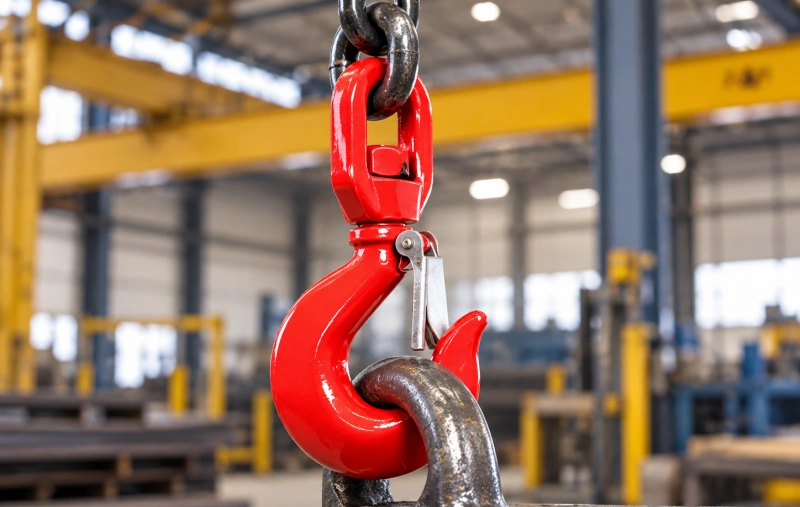
Before use, check that the latch closes freely, aligns with the hook tip, and is not bent, cracked, loose, or obstructed. Use only the replacement latch or kit specified for the hook model. Do not drill, weld, or reshape a hook to accept a different latch.
Rigging Hook Safety Rules
- Read the hook markings and manufacturer’s instructions before use.
- Verify that the WLL is adequate for the planned load and configuration.
- Keep the load seated in the bowl; avoid tip, side, and back loading unless the product is specifically designed and rated for it.
- Do not force an oversized lifting point or multiple components into the hook opening.
- Ensure the hook can align with the load path without twisting the sling or chain.
- Keep hands and body parts away from pinch points while tension is applied.
- Do not use a hook if required identification is missing and the product cannot be positively identified and rated.
- Do not weld, heat, grind, bend, or field-repair a hook unless a documented, manufacturer-approved process expressly permits it.
- Remove a questionable hook from service and have it evaluated by an appropriately qualified person.
Inspection and Removal from Service
Inspect the hook before use and perform periodic inspections according to the manufacturer’s instructions, applicable regulations, operating environment, and service severity. The broader rigging hardware inspection guide explains how to structure inspection and recordkeeping across different component types.
During hook inspection, look for:
- Cracks, nicks, gouges, sharp marks, or other surface damage.
- Bending, twisting, increased throat opening, or another change in shape.
- Wear in the bowl, eye, clevis, pin holes, or other bearing areas.
- Heat damage, weld spatter, severe corrosion, or chemical attack.
- A missing, damaged, or poorly operating latch or locking mechanism.
- A worn, bent, incorrect, or insecure clevis pin or retaining device.
- Illegible or missing identification or WLL markings.
- Restricted swivel movement, excessive looseness, or damage where a swivel is fitted.
Removal criteria are not identical for every hook. Use the limits in the applicable manufacturer’s documentation and governing standard. Do not return a hook to service merely because visible damage appears minor.
Common Selection Mistakes
| Mistake | Why It Matters | Better Action |
| Choosing by opening size alone | The shape does not confirm grade, WLL, or intended loading. | Identify the model and check current technical data. |
| Treating the latch as load-bearing | A latch is a retention device, not the hook bowl. | Seat the connection in the bowl. |
| Assuming every swivel rotates under load | Rotation capability depends on the design. | Check the exact product instructions. |
| Mixing grades or chain sizes | Parts may fit but form an unapproved or lower-rated assembly. | Use a compatible system and its stated assembly rating. |
| Using a grab hook as a general sling hook | The geometry and function differ. | Select the hook type intended for the operation. |
| Using coating as proof of environmental suitability | Finish alone does not establish temperature or chemical limits. | Confirm material, finish, and service limits. |
Information to Include in a Hook Inquiry
A complete inquiry helps the supplier verify both capacity and compatibility. Include:
- Intended operation and loading direction.
- Required hook type and attachment style.
- Required WLL and units.
- Chain grade and nominal diameter, if the hook connects to chain.
- Dimensions of the mating lifting point, link, or fitting.
- Required latch or locking mechanism.
- Operating temperature, corrosion exposure, and other environmental conditions.
- Required standard, markings, finish, quantity, and documentation.
- Whether third-party inspection or project-specific testing is required.
For product models, dimensions, and quotation support, use the lifting hook range. Final selection should be confirmed against the exact product data and the complete lifting assembly.
FAQ
What Is the Most Common Type of Rigging Hook?
There is no single most common hook for every operation. Sling hooks with latches are widely used in general chain-sling assemblies, while grab hooks, self-locking hooks, foundry hooks, and other designs serve different tasks. Choose by function, connection, WLL, and compatibility rather than popularity.
What Is the Difference Between an Eye Hook and a Clevis Hook?
An eye hook connects through its closed eye using a compatible link or connector. A clevis hook uses a pin between two ears and may connect directly to compatible chain when designed for that system. Both require dimensional and rating checks.
Is a Hook with a Latch Always Safer?
A functioning latch helps retain the connected component, especially while the rigging is slack, but it does not make an incorrect connection safe. The load must still sit in the bowl, and the hook must be correctly rated, aligned, and inspected.
Can a Swivel Hook Rotate While Loaded?
Only if the specific hook is designed and rated for rotation under load. Some swivel hooks are intended for positioning before loading, not continuous rotation. Check the manufacturer’s instructions for the exact model.
Can Grade 80 and Grade 100 Hooks Be Interchanged?
Not on grade alone. The hook, chain, connecting links, and other components must be compatible in grade, size, geometry, and rating. Use the rating of the approved complete assembly.
When Should a Rigging Hook Be Removed from Service?
Remove the hook from service when inspection identifies a condition that exceeds the applicable manufacturer or standard limits, or whenever the hook’s identity and rating cannot be confirmed. Cracks, deformation, significant wear, heat damage, severe corrosion, damaged locking components, and unauthorized modifications all require evaluation.
Conclusion
Rigging hook selection begins with the operation, not the hook shape. Identify how the hook will connect, where the load will bear, which locking action is required, and whether the complete assembly is compatible. Then verify the exact WLL, markings, environmental limits, and inspection criteria for the selected model.
These checks help prevent a common mistake: treating hooks that look similar as interchangeable. Use the product documentation and the requirements of the complete lifting system as the final basis for selection and use.