Rigging hardware inspection is more than a cursory check for rust. An effective inspection verifies identification, working load limit (WLL) or rated capacity where applicable, condition, critical dimensions, moving features, and the hardware’s continued suitability for its intended load path.
The exact acceptance and removal criteria must be based on the governing regulation or standard, the hardware manufacturer’s instructions, and the applicable employer or site procedure.
This guide focuses on detachable rigging hardware. ASME B30.26 covers shackles, links, rings, swivels, turnbuckles, eyebolts, hoist rings, wire rope clips, wedge sockets, rigging blocks, and load-indicating devices within its scope. Hooks and slings are addressed in separate B30 volumes, so their detailed inspection criteria should not be applied indiscriminately to a detachable-hardware checklist.
If you are still defining the product categories, see what rigging hardware includes and the types of rigging hardware. For product selection and procurement, use the rigging hardware commercial hub.
Quick Answer: How Often Should Rigging Hardware Be Inspected?
There is no single global inspection schedule that applies to every hardware item, sling, and jurisdiction. Apply the requirements that govern the workplace and the exact product being inspected.
| Scope | What the Source Says | Practical Takeaway |
| U.S. Construction — Rigging Equipment | OSHA 29 CFR 1926.251(a)(1) requires rigging equipment for material handling to be inspected before use on each shift and as necessary during use. Defective equipment must be removed from service. | For covered construction work, include a shift-based inspection in the job plan and inspect again when service conditions warrant. |
| U.S. Construction — Slings | OSHA 1926.251(a)(6) requires each sling and its fastenings and attachments to be inspected each day before use by a competent person designated by the employer, with additional inspections during use when conditions warrant. | Do not treat the sling as inspected merely because the associated hardware was checked. |
| U.S. General Industry — Slings | OSHA 1910.184(d) requires daily-before-use inspection of slings, fastenings, and attachments, plus additional inspections during use when service conditions warrant. | Daily or pre-use sling inspection is separate from hardware-specific periodic inspection programs. |
| Alloy Steel Chain Slings | OSHA 1910.184(e)(3) requires thorough periodic inspection regularly at intervals no greater than 12 months; the employer keeps a record of the most recent month of that inspection. | The 12-month maximum is a chain-sling requirement, not a universal interval for every rigging component. |
| ASME B30.26 Hardware | The current ASME B30.26-2026 standard covers inspection and maintenance of detachable rigging hardware. Exact inspection and removal requirements should be verified against the current edition and the manufacturer’s instructions for the product. | Do not substitute a generic inspection schedule for the current standard or the manufacturer’s criteria. |
1. Start With Identification and the Correct Product Data
Before assessing wear or damage, confirm exactly what you are inspecting. Verify the manufacturer, model or pattern, size, working load limit (WLL) or rated capacity where applicable, and any required identification markings. If the item cannot be positively identified, do not infer its capacity from appearance or dimensions alone.
- Locate the manufacturer’s current instructions, specification sheet, or drawing.
- Confirm that the item belongs to the intended assembly and service.
- Check that all required markings remain legible.
- Compare the actual hardware with the correct dimensional data before assessing wear or deformation.
2. Clean the Hardware Enough to Inspect Critical Surfaces
Dirt, grease, paint, scale, and corrosion products can conceal cracks, wear, and deformation. Clean the component sufficiently to inspect load-bearing surfaces without using a process that damages the part or removes required markings. If a coating or contamination prevents an adequate inspection, quarantine the item until it can be properly evaluated.
3. Check Shape, Dimensions, and Evidence of Overload
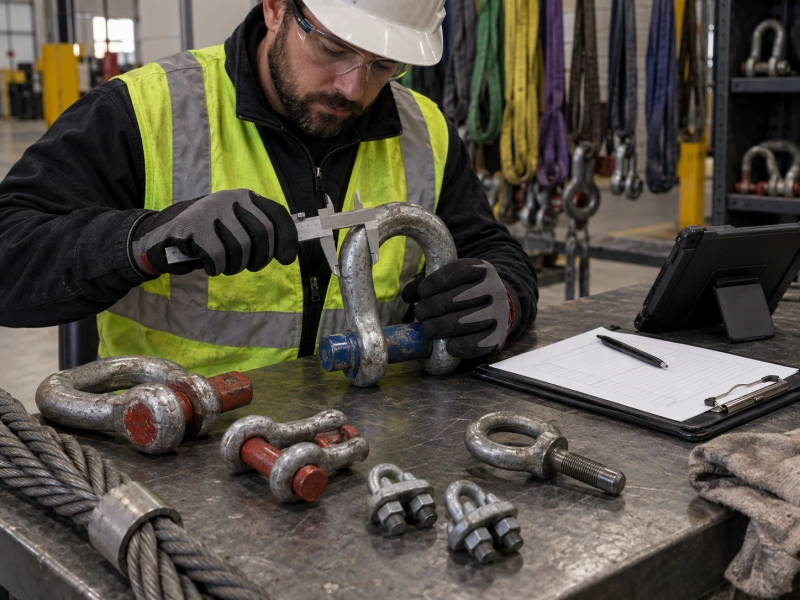
Look for bending, twisting, elongation, spreading, necking, distorted openings, bent pins, misalignment, or other changes from the original shape. Measure critical dimensions when the applicable standard or manufacturer provides a limit. Do not apply a generic wear percentage across different hardware families.
4. Look for Cracks, Gouges, Nicks, Heat Damage, and Unauthorized Modification
Cracks, sharp gouges, deep nicks, evidence of overheating, arc strikes, unauthorized welding, grinding, drilling, or other field modifications can alter the hardware’s strength or stress distribution. If damage creates doubt about continued service, remove the item from service and refer the disposition decision to the manufacturer or an appropriately qualified person.
5. Evaluate Corrosion and Pitting
Surface discoloration alone does not establish whether a component remains suitable for service. Check for section loss, deep pitting, crevice attack, and corrosion at threads, pins, bearing areas, and other highly loaded regions. If corrosion has changed critical dimensions or makes the condition uncertain, quarantine the hardware and compare it with the manufacturer’s removal criteria.
6. Inspect Pins, Threads, Bolts, Nuts, Cotters, and Moving Features
Critical defects can occur at interfaces as well as in the main body. Check pins for straightness and correct engagement; threads for damage, stripping, or severe corrosion; nuts and retaining devices for correct fit; and swiveling or pivoting components for the movement intended by the manufacturer. Do not substitute improvised pins, bolts, nuts, or retaining devices.
Component-by-Component Rigging Hardware Checklist
| Hardware Family | Inspect For | Related QDP Resource |
| Shackles and Pins | Required identification; body or pin distortion; cracks; wear; damaged threads; corrosion or pitting; mismatched or improvised pins; unauthorized welding or modification. | Shackle product range and product-specific inspection criteria. |
| Turnbuckles / Adjustable Hardware | Bent bodies or end fittings; damaged or seized threads; cracks; corrosion; unauthorized modification; missing or damaged locking or retention features where the design uses them. | Turnbuckle range and dedicated turnbuckle inspection guidance. |
| Links, Rings, Swivels, and Master Links | Cracks; deformation; wear; section loss; corrosion; damaged welds where applicable; free movement where the design requires rotation; legible identification where required. | Master links and related rigging hardware categories. |
| Eyebolts, Eye Nuts, and Hoist Rings | Thread damage; bent or elongated eyes; cracked or damaged shoulders; seating condition; deformation; corrosion; swivel or pivot function where applicable; product identification. | Eye bolts and eye nuts; use exact manufacturer mounting instructions. |
| Wire Rope Clips, Thimbles, and Sockets | Cracks; deformation; damaged threads or nuts; corrosion; damaged saddles or bodies; deformed thimbles; evidence that a termination has moved or was assembled incorrectly. | Wire rope fittings; installation details depend on the exact fitting and rope. |
| Rigging Blocks | Check side plates, pins, sheaves, and attachment points for cracks, distortion, wear, and corrosion; verify that moving parts operate as intended and required markings remain legible. | Pulley and block product category; follow the exact block instructions. |
| Hooks | Hooks are adjacent lifting hardware, but detailed inspection belongs under ASME B30.10 rather than B30.26. | Use the dedicated hook inspection resource for throat opening, twist, latch condition, and hook-specific removal criteria. |
Product and component links: shackles · turnbuckles · master links · eye bolts · wire rope fittings · rigging blocks · hook inspection
When Should Rigging Hardware Be Removed From Service?
Remove or quarantine hardware when the applicable rule or manufacturer requires removal, or whenever a condition creates doubt about safe continued use.
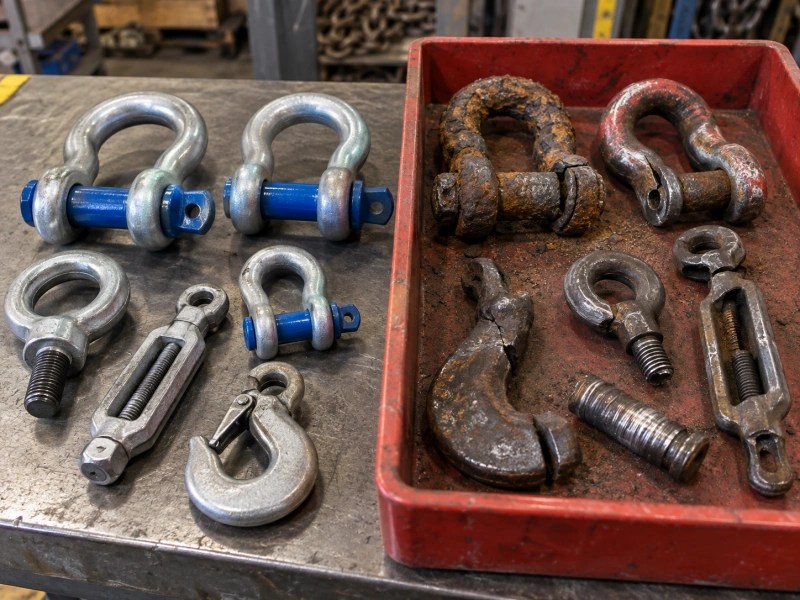
Typical triggers include cracks, significant deformation, wear or section loss beyond the permitted limit, severe corrosion or pitting, damaged threads or pins, missing required identification, heat damage, unauthorized welding or modification, and any condition that prevents the hardware from functioning as designed.
Do not return questionable hardware to service simply because it can be made to fit. Repairs, modifications, and replacement parts must comply with the manufacturer’s instructions and the governing standard. Field welding, grinding, bending, or hardware substitution is not an acceptable default repair strategy.
How Often Should Slings Be Inspected?
Sling inspection frequency is often discussed alongside rigging hardware inspection, but the applicable requirements must remain distinct. They are addressed together here only to clarify the scope of the inspection-frequency question.
For U.S. general industry, OSHA 1910.184 requires slings and their fastenings and attachments to be inspected each day before use, with additional inspections during use when service conditions warrant. For alloy steel chain slings, OSHA also requires thorough periodic inspection at intervals no greater than 12 months, with frequency based on use, service severity, lift type, and service history.
For U.S. construction work, OSHA 1926.251 requires covered rigging equipment to be inspected before use on each shift and each sling and its fastenings and attachments to be inspected each day before use, with additional inspections when service conditions warrant.
Other jurisdictions, sling materials, and industry standards may impose different or additional requirements. Always identify the rule that applies to the exact sling and workplace.
Who Should Perform the Inspection?
Use the inspector role required by the applicable regulation, standard, and employer program. OSHA uses specific terms such as competent person for certain sling inspections, while ASME standards use designated-person and qualified-person concepts for different decisions.
The key issue is not the job title on a certificate: the inspector must have the knowledge, authority, and product information required for the inspection being performed, and uncertain conditions should be escalated appropriately.
What Should an Inspection Record Include?
Recordkeeping requirements are not identical for every hardware type. Even where a written record is not specifically required, a consistent log can improve traceability and trend detection. A practical inspection record can include:
- equipment or hardware ID, manufacturer, model or pattern, and size;
- WLL or rated capacity, where applicable;
- location or assembly identification;
- inspection date and inspection type;
- inspector name or identifier;
- condition of required markings and critical dimensions;
- damage, wear, corrosion, and functional findings;
- measurements compared with the applicable manufacturer or standard limit, where one exists;
- disposition: accepted, quarantined, removed, sent for manufacturer or qualified-person review, or repaired under an approved process;
- photos and work-order or replacement references, when useful.
Important exception: OSHA 1910.184(e)(3) specifically requires the employer to make and maintain a record of the most recent month in which each alloy steel chain sling was thoroughly inspected.
A Simple Rigging Hardware Inspection Workflow
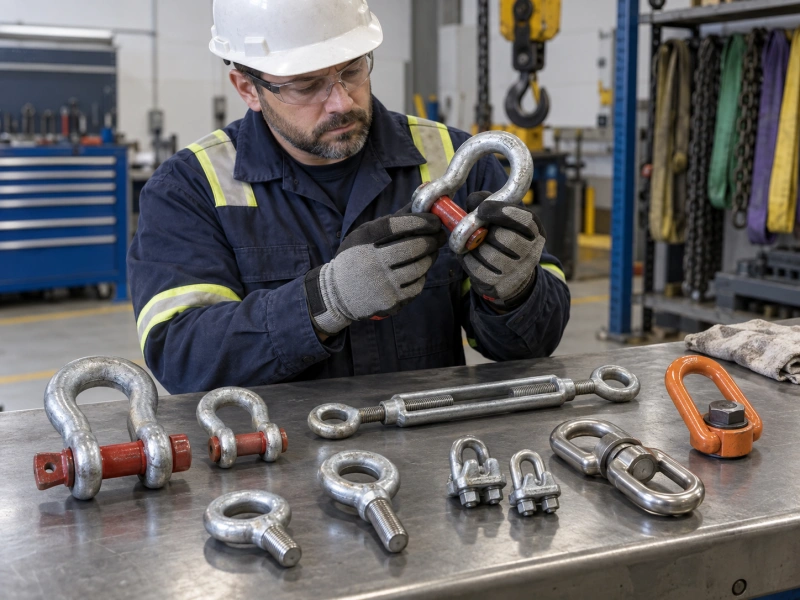
- Identify the exact hardware and applicable product data.
- Confirm that required identification and WLL or rated-capacity markings are legible.
- Clean the component enough to inspect critical areas.
- Inspect the body and load-bearing surfaces for cracks, deformation, wear, corrosion, and heat damage.
- Inspect the pins, threads, nuts, cotters, latches, and moving features that belong to the design.
- Measure critical dimensions where the manufacturer or standard provides a limit.
- Compare findings with the exact removal criteria, not with a generic percentage from an unrelated source.
- Quarantine or remove questionable hardware from service.
- Escalate uncertain repair or reuse decisions to the manufacturer or a qualified person.
- Record the result when required by the governing rule or when useful for the inspection program.
FAQ
How Often Should Rigging Hardware Be Inspected?
For U.S. construction work covered by OSHA 1926.251, rigging equipment must be inspected before use on each shift and as necessary during use. Other workplaces and hardware classes may follow different rules, so use the applicable regulation, the current standard, and the manufacturer’s instructions.
Does Every Rigging Hardware Item Need an Annual Inspection?
Do not apply that statement universally. Some sling and hardware standards use periodic inspection intervals that can extend up to one year under defined conditions, but exact requirements vary by item, service, and governing standard. A periodic inspection also does not replace shift, daily, or pre-use inspections where those are required.
What Percentage of Wear Requires Rigging Hardware to Be Removed From Service?
There is no single percentage for all rigging hardware. Removal limits differ by hardware class, measurement location, standard edition, and manufacturer. Use the exact criteria for the component being inspected.
Do Rigging Inspections Have to Be Documented?
It depends on the equipment and governing rule. Some inspections have explicit record requirements—for example, OSHA requires a record of the most recent month of the thorough periodic inspection for alloy steel chain slings. Other hardware inspections may have different requirements. A site log can still be valuable even when a specific written record is not mandated.
Can Damaged Rigging Hardware Be Repaired?
Only when repair is permitted by the manufacturer and applicable standard, and the repaired item is returned to service under the required approval and testing process. Do not use field welding, grinding, bending, or improvised replacement parts as a default repair method.
Are Hooks Inspected Under ASME B30.26?
Hooks are covered by ASME B30.10, not by the main detachable-hardware scope listed in B30.26. Keep hook-specific throat-opening, twist, latch, and removal criteria in the appropriate hook inspection procedure.
Final Safety Note
This article is a screening and inspection-program design guide, not a substitute for the current governing standard or the manufacturer’s instructions. Before accepting a questionable component, verify the exact product, applicable jurisdiction, current standard edition, and the manufacturer’s removal criteria.
Need replacement or correctly specified hardware? Browse the rigging hardware range and provide the product type, WLL or rated capacity, dimensions, applicable standard, quantity, and documentation requirements for quotation.