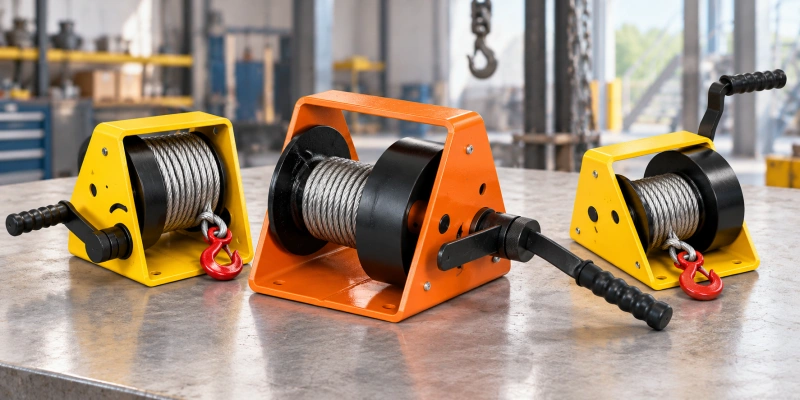
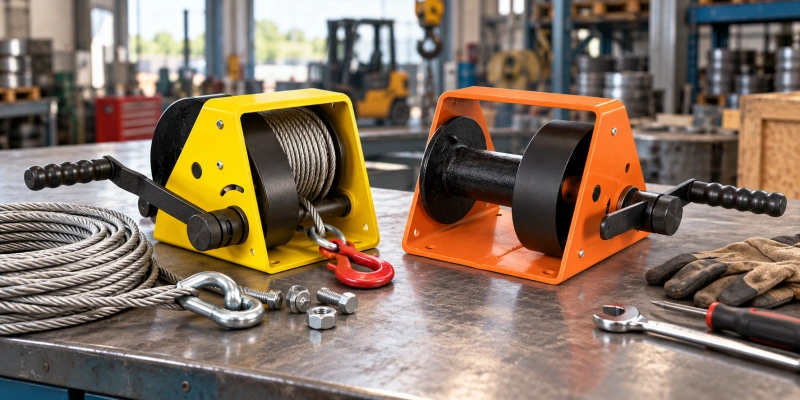
Hand winches, often called manual winches, let an operator move a load by turning a crank. Most wind wire rope or a strap onto a drum; designs and permitted uses vary. This guide compares eight manufacturers and brands, from industrial lifting winches to trailer pulling models.
The table gives you a starting point. Before choosing a supplier, check whether the exact winch is approved for lifting or pulling, how its load is rated, and how it holds the load when you release the handle.
Hand Winch Manufacturers at a Glance
| Company or brand / market | Verified manual range | Published rating example or range | Product focus |
| Powerful Machinery / China | HWV worm gear manual winch | 250–1,000 kg SWL | Fixed industrial installations |
| Dutton-Lainson / US | Pulling, brake and worm gear winches | WG1500: 1,500 lb | Trailer pulling and load-holding models |
| Fulton / US brand | Company or brand/market | 142411: 2,600 lb | Trailer pulling |
| Thern / US | Spur and worm gear hand winches | Model dependent | Industrial lifting and pulling |
| Gebuwin / Netherlands | Spur and worm gear hand winches | 150–7,500 kg range | Industrial and marine installations |
| haacon / Germany | Haacon / Germany | 50–3,000 kg range | Wall or base mounting |
| Huchez / France | MANIBOX GR and VS hand winches | GR 300–2,000 kg; VS 250–3,000 kg on range page | Industrial lifting and positioning |
| MAXPULL / Japan | Manual ratchet, capstan and other winches | Model dependent | Specialized manual mechanisms |
The figures above come from different product lines and use the suppliers’ own rating terms. A trailer winch’s rated line pull does not establish a safe working load for lifting. Compare the exact model, application, and rope layer before treating two figures as equivalent.
What Is a Hand Winch or Manual Winch?
Most hand winches turn a drum through gears as the operator cranks. A hand puller, often called a come-along, uses a lever and ratchet to draw two hooks together instead. The distinction affects how the tool mounts and how far it can move a load. For a closer comparison, see hand winch versus come-along.
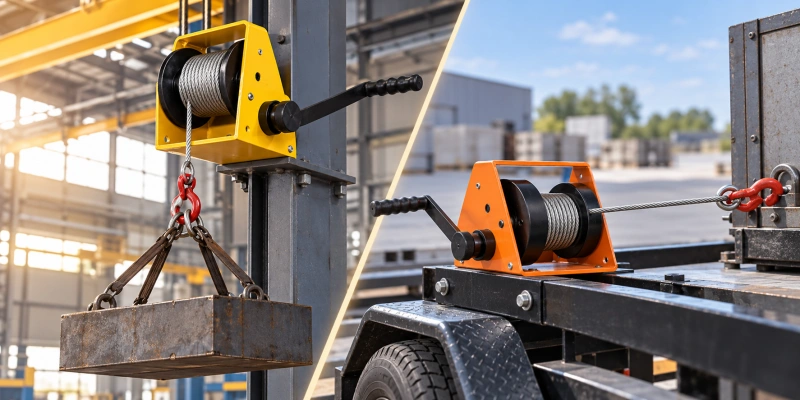
A hand crank does not make every winch suitable for vertical lifting. The model’s instructions and rating must explicitly cover the intended use.
How We Selected These Manufacturers?
We selected companies whose own websites show current hand-operated winches. For each range, we checked the published application, capacity, gearing, braking or holding method, and available technical documents. The descriptions below reflect those published products. They do not score one company against another or imply that we tested the winches.
8 Hand Winch Manufacturers to Compare
1 Powerful Machinery
Powerful Machinery lists three HWV worm gear winches for industrial lifting. The HWV manual winch specifications give each model’s safe working load, steel wire rope diameter, and transmission ratio. The product page also describes an automatic brake and a separate gearbox. Request a current drawing and operating instructions when specifying the mounting and load path.
| HWV model | SWL | Listed steel wire rope | Transmission ratio |
| VS250 | 250 kg | 5 mm | 15:1 |
| VS500 | 500 kg | 6.8 mm | 21:1 |
| VS1000 | 1,000 kg | 9 mm | 26:1 |
Powerful Machinery also has a separate GR hand winch range. For an RFQ, state the load, required rope travel, mounting position, and whether the job involves lifting or pulling. Ask for the current model sheet and written confirmation of the selected rating.
2 Dutton-Lainson Company
Dutton-Lainson separates pulling, brake, and worm gear winches in its catalogue. The WG1500 worm gear series carries a 1,500 lb first-layer rating and includes standard, split-reel and alternative drive versions. The company lists that series for horizontal pulling and vertical lifting, with restrictions in its instructions.
Buyers comparing trailer hauling with a load-holding duty should choose from the appropriate category and check the exact part number’s rope and operating requirements.
3 Fulton
Fulton focuses on trailer winches. Its part 142411 has two speeds, a 2,600 lb rated line pull, a zinc finish and a manually activated hand brake. The low gear gives greater mechanical advantage for a heavy pull; the listing says no strap is included. This is a trailer pulling example, so do not treat its line-pull rating or hand brake as approval for overhead lifting.
4 Thern
Thern offers spur gear and worm gear hand winches for lifting, lowering, positioning and pulling. Some stainless steel models use an automatic Weston-style load brake. Its range is relevant when an installation calls for a particular gear layout, finish, or mounting arrangement. Compare the model drawings and instructions, since the brake and load rating vary across the range.
5 Gebuwin
Gebuwin’s hand winches cover spur gear and worm gear designs, with published capacities from 150 kg to 7,500 kg. Its catalogue includes marine, stainless steel and theatre versions, and the product pages provide sheets, instructions and drawings. This makes it easier to shortlist a model for a specific environment. Use the individual product sheet for the actual rating and rope capacity; the range endpoints describe different winches.
6 Haacon Hebetechnik
Haacon lists wall-mounted and base-mounted manual cable winches. Its Tango K 500, for example, has a 500 kg first-layer line pull and a 320 kg top-layer figure. That difference matters when the drum carries several layers of rope. The product page also gives rope take-up, diameter and mounting details, so a buyer can compare the full installation rather than the headline capacity alone.
7 Huchez
Huchez offers MANIBOX GR spur gear winches and MANIBOX VS worm gear winches. Its range page lists GR models from 300 to 2,000 kg and VS models from 250 to 3,000 kg, including painted or stainless steel frame options. Buyers can use the two series to compare gearing and corrosion protection, then check the chosen model’s rope length, winding direction, and installation instructions.
8 MAXPULL
MAXPULL lists several manual mechanisms, including ratchet-handle and capstan winches, with manuals and CAD files for model selection. A capstan pulls rope around a rotating drum while the operator manages the free end; it does not store the rope like a conventional drum winch.
That distinction matters when rope travel or the operating layout rules out a standard drum design. Check the selected model’s permitted lifting or pulling use.
How to Choose a Manual Winch Supplier?
Start with the load path and rating
First define the job: pulling, lifting, lowering, or holding a load. Give the supplier the load weight, travel, operating frequency, pulley layout, and likely friction. Ask which rating applies to your use and at which rope layer it is measured. As rope builds up on a drum, the effective radius grows and available line pull usually falls. A pulling rating alone does not authorize lifting, especially over people or for personnel.
Check the brake and gear arrangement
Ask how the winch holds a load when the operator stops cranking and how controlled lowering works. A ratchet and pawl, an automatic load brake and a worm gear work differently; none by itself establishes lifting approval. Gear ratio affects crank effort and speed. Compare the manufacturer’s brake description and operating instructions for the exact winch.
Match the rope, drum, and mounting
Specify the rope or strap diameter, travel, drum capacity, minimum wraps, lead angle, and termination. Our steel wire rope range and wire rope fittings pages show related components, but the winch supplier must approve the rope and termination for its model. Request a mounting drawing with the bolt pattern and crank clearance, and make sure the supporting structure can carry the load.
Check environment and documentation
Outdoor and marine sites may need a different finish and maintenance schedule from indoor installations. Ask about the frame, drum, and fastener materials, then request the model drawing, operating manual, and available spare parts. If you need a change to mounting, rope, or finish, send those requirements with the RFQ and ask the supplier to confirm what it can supply.
Questions to Ask Before Ordering
- Is this exact model rated for lifting, pulling, or both, and does it permit suspended loads?
- Is the published capacity measured at the first rope layer? What is it at the maximum working layer?
- Which brake or holding mechanism does the model use, and how is a load lowered?
- What gear type and ratio are specified, and what hand force is required at rated load?
- Which rope or strap diameter, capacity, minimum wraps, and termination are approved?
- What mounting pattern, orientation, and supporting structure are required?
- What finish is supplied for the actual operating environment?
- Which drawings, operating instructions, inspection records, and spare parts can be supplied?
- Which requested OEM changes are available for this exact model and order?
FAQs
Is a hand winch the same as a manual winch?
Usually, yes. Manufacturers use both terms for a hand-operated winch. Check the mechanism and intended use, since other manually operated pulling tools can have similar names.
Can a hand winch be used for lifting?
Yes, if the manufacturer rates that model and configuration for the intended lift. A winch rated only for pulling is not necessarily suitable for vertical lifting, even if it has a hand brake.
How do I choose the capacity?
Give the supplier the load, rope path, and required travel. Compare its published capacity at the rope layer you will actually use, then follow the model’s instructions for mounting and operation.
How does a brake winch differ from a ratchet pulling winch?
An automatic load brake is designed to control or hold the load as specified by its manufacturer. A ratchet and pawl resist rotation by engaging gear teeth. Check how the particular winch holds and lowers a load; the names alone are not enough.
Are worm gear winches always self-locking?
No. Holding behavior depends on the gear design and operating conditions. Follow the model’s stated brake and holding provisions instead of assuming that any worm gear will hold a suspended load.
Can a manual winch be customized for an OEM project?
Options vary by supplier and model. Send the required capacity, rope, mounting, finish, and drawings with your inquiry, and get the proposed changes confirmed in writing.
Request a Quote for the Actual Model
Once you have a shortlist, compare the actual model sheets and send the suppliers the same application brief. For an HWV inquiry, review the HWV manual winch product page and contact Powerful Machinery. Include the load, rope travel, mounting drawing, and intended lifting or pulling duty.