A custom chain sling quote is only as accurate as the information you send. If your RFQ says “two-leg chain sling, 10 feet long” but leaves out the load, sling angle, fittings, and service conditions, the supplier has to guess—or come back with a long list of questions. Either way, you lose time and may receive an assembly that does not fit the lift.
A complete chain sling specification describes the lift before it describes the chain. You identify the maximum gross load, center of gravity, lifting points, hitch, available headroom, and operating environment. Your manufacturer can then select a compatible chain grade, diameter, master link, hooks, and connectors, and confirm the rated capacity of the finished assembly.
Use the steps below to prepare a custom chain sling RFQ that a fabricator can review without filling in critical blanks. You will also find a fillable chain sling spec sheet in this workbook. Complete it, attach a drawing or marked-up photo when the geometry is unusual, and ask the supplier to state every assumption in the quotation.
Key Takeaways
- Start with the maximum gross load, center of gravity, pick points, hitch, and headroom—not a guessed chain diameter.
- State the worst-case sling angle and say whether you measure it from the horizontal, from the vertical, or as the included angle between legs.
- Measure reach bearing point to bearing point, including the top and bottom fittings.
- Give the supplier connection dimensions, service conditions, required standard, tag details, and documentation needs.
- Ask the manufacturer to confirm the assembly WLL, angle basis, component compatibility, proof-test status, and any deviations from your RFQ.
What Should a Chain Sling Specification Include?
Your chain sling specification should answer four practical questions: What are you lifting? How will the sling connect? What conditions will it face? What evidence must arrive with it? When those answers are clear, the manufacturer can translate your lift into an assembly rather than quote a generic piece of chain.
| RFQ section | Information to provide | Why it matters |
|---|---|---|
| Load | Maximum gross load, load description, center of gravity, pick-point count, and spacing | Establishes the actual demand on the chain sling |
| Geometry | Hitch type, leg count, angle convention, worst-case angle, headroom, and reach | Controls chain sling leg tension and assembly length |
| Components | Chain grade preference, top fitting, bottom fittings, adjusters, and required openings | Ensures the sling fits the crane hook and load connection points |
| Service | Temperature, chemicals, corrosion, abrasion, duty cycle, and sharp edges | May affect material, finish, working load limit (WLL), or inspection requirements |
| Compliance | Destination market, required standard, identification tag, certificate, traceability, and testing | Defines the evidence required for acceptance and safe use |
1. Define the Load Before You Select the Sling
Give the supplier the maximum gross load the sling will support. Include the lifted item plus any spreader beam, lifting frame, shackles, magnets, clamps, or other below-the-hook equipment that the sling carries. Use one unit system consistently and identify whether the value is an actual weight, a maximum design weight, or an estimate that still needs verification.
Describe the load as well as its weight. A compact machine with one central lifting eye calls for a different arrangement than a long fabricated beam, a hot casting, or a skid with four lifting lugs. State the number and location of the pick points, their rated capacity, and the center of gravity. If the center of gravity is offset or changes between lifts, say so; adjustable legs may be more useful than a fixed bridle.
A drawing is often the fastest way to prevent a mismatch. Mark the pick-point spacing, hook or shackle sizes, crane hook dimensions, required lifting orientation, obstacles, and available headroom. For repeat production, include the drawing number and revision in the RFQ so the quoted sling can be tied to the correct load configuration.
2. State the Hitch and Number of Legs
Tell the manufacturer whether you will use a vertical, bridle, basket, or choker arrangement. Do not assume that the same assembly has the same WLL in every hitch. The way the sling contacts and controls the load affects its rating, stability, and hardware selection.
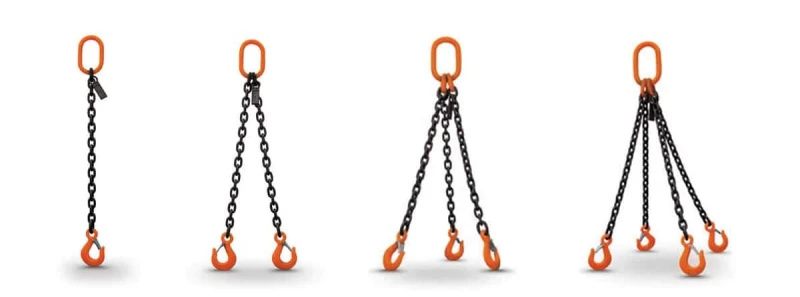
Then specify one, two, three, or four legs. A single leg suits a direct pick with one approved attachment point. Two legs stabilize loads with two pick points. Three- and four-leg bridles can control larger or irregular loads, but extra legs do not automatically divide the weight equally. Load stiffness, pick-point elevation, center of gravity, and leg-length tolerance all influence load sharing.
RFQ tip: For a four-leg bridle, ask the manufacturer to state the rating method and the number of legs assumed to carry the load. Do not multiply a single-leg WLL by four.
3. Give the Worst-Case Sling Angle—and Define the Convention
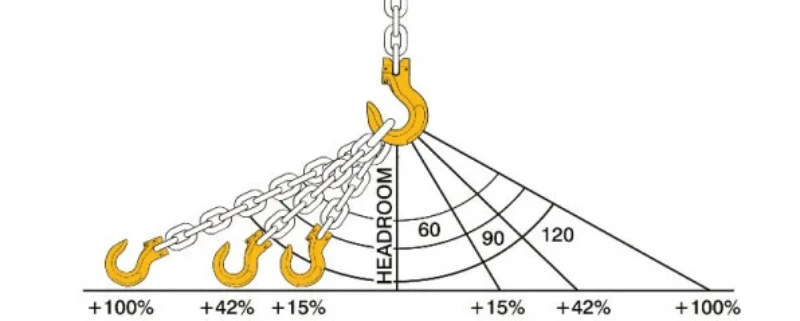
Sling angle is one of the most common RFQ errors. Some drawings show the angle from the horizontal, others from the vertical, and others show the included angle between two legs. A number such as “60°” is ambiguous unless you name the reference plane.
Provide the worst-case operating angle and a sketch. As a multi-leg sling becomes flatter, leg tension increases and the assembly WLL falls. If the exact angle is not available in the manufacturer’s rated-load table, use the next more conservative published angle or have a qualified person and the sling manufacturer confirm the rating. Do not plan to operate below the manufacturer’s permitted minimum angle.
Also give the pick-point spacing and vertical distance from the load connection to the master link. These dimensions allow the manufacturer to check the angle instead of relying on a field estimate. If you will use the same sling on several loads, provide the full geometry range and identify the least favorable case.
4. Specify Chain Grade and Let WLL Drive the Chain Size
For overhead lifting, specify an approved alloy lifting chain system for the market and standard that apply to your site. Grade 80 and Grade 100 are widely used; some suppliers also offer Grade 120. Grade 100 generally provides a higher WLL than Grade 80 at the same nominal diameter, which can reduce sling weight or increase capacity, but availability, component systems, temperature limits, and site standards still matter.
Do not request transport, tie-down, proof-coil, or general-purpose chain for an overhead lifting sling. Color is not a reliable grade identifier because finishes vary by manufacturer. Your RFQ should require grade markings, traceability, and a durable identification tag on the finished sling.
If you already use a controlled component system, state the required grade, manufacturer, or approved equivalent. Otherwise, give the required assembly WLL and allow the chain sling manufacturer to propose the nominal chain size. Ask the quotation to show the assembly WLL at your stated hitch and angle, not only the catalog WLL of a bare chain leg.
Weakest-component rule: Hooks, master links, coupling links, and adjusters must be compatible with the chain. If a component has a lower rated capacity, the finished sling is limited by that component.
5. Measure Chain Sling Reach Bearing to Bearing
Reach is the effective length of the finished sling, including attachments. For a multi-leg bridle, measure from the load-bearing surface inside the top master link to the load-bearing surface of the lower hook or fitting, with the leg straight and pulled taut. Do not measure only the chain body and then add hardware—the finished sling will be longer than intended.
State the reach for each leg, the unit, and the acceptable tolerance. If all legs must be matched, say so. If the load needs to be leveled, identify the adjustment range you need rather than simply asking for “adjustable.” A fixed-reach sling can be simpler and lighter for one repeat lift; an adjustable sling can cover different pick-point elevations or an off-center center of gravity.
Headroom and reach are related but not interchangeable. Headroom is the available vertical space between the lifting device and the load. Reach is a dimension of the sling. Give both when clearance is tight, and include the hook-to-load geometry so the supplier can check that the proposed master link and fittings will fit.
6. Choose the Top and Bottom Fittings by Connection
The top fitting must seat correctly in the crane or hoist hook without crowding, point loading, or bearing on the latch. Provide the hook opening, bowl or saddle dimensions, and any restrictions on master-link width or thickness. For multi-leg slings, the manufacturer may propose an oblong master link or a master-link assembly sized for the number of legs and angle.
Choose bottom fittings by how you will connect to the load. Sling hooks with latches are a common general-purpose choice. Self-locking hooks can help retain the connection when the line goes slack. Foundry hooks provide a wide, open throat for suitable trunnions or lifting points. Grab hooks or shortening clutches can provide adjustment, but the specific component and engagement method must be approved for the chain system.
Do not specify “hook” alone. Give the connection type and dimensions: lifting-lug hole diameter and thickness, shackle pin and bow size, trunnion diameter, or required hook throat opening. State whether swivel action, a latch, positive locking, or a particular orientation is needed. Ask the supplier to confirm that every fitting matches the chain grade and nominal size.
7. Describe Service Conditions That Can Change the Design
A sling quoted for a clean indoor shop may not be suitable for a furnace area, galvanizing line, offshore deck, acid process, or abrasive foundry. Provide the minimum and maximum service temperature, chemical names and concentrations, outdoor exposure, saltwater or humidity, expected abrasion, sharp edges, and contamination that may affect the chain or fittings.
Give the duty pattern as well: occasional maintenance lift, daily production, high-cycle service, or severe service. Mention any potential for impact, snagging, side loading, or uncontrolled motion so the supplier can flag an unsafe method or request an engineered lift review. Shock loading is not an acceptable way to gain capacity; the lift plan should keep the load controlled.
Avoid choosing a coating by appearance. Galvanizing, plating, paint, black finish, and corrosion-resistant materials can have different limits and may not be available for every lifting-chain grade. Describe the exposure and required service life, then ask the manufacturer to recommend a compatible material or finish and disclose any WLL or temperature restrictions.
8. Define Standards, Tagging, Testing, and Documents
Name the destination country, end-user standard, and any project specification. A U.S. RFQ may refer to OSHA 1910.184 and the applicable ASME B30.9 requirements; European, UK, Australian, and other markets use different standards and marking systems. Do not mix requirements casually. Ask the supplier to identify the standard used to design, manufacture, rate, test, and mark the assembly.
At minimum, request a durable identification tag showing the information required by your jurisdiction and the applicable standard. For U.S. alloy steel chain slings, OSHA requires size, grade, rated capacity, and reach. Your purchasing system may also need the manufacturer, sling type, leg count, angle basis, serial number, purchase order, or asset number.
State which documents must ship with the sling: certificate of conformity, proof-test certificate, material or component traceability, manufacturer’s WLL table, chain sling inspection and use instructions, dimensional drawing, and third-party inspection report if required.
In the United States, OSHA requires new, repaired, or reconditioned alloy steel chain slings to be proof tested before use and requires the employer to retain the proof-test certificate. Put that document requirement in the RFQ rather than chasing it after delivery.
9. Ask the Supplier to Confirm Assumptions and Deviations
A professional quotation should do more than list a price. Ask the manufacturer to repeat the proposed configuration, chain grade and diameter, reach, fittings, assembly weight, WLL at the specified hitch and angle, design or safety factor where applicable, standard, finish, proof-test status, tag contents, documents, lead time, and quotation validity.
Require a clear deviations section. If a requested hook is not compatible, a finish is unsuitable, or the stated angle produces an inadequate WLL, you want the supplier to say so and propose an alternative. For unusual loads, request an approval drawing before production. Review the drawing against the load, crane hook, lifting points, and headroom—not only against the purchase order description.
Chain Sling Specification Example
You can use this format as a concise RFQ summary. The values below are an example only; your manufacturer or a qualified person must confirm the final selection and rating.
RFQ Example: Two-Leg Grade 100 Chain Sling
Application: Indoor machinery handling; repeat lift
Maximum gross load: 12,000 lb, including below-the-hook rigging
Load: Rigid skid with two rated lifting lugs; center of gravity shown on Drawing PM-241 Rev. B
Configuration: Two-leg bridle with fixed reach
Hitch: Bridle/direct connection through rated shackles
Worst-case angle: 45° from horizontal; 90° maximum included angle
Required assembly WLL: At least 12,000 lb at the stated hitch and angle
Chain: Grade 100 alloy lifting chain; manufacturer to select the nominal size
Reach: 8 ft 0 in, bearing point to bearing point, for each leg; supplier to state matched-leg tolerance
Top fitting: Master link sized for the crane-hook dimensions shown on the drawing
Bottom fittings: Self-locking hooks sized for the specified shackles; supplier to confirm opening and orientation
Service conditions: −10°F to 120°F; dry indoor use; daily lifts; moderate abrasion; no chemical exposure
Compliance: OSHA 1910.184 and applicable ASME B30.9 requirements
Required deliverables: Durable identification tag, approval drawing, certificate of conformity, proof-test certificate, WLL information, serial-number traceability, and inspection/use instructions
Supplier response: State all assumptions and deviations, assembly weight, lead time, and quotation validity
Example only. The manufacturer or another qualified person must confirm the final chain size, components, configuration, and assembly rating.
Common RFQ Mistakes to Avoid
- Ordering by chain diameter without stating the load, hitch, and angle.
- Giving chain-only length instead of finished bearing-to-bearing reach.
- Writing “60° sling angle” without defining the reference plane.
- Assuming four legs share the load equally or provide four times the capacity.
- Specifying hooks without connection dimensions.
- Mixing grades, brands, or component systems without written compatibility.
- Omitting temperature, chemical, corrosion, abrasion, or duty-cycle conditions.
- Treating a catalog component WLL as the rating of the complete assembly.
- Asking for “certification” without listing the exact certificates, standards, and traceability required.
- Releasing production before the approval drawing matches the actual load and crane hook.
FAQ
What is the most important information in a chain sling specification?
Start with maximum gross load, hitch, number of legs, worst-case sling angle, and load geometry. Those inputs establish the capacity and configuration. Reach, fittings, service conditions, standards, and documentation then complete the RFQ.
How do you measure chain sling reach?
Measure the effective length of the finished leg from the load-bearing surface of the upper terminal component to the load-bearing surface of the lower terminal component. The measurement includes the hardware and is commonly called bearing-to-bearing reach.
Should you specify chain size or working load limit?
Specify the required assembly WLL at your actual hitch and worst-case angle. If your site has an approved chain system, you can also state grade and nominal size. Otherwise, let the manufacturer select the chain diameter and confirm the finished assembly rating.
What documents should you request with a custom chain sling?
Request the documents your jurisdiction and quality system require. Common deliverables include an approval drawing, certificate of conformity, proof-test certificate, WLL information, serial-number traceability, and inspection/use instructions. Name each document in the RFQ.
Can you use Grade 70 chain in a lifting sling?
Do not specify Grade 70 transport chain for overhead lifting. Request an alloy lifting chain grade and matched component system that the manufacturer rates and certifies for your application and market.
Send a Chain Sling RFQ Your Manufacturer Can Build From
A clear chain sling specification removes avoidable questions without pretending that a buyer should engineer the sling alone. You define the load, geometry, connections, service, and compliance evidence. The manufacturer selects or verifies the component system, confirms the assembly WLL, and documents the finished sling.
Complete the fillable spec sheet in this workbook and send it with your load drawing or marked-up photos. Powerful Machinery can review your custom chain sling RFQ, confirm the missing details, and provide an approval drawing and quotation for the required assembly.
Final sling selection and lift planning should always be completed by qualified personnel in accordance with the applicable standards and manufacturer instructions.