Understanding the Key Differences
Explore the distinct features of hand winches and come-along tools.
Features | GR Hand Winch | JHW Come Along Tool |
|---|---|---|
Operation Type | Manual crank handle operation | Ratchet mechanism for operation |
Load Capacity | Up to 2 tons (4,400 lbs) | 1.2 to 4 tons capacity |
Portability | Lightweight and compact | Highly portable and easy to carry |
Safety Features | Automatic brake system included | Safety latches and hooks |
Ease of Use | Requires physical effort to crank | User-friendly with precise tension control |
Maintenance Needs | Regular lubrication and checks are required | Monthly inspections recommended |
Versatility | Suitable for various heavy-duty tasks | Ideal for quick, portable jobs |
Cost | Generally higher initial cost | More affordable option |
When you compare a hand winch vs come along, you notice clear differences in how each tool operates and performs. You need to choose the right tool for your job to maximize safety and efficiency.
For example, the GR Hand Winch by Powerful Machinery offers heavy-duty lifting with an automatic brake system, while the Come Along Tool from JHW uses a ratchet mechanism for precise tension control.
Businesses often prefer hand winches for repetitive tasks, but both tools maintain high demand and customer satisfaction.
Selecting the correct tool impacts safety and efficiency.
Factor
Explanation
Load Capacity and Specifications
Ensuring tools can handle the intended load prevents safety risks and inefficiencies.
Material and Durability
The choice of materials affects tool performance and longevity, especially in harsh environments.
Compliance with Safety Standards
Adhering to safety regulations mitigates risks and ensures legal compliance in operations.
Ease of Maintenance
Tools that are easy to maintain reduce unexpected failures and enhance safety.
Manufacturer Reputation
Choosing reputable manufacturers ensures quality and reliable after-sales support.
Key Takeaways
Choose a hand winch for heavy lifting tasks. It offers higher load capacity and safety features like automatic brakes.
Select a come-along for portable jobs. Its compact design and ratchet mechanism allow for precise tension control in tight spaces.
Regular maintenance is crucial for both tools. Inspect cables, lubricate moving parts, and check for wear to ensure safety and reliability.
Consider the environment when selecting a tool. Hand winches perform well in harsh conditions, while come-alongs are ideal for quick, light tasks.
Always check the rated capacity before use. This prevents accidents and ensures efficient operation of your chosen tool.
What Is a Hand Winch?
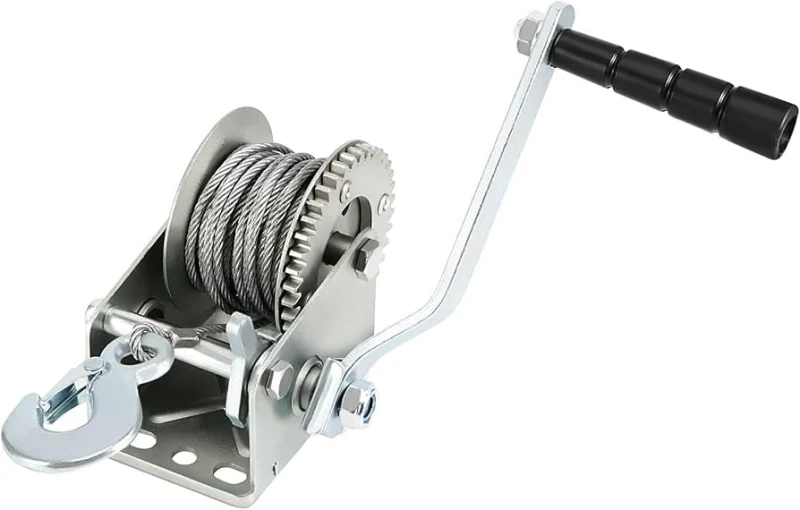
Hand Winch Definition
A winch is a mechanical tool that helps you lift or pull heavy objects with less effort. You often see winches in construction, transportation, and even outdoor activities. When you use a hand winch, you operate it manually, making it a true hand-operated device.
Unlike electric winches, which need a power source, a hand winch relies on your strength and control. This makes it highly portable and easy to use in places where electricity is not available.
The GR Hand Winch from Powerful Machinery stands out as a reliable example. You can use this winch in many environments, from construction sites to entertainment venues. It comes in several models, such as the GR150, GR300, GR500, GR1000, and GR2000, each designed for different load capacities.
Tip: Choose a winch model that matches your load requirements for maximum safety and efficiency.
Characteristic | Hand Winch | Electric Winch |
|---|---|---|
Operation | Manual | Motor-powered |
Physical Effort | User effort required | Minimal user effort |
Load Capacity | Smaller loads | Heavier loads |
Portability | Highly portable | Less portable |
Power Source | No electricity needed | Needs electricity |
Hand Winch Features
You benefit from several key features when you use a hand winch:
Automatic brakes engage when you release the handle, keeping your load secure.
Free-spooling drums let you unwind the cable quickly and easily.
Gear mechanisms offer single or dual speeds for different tasks.
Ergonomic handles reduce hand fatigue and improve control.
Durable drums and cables manage heavy loads safely.
The GR Hand Winch includes a heavy-duty steel frame, an automatic brake system, and a free-spooling drum. You can adjust the rope direction and fix the winch securely, making it versatile for many jobs.
Hand Winch Uses
You find hand winches in many industries. In construction, you use a winch to lift materials weighing 500 to over 1,000 pounds. In off-roading, a winch helps you recover vehicles stuck in mud or sand, often handling loads between 2,000 and 4,000 pounds.
You also see winches in marine and entertainment settings, where they move equipment or rigging.
The GR Hand Winch works well in harsh environments, from -10°C to +50°C. You can rely on it for lifting, pulling, or securing loads in almost any situation. Regular maintenance, like checking and lubricating the gearbox, keeps your winch safe and reliable for every use.
What Is a Come Along?
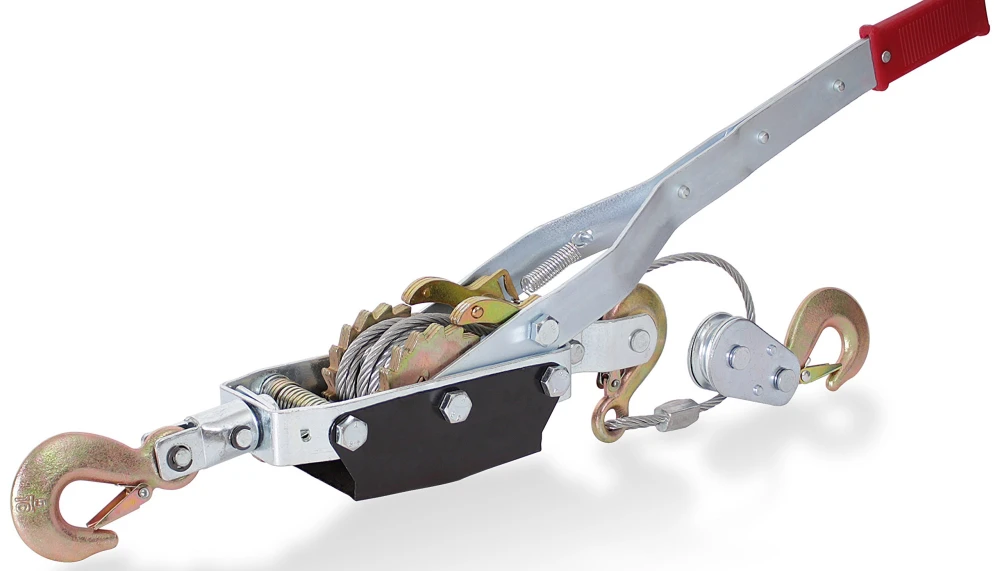
Come Along Definition
You use a come-along when you need a manual tool for pulling or lifting loads. This tool operates with a ratchet mechanism and lever, giving you a mechanical advantage for moving heavy objects. Unlike a hand winch, which uses a crank handle and drum, a come-along relies on a wire rope system and ratchet action.
The JHW Come Along Tool stands out as a reliable option, offering up to 3 tons of pulling capacity. You find this tool compact and easy to carry, making it ideal for jobs where portability matters.
Note: A come-along is often called a ratchet puller. You can use it for tasks that require precise tension control and secure load handling.
Feature | Come Along | Hand Winch |
|---|---|---|
Operation | Manual operation using a ratchet mechanism | Manual operation using a crank handle |
Design | Simpler and smaller | Consists of a drum, gears, and a crank |
Pulling Capacity | Lower maximum pulling capacity | Typically, lower load capacities compared to electric winches |
Portability | More compact and easier to transport | Portable, usable in remote locations |
Cost | Generally cheaper than a winch | More affordable upfront compared to electric winches |
Physical Exertion | Requires significant manual effort | Requires physical effort to crank |
Versatility | Less versatile, not ideal for off-roading | Versatile for various applications |
Speed of Operation | Slower due to manual operation | Slower operation compared to electric winches |
Come Along Features
You benefit from several features when you choose a come-along. The ratchet mechanism lets you pull loads with controlled increments. The wire rope system provides strength and durability. Safety latches prevent accidental release, and swivel hooks reduce rope twist.
Dual pawl designs ensure smooth ratcheting in both directions. Overload protection, such as a shear pin, helps you avoid damage if you exceed the rated capacity. The JHW Come Along Tool offers a user-friendly design, making it easy to operate and adjust tension.
Ratchet mechanism for precise control
Wire rope system for durability
Safety latches and swivel hooks
Dual pawl design for secure operation
Overload protection for safety
Come Along Uses
You use a come-along in many scenarios. In construction, you move equipment or position cables. Automotive professionals rely on a come-along for vehicle rescue and heavy-duty tasks. Fire services use it in rescue situations, where mechanical advantage is crucial.
You can also use a come-along for moving furniture or securing loads during transport. The compact size and portability make it suitable for both professional and DIY projects. The JHW Come Along Tool fits home and commercial needs, providing reliable performance every time.
Tip: Always check the rated capacity before using a come-along to ensure safe operation.
Hand Winch vs Come Along Comparison
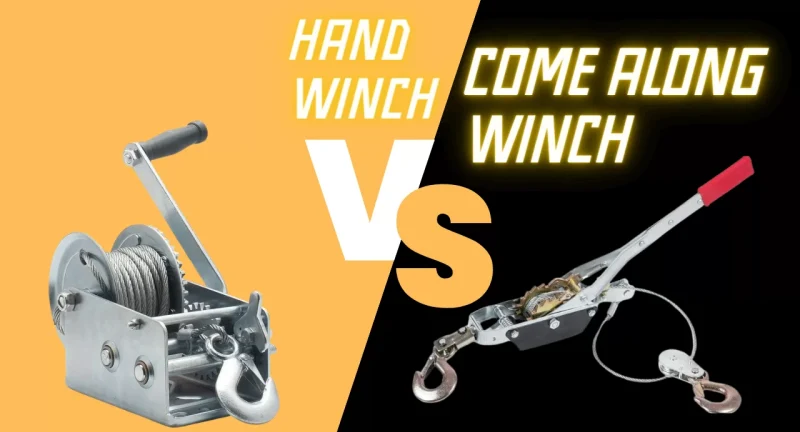
Mechanism and Operation
You notice clear differences in how each tool operates when comparing a hand winch vs come along. A hand winch uses a crank handle to wind a cable around a drum. This mechanism gives you a steady pull and smooth force application over a known distance.
You control the speed and tension by turning the handle, which makes the winch ideal for tasks that require consistent movement of a heavy load.
A come-along tool operates with a ratchet-and-pawl system. You move the handle back and forth to incrementally tension the wire rope. This design allows you to position loads with precision and adjust tension in small increments.
You benefit from portability and ease of use, especially in tight spaces or when you need to make fine adjustments.
Tool Type | Mechanism Description | Mechanical Advantage Description |
|---|---|---|
Hand Winch | Uses a continuous crank handle to wind a cable around a drum. | Provides a steady pull over a known distance with smooth force application. |
Come Along | Utilizes a back-and-forth motion of a handle to operate a ratchet-and-pawl system. | Allows for incremental tensioning and precise positioning, excelling in portability. |
Tip: Choose a hand winch for steady, controlled movement of larger loads. Select a come-along tool when you need precise positioning and portability.
Strength and Capacity
You must consider strength and capacity when choosing between a hand winch vs come along. Hand winches typically offer higher maximum pulling capacity, making them suitable for heavier tasks.
For example, the GR Hand Winch can handle loads up to 2 tons (4,400 lbs), which is ideal for lifting or pulling a heavy load in construction or industrial settings.
Come along, tools usually have a capacity range from 1.2 to 4 tons. You find these tools useful for pulling or securing loads, but you must pay attention to the safe lifting limit. Exceeding the recommended capacity can lead to equipment failure and safety risks.
Tool Type | Load Capacity |
|---|---|
Come Along | 1.2 – 4 tons |
Hand Winch | 2 tons (4,400 lbs) |
Product Name | Load Capacity | Cable Length |
|---|---|---|
TORIN Come Along Winch Tool | 2 tons (4,400 lbs) | 7.5 Feet |
Note: Always check the rated capacity before starting your task. Using the right tool prevents accidents and ensures efficient operation.
Portability and Maintenance
You gain an advantage in portability with both tools, but hand winches stand out in field applications. The winch design is lightweight and compact, allowing you to transport and reposition it easily. You do not need electrical power, so you can use a hand winch in remote locations or on job sites with limited access to electricity.
This independence makes the winch adaptable to various conditions.
Come-along tools also offer portability due to their compact size. You can carry them to different locations and use them for quick tasks. However, the hand winch vs come along comparison shows that hand winches may have a distinct advantage in mobility and adaptability.
Maintenance is essential for both tools. You should follow regular maintenance schedules to keep your equipment reliable. For hand winches, you need to lubricate gears, inspect components, and replace worn parts. Preventive maintenance programs help you catch potential issues early and maintain mechanical efficiency.
Lubricate moving parts regularly.
Inspect gears and cables for wear.
Replace damaged components promptly.
Test efficiency to ensure safe operation.
For come-along tools, you should perform monthly visual inspections and quarterly detailed examinations. High-use environments require weekly checks, while occasional-use applications may extend maintenance intervals.
Monthly visual inspections are recommended.
Quarterly detailed examinations necessary.
Weekly inspections for high-use environments.
Occasional-use applications may extend intervals.
Regular maintenance increases reliability and extends the lifespan of your equipment.
Safety and Reliability
Safety features play a critical role in the hand winch vs come along comparison. You must select equipment that meets international safety standards. Built-in safety features such as overload protection and secure locking mechanisms reduce accident rates and improve reliability.
Safety Feature | Impact on Accident Rates |
|---|---|
Emergency-stop systems | Prevents accidental operation, reducing injury risk |
Overload protection | Prevents equipment failure, lowering accident likelihood |
Automatic brakes | Ensures controlled descent, minimizing injury from falling loads |
Hand winches often include automatic brakes, which ensure controlled descent and minimize injury from falling loads. You benefit from a safer mechanism for lowering loads, especially during heavy-duty operations. The winch provides precision and reduces the risk of jerks or cable slipping.
The Tirfor is designed to move heavy loads with safety and precision, offering a much more effective mechanism for lowering loads compared to come-alongs, which can cause jerks and potential failures due to cable slipping.
Come along tools have a maximum capacity of around 4,000 pounds, but the safest lifting limit is only 2,000 pounds. You must avoid exceeding this limit to prevent equipment failure and serious safety risks.
Choose equipment with overload protection.
Use automatic brakes for controlled movement.
Follow safety standards to reduce accidents.
Safety and reliability depend on proper tool selection, regular maintenance, and adherence to rated capacity.
Pros and Cons
Hand Winch Pros
You gain several advantages when you choose a hand winch for lifting or pulling. This tool adapts to many environments and industries, including automotive recovery, marine mooring, and construction. You can use it for both lifting and pulling, which increases versatility.
The straightforward design allows you to operate the winch with minimal training. You save money because hand winches cost less than electric or hydraulic systems. The initial purchase price stays low, and operating costs remain minimal.
You benefit from reliable performance in various conditions, making this tool a practical choice for heavy-duty tasks.
Versatility for lifting and pulling
Easy operation with minimal training
Cost-effective solution
Reliable in harsh environments
Simple design enhances durability
Hand Winch Cons
You face some limitations with hand winches. The pulling force depends on your physical strength, which restricts the maximum load you can handle. You may find it challenging to move extremely heavy loads without additional manpower.
Manual operation can lead to fatigue during extended use. You must monitor the tool closely to avoid overloading and ensure safe operation.
Limited by available manpower
Physical effort required for operation
Fatigue during prolonged use
Come Along Pros
You benefit from the portability and precision of a come-along tool. The compact size makes it easy to carry and store. You can use the ratchet mechanism to adjust tension in small increments, which helps with precise positioning. This tool works well for quick tasks and in tight spaces.
You find it useful for securing loads and moving equipment in automotive and construction settings.
Portable and easy to transport
Precise tension control with a ratchet mechanism
Effective for quick tasks and tight spaces
Useful for securing and moving loads
Come Along Cons
You encounter some drawbacks with come along tools. Compatibility issues may arise when integrating with older systems. Disconnected information can hinder efficiency, especially if you rely on multiple tools or software solutions.
Employee resistance and adoption problems may affect the success of new systems. You must address these challenges to maintain productivity and safety.
Compatibility issues with legacy systems
Disconnected information reduces efficiency
Resistance to adoption among users
Tip: Evaluate your task requirements and work environment before selecting a tool. Consider the pros and cons to ensure you choose the best option for your needs.
Choosing the Right Tool
Task-Based Recommendations
You need to match your tool to the demands of your project. Consider these factors before you decide:
Heavy-duty hand winch with brake prevents accidental unwinding.
Automatic brakes engage when the load reaches its position, locking the drum.
Self-locking mechanisms keep your load stationary when you release the handle.
Load capacity: Make sure the winch can handle the maximum weight for pulling and lifting.
Cable or strap length and material: Choose a length and material that fit your task and offer durability.
Gear ratio: Select a ratio that improves lifting efficiency for your intended use.
Environmental conditions also matter. Moisture, temperature extremes, and exposure to chemicals can weaken materials and affect performance. You should select a winch that operates reliably in harsh conditions.
Tip: Always check the rated capacity and environmental suitability before you start your project.
Scenarios for Winch Use
You should choose a winch for tasks that require steady force and secure load retention. The GR Hand Winch from Powerful Machinery offers models like GR150, GR300, GR500, GR1000, and GR2000. These models cover safe working loads from 150 kg to 2000 kg.
You can use the best winch for construction, water treatment, or entertainment applications. The automatic brake system and heavy-duty design make it ideal for lifting heavy equipment or pulling vehicles. You benefit from adjustable rope directions and secure fixing positions.
Model | Safe Working Load | Ideal Use Case |
|---|---|---|
GR150 | 150 kg | Light rigging, small loads |
GR1000 | 1000 kg | Construction, vehicle recovery |
GR2000 | 2000 kg | Industrial lifting |
Weather conditions can influence operational efficiency. The GR Hand Winch works in temperatures from -10°C to +50°C, making it reliable for outdoor and indoor projects.
Scenarios for Come Along Use
You should select a come-along tool for quick, portable jobs. The JHW Come Along Tool handles up to 3 tons and fits automotive repairs, cable positioning, and rescue operations. Its ratchet mechanism lets you adjust tension with precision.
Compact size makes it easy to transport and store. You can use it for securing loads during transport or moving furniture.
Portable and easy to carry
Effective for tight spaces and quick tasks
Suitable for DIY and professional projects
Cost also influences your decision. Come along tools are generally less expensive and offer a low-cost solution for DIY lifting. Hand winches cost more but provide functional advantages when mounted properly.
Choose a winch for heavy-duty, repetitive tasks. Select a come-along tool for portable, precise jobs.
Conclusion
You see clear differences between hand winches and come along tools. Hand winches use a crank and gear train, offer higher capacity, and feature automatic brakes for safety. Come-along tools rely on a ratchet mechanism and excel in portability.
Feature | Hand Winch | Come Along Tool |
|---|---|---|
Mechanism | Crank & gear train | Ratchet mechanism |
Capacity | Higher, task-specific | Varies, portable |
Safety | Automatic brakes | Safety hooks |
Choose a hand winch for heavy lifting and secure load retention. Select a come-along tool for quick, portable jobs. Always inspect cables, wear gloves, and lubricate moving parts regularly to maximize safety and performance.
FAQ
What is the main difference between a hand winch and a come-along?
You operate a hand winch with a crank and drum, which provides a steady force. You use a come-along with a ratchet mechanism, allowing precise tension control. Each tool suits different tasks and environments.
Which tool should you choose for heavy lifting?
You should select a hand winch for heavy lifting. The GR Hand Winch offers higher load capacities and automatic brakes, making it ideal for construction and industrial applications.
Are hand winches or come-along tools easier to transport?
You find come along tools are easier to transport. Their compact size and lightweight design make them suitable for quick jobs and tight spaces. Hand winches offer portability but may require mounting.
How do you maintain these tools for safety?
You need to inspect cables, lubricate moving parts, and check for wear regularly. Follow manufacturer guidelines for maintenance. Proper care ensures reliable performance and reduces accident risks.
Can you use both tools for vehicle recovery?
You can use both tools for vehicle recovery. Hand winches handle heavier loads and provide secure retention. Come along tools work well for smaller vehicles or precise positioning.