You rely on a crane scale when you need to measure heavy loads with precision in demanding environments. This essential tool attaches to lifting equipment and displays real-time weight data, helping you avoid overloads and ensure safety.
The global crane market reached $35.58 billion in 2023 and continues to grow. Powerful Machinery stands out as a trusted manufacturer, delivering certified and reliable crane scales for industries where accuracy and durability matter most.
2023 market size: $35.58 billion
2024 forecast: $37.00 billion
Key Takeaways
Crane scales measure heavy loads accurately, ensuring safety during lifting operations.
Regular calibration of crane scales is essential for maintaining accuracy and compliance with industry standards.
Digital crane scales offer advanced features like wireless connectivity and data logging for improved efficiency.
Choosing the right crane scale involves considering environmental protection, display visibility, and compliance with safety standards.
Routine inspection and maintenance of crane scales prevent malfunctions and extend their lifespan.
Crane Scale Overview
What is a Crane Scale?
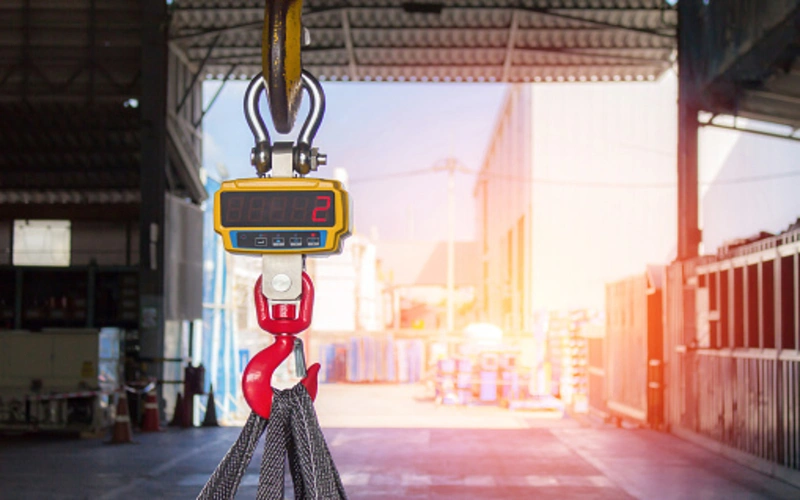
You use a crane scale when you need to measure the weight of heavy materials suspended by a crane. This weighing device, sometimes called a crane weigher, converts the gravitational force from a load into an electrical signal. The scale processes this signal and displays the weight in real time.
Industrial standards define a crane scale as a tool that measures the mass of objects lifted by cranes, ensuring you get accurate readings during lifting operations. You can rely on this technology to prevent overloads and maintain safety in your workplace.
Powerful Machinery brings over two decades of expertise to the design and manufacture of crane scales. You benefit from their commitment to quality, safety, and reliability. Their products meet strict international standards, making them a trusted choice for industries worldwide.
Key Components
A crane scale contains several essential components that work together to deliver accurate weight measurements. Each part serves a specific function to ensure safety and reliability.
Component | Function |
|---|---|
Load Cell | Detects deformation caused by the load and converts it into an electrical signal. |
Hook | A durable component that safely holds large loads during lifting. |
Display | Provides a real-time readout of the weight, which can be digital or analog. |
Housing | Protects internal components from dust, moisture, and physical damage. |
You will also find a power source, usually batteries, that supports mobile use. The upper shackle or eye connects the scale to the crane, while the lower hook secures the load. The housing shields all internal parts from harsh environments, ensuring long-term durability.
How Crane Scales Work?
Crane scales operate using a load cell that measures the force from the suspended load. The load cell transforms this force into an electrical signal. The display unit then shows the weight, allowing you to monitor the measurement instantly. You can adjust the display to show different units, such as kilograms or pounds.
Modern crane scales often feature wireless connectivity. This technology lets you transmit data to remote devices, such as tablets or smartphones. You can monitor weight readings from a safe distance, which reduces the risk of accidents.
Some models allow you to log data for later analysis or print weight records for documentation. Regular calibration ensures that your scale remains accurate and reliable.
Tip: Always calibrate your crane scale before critical lifting operations to guarantee precise results.
Crane Scale vs Dynamometer
You may wonder how a crane scale compares to a dynamometer. Both tools measure weight, but they serve different purposes and offer unique advantages. The table below highlights the main differences:
Feature | Crane Scales | Dynamometers |
|---|---|---|
Function | Weigh loads lifted by a crane | Measure force, tension, and weight |
Portability | Generally heavier, fixed installation | More portable, suitable for field tests |
Capacity | Up to 30t | Up to 300t |
Accuracy and Sensitivity | Standard accuracy | Exceptional precision, detects minute changes |
Common Use Cases | Limited to lifting applications | Wide array, including tension measurement and compression testing |
You should choose a crane scale when you need to weigh heavy loads during lifting operations. If you require higher sensitivity or need to measure tension and compression in various settings, a dynamometer may suit your needs better.
Types of Crane Scales
Analog and Digital Crane Scales
You will find two main types of crane scales in the market: analog and digital. Analog models use mechanical springs and a needle to show the weight. These scales offer basic functionality and moderate accuracy. You must interpret the needle position, which can sway during lifting.
Digital crane scale models use electronic sensors and a digital display unit. This technology gives you precise readings with much tighter tolerances. You can trust digital crane scales for critical tasks that demand high accuracy.
Feature | Analog Crane Scales | Digital Crane Scales |
|---|---|---|
Accuracy | Low to mid: typically between 1%–0.5% of full scale | Mid to high: typically between 0.5%–0.1% of full scale |
Durability | Mechanical springs can wear out over time | High-quality load cell bodies can withstand an unlimited number of lifts |
Readability | Needle-based displays are prone to swaying | Bright LED/LCD screens with stable, real-time readings |
Features | Limited to basic weight measurement | Wireless connectivity, overload alarms, unit conversion, and data logging and export |
Maintenance | Susceptible to rust and mechanical wear | Digital calibration can be performed by the operator |
Digital crane scales provide enhanced accuracy and advanced features. You benefit from automatic temperature compensation and overload alarms. The digital display unit offers clear, stable readings, even in busy industrial environments.
Electronic Crane Scale Models
Electronic crane scale models dominate heavy industry. You can choose from a wide range of capacities, from 500 pounds to over 400,000 pounds. These models often include hooks for easy crane installation.
Many feature remote controls, Bluetooth, and rechargeable batteries for convenience. The digital display unit ensures you see accurate weights at a glance.
Model Type | Capacity Range | Features |
|---|---|---|
NTEP-approved models | 500 to 400,000 pounds | Optional remotes and wireless applications |
Model Series | Features |
|---|---|
CAS NC1 Series | Battery-operated with AC adapters |
CAS Caston II Plus Series | Bluetooth capability |
CAS Caston III Plus Series | Bluetooth capability |
CAS CCB Series | Standard wireless remote controls |
You will find versatile options for every application. Powerful Machinery offers electronic crane scale models with capacities from 100 kg up to 12 tonnes, meeting the needs of construction, shipping, and manufacturing.
Heavy-Duty and Specialized Types
You may need a heavy-duty or specialized crane scale for extreme loads. These models support impressive weight capacity levels, reaching up to 200 tonnes in some cases. You can rely on these scales for mining, steel production, and large-scale cargo handling.
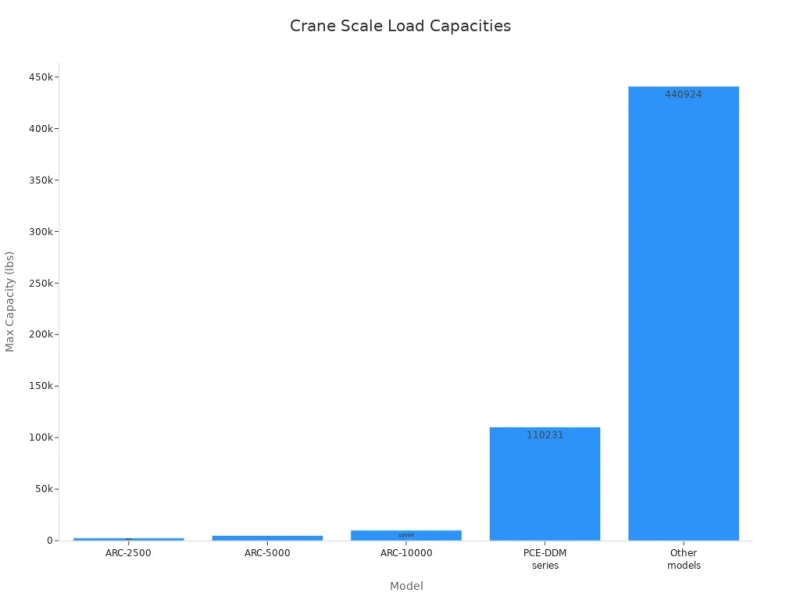
Model | Maximum Capacity |
|---|---|
ARC-2500 | 2,500 lbs (1,134 kg) |
ARC-5000 | 5,000 lbs (2,268 kg) |
ARC-10000 | 10,000 lbs (4,536 kg) |
PCE-DDM series | Up to 50 t (110,231 lbs) |
Other models | Up to 200 t (440,924 lbs) |
Powerful Machinery’s heavy-duty models are built for durability and safety, even in the harshest environments.
Features and Technologies
Modern digital crane scale models offer advanced features that boost your productivity. Wireless connectivity lets you monitor weights from a distance, improving safety. Data logging capabilities help you track inventory and analyze trends over time.
Many scales now support integration with enterprise systems, making your workflow more efficient. You can also find models with IoT integration and remote access for predictive maintenance and real-time analysis.
Tip: Choose a digital crane scale with wireless connectivity and data logging capabilities if you need real-time monitoring and seamless data management.
Functions, Benefits, and Applications
Core Functions of Crane Scales
You rely on crane scales to perform several essential tasks during lifting operations. These devices help you weigh heavy loads with accuracy and speed. The main functions of crane scales include:
Material handling and logistics: You can weigh goods, shipping containers, and oversized packages directly in warehouses.
Construction and engineering: You use crane scales to lift and position steel beams and machinery safely on job sites.
Manufacturing: You measure raw materials and finished goods, which support inventory management and quality control.
Shipping and transportation: You determine cargo weight for efficient loading and compliance with transport regulations.
Commercial fishing: You weigh seafood to ensure you meet catch limits.
Aviation: You test and certify aircraft components for weight and performance.
Mining: You weigh ores and minerals during extraction to ensure safe load capacities.
These functions of crane scales make them vital for many industrial applications.
Key Benefits for Industry
You gain many benefits when you use crane scales in your operations. These devices improve safety, efficiency, and accuracy in every weighing process. Here are the main benefits:
Increased efficiency: You speed up loading and unloading by getting rapid, precise weight measurements.
Enhanced safety: You prevent overloading, which reduces the risk of accidents and protects your team.
Improved accuracy: You receive precise weight measurements, which help you comply with regulations and avoid costly penalties.
Better inventory management: You keep accurate records, reduce errors, and control stock more effectively.
Cost reduction: You lower operational expenses by optimizing loading and reducing labor costs.
Seamless integration: You can connect crane scales to warehouse management systems for real-time updates.
Quality control: You ensure goods are handled properly, which maintains product quality.
Data collection: You gather weight data for analysis, helping you improve future operations.
Space efficiency: You weigh and move goods directly, saving valuable warehouse space.
Sustainability: You optimize resources and reduce waste by preventing overloading and underloading.
Operational efficiency: You weigh and transport goods at the same time, streamlining workflows and reducing handling times.
Powerful Machinery’s crane scales deliver these benefits with unmatched durability and accurate readings, even in harsh environments.
Industrial Applications
Crane scales serve a wide range of industrial applications. You find them in logistics and warehousing, the construction industry, manufacturing, shipping, commercial fishing, aviation, and mining. The table below shows how you use crane scales in different sectors:
Industry | Applications |
|---|---|
Material Handling and Logistics | Weighing goods, shipping containers, and oversized packages in warehouses and distribution centers |
Construction and Engineering | Lifting and positioning heavy materials like steel beams and machinery on construction sites |
Manufacturing | Measuring raw materials and finished goods for inventory management and quality control |
Shipping and Transportation | Weighing cargo containers and bulk shipments for compliance with weight limits |
Commercial Fishing | Weighing seafood for catch weights and commercial transactions at docks |
Aviation | Testing and certifying aircraft components for weight and performance |
Mining | Weighing ores and minerals during extraction and transportation |
You can trust Powerful Machinery’s crane scale models to provide precise weight measurements and reliable performance for all these applications. Their advanced load cell technology ensures you get accurate readings every time.
Safety, Calibration, and Maintenance
Safety Considerations
You must prioritize safety when operating crane scales. Always follow established safety standards to protect your team and equipment. The table below outlines key regulations that guide safe crane scale use:
Standard | Description |
|---|---|
CSA Standard C22.1-94 | Canadian Electrical Code for electrical components and functions |
ANSI Standard MH27.1-2003 | Patented Track Underhung Cranes and Monorail Systems |
CMAA No. 70 (2004) | Top Running Bridge & Gantry Type Multiple Girder Electric Overhead Traveling Cranes |
CSA Standard B167-96 | Maintenance and Inspection of Overhead Cranes, Gantry Cranes, Monorails, Hoists, and Trolleys |
ANSI/ASME B30.2-2005 | Overhead and Gantry Cranes (Top Running Bridge, Single or Multiple Girder, Top Running Trolley) |
ANSI/ASME B30.11-2004 | Monorails and Underhung Cranes |
ANSI/ASME B30.16-2003 | Overhead Hoists (Underhung) |
ANSI/ASME B30.17-2003 | Overhead and Gantry Cranes (Top Running Bridge, Single Girder, Underhung Hoist) |
You should inspect the crane scale before each use. Look for visible damage, loose connections, or worn parts. Never exceed the rated capacity. Always ensure the load is balanced and secure before lifting.
Tip: Use only certified crane scales that meet international safety standards. Powerful Machinery’s products comply with OSHA, ANSI, and other global regulations, giving you peace of mind during every lift.
Crane Scale Calibration
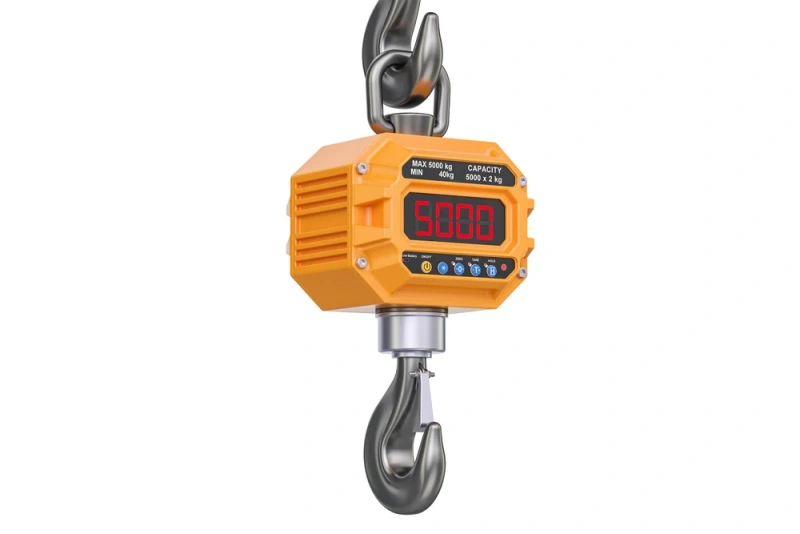
You need to calibrate your crane scale regularly to maintain accuracy. Calibration prevents overloads and ensures compliance with industry standards. Follow these steps for effective calibration:
Use certified calibration weights.
Place the scale on a stable, level surface.
Follow the manufacturer’s instructions for adjusting the readings.
Record each calibration in a logbook for traceability.
Powerful Machinery recommends a consistent calibration schedule. This practice helps you avoid costly errors and supports compliance verification. Regular calibration also extends the life of your equipment.
Crane Scales Inspection and Repair
Routine inspection and prompt repair keep your crane scale reliable. The table below lists common issues and solutions:
Cause of Malfunction | Solution |
|---|---|
Inaccurate Readings | Avoid overloading, clean regularly, and replace worn parts |
Unstable Measurements | Level the scale, reduce vibrations, check connections |
Scale Won’t Turn On | Check batteries, inspect internal components |
Uneven Weighing | Position items correctly, service load cells |
Calibration Errors | Maintain schedule, control environment |
You should document all inspections and repairs. This record-keeping supports safety audits and compliance checks. Powerful Machinery’s crane scales are designed for easy maintenance and long-term durability. You can trust their support team for guidance on repairs and part replacements.
Note: Regular inspection, calibration, and documentation help you achieve the highest safety and performance standards in your lifting operations.
Selecting and Using Crane Scales
Choosing the Right Crane Scale
Selecting the best crane scales for your operation requires careful consideration of your environment, application, and compliance needs. You must evaluate several criteria to ensure safety, accuracy, and long-term performance.
The table below outlines the most important factors to review when choosing the right crane scale for your facility:
Criteria | Description |
|---|---|
Environmental Protection | Choose models built from stainless steel or aluminum. Look for IP ratings that guarantee resistance to dust and moisture. For hazardous locations, select intrinsically safe designs. |
Display and Interface | Ensure the display remains visible in all lighting conditions. User-friendly controls help operators work efficiently and reduce errors. |
Remote Displays | Consider options that allow you to view weight readings from different locations. This feature increases safety and streamlines workflow. |
Power Source | Evaluate battery life and available power options. Long battery life reduces downtime and keeps your operation running smoothly. |
Compliance | Confirm that the scale meets industry standards and legal-for-trade certifications. Compliance ensures you meet regulatory requirements and maintain safety. |
Connectivity | Look for wireless connectivity and data integration features. These capabilities support real-time monitoring and seamless data management. |
You should also consider the support and after-sales services provided by your supplier. Powerful Machinery stands out by offering:
Sales and professional installation of crane scales
Calibration services to maintain accuracy
Repair and maintenance services for long-term reliability
Preventive maintenance programs tailored to your needs
24/7 emergency response for urgent issues
Expert technicians with years of experience
A strong focus on safety, health, and environmental compliance
These services ensure your equipment stays in top condition and your team receives the support needed for safe, efficient operations.
Tip: Always partner with a supplier who provides comprehensive after-sales support and certified products. This approach protects your investment and guarantees ongoing performance.
How Accurate Are Crane Scales?
You can expect high accuracy from modern crane scales. Most industrial models deliver accuracy within ±1% of the measuring range. Advanced models, such as the MSI-4260M, achieve precision up to ±0.1%. This level of accuracy ensures you meet regulatory requirements and avoid costly mistakes.
Several factors can affect the accuracy of your crane scales:
Temperature extremes can impact electronic components.
Improper loading, such as side-loading or shock-loading, introduces errors.
Low battery power causes unstable readings.
Calibration drift occurs over time, requiring regular recalibration.
Humidity and corrosive environments may degrade reliability.
Incorrect setup or use of calibration weights leads to inaccurate results.
Mechanical wear and tear can cause discrepancies.
Environmental factors like air pressure and uneven surfaces affect performance.
Ignoring overload indicators or failing to zero the scale before use can result in false readings.
You should always follow the manufacturer’s guidelines for calibration and maintenance. Regular checks and proper operation help you maintain the highest accuracy.
How to Use a Crane Scale?
You must follow a step-by-step process to use crane scales safely and effectively in your facility. Proper use protects your team, your equipment, and your materials. Here is a recommended procedure:
Install and Calibrate: Securely install the crane scale according to the manufacturer’s instructions. Calibrate the device before each use to ensure accurate readings.
Perform Maintenance Checks: Inspect the scale for visible damage, loose connections, or worn parts. Address any issues before the operation.
Train Operators: Ensure all personnel receive training and certification for operating crane scales.
Respect Weight Limits: Never exceed the weight limits specified by the manufacturer.
Secure the Load: Use appropriate rigging equipment to attach the load. Confirm the load is stable and balanced.
Conduct Pre-Lift Inspections: Check the condition of the scale and verify the load’s stability before lifting.
Monitor Load Distribution: Distribute the load evenly and remain aware of the center of gravity.
Establish Communication: Set up clear communication protocols between all team members involved in the lift.
Monitor During Operation: Watch for overload indicators and ensure the display reads zero before each lift.
Document and Review: Record weight data and review logs for compliance and future reference.
Note: Avoid common mistakes such as ignoring overload indicators, neglecting calibration, or operating with a low battery. These errors can compromise safety and accuracy.
You can rely on Powerful Machinery for ongoing support, including calibration, repair, and preventive maintenance. Their warranty and service programs help you maximize the lifespan and reliability of your crane scale investment.
Conclusion
You depend on a crane scale to keep your operations safe and efficient. Choosing certified, reliable equipment helps you avoid costly errors and meet industry standards. Long-term cost savings include:
Fewer safety risks and accidents
Less downtime from inefficiency
Better compliance with regulations
Reduced inventory and shipping mistakes
Applying best practices extends the life of your equipment.
Best Practice | Benefit |
|---|---|
Regular Calibration | Accurate, reliable results |
Timely Maintenance | Early damage detection, longer lifespan |
Proper Selection | Best performance for your job |
Record Keeping | Easier troubleshooting, consistent results |
You can trust Powerful Machinery for proven solutions and ongoing support.
FAQ
How do you reset a crane scale?
You can reset your crane scale by pressing and holding the “Reset” or “Zero” button until the display returns to zero. Always check the user manual for model-specific instructions.
Can you switch between kilograms and pounds on a crane scale?
You can change units by accessing the settings menu. Select the “Units” option and toggle between kg and lbs. This feature helps you match your preferred measurement system.
What is the typical lifespan of a crane scale?
You can expect a high-quality crane scale to last 5–10 years with proper maintenance. Regular calibration and inspection extend the lifespan and ensure reliable performance.
What should you do if your crane scale shows inaccurate readings?
Check for overload or uneven loading.
Calibrate the scale using certified weights.
Inspect for visible damage or loose connections.
Contact technical support if issues persist.