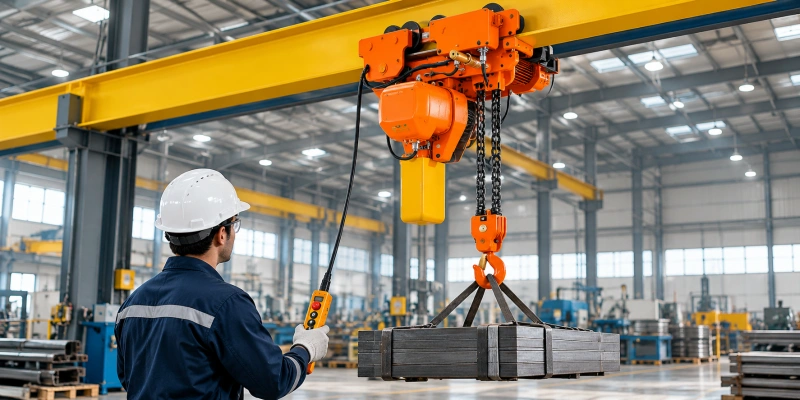
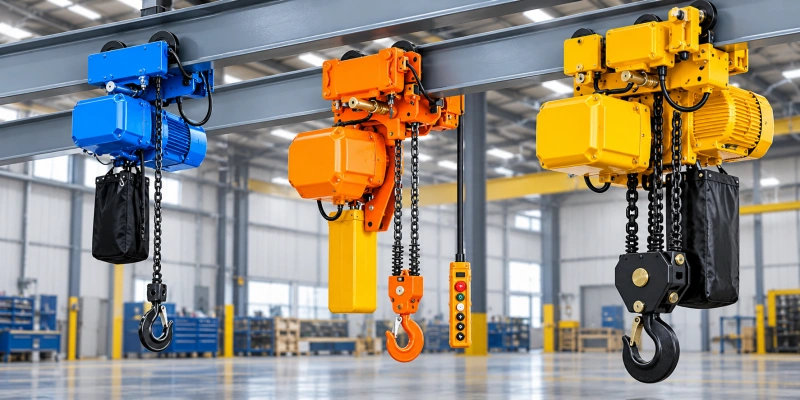
Choosing an electric chain hoist starts with the load, the lifting cycle, the available power, and the mounting space. This guide compares seven suppliers and manufacturing groups using named product lines. It also shows which details to request before you accept a quotation.
Disclosure: Powerful Machinery publishes this guide and is included in the comparison. This is a procurement shortlist, not a ranking. Company and product information was checked on October 29, 2026; confirm the exact model and commercial terms before ordering.
Electric Chain Hoist Manufacturers at a Glance
| Company or group | Identity and home base | Published chain hoist example and capacity | Configuration to check | Useful starting point |
| Qingdao Powerful Machinery | China-based lifting equipment supplier; publisher of this guide | HHSY, 0.5–5 t across seven listed models | 3 m standard lift; confirm power and suspension by quoted model | Published HHSY model data and direct RFQ |
| Stuart Rush | U.S. manufacturer; Lodestar, Coffing and related lines | Lodestar Classic Model H example: 1 U.S. ton | Example: 20 ft lift, 8 ft/min, 230/460 V, 3-phase, 60 Hz | Identify the exact series and local parts route |
| Konecranes / Demag | Finland-based group; Demag is a product brand | Demag DC-Com, up to 2,000 kg | Two lifting speeds and trolley interface on DC-Com | Hoist integration with crane systems |
| ABUS Kransysteme | German crane and hoist manufacturer | ABUCompact GMC–GM8, up to 4 t | GMC single-phase 230 V; other models differ | Workstations and light crane systems |
| LIFTKET Hoffmann | German electric chain hoist specialist | STAR COMPLETE, 125–6,300 kg; broader company range to 25,000 kg | Single- or three-phase range varies; push or electric trolley | Specialist dealer supply and configured lifts |
| GIS AG | Swiss electric chain hoist manufacturer | GP series, up to 8,000 kg on current GP2500 | Single/three phase, low headroom and special versions | Industrial and specified environments |
| Ingersoll Rand | US-based industrial lifting manufacturer | E-LIFT, 0.5–5 metric tons | VFD control, model-specific duty and headroom | Controlled positioning and service planning |
These capacities refer to different series and units. Compare the proposed model, duty, and technical sheet. If you are new to the equipment, read what an electric chain hoist is before drawing up your shortlist.
How We Evaluated the Manufacturers
We checked company and product pages for the maker, brand, series, and published specifications. Ownership matters here: Columbus McKinnon acquired Kito Crosby in February 2026, then completed the divestiture of its U.S. power chain hoist and chain business on March 4. Stuart Rush now lists Lodestar and Coffing among its electric chain hoist lines.
Demag belongs to the Konecranes group. We therefore count the actual businesses behind the listed products rather than treating every familiar brand as an independent factory.
For each entry, we identified a named electric chain hoist line and checked published capacity and configuration details. Where a public page does not specify voltage, duty, or a safety feature for the quoted model, ask for the current technical sheet.
For a fair comparison, send every bidder the same load, hook travel, duty, site power, and beam details. Ask for the full model code, technical drawing, applicable product documents, test records, spare-parts route, and written warranty terms. ISO 9001 describes a quality management system; it does not replace model- and market-specific product conformity documents.
Electric Chain Hoist Manufacturer Profiles
Stuart Rush and Its Electric Chain Hoist Brands
Stuart Rush is a U.S. hoist manufacturer formed when Columbus McKinnon sold its U.S. power chain hoist and chain operations in March 2026. Its electric chain hoist range includes Lodestar Classic, Lodestar VS, Lodestar XL, and Coffing JLC and EC models. The company lists individual configurations by capacity, lift, speed, voltage, and suspension; these vary by model.
For example, its catalogue lists a 1 U.S. ton Lodestar Classic Model H with a 20 ft lift, 8 ft/min lifting speed and 230/460 V three-phase, 60 Hz supply. That is one order configuration, not a specification for all Lodestar hoists. Choose the exact model and confirm the trolley, duty rating, local parts source, and warranty route with the seller.
A current Columbus McKinnon brand page may still show the CM name, while Stuart Rush markets selected products as “CM by Stuart Rush.” For Lodestar or Coffing purchases, use the current Stuart Rush product listing and ask the seller to identify the legal maker on the offer and nameplate.
Konecranes and the Demag DC Range
Konecranes is a Finland-based lifting group whose portfolio includes Demag. Demag offers DC electric chain hoists for stationary mounting or trolley travel. The DC-Com series has capacities up to 2,000 kg, two lifting speeds, and 24 V contactor control. These specifications apply to DC-Com; other DC models have different configurations.
For a crane or monorail, send the beam dimensions, available headroom, travel distance, and site power. Ask for the assembled hoist-and-trolley drawing and confirm which controls, limits, and electrical connection are included. The Demag DC buyer guide offers selection examples, while the quoted model code and wiring diagram establish the actual supply.
ABUS Kransysteme
ABUS makes cranes and electric chain hoists in Germany. Its ABUCompact line runs from the small GMC to the GM8, which is rated up to 4 t. The GMC uses a 230 V single-phase supply and reaches 250 kg. The larger GM models have different electrical arrangements, so specify the exact model before comparing power and control options.
For a workstation crane or an existing beam track, provide the beam profile and flange width, hook travel, and available mounting space. ABUS lists push and electric trolleys, model-dependent speeds and control arrangements. Ask for the assembled headroom, trolley compatibility, duty, and product documents for the proposed combination.
LIFTKET Hoffmann
LIFTKET makes electric chain hoists in Germany. Its STAR COMPLETE page lists 125–6,300 kg for three-phase versions and 125–2,000 kg for single-phase versions, with stationary, push-trolley and electric-trolley arrangements. The company also describes a broader product range reaching 25,000 kg; that figure is not the STAR COMPLETE rating.
This is a useful shortlist entry for a configured industrial hoist. State the lift, power, duty, reeving, and suspension, then ask which STAR or POWER model meets them. LIFTKET also sells stage equipment, but an industrial model should never be assumed suitable for lifting or holding loads above people. Request the application-specific documentation if that is the intended use.
GIS AG
GIS AG manufactures electric chain hoists in Switzerland. Its GP range includes the GP2500, with a published maximum of 8,000 kg in the two-fall configuration. GIS lists single- and three-phase versions and options including frequency control, low-headroom construction and corrosion-resistant designs. Its site also provides a parts route.
Give GIS the dust, water, temperature, and corrosion conditions as well as your duty pattern. Ask which GP variant, enclosure rating, and trolley arrangement apply. For low-headroom or special versions, use the assembled drawing and model documentation; dimensions from the standard suspension may not carry over.
Ingersoll Rand
Ingersoll Rand lists E-LIFT electric chain hoists from 0.5 to 5 metric tons. The series page describes a permanent-magnet motor with VFD control, adjustable low-speed operation, an IP55 hoist housing and an IP65 pendant. Model tables provide duty, speed, power, weight and headroom data.
If precise positioning or frequent starts matter, compare the speed and duty at the required capacity. Check whether the quoted order includes the pendant, power arrangement, and trolley you need. Ingersoll Rand also lists an ELK series; keep the selected series and its documents together when comparing offers.
Qingdao Powerful Machinery Electric Chain Hoists
Powerful Machinery is the publisher of this guide and a China-based supply option for industrial buyers. Our HHSY electric chain hoist specifications publish seven models, from 0.5 t to 5 t rated capacity, each with a 3 m standard lift. The table below reproduces the model-level capacity, motor power, number of load-chain falls, chain diameter, and lift speed shown on that product page. It is a comparison starting point; the technical offer and nameplate should control the final order.
| HHSY model | Capacity (t) | Motor (kW) | Falls | Chain diameter (mm) | Lift speed (m/min) |
| HHSY-0.5A | 0.5 | 1.1 | 1 | 6.3 | 7.8 |
| HHSY-1.0A | 1.0 | 1.5 | 1 | 7.1 | 6.8 |
| HHSY-2.0A | 2.0 | 1.5 | 1 | 10.0 | 6.8 |
| HHSY-1.0B | 1.0 | 1.5 | 2 | 6.3 | 3.9 |
| HHSY-2.0B | 2.0 | 1.5 | 2 | 7.1 | 3.4 |
| HHSY-3.0B | 3.0 | 3.0 | 2 | 10.0 | 5.8 |
| HHSY-5.0B | 5.0 | 3.0 | 2 | 11.2 | 2.8 |
The 1 t and 2 t models each have two configurations with different numbers of load-chain falls, chain diameters, and lifting speeds. Include the full HHSY model code in your inquiry. The published test-load row does not, by itself, describe the factory test procedure or the records supplied with an order.
We can review the required capacity, lift, and application against the listed models. Send your site voltage, phase, frequency, lifting cycle, available headroom, requested hook or trolley arrangement, quantity, and destination. We will confirm the applicable electrical configuration, control, documentation, any OEM request, testing evidence, service terms, and lead time in the specific offer.
Our electric chain hoists range shows other product configurations, but a category description is not a substitute for a model-specific datasheet.
Manufacturer vs Supplier: What Buyers Should Know
A manufacturer makes or assembles a hoist under an identified legal entity. A brand is the name under which it is sold. A distributor resells equipment and may provide local stock, installation, or service; a trading supplier may coordinate purchases from several factories. One company can occupy more than one of these roles. For the proposed unit, identify the actual maker and the business responsible for parts and warranty.
Buying directly can make sense for a custom configuration or an engineering discussion. A local distributor may be more useful when installation, parts, and prompt service are priorities. In either case, request the full model code, maker, production location, current datasheet, and named after-sales contact in the quotation.
How to Choose an Electric Chain Hoist Manufacturer
Start With the Load and Lifting Cycle
Start with the heaviest load, including any below-hook attachment carried by the hoist. Check it against the rated load of the proposed hoist and every component in the lifting arrangement. Tell the supplier how often you lift, how long the motor runs, and how many starts occur during a shift. These details determine whether the model suits the work; capacity alone does not.
Specify the distance the hook must travel between its lowest and highest working positions. A longer lift may require more chain, a suitable container and additional clearance. For a trolley, send the beam profile and flange width; for a stationary hoist, identify the support point. Have the supporting structure and complete installation checked for the intended loads.
Match Power, Speed and Control to the Site
Provide the site voltage, phase and frequency. Single-phase and three-phase offerings differ by series, so compare the proposed model rather than assuming one phase implies a particular duty or capacity. Confirm both the supply voltage and control voltage. If fine positioning matters, request the lifting-speed range under load and the controller specified in the quotation.
For trolley travel, specify push, geared or motorized operation, beam range, travel distance and the control method. If you need a basic explanation of the lift mechanism, see how an electric chain hoist works.
Check Environment, Safety Devices and Evidence
Describe exposure to dust, water, corrosive substances, temperature extremes or a hazardous atmosphere. Ask for the proposed model’s enclosure rating and operating limits. Identify its brake, upper and lower limits, overload protection and emergency-stop arrangement, and check which are standard or optional. A standard industrial unit is not automatically approved for a hazardous location.
Request the model datasheet, operating and maintenance manuals, wiring diagram, and destination-market documents. Agree on any factory test procedure and ask for records tied to the supplied unit. For checks before service, see our electric chain hoist inspection guide.
Plan for Parts, Service and Commercial Terms
Ask where you can obtain replacement load chain, hooks, brake parts and controls for the selected model, and how long delivery takes. Get the warranty period, exclusions and claim route in writing. Put any requested branding, voltage, lift or control variation in the quotation and drawing. Compare the delivered equipment, documents and support as well as the price.
Electric Chain Hoist RFQ Checklist
Send the same information to each supplier so their offers can be compared:
- Load and application: Maximum load including below-hook attachments; load dimensions and center of gravity; lifting task and industry.
- Capacity and lift: Required rated capacity; lowest and highest hook position; true hook travel; quantity of hoists.
- Duty: Lifts per hour, daily operating hours, starts and stops, expected service pattern and required duty classification.
- Power and control: Site voltage, phase and frequency; requested control voltage if specified; single, two or variable-speed need; pendant or radio control.
- Suspension and travel: Hook or lug suspension; push, geared or electric trolley; beam section and flange width; travel distance and available headroom.
- Environment: Indoor or outdoor; temperature, moisture, dust, corrosion or hazardous-area classification where relevant.
- Model and safety: Proposed full model code; chain falls and diameter; brake, upper/lower limits, overload and emergency-stop configuration; applicable documents.
- Acceptance and service: Requested inspection and factory test records; manuals and wiring drawing; spare-parts list, warranty terms and local service route.
- Commercial and OEM: Quantity, destination, requested delivery date, Incoterm, packaging, branding or other custom requirements that must appear in the offer.
Attach a beam drawing and installation photos if available. Ask each supplier to flag exceptions. For a Powerful quotation, use our contact page and include an HHSY model code if one seems suitable.
FAQs
What is the difference between a manufacturer and an electric chain hoist supplier?
The manufacturer is the identified maker; the supplier is the business selling you the hoist. A distributor can supply a manufacturer’s model and provide local service. Ask who made the quoted unit and who will provide parts and handle warranty claims.
What information should I include in an electric chain hoist RFQ?
Provide the maximum load, hook travel, lifting cycle, site power, beam dimensions, available headroom, environment, quantity, and destination. Add any required documents or tests. If replacing a hoist, send its nameplate and installation drawing.
Which documents should I request before shipment?
Ask for the model datasheet, operating and maintenance manuals, wiring diagram, nameplate data and any inspection or test records specified in the order. Confirm the declaration or certification required for that model in your destination market.
How should factory load testing be verified?
Agree on the procedure, load, acceptance criteria, and records before ordering. Then check the report against the delivered model and serial number. State any witness requirement in the RFQ.
What should I check when sourcing from China?
Identify the legal maker and seller, the factory location, and the model being quoted. Check site power, destination-market documents, test evidence, parts supply, and written warranty terms. Powerful’s HHSY table gives the published model specifications; the final offer must confirm the selected configuration.
Do I need a hook-mounted, manual trolley or electric trolley hoist?
A fixed hoist needs a suitable engineered support. A push or geared trolley permits manual beam travel; an electric trolley provides powered travel. Send beam dimensions, travel distance, and headroom, then request an assembled drawing. Follow the model manual for installation; our installation guide gives a general overview.
Request a Model-Specific Quote
Send us the load, hook travel, lifting cycle, site power, and beam details, plus the quantity and destination. We can compare them with the published HHSY models and provide a model-specific technical and commercial offer. Use the same requirements for every bidder so you can compare the proposed equipment and support on equal terms.