You cannot decide whether a wire rope can remain in service from one broken-wire number alone. The answer depends on what the rope does, its construction, where the breaks occur, and which rule governs the equipment. A running rope on a construction crane is not judged by the same broken-wire criterion as a wire rope sling in a general-industry workplace.
For a running rope on a construction crane covered by OSHA 29 CFR 1926.1413, six randomly distributed broken wires in one rope lay, or three broken wires in one strand in one rope lay, are Category II deficiencies. That is an action threshold, not an allowance to keep lifting with six broken wires.
Rotation-resistant and standing crane ropes have different criteria. A sling covered by OSHA 29 CFR 1910.184 has another threshold. First, identify the rope and applicable provision; then count the breaks over the length that provision specifies.
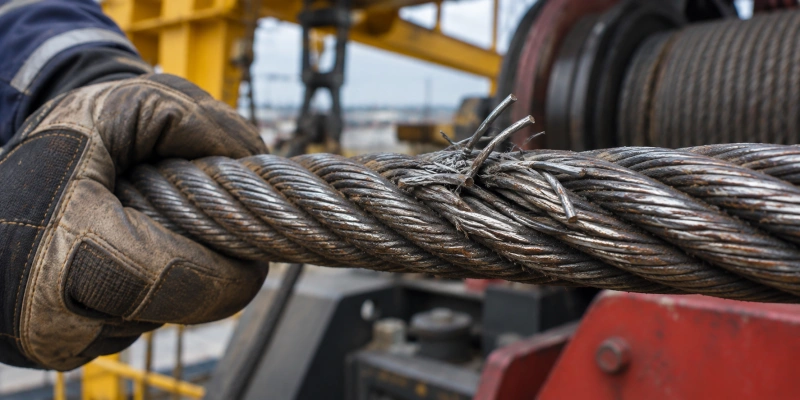
If you find a broken strand, substantial distortion, significant corrosion, heat damage, or a compromised end connection, a low visible-wire count does not settle the question. Check these other findings against the applicable wire rope discard criteria as part of the same inspection.
Broken-Wire Criteria Depend on the Application
The following U.S. provisions illustrate why an inspector must name the application and reference length beside every number. They do not replace the equipment manual, the rope manufacturer’s criteria, or the rule that applies at your site.
| Rope and governing provision | Broken-wire finding | Length or location |
| Construction crane running rope · OSHA 1926.1413 | Six randomly distributed broken wires, or three in one strand | One rope lay |
| Construction crane rotation-resistant rope · OSHA 1926.1413 | Two randomly distributed broken wires, or four randomly distributed broken wires | Six rope diameters, or 30 rope diameters, respectively |
| Construction crane pendant or standing rope · OSHA 1926.1413 | More than two beyond end connections, or more than one at an end connection | One rope lay at the specified location |
| General-industry wire rope sling · OSHA 1910.184(f)(5)(i) | Ten randomly distributed broken wires, or five in one strand | One rope lay |
| Construction rigging wire rope · OSHA 1926.251(c)(4)(iv) | Visible broken wires exceed 10% of the total number of wires | Any length of eight rope diameters |
In the first three rows, OSHA 1926.1413 treats the listed visible broken wires as Category II deficiencies. Operations involving that crane rope must be prohibited until the employer meets one of the corrective conditions in the regulation.
Those conditions include following the rope manufacturer’s established criterion or a different criterion approved in writing for that specific rope, replacing the rope, or correcting localized damage by severing it where the rule permits. This is a controlled regulatory process, not permission for an operator to cut a rope and return it to service independently.
OSHA 1910.184 requires a wire rope sling covered by its general-industry provision to be removed from service immediately at the listed ten-or-five threshold. OSHA 1926.251(c)(4)(iv), which addresses construction rigging wire rope, instead states that rope shall not be used when visible broken wires exceed 10% of all its wires in any length of eight diameters, or when other excessive wear, corrosion, or defect is present.
Do not use either sling or construction rigging figure as the running-rope rule for a construction crane.
What Is One Rope Lay?
A rope lay is the distance along the rope in which one outer strand makes a complete turn around the rope. It describes a length, not a strand count. Find a strand you can follow on the surface. Mark where it starts at one position around the rope, then follow that strand until it returns to the same position.
The distance between those points is one lay for that rope. Record the actual measured length rather than guessing it from the nominal diameter.
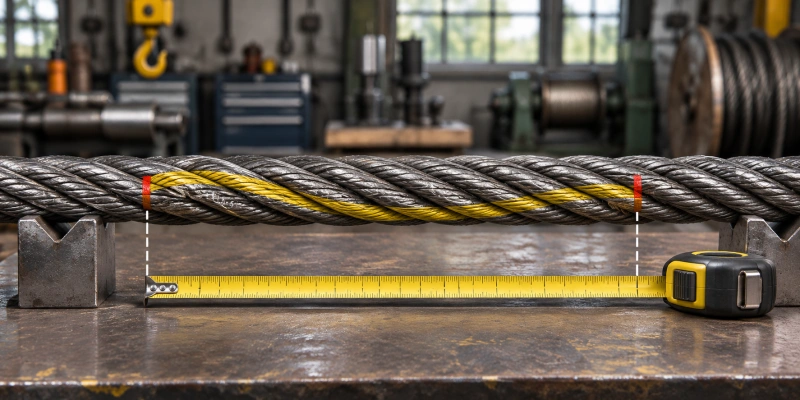
That distinction matters because the table uses different reference lengths. The standard running-rope criterion above looks at one rope lay. The rotation-resistant criterion under the cited crane rule looks at six or 30 rope diameters. The construction rigging provision uses eight diameters. If a rope measures 20 mm in diameter, eight diameters equal 160 mm; that arithmetic does not tell you the length of one rope lay. Measuring over the wrong span can change the result even when every visible break has been counted correctly.
If you do not know the rope construction, the nominal diameter, or its job on the equipment, pause before choosing a rope. Check the crane or hoist manual, rope records, identification, and the governing inspection procedure. “Wire rope” on a purchase order is not enough information to select a removal limit.
How to Count and Record Broken Wires?
Begin with the section of rope that is accessible for the inspection required by the applicable rule. Look around the rope’s full visible circumference, not just the side facing you. Record the position of each break, the length you inspected, and whether the breaks are randomly distributed or concentrated in one strand.
Do not count one broken strand as though it were a single broken wire. Use suitable gloves and the site’s safe inspection method; do not drag an unprotected hand along exposed broken wires.
For a crane running rope, separately note the total breaks in one lay and the number in any one strand over that same lay. Either condition in the OSHA 1926.1413 row can trigger the Category II process. For a rotation-resistant crane rope, measure each applicable diameter-based span and use its corresponding count.
For a standing rope, distinguish breaks beyond end connections from those at an end connection. The word “more than” matters: two and three are not interchangeable, and neither are one and two.
Photograph a marked section with a scale when practical, and record the rope construction, equipment, date, and exact location. A note saying “several broken wires” cannot show which reference length was measured or whether the same strand contains multiple breaks.
If the rope has limited visibility around a drum or termination, follow the inspection process for that equipment rather than treating an incomplete count as a clean finding.
A Broken Strand Is a Different Finding
Each outer strand contains individual wires. If several individual wires have fractured, you count them under the appropriate broken-wire rule. If a whole strand is broken, the rope has lost a larger structural element. OSHA 1926.1413 lists a broken strand on a construction crane rope as a Category III deficiency, separate from the Category II visible broken-wire counts.
Operations involving the affected rope must stop until the specific corrective requirements of the provision have been met.
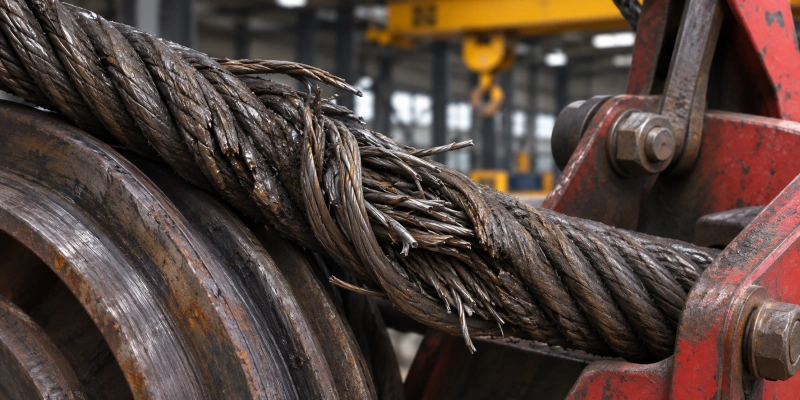
The regulation permits certain localized Category III damage other than power-line contact to be corrected by severing the rope under its stated conditions, including the prohibition on joining rope lengths by splicing and the minimum number of wraps on the drum.
Replacement is another route. Severing is an option only if all relevant conditions can be met; it is not routine rope repair. The responsible employer must determine the permitted action for the equipment and rope.
Where the Breaks Occur Changes the Assessment?
A count is only part of the inspection record. Give particular attention to breaks at or near terminal ends, drum crossover and flange points, repeated pickup points, and areas that pass over sheaves or undergo reverse bends. OSHA 1926.1413 identifies these as critical review areas for construction crane ropes.
Breaks grouped in a short section can also point to local damage or accelerated deterioration. Record the pattern and location, and apply the specified count to each required inspection length.
You may see an exposed broken wire on the crown of a strand or a break in the valley between strands. Either location warrants assessment in context. A valley break may call for closer examination of the rope’s internal condition, but its location alone does not provide one removal threshold for every rope. Follow the equipment, manufacturer, and site procedures if you suspect internal deterioration.
Check the rope and its end connections for other defects while you investigate broken wires. Kinking, crushing, birdcaging, core protrusion, significant corrosion, and heat or electrical damage may independently require action.
Rope diameter reduction is a different measurement from wear of an individual outside wire. For construction crane rope, OSHA 1926.1413 lists a reduction of more than 5% from nominal rope diameter as a Category II deficiency. The applicable limit may differ in another setting. The wire rope inspection guide explains the wider inspection workflow.
Common Questions About Broken Wire Rope
Can You Add Breaks From Separate Rope Lays?
Do not add breaks from widely separated sections and treat the sum as though it occurred in one rope lay. Inspect each applicable reference length and record where the breaks fall. A localized group may need attention even if another part of the rope has few breaks. Have the responsible inspector assess the rope’s full condition under the applicable rule.
Does the 10 and 5 Rule Apply to a Crane Hoist Rope?
No, if you mean the running hoist rope on a construction crane covered by OSHA 1926.1413. The ten-randomly-distributed or five-in-one-strand criterion in OSHA 1910.184(f)(5)(i) applies to wire rope slings under that general-industry provision. Identify the equipment and the applicable regulation before using either number.
Can I Use the OSHA Figures for an ISO Inspection?
Do not assume so. ISO 4309:2017 addresses the care, inspection, and discard of steel wire ropes used on cranes and hoists. Its assessment depends on the rope and equipment conditions described in that standard. Use the applicable edition and the relevant manufacturer instructions rather than copying a U.S. example from the table into a different inspection program.
When You Need a Replacement Rope
If the applicable process calls for replacement, start with the equipment manufacturer’s rope specification. Record the equipment model, rope construction, nominal diameter, core, tensile grade, length, lay, and end termination. Include the service conditions and any required documentation in your request.
These details help the supplier match the existing equipment requirements rather than suggest a rope based on diameter alone.
You can compare steel wire rope constructions and send Powerful Machinery the existing specification for a replacement quotation. Match the selected rope and its installation to the equipment requirements. Inspection, removal, and return-to-service decisions remain with the responsible personnel under the applicable rules.