A pallet jack is a wheeled material-handling tool that raises a pallet just enough to clear the floor and moves it from one place to another. You may also hear it called a pallet truck, pump truck, or hand pallet truck. The names often describe the same basic job, although “hand” usually identifies a manual model and “electric” identifies a powered one. If you need to move palletized goods across a warehouse or from a receiving area to a stockroom, it is one of the first tools you will consider.
The important limit is in the job description: a standard pallet jack handles low-level transport. It is not a substitute for a forklift or stacker when you need to put a pallet on a rack. This guide explains the parts you will see, how the lift works, and what to check before choosing a truck. For the complete operating sequence, use our guide to using a pallet truck.
The Short Answer: A Pallet Truck and a Pallet Jack
In everyday warehouse language, pallet truck and pallet jack are largely interchangeable. Both refer to a truck with two forks that enter a suitable pallet and raise it a short distance for travel. “Pump truck” commonly points to a hand-operated hydraulic version.
Some companies use “pallet truck” for the broader equipment family and “pallet jack” for a smaller walk-behind machine. That naming choice does not establish capacity, lift height, or operating controls: the model and its data plate do.
You may see a manual hand truck, a powered walkie, a rider truck, a low-profile model or a high-lift specialist sold under the same umbrella term. It helps to ask what the truck actually needs to do rather than rely on the name in a listing.
A high-lift pallet jack, for example, is made for specific work-height tasks, while a standard low-lift jack is intended to travel with the pallet close to the floor. Neither label, by itself, tells you whether a particular pallet or route is suitable.
How Does a Pallet Jack Work?
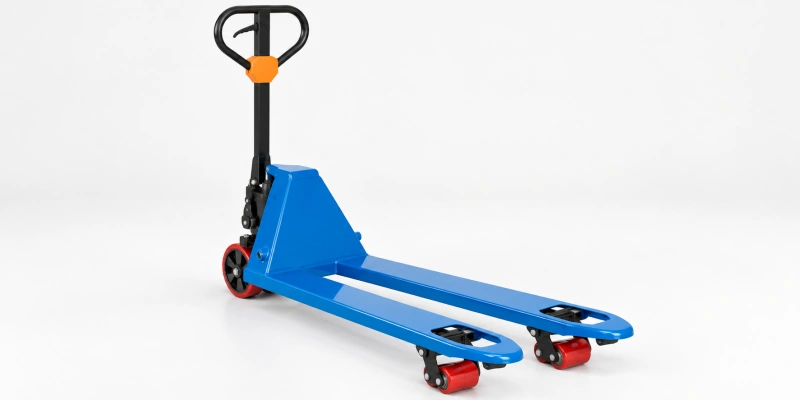
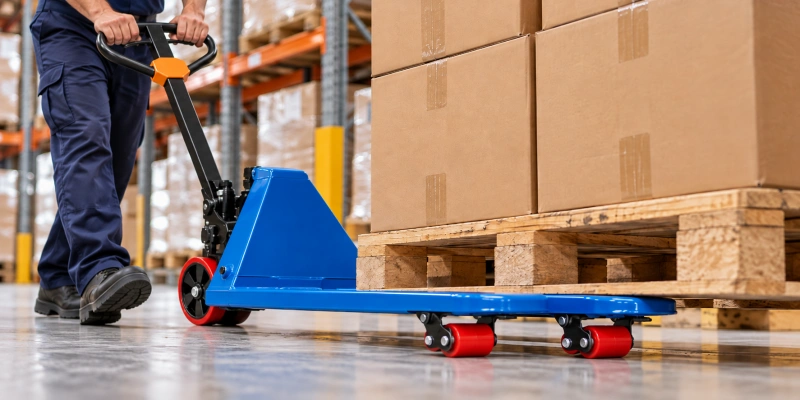
The forks slide into the pallet openings. Wheels under the fork tips and a pair of steer wheels at the handle end let the truck roll. On a manual hydraulic model, moving the handle through its lift stroke drives a pump.
Hydraulic pressure raises the fork assembly slightly; a lowering control releases that pressure so the load can settle back onto the floor. You supply the force to move and steer the load. The exact control positions and linkage vary, so read the labels and the instructions on your unit.
An electric pallet jack uses a motor for travel; many powered designs also lift electrically. Its tiller controls, braking behavior, and battery system are model-specific. An electric truck can reduce the physical effort of repeated moves, but it still has a rated capacity, a defined operating area, and training requirements. Do not treat a powered truck as a manual pump truck with a battery added.
The process has three distinct phases: the forks support a suitable pallet, the mechanism lifts it only enough to clear the floor, and the wheels carry it along an approved route. The pallet and its load must be stable before travel. The truck must then lower the pallet completely before the forks are withdrawn. A jack that lifts a load is not necessarily the right jack for that pallet, floor, or distance.
The Main Parts and What They Do
Knowing the parts makes a specification sheet easier to read and an inspection easier to perform. The table below is a general anatomy of a common low-lift manual truck; your model may arrange components differently.
| Part | What you should understand |
| Forks | Enter the pallet and support it; length, width, and lowered height determine pallet fit. |
| Load rollers | Sit near the fork tips and roll beneath the pallet; damaged rollers can catch boards or floor joints. |
| Steer wheels | Support and turn the handle end of the truck; wheel material should suit the operating surface. |
| Handle and control | Steer the truck and, on a manual model, select lift, travel, or lower as designed. |
| Hydraulic pump and cylinder | Convert handle strokes into a small lift on a manual hydraulic truck. |
| Frame and data plate | Carry the assembly and identify the actual model and its marked capacity. |
The names sound simple, but the dimensions are not interchangeable. A fork that is too wide for an opening, a roller that cannot pass the pallet bottom, or a fork height that will not fit under it prevents a safe pickup. For a deeper look at the assembly, see the parts of a pallet jack.
What Are Pallet Jacks Used For?
You will often see pallet jacks in receiving, shipping, warehouses, factories, and retail backrooms. Typical work includes taking a pallet from a receiving position to storage, moving materials to a production area, and repositioning packed goods on a suitable floor.
The tool is useful because you can move a pallet without unloading every box by hand. How often you make the trip and how far you travel affect whether a manual or powered machine is sensible.
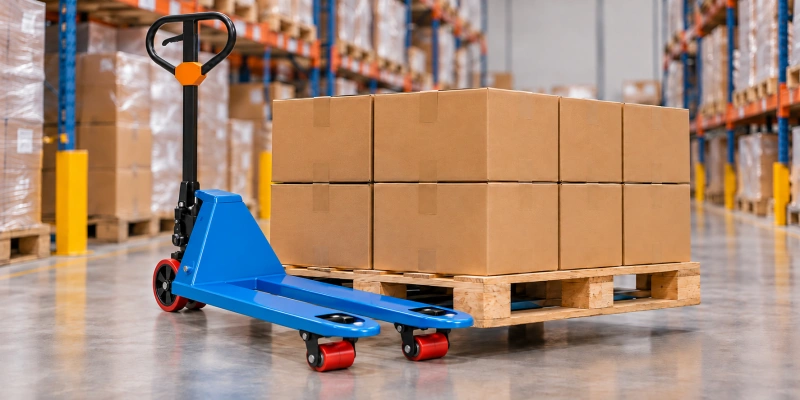
A standard hand pallet jack is most at home on a firm, reasonably level indoor route where the pallet fits the forks, and the load can be controlled. Slopes, dock plates, damaged floors, tight turns, and mixed pedestrian traffic change the task.
They need a route and equipment assessment, not an assumption that all pallet jacks can handle them. Outdoor and rough-terrain versions exist, but their name does not extend the limits of an ordinary indoor model.
A pallet jack cannot do every kind of lifting job. Standard low-lift designs do not stack loads on racks or raise people. They should not be used to tow a trailer, carry a rider on a walk-behind truck, or transport a poorly secured pallet. If you need elevated placement, choose equipment designed and rated for that purpose, with a trained operator and a suitable site.
Manual, Electric and Specialty Types
Manual pallet jacks use an operator-powered hydraulic lift and operator force for travel. They can be straightforward for occasional short moves on suitable floors. Electric walk-behind trucks use powered travel and often powered lift, which can help when loads move repeatedly or over a longer route.
Rider models support different travel patterns, with their own space, control, and operator requirements. The right choice is set by the work, not a blanket claim that one type is always safer or stronger.
Specialty designs address narrower tasks. A low-profile truck may fit a pallet with reduced entry clearance. A high-lift design can bring a suitable load to an ergonomic work height; it should not be presumed equivalent to a racking stacker.
Scale-equipped trucks can combine movement and weighing, subject to the model’s weighing range and accuracy. Rough-terrain models need their specific surface, wheel, stability, and route limits checked.
If you are comparing product families, the types of pallet jacks guide explains these options in more detail. For the decision between operator-powered and motorized equipment, see electric pallet jack vs manual pallet jack. The same terms can appear on different models, so always return to the exact product sheet before ordering.
How to Tell Whether a Pallet Jack Fits Your Job?
Start with the full load: goods, packaging, and pallet. Compare that weight with the capacity marked on the specific truck in the configuration you will use. A headline capacity is not permission to move an unstable, off-center, or poorly supported load. Confirm that the pallet is sound, that both forks can enter as intended, and that the load can be supported without catching boards or damaging goods.
Next, measure the pallet and the route. Fork length, overall fork width, lowered fork height, and turning clearance matter more than a general “standard pallet” label. Check doorway and aisle widths using the loaded pallet’s dimensions, not just the truck’s width.
Think about floor joints, thresholds, dock edges, and the distance covered each shift. Wheel material affects rolling and floor compatibility, but no wheel makes an unsuitable surface automatically safe. The pallet truck sizes guide helps you identify which dimensions to request.
Finally, match the frequency of the work to the operator and the site. A short, occasional trip may call for a manual truck; repeated, longer moves may justify powered travel. Powered equipment also brings battery charging, control familiarity, inspection, and formal operator training considerations. If you are selecting for a new site, describe the load, pallet openings, floor, slopes, distance, moves per shift, and available turning space to the supplier.
For a concrete example rather than a universal specification, Powerful Machinery’s ORM-HP hand pallet truck page lists 2,000, 2,500 and 3,000 kg capacity variants, fork length options of 1,100 or 1,200 mm, overall fork widths of 550 or 685 mm, and nylon, rubber or polyurethane wheel options.
The page also shows variant-dependent lowered and raised fork heights. Confirm the exact combination available, current drawing, marking and application requirements before treating any one figure as the specification for your unit.
Basic Handling and Safety Boundaries
Before using a truck, check for bent or cracked forks, damaged rollers or wheels, leaks, unreadable markings, and controls that do not work as intended. Look at the pallet and travel path as well. Do not keep using a defective truck because it can still raise a pallet. Report the problem and follow your workplace’s out-of-service process. Follow the manufacturer’s instructions for the particular model.
Keep the load low enough to clear the floor, move at a speed you can control, and give people room. Keep hands and feet clear when lowering. Never walk where a rolling load could pin you against a rack or wall. If the pallet blocks your view, use the site’s approved traffic control or a suitable alternative. Lower it completely before leaving it; do not leave forks projecting into a walkway.
In the United States, OSHA’s powered industrial truck rules cover motorized hand trucks and require operator training and evaluation. A fully manual hydraulic truck is not in the same regulatory category, although workers still need instruction appropriate to the equipment and workplace hazards.
Rules differ by jurisdiction; your site procedure and the truck’s manual remain essential. The pallet truck inspection checklist provides a more detailed check, while our operation guide walks through the full manual sequence.
Pallet Jack Questions You May Have
Is a pallet jack the same thing as a pallet truck?
Usually, yes. Both terms commonly describe a low-lift truck that moves palletized goods. “Hand pallet truck” typically identifies a manual hydraulic unit, while “electric pallet truck” identifies a powered one. Check the actual design and controls rather than assuming the terminology is consistent between suppliers.
Can a pallet jack lift a pallet onto a shelf?
A standard low-lift pallet jack raises a pallet only enough for ground-level travel. Use a suitable stacker or forklift to place a pallet on a shelf or rack. A specialty high-lift jack serves specific work-height tasks, but you must follow its own load and stability limits.
How much can a pallet jack carry?
There is no single capacity for every jack. Read the capacity marking and current specification of the specific unit, and account for the pallet and packaging in the total load. Powerful Machinery’s ORM-HP hand pallet truck page shows several rated variants; those numbers do not define other manual or powered models.
Can I use a pallet jack on a ramp or rough floor?
Do not assume you can. A slope or damaged surface can change traction, stopping effort, and load stability. Follow the manufacturer’s stated limits and your site’s approved route and procedure. If the move cannot be controlled with the chosen truck, select another method. See our pallet jack ramp guide for the questions to check before planning that route.
Do electric pallet jacks require training?
Yes, operators need model- and site-appropriate instruction. In U.S. workplaces covered by OSHA’s powered industrial truck standard, powered pallet trucks fall within that standard’s training and evaluation provisions. Check the applicable rules in your jurisdiction, the employer’s procedures, and the manufacturer’s manual.
A Good Starting Point for Your Next Move
A pallet jack is a simple idea with several practical limits: forks go into the pallet, a low lift clears the floor, and wheels carry the load to its destination. Choose a truck by the actual pallet, load, floor, and travel pattern, then learn the controls of that exact unit. If you are still comparing models, browse the pallet jack range and share your pallet dimensions, maximum loaded weight, and route with the supplier.