When you buy welded link chain internationally, the standard name on a quotation can look reassuring. EN, NACM, DIN and AS all sound precise. The problem is that they do not describe one universal chain system. Each family grew around different markets, applications, dimensions, grades and testing rules.
That matters because two chains with the same nominal diameter may have different pitch, inside width, material, proof test, marking and working load limit. One may be suitable for a lifting sling. Another may be intended for cargo restraint, a windlass, a conveyor or general utility work. A familiar grade number does not make them interchangeable.
In this chain standards comparison, you will see where EN, NACM, DIN and Australian Standards fit, how their scopes differ, and what you should put in an RFQ. The focus is welded round-link chain for lifting, lashing, anchor or windlass service, and general industrial use. Roller, drive and transmission chains are outside this guide.
Key Takeaways
- Start with the application. Lifting, lashing, anchor or windlass, and general-purpose chain require different standards.
- EN is a family, not one specification. EN 818 covers short-link lifting chain and chain slings, while EN 12195-3 covers lashing chains.
- NACM organizes North American welded steel chain by product type and grade, including Grades 30, 43, 70, 80 and 100.
- DIN standards are product-specific. DIN 5685, DIN 765 and DIN 766 do not carry the same scope, test status or permitted use.
- AS means Australian Standards in this guide. AS 2321 covers non-calibrated short-link lifting chain, while AS 3775 covers Grade T(80) and V(100) chain slings.
- Never approve a substitute from diameter or grade alone. Check the exact standard and edition, link geometry, WLL basis, proof and breaking tests, markings, certificates and compatible hardware.
What Do Chain Standards Actually Control?
A chain standard can control much more than the number stamped on a link. Depending on its scope, it may define nominal diameter, pitch, internal and external width, material, heat treatment, dimensional tolerance, proof force, minimum breaking force, elongation, marking, traceability and acceptance tests.
It may also say what the chain is for. This is the first point you should check. A dimensional standard for a general-purpose chain is not automatically a lifting standard. A lashing chain is rated for restraining cargo, not suspending it. A calibrated chain may be made to engage a chainwheel, but calibration alone does not establish a lifting WLL.
You should also separate three figures that are often confused:
- Working load limit, or WLL, is the maximum load assigned for service under stated conditions.
- Manufacturing proof force is a test load applied during production or acceptance.
- Minimum breaking force is a destructive performance threshold.
Proof force and minimum breaking force are not service ratings. Your RFQ and certificate should state each value with its basis and unit so nobody has to infer one from another.
EN vs NACM vs DIN vs AS: Quick Comparison
| Family | Main market context | Relevant welded-link examples | Typical use | Main buying caution |
|---|---|---|---|---|
| EN | European standards adopted nationally as BS EN, DIN EN, and other versions | EN 818 series; EN 12195-3; EN 1677 components | Lifting chain, chain slings, hoist chain, and road-load lashing | Quote the exact part; “EN chain” is not a complete specification. |
| NACM | North American welded steel chain specifications | Grade 30 Proof Coil; Grade 43 High Test; Grade 70 Transport; Grade 80 and Grade 100 Alloy | General utility, transport restraint, and alloy lifting chain, depending on the grade and applicable rules | NACM publishes specifications but does not inspect or certify a supplier’s product. |
| DIN | German national and adopted European standards | DIN 5685 series; DIN 765; DIN 766; DIN EN 818 | General-purpose, non-proof-loaded, close-tolerance, conveyor, and lifting products, depending on the exact document | Similar DIN numbers can have very different scopes; always state the edition. |
| AS | Australian Standards | AS 2321; AS 3775.1; AS 3775.2; AS 4797 | Short-link lifting chain, chain slings, and stainless-steel lifting chain | Match the chain, components, sling design, tag, and test documents to Australian requirements. |
EN Chain Standards: Choose the Part That Matches the Job
When you specify European chain, “EN compliant” is too broad. EN numbers are organized by product and use. For the chain products in this guide, the most important distinction is between lifting and lashing.
EN 818 for lifting chain and chain slings
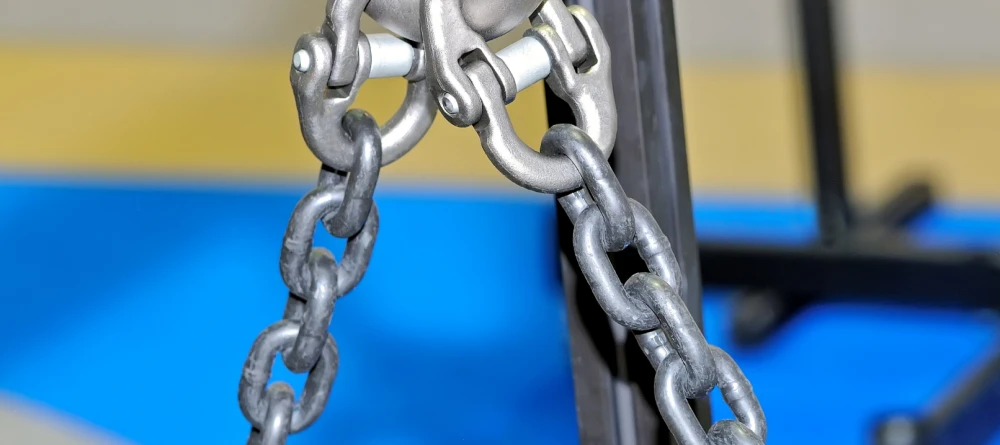
The EN 818 series covers short-link chain for lifting purposes. You may see it adopted as BS EN 818 in the United Kingdom or DIN EN 818 in Germany. The prefix identifies the national adoption; the underlying EN requirements are not a separate grade system.
The part number changes the product you are buying. EN 818-1 gives general conditions of acceptance. EN 818-2 addresses medium-tolerance Grade 8 chain for chain slings. EN 818-4 addresses Grade 8 chain slings. EN 818-6 covers information for use and maintenance supplied by the manufacturer. EN 818-7 covers fine-tolerance Grade T hoist chain.
That last distinction is easy to miss. Medium-tolerance sling chain and fine-tolerance hoist chain are both short-link products, but you should not substitute one for the other. A hoist pocket wheel needs controlled pitch and geometry. A chain sling needs a rated assembly made from compatible chain and components, with configuration, reach, angle and WLL documented.
EN 12195-3 for lashing chains
EN 12195-3 applies to lashing chains and chain combinations used to secure goods on road vehicles and other surface-transport load carriers. It deals with a restraint assembly, including the chain, connecting parts and hand-operated tensioning device.
If you are securing cargo, ask for lashing capacity and the complete assembly data required by the applicable standard and local law. Do not replace lashing capacity with a lifting WLL, and do not use an EN 12195-3 lashing chain as an overhead lifting sling.
NACM Chain Standards: Product Type and Grade Both Matter
NACM welded steel chain specifications are widely used for North American industrial and commercial chain. Their scope includes familiar categories such as Grade 30 Proof Coil, Grade 43 High Test, Grade 70 Transport, Grade 80 Alloy and Grade 100 Alloy, as well as other welded-link types.
This system is convenient, but the grade number is only one part of the specification. Grade 30, 43 and 70 chains are commonly used for general utility or load restraint within their stated ratings; they are not overhead lifting chains. Grade 80 and Grade 100 alloy chain may be used in lifting applications when the chain and complete sling meet the relevant NACM, ASME, OSHA and site requirements.
NACM specifications also define periodic grade embossing for many grades. Those markings help you identify a chain, but they do not replace a certificate or a legible sling identification tag. The manufacturer’s mark, lot traceability, test results and WLL documentation still matter.
You should also understand NACM’s role. The association publishes specifications, but it does not inspect, approve or certify individual products. If a quotation says “NACM chain,” ask the manufacturer for the exact product type, grade, dimensional table, test basis and certificate of conformity. Compliance must be supported by the manufacturer’s quality and test records.
DIN Chain Standards: Read the Scope Before the Number
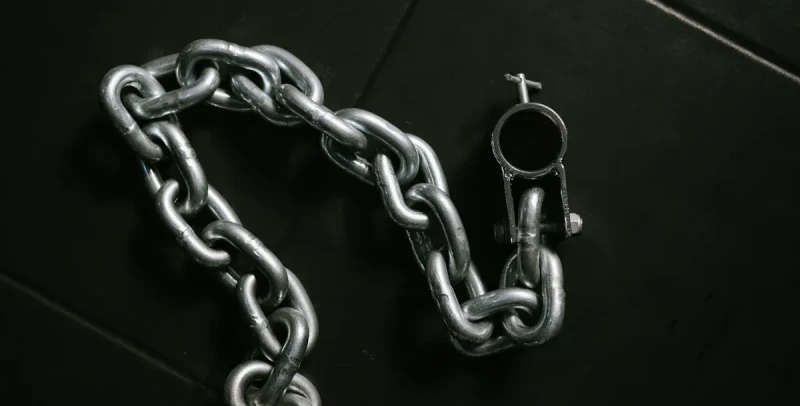
DIN is often used in the market as shorthand for a link pattern, especially for metric chain. That shortcut can cause trouble because DIN publishes separate documents for different products, and their scopes can change between editions.
DIN 5685 for non-proof-loaded general-purpose chain
DIN 5685 is a series for round steel link chains that are not proof loaded. Part 1 covers long-link chain, and other parts cover different link proportions. These chains can suit barriers, suspension of non-critical items and other general purposes, depending on material and finish.
The phrase “non-proof loaded” is the decisive warning. You should not use DIN 5685 chain for lifting simply because its diameter looks similar to lifting chain.
DIN 765 and DIN 766 for close-tolerance round-link chain
DIN 765:2024 covers tested, close-tolerance Grade 4 round steel link chain for general technical purposes. DIN 766:2015 covers tested, close-tolerance Grade 3 short-link chain with a nominal pitch of 2.8 times the diameter for chain conveyors and bucket elevators.
This is where edition control becomes essential. DIN Media states that the current DIN 766 no longer covers hoist chain and must not be used as a lifting accessory, sling or load-bearing device with cranes or hoists. In the anchor-chain market, however, “DIN 766” is still commonly used to describe a calibrated metric link geometry for windlass compatibility.
If you are buying anchor or windlass chain, do not stop at the market label. State the required chainwheel or gypsy, nominal diameter, pitch, inside width, outside width, material grade, galvanizing, proof test, minimum breaking force and certificate. Ask for a sample fit when the windlass compatibility is uncertain. The exact geometry matters more than the name printed in a catalogue.
DIN EN is an adopted EN standard
A designation such as DIN EN 818-2 means Germany has adopted EN 818-2. You should treat it as part of the EN lifting-chain family, not as a separate DIN alternative. This small naming detail prevents duplicate or contradictory requirements in your RFQ.
Australian Chain Standards: AS 2321, AS 3775 and AS 4797
For Australian lifting applications, the chain and the finished sling are covered by related but different standards.
AS 2321:2014 specifies non-calibrated welded round-steel short-link chain for lifting purposes. It includes several grades, including Grade T(80) and Grade V(100). AS 3775.1:2014 specifies Grade T(80) and V(100) chain sling products made with chain complying with AS 2321. AS 3775.2:2014 covers care and use.
That structure means an AS 2321 chain is not yet a complete AS 3775 sling. The assembly also needs compatible components, a verified configuration, a rated WLL, identification, proof testing and documentation. Australian guidance expects a sling tag and test certificate that can be matched to the assembly.
If you require stainless lifting chain, AS 4797 covers stainless steel link chain for lifting purposes. Do not substitute decorative or general-purpose stainless chain. Corrosion resistance does not create lifting capacity, and stainless grades can have different mechanical and environmental limits from heat-treated alloy chain.
Why You Cannot Convert the Standards One-to-One?
A cross-reference table can help you find a starting point, but it should never be used as an approval to substitute products. Four differences block a simple one-to-one conversion.
1. The intended use may be different
EN 818-2 and AS 2321 include lifting chain. EN 12195-3 and NACM Grade 70 are associated with load restraint. DIN 5685 is non-proof-loaded general-purpose chain. Current DIN 766 is a conveyor and bucket-elevator standard. The application has to match before you compare any dimensions.
2. Grade labels do not prove equal performance
A number such as 80 or 100 may indicate a strength class in more than one system, but the complete requirements can differ. Material, heat treatment, dimensional tolerance, elongation, proof force, breaking force, markings and sling design rules all affect conformity. Compare certified values, not just the embossed number.
3. Nominal diameter does not prove dimensional compatibility
Two 8 mm chains may have different pitch and width. That difference can prevent a link from seating in a hoist pocket wheel or anchor windlass gypsy. For any chain that engages a wheel, you need the full link geometry and the equipment manufacturer’s approved chain specification.
4. WLL and test conventions can differ
Standards may use different design factors, grade bases, assembly factors, units and marking rules. A WLL for straight chain is not automatically the WLL of a multi-leg sling or lashing assembly. Sling angle, number of legs, hitch, temperature and component selection can change the rating.
Which Chain Standard Should You Specify?
| Your application | Strong starting point | What you should add |
|---|---|---|
| Overhead lifting in an EN market | Applicable EN 818 part; EN 1677 components where relevant | Sling configuration, grade, diameter, reach, WLL, angle range, markings, certificate, and local legal requirements |
| Road-load restraint in an EN market | EN 12195-3 | Lashing capacity, chain size and grade, end fittings, tensioner, markings, and applicable vehicle/load-restraint rules |
| North American general or transport chain | Exact NACM product type and grade | Imperial or metric size, WLL, finish, markings, proof and breaking data, and applicable transport rules |
| North American alloy chain sling | NACM Grade 80 or Grade 100 chain, plus applicable ASME/OSHA requirements | Complete sling design, components, tag, WLL, test certificate, and inspection requirements |
| Australian lifting chain | AS 2321 | Grade, diameter, WLL, markings, manufacturer traceability, and certificate |
| Australian chain sling | AS 3775.1 with AS 2321 chain; AS 3775.2 for care and use | Sling configuration, components, reach, WLL, tag, test certificate, and inspection plan |
| General-purpose DIN-pattern chain | Exact DIN number, part, and edition | Tested or non-proof-loaded status, link dimensions, finish, and a clear “not for lifting” statement where applicable |
| Anchor or windlass chain | Equipment-approved chain pattern and project requirements | Diameter, pitch, widths, calibration tolerance, grade, coating, proof force, breaking force, certificate, and sample fit |
| Stud-link ship anchor or mooring chain | Vessel specification, classification-society rules, and applicable marine standard | Grade, link size, shot length, heat treatment, proof and break tests, survey, and traceability |
How to Write a Chain RFQ That Can Be Quoted Correctly?
The easiest way to avoid a vague quotation is to build your RFQ in the following order.
- Define the use. State lifting, lashing, anchor or windlass, mooring, conveyor, barrier or another specific duty.
- Name the standard precisely. Include the issuing body, number, part and required edition. If you will accept a later edition, say so.
- Specify grade and material. State carbon steel, alloy steel or stainless steel, plus the required grade or material designation.
- Give all critical dimensions. Include nominal bar diameter, pitch, inside width and outside width. State whether the chain must be calibrated or close tolerance.
- State the rating basis. Give the required WLL or lashing capacity, manufacturing proof force and minimum breaking force, with units and applicable design basis.
- Describe the environment. Include temperature range, exposure to salt water, chemicals, abrasion or hydrogen-embrittlement risk.
- Specify the finish. Choose self-coloured, painted, electro-galvanized, hot-dip galvanized, polished stainless or another approved treatment.
- Define markings and traceability. Request grade marks, manufacturer’s mark, batch or lot identification, sling tag or other required identification.
- List the documents. Ask for a certificate of conformity, material certificate, proof-test report, breaking-test report, dimensional inspection report and third-party inspection when required.
- Confirm interfaces. Name the hooks, master links, shackles, tensioners, pocket wheel, windlass gypsy or other equipment the chain must fit.
- State quantity and delivery form. Give total length, cut lengths, number of assemblies, packaging, corrosion protection and destination.
- Ask the supplier to list deviations. A clear deviation schedule is safer than a quotation that silently substitutes a different standard.
Common Chain Standards Mistakes to Avoid
Buying by diameter alone
Diameter is only one dimension. Pitch and width control compatibility with pocket wheels, windlasses and fittings. Grade and tests control performance.
Treating transport chain as lifting chain
Grade 70 transport chain and EN lashing chain are designed for restraint, not overhead lifting. Use a purpose-rated lifting chain and sling assembly.
Using a catalogue name as the specification
Names such as “DIN 766 anchor chain” or “Australian link chain” can describe a market pattern rather than the full current standard. Put dimensions, grade, tests and intended use on the purchase order.
Accepting a certificate that does not identify the batch
A certificate is useful only when you can link it to the delivered chain. Check heat, lot, batch, test sample and product marking references.
Assuming the standard replaces local law
A product standard does not cancel workplace, transport, machinery, marine or inspection rules at the destination. Confirm the legal and site requirements before you approve production.
How Powerful Machinery Helps You Control the Specification?
When you source from Powerful Machinery, you can send the standard and application instead of trying to translate every system yourself. We can review the required link dimensions, grade, finish, tests, markings and delivery form before production.
For lifting projects, you can specify Grade 80 or Grade 100 lifting chain and the compatible sling components you need. For transport, you can define the lashing standard and assembly. For anchor or windlass chain, you can provide the chainwheel data or an existing-chain sample so the link geometry is checked before a full order.
The best result comes from a short technical review at the RFQ stage. It is faster to resolve a pitch or certificate question before production than after the chain reaches your site.
Conclusion
You do not need to memorize every clause in EN, NACM, DIN and Australian chain standards. You do need to know what each document is intended to control.
Start with the application, then state the exact standard and edition. Compare grade, link geometry, WLL basis, proof and breaking tests, markings, traceability and compatible equipment. If any of those points differ, treat the proposed chain as a new technical selection rather than an automatic equivalent.
That approach gives your manufacturer a specification it can build and test, gives your purchasing team quotations it can compare, and gives your operators a chain that matches the job.
FAQs About Chain Standards
Are EN, NACM, DIN and AS chain standards equivalent?
No. They may cover similar applications or strength classes, but their scopes, dimensions, tests, markings and documentation can differ. Approve an alternative only after a technical comparison of the exact products.
Is DIN 766 chain suitable for lifting?
Not under the current DIN 766:2015 scope. DIN Media states that it applies to close-tolerance Grade 3 chain for conveyors and bucket elevators and must not be used as a lifting accessory, sling or load-bearing device with cranes or hoists. Use the applicable lifting-chain standard for your lift.
What is the difference between EN 818-2 and EN 818-7?
EN 818-2 covers medium-tolerance Grade 8 chain for chain slings. EN 818-7 covers fine-tolerance Grade T hoist chain. You should match a hoist chain to the hoist manufacturer’s pocket-wheel and chain specification.
Can you use NACM Grade 70 chain for overhead lifting?
No. Grade 70 is transport or tie-down chain. For overhead lifting, use a purpose-rated alloy chain and a complete sling that meets the applicable lifting rules.
Does an AS 2321 chain automatically make an AS 3775 sling?
No. AS 2321 covers the short-link lifting chain. The finished Grade T(80) or V(100) sling also needs to meet AS 3775 requirements for product design, compatible components, WLL, identification, testing and documentation.
What should you compare when changing chain standards?
Compare intended use, current edition, grade and material, diameter, pitch, widths, tolerance or calibration, WLL basis, proof force, minimum breaking force, elongation, markings, certificates and equipment compatibility. A matching diameter is not enough.
Safety note: This comparison is purchasing guidance, not a lift plan, load-restraint calculation or engineering approval. Use the latest applicable standards and destination regulations. Have a competent or qualified person confirm the chain, assembly, inspection and operating conditions before use.