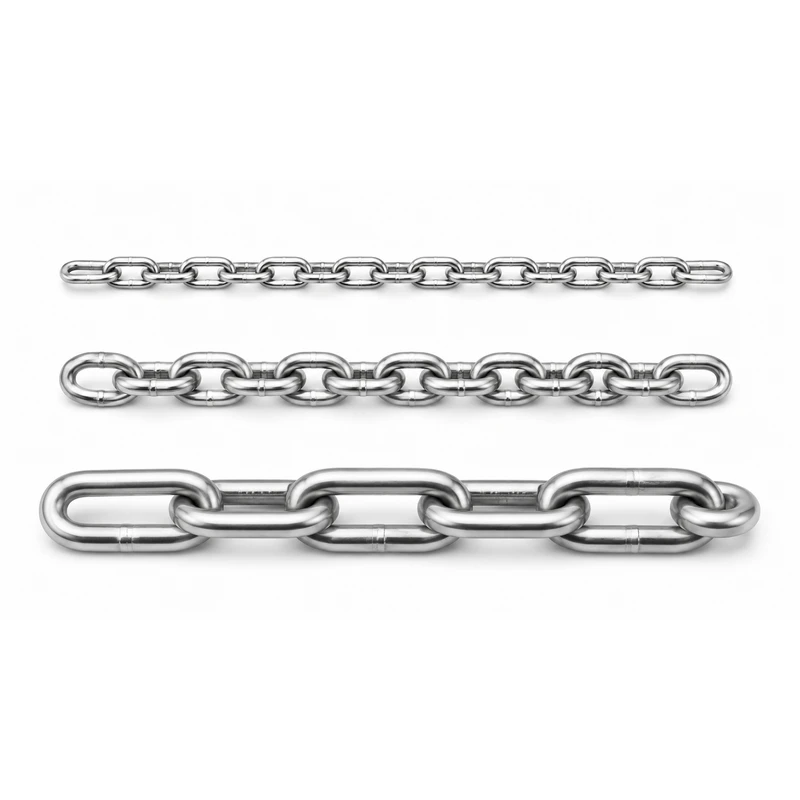
One shackle of anchor chain is traditionally 15 fathoms (90 feet). That converts to exactly 27.432 metres. In metric anchor-chain specifications, a standard length is commonly described as a nominal 27.5 metres. You will see both figures in maritime writing; they describe the same conventional unit in ordinary conversation, but 27.5 and 27.432 are not identical measurements.
If you are checking the length supplied to a vessel or preparing an order, use the chain’s approved drawing and certificate rather than assuming a rounded conversion is its measured length.
The word “shackle” is easy to misread because it has another meaning. It can refer to a length of anchor cable, or to the separate metal fitting that joins components. This article is about the length. You will learn how the units relate, how to read a report such as “three shackles in the water,” and where the nominal figure stops being enough for a purchasing or operational decision.
Key Takeaways
- In traditional seamanship, one shackle or shot is 15 fathoms, equal to 90 feet or exactly 27.432 metres.
- For metric chain supply and many class-rule calculations, a standard length is nominally 27.5 metres. Treat that as a stated nominal length, not the exact conversion of 90 feet.
- The number of shackles tells you approximately how much cable has been paid out, but not how much to deploy at an anchorage.
- A joining shackle or anchor shackle is a metal fitting. Its dimensions, grade, and test requirements are different from chain-section length.
What Does One Shackle Mean?
On a ship, “one shackle of cable” is a convenient way to describe a length of anchor chain. You may also hear “one shot,” especially in North American usage. The traditional unit is 15 fathoms. Since one fathom is 6 feet, the calculation is 15 × 6 = 90 feet. Converting by the exact international foot gives 90 × 0.3048 = 27.432 metres. Rounded to two decimal places, that is 27.43 metres.
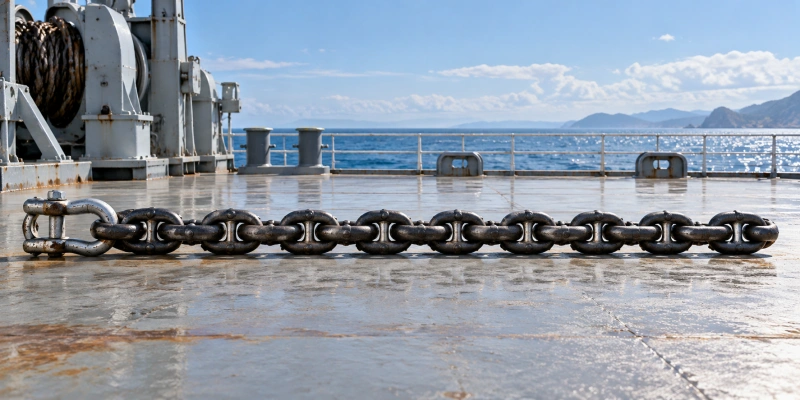
The standard metric production length often appears as 27.5 m. For example, IACS UR W18 refers to proof testing each 27.5 m chain-cable length, and IACS Recommendation No. 10 uses a 27.5 m length in its chain-mass tables. In this context, 27.5 m is a nominal section length in a metric specification.
The difference from the traditional conversion is 0.068 m, or 6.8 cm, per section. It is small for a spoken estimate but should not be silently erased from an exact dimensional check.
Think of the shackle count as a shared language for the bridge and foredeck. It lets you communicate an approximate amount of cable quickly while the vessel’s markings, equipment records, and procedures supply the practical reference.
If your paperwork states a different segment length or includes a short end section, follow the as-fitted documentation instead of assuming every part of the chain is a full nominal shackle.
Anchor Chain Length Conversion Table
The table multiplies the nominal metric section length of 27.5 m. It is a unit-conversion aid, not a recommendation for how much chain to let go. A traditional 90-foot calculation will give slightly different metric totals.
| Full nominal sections | At 27.5 m per section | At 90 ft per section |
| 1 | 27.5 m | 90 ft (27.432 m) |
| 2 | 55.0 m | 180 ft (54.864 m) |
| 3 | 82.5 m | 270 ft (82.296 m) |
| 5 | 137.5 m | 450 ft (137.160 m) |
| 8 | 220.0 m | 720 ft (219.456 m) |
| 10 | 275.0 m | 900 ft (274.320 m) |
To estimate a nominal metric length from a whole number of shackles, multiply the count by 27.5 m. To convert the traditional unit, multiply by 90 feet or by 27.432 m. State which convention you used when quoting a figure, especially if someone will compare it with a certificate, chain inventory, or class-approved drawing.
For example, eight nominal metric lengths total 8 × 27.5 = 220 m. Eight traditional 90-foot lengths total 720 ft, or 219.456 m. Neither figure says that eight shackles should be paid out at your anchorage. It says what eight lengths mean under the chosen convention. A mixed assembly, repairs, or replacement sections can also affect the as-fitted total.
Shackle, Shot and Metal Shackle: Three Similar Terms
A “shot” and a “shackle” can both identify a length of anchor cable. A joining shackle, Kenter-type connecting link, end shackle or anchor shackle, by contrast, is hardware that connects parts of the assembly. The exact connection arrangement depends on the chain and vessel. The connector is not 27.5 m long; the phrase “one shackle of chain” describes a section of cable, usually joined to other sections.
This difference matters when you search for specifications. “How long is a shackle?” can bring up a dimension chart for a bow or Dee lifting shackle. That chart may give a pin diameter, jaw opening, body diameter, and working load limit, but it does not convert anchor-chain lengths.
For hardware geometry, read the shackle sizes guide or the procedure on how to measure a shackle. Those pages address a different purchase and inspection task.
Do not choose an anchor-cable connector by matching only its nominal name to a chain length. The grade, chain diameter, dimensions, joining method, and required documentation must match the approved assembly. The uploaded Powerful Machinery catalogue shows separate anchor-chain test-load tables and joining arrangements; it does not make every fitting interchangeable with every chain.
What Does “Three Shackles in the Water” Tell You?
When a deck report says that three shackles are in the water, the quick nominal metric estimate is 3 × 27.5 = 82.5 m of cable to the reporting reference. Under the traditional 90-foot definition, the total is 270 ft, or 82.296 m.
In routine speech, both may be described as roughly 82 m. The phrase reports a length paid out; it does not on its own tell you the water depth, the position of the anchor, the amount lying on the seabed, or the horizontal distance to it.

The reference point matters. One crew may report marks as they pass the windlass, while another phrase specifies a mark at the waterline or in the hawse pipe. Ask which convention is used in the vessel’s anchoring procedure. A colored cable marking helps identify sections, but markings may be obscured by wear or paint; consult the vessel’s actual marking plan rather than assuming one universal color scheme.
A full count also says nothing about whether the chain is running freely, whether a joining link is approaching the windlass, or whether the anchor is holding. Those observations belong to the anchoring team’s live procedure. Length arithmetic helps you interpret a report; it cannot replace the people and instruments managing the operation.
Why the Length Matters Without Becoming a Deployment Rule
Knowing the unit helps you compare a verbal bridge order with an inventory, chain marks and the available cable on board. It also helps a buyer check a purchase order that states a total chain length in metres but a delivery breakdown in full shots.

If you receive a request for 220 m as eight 27.5 m sections, for example, the nominal arithmetic agrees. The completed assembly may still include end fittings and connection details that need separate checking.
The amount paid out for an actual anchorage is a separate decision. Water depth, tide, expected wind and current, holding ground, ship movement, traffic, swinging room, anchor type, available cable and the vessel’s approved procedures all matter. A single scope ratio cannot guarantee that an anchor will hold. Even a correct count of shackles cannot prove a satisfactory set or safe clearance from another vessel.
If you need to estimate an initial deployment count for a merchant vessel, use the dedicated guide to calculating how many shackles to drop anchor. Its estimate is a planning input that still needs the master’s judgment and onboard checks. Keep that operational calculation there; this page explains the length unit that goes into it.
Why Chain Sections Are Joined and Marked?
Long anchor cables are built as assemblies of chain lengths and connection components. A standard section length makes manufacturing, testing, documentation, and replacement easier to organize. It also gives the deck team a repeatable reference when the cable is paid out.
The actual arrangement includes details such as end links, joining parts, a swivel where specified, and a connection to the anchor. The arrangement must be checked against the vessel’s approved drawing, not inferred from the fact that a section is 27.5 m.
IACS UR W18 addresses anchor-chain cables and accessories, including tests and documentation for specified grades and products. It calls for proof testing each 27.5 m length under its scope and sets separate provisions for chain accessories.
This is useful evidence for the metric nominal length, but it does not mean that every chain sold anywhere carries the same certificate or that ordinary lifting-shackle standards define a nautical shackle.
Visible section marks let a crew count what has passed a chosen reference point. Check the marking plan and the chain’s condition before relying on a visual count. If paint or a marking has been lost, the response is to follow the ship’s procedure for uncertain cable length, not to guess from the number of links visible at the deck edge. A verified inventory and connection record also matter after chain repair or end-for-end.
How to Specify Chain Length When You Buy?
If you are buying anchor chain, start with the total required length per anchor and the intended number of nominal sections. Then identify the chain diameter, grade, stud-link or studless design, surface condition, chain and accessory drawings, joining arrangement and the applicable class or project specification.
Ask how the supplier defines a nominal length and what is included when it reports total assembled length. A length in metres is more useful when its reference points and permitted tolerance are stated.
The uploaded Powerful Machinery catalogue has an anchor-chain section with separate stud-link and studless test-load information and joining-form illustrations. These tables address specific diameter and grade combinations; they do not establish one universal load rating for a 27.5 m length.
Do not quote a proof load or breaking load from one row without the matching product and controlled current specification. The catalogue also does not confirm that every delivered chain is exactly a 27.5 m section or that every order includes a particular joining part.
For a practical inquiry, send the vessel or project reference, the required length per side, chain grade and diameter, link style, connection drawing, any class-survey or test-document requirement, and the destination.
Ask the supplier to confirm the manufactured section length, the number of full and partial lengths, the end arrangement, and the certification scope for that order. You can review the anchor chain range before submitting those details.
Common Length Questions
Is One Shackle Exactly 27.5 Metres?
Not if you are converting the traditional definition exactly. Fifteen fathoms is 90 feet, which is 27.432 m. The 27.5 m figure is a common nominal metric chain-section length. Use the unit and specification stated in the relevant document, especially when a small dimensional difference matters.
Is a Shackle the Same as a Shot of Chain?
In this length context, yes: both terms commonly identify a standard section of anchor cable. Local usage and the vessel’s records control how a particular assembly is described. Neither term, by itself, identifies the dimensions of the metal connector.
How Many Feet Are in Five Shackles?
Using the traditional definition, five × 90 feet = 450 feet, or exactly 137.16 m. Five nominal 27.5 m metric sections total 137.5 m. Give the convention with the answer; do not relabel 137.5 m as the exact conversion of 450 feet.
Does a 27.5 Metre Shackle Tell Me How Much Chain to Deploy?
No. It tells you the nominal length of one section. Deployment depends on the specific vessel, depth, weather, current, seabed, available space, equipment, and approved anchoring plan. Use the section length to interpret or calculate an estimate, then follow the vessel’s procedure for the actual operation.
Does Chain Diameter Change the Length of a Shackle?
Diameter changes the chain’s size, mass, and strength data, but it does not change the meaning of the traditional 15-fathom unit. A manufacturer may supply another section length under a particular order, so check the as-built documentation. Never infer a chain’s capacity from its length alone.
Final Check
When someone asks how long a shackle of anchor chain is, you can answer “15 fathoms or 90 feet,” then explain that metric chain specifications commonly call one section 27.5 m nominal. If the number will go into an inventory, drawing, or operating plan, use the vessel’s as-fitted data and say which length convention you mean.
That small clarification keeps a quick maritime shorthand from turning into a wrong product specification or anchoring instruction.