You need a clear estimate before you drop anchor, but the word “shackle” can confuse. In this article, a shackle—also called a shot—means a standard length of anchor cable or chain, not the separate metal connector used in rigging.
For merchant-ship planning, a commonly used estimate is: Number of shackles = 1.5 × √water depth in meters. At a water depth of 20 meters, the result is about 6.7 shackles. This is a planning estimate, not an automatic bridge order.
The master and responsible deck officers must still consider the vessel, holding ground, weather, current, tide, swinging room, traffic, available cable, and the company’s safety management procedures.
Quick answer: Use N = 1.5√D as the main merchant-ship estimate, where N is the number of shackles and D is water depth in meters. Keep the result as an estimate until it has been checked against the vessel’s approved anchoring procedure and actual conditions.
Key Takeaways
- In anchor-cable terminology, one shackle is nominally 27.5 meters; 15 fathoms or 90 feet converts to about 27.43 meters.
- Use one calculation framework from start to finish. Do not combine the 1.5√D merchant-ship rule with a small-craft scope ratio in the same calculation.
- “Three shackles in the water” means approximately three standard cable lengths—about 82.5 meters—have been paid out to the stated reference point.
- Never treat the calculated number as a universal instruction. The final amount depends on the ship, anchorage, conditions, space, and onboard procedures.
- Anchor-chain grades, dimensions, proof loads, and breaking loads are product specifications; they do not determine the operational amount of cable by themselves.
What Does “One Shackle” Mean in Anchor Chain?
A shackle or shot is a unit used to report the length of anchor cable paid out. One shackle is 15 fathoms (90 feet), or approximately 27.43 meters. Metric anchor-chain catalogues commonly use a nominal 27.5-meter chain length. For the difference between the 90-foot traditional conversion and a nominal 27.5-metre chain length, see our anchor-chain shackle length guide.
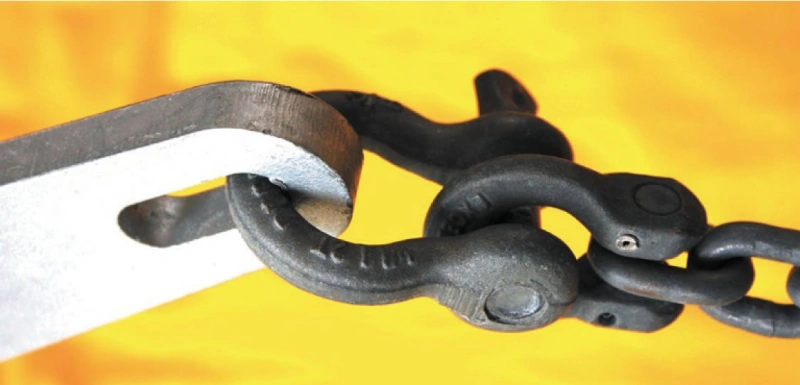
Do not confuse this length unit with a physical shackle. A Kenter shackle, joining shackle, or anchor shackle is a connector in the chain assembly. The connector has its own dimensions, grade, test requirements, and installation purpose; it is not the unit used in the calculation.
| Cable amount | Nominal metric length | Feet | Fathoms |
| 1 shackle | 27.5 m | 90 ft | 15 fathoms |
| 2 shackles | 55.0 m | 180 ft | 30 fathoms |
| 3 shackles | 82.5 m | 270 ft | 45 fathoms |
| 4 shackles | 110.0 m | 360 ft | 60 fathoms |
How to Estimate the Number of Shackles From Water Depth?
The following merchant-ship rule is commonly attributed to the Admiralty Manual of Seamanship and is reproduced in current loss-prevention guidance:
| Main formula: N = 1.5 × √D |
Where:
- N = estimated amount of cable in shackles.
- D = water depth in meters at the anchoring position.
- √D = the square root of the water depth.
Source note: The Shipowners’ Club anchoring guidance presents this as one of two commonly used formulas and identifies it as an Admiralty Manual of Seamanship method. Treat it as an estimate that remains subject to the vessel’s operating procedures.
Calculation Steps
- Confirm the water depth at the intended anchoring position using the ship’s approved navigational information and the expected tidal condition.
- Take the square root of the water depth in meters.
- Multiply the result by 1.5 to obtain the preliminary number of shackles.
- Check the estimate against swinging room, nearby traffic, holding ground, weather, current, the amount of cable available, and company or master’s requirements.
- State the final order and cable report using the vessel’s standard terminology, including whether the reference is “in the water,” “on deck,” or another defined point.
Worked Examples
| Water depth D | Calculation | Planning estimate N | Approx. cable length at N × 27.5 m |
| 9 m | 1.5 × √9 | 4.5 shackles | 123.8 m |
| 20 m | 1.5 × √20 | 6.7 shackles | 184.5 m |
| 36 m | 1.5 × √36 | 9.0 shackles | 247.5 m |
Important: Do not apply a blanket “always round up” rule without operational review. The practical order may be affected by available swinging room, cable markings, local restrictions, vessel procedures, and the master’s assessment. The decimal result is a planning value, not a substitute for bridge judgment.
What Do “2, 3, or 4 Shackles in the Water” Mean?
The phrase reports how much anchor cable has been paid out. Using the nominal 27.5-meter length, two shackles are about 55 meters, three are about 82.5 meters, and four are about 110 meters. This wording helps the forecastle team and bridge maintain a shared picture of the cable deployment.
| Report | Approximate chain paid out | Plain-language meaning |
| 2 shackles in the water | 55 m | Two standard cable lengths have passed the vessel’s defined reporting point. |
| 3 shackles in the water | 82.5 m | Three standard cable lengths have been paid out to the stated reference. |
| 4 shackles in the water | 110 m | Four standard cable lengths have been paid out to the stated reference. |
Reporting conventions can vary between vessels. “Three in the water” is not necessarily identical to “three on deck” or “three at the windlass.” Use the wording, cable markings, and reference points defined by the vessel’s onboard procedure.
Why the Actual Number of Shackles Can Differ?
Water depth gives you a starting point, but it does not describe the full anchoring problem. Before deciding how many shackles to pay out, you should assess:
- Wind, current, sea, swell, and expected weather changes.
- Holding ground, seabed condition, and the possibility of fouling or poor anchor penetration.
- The expected depth throughout the stay, including tide and under-keel-clearance considerations.
- Vessel size, windage, draft, loading condition, anchor and cable arrangement, and the chain remaining in the locker.
- Available swinging room, nearby vessels, traffic lanes, underwater hazards, and local anchorage restrictions.
- The company safety management system, bridge/forecastle procedures, master’s standing orders, and any classification or flag requirements that apply to the vessel.
Merchant-Ship Formula vs. Scope Ratio: Do Not Mix the Methods
The 1.5√D rule estimates merchant-ship cable directly in shackles. A scope-ratio method starts with a required cable length and divides that length by the length of one shackle. These are different calculation frameworks.
The same Shipowners’ Club guidance also lists a separate minimum-length estimate: cable length in meters = 4 × water depth in meters. If that method is the one required by your onboard procedure, convert the resulting cable length to shackles by dividing by 27.5. Do not average the two methods, add them together, or insert hawse height and a recreational-boat scope ratio into the 1.5√D formula.
For a deeper discussion of anchor chain length and scope, use the dedicated length guide. If you are sizing rode for a yacht or small boat, see how much anchor chain a small craft may need. Keeping those topics separate prevents merchant-ship cable calculations from being mixed with recreational anchoring advice.
Anchor Chain Components: Kenter, Joining, and Anchor Shackles
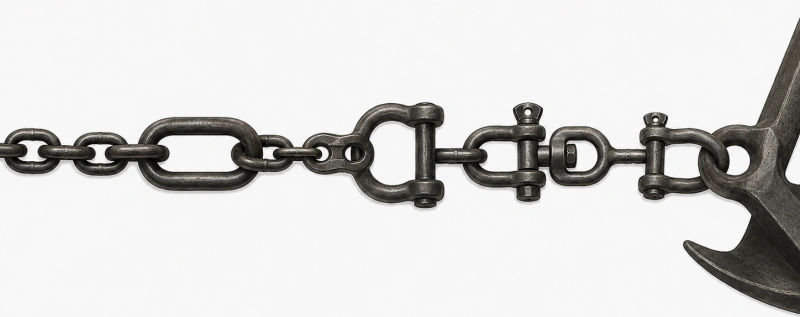
An anchor-chain assembly can include common links, enlarged links, end links, Kenter shackles, joining shackles, swivels, and anchor shackles. These components connect chain lengths or connect the chain to the anchor. Their names contain “shackle,” but they are physical components—not the shackle/shot length used in the water-depth formula.
If your search is about bow shackles, D shackles, screw-pin shackles, working load limits, or lifting connections, go to the dedicated rigging and connection shackles page. Those products have a different selection process and should not control an anchor-cable deployment calculation.
Powerful Machinery Anchor Chain Reference
Powerful Machinery’s catalogue separates product specifications from operational anchoring guidance. Its stud-link anchor-chain table covers nominal diameters of approximately 17.5 to 130 mm and lists AM1, AM2, and AM3 grades together with proof load, breaking load, and weight per 27.5 meters. Its studless range uses BM1, BM2, and BM3 grade designations and also reports dimensional, load, and weight data.
These fields help you prepare a technical enquiry, but they do not tell a bridge team how many shackles to deploy. Product selection must be based on the vessel’s approved design, class requirements, chain diameter and grade, required test documentation, and the exact assembly configuration.
You can review Powerful Machinery’s anchor chain product range after completing the operational calculation. For an RFQ, provide the nominal diameter, stud-link or studless construction, grade, total length or number of 27.5-meter lengths, component arrangement, proof/breaking-load requirements, inspection body, coating, markings, certificates, and delivery destination.
Pre-Deployment Checks
Keep the pre-deployment check focused on the actual operation:
- Confirm the anchoring position, expected depth, tide, weather, current, holding ground, and swinging room.
- Verify the anchor and cable to be used, the amount of cable available, and the meaning of each chain marking.
- Check the visible cable, joining components, stopper, brake, windlass, and communication equipment in accordance with the vessel’s procedures.
- Brief the bridge and forecastle teams on the method, target amount of cable, reporting terms, abort criteria, and individual responsibilities.
- After deployment, monitor the vessel’s position and cable behavior using the ship’s approved anchor-watch procedure.
Conclusion
To estimate how many shackles to drop anchor on a merchant ship, use N = 1.5√D as a planning method when it is consistent with the vessel’s approved procedure. Define the water depth in meters, calculate the estimate once, and then review it against the actual anchorage, ship, weather, current, swinging room, and cable available.
The calculation is only one part of the decision. Clear terminology matters just as much: a shackle/shot is a standard cable length, while Kenter, joining, and anchor shackles are physical connectors. Keeping those meanings separate helps the bridge and forecastle team communicate accurately and helps buyers specify the correct anchor-chain assembly.
Need product specifications rather than an operational anchoring decision? Request anchor chain specifications or a quotation from Powerful Machinery with the vessel-approved chain and component requirements.
FAQ
How many shackles should you drop anchor?
For merchant-ship planning, one commonly used estimate is N = 1.5√D, where D is water depth in meters. The result must be checked against the vessel’s approved procedures and the actual anchoring conditions; it is not a universal command.
How long is one shackle of anchor chain?
One shackle is 15 fathoms or 90 feet, which is approximately 27.43 meters. Metric anchor-chain tables commonly use a nominal 27.5-meter length.
What does “three shackles in the water” mean?
It generally means about three standard cable lengths—approximately 82.5 meters—have been paid out to the vessel’s defined reporting point. Check the onboard terminology because “in the water,” “on deck,” and “at the windlass” can identify different reference points.
Should you always round the calculation up?
Do not use an automatic rounding rule without operational review. The final order must consider cable markings, available swinging room, conditions, local restrictions, and the vessel’s procedures. Keep the decimal result as a planning estimate until the responsible officer confirms the practical amount.
Is the scope-ratio formula the same as the 1.5√D formula?
No. The 1.5√D method estimates cable directly in shackles. A scope method first calculates cable length and then converts that length to shackles. Use the method required by the vessel or operating context, and do not combine the formulas.