Plastic barrier chain is easy to shorten when you choose a tool that matches the link thickness and material. Thin, flexible links may cut cleanly with heavy-duty scissors or utility shears. Thicker or more rigid links usually need diagonal cutters, bolt cutters, or a fine-tooth hand saw. Measure first, support the link, keep your hands outside the cutting path, and smooth the cut edge before installation.
This guide applies to plastic chain used for crowd control, hazard marking, parking areas, and decorative boundaries. It does not apply to chain used for lifting, towing, load restraint, or personal protection. If you are selecting chain for a new barrier, compare Powerful Machinery’s plastic barrier chain options before deciding what length to cut.
What Is the Best Way to Cut Plastic Chain?
Measure the required length, mark a link that can be discarded, secure that link on a stable work surface, and cut it with a tool that closes without twisting or crushing the plastic. Use heavy-duty scissors or shears only on thin links. For thicker links, use cutters with adequate jaw capacity or a fine-tooth hand saw. Remove the cut link, deburr the remaining chain ends, and inspect the adjacent links before fitting a connector.
Choose the Right Cutting Tool
Do not choose a tool from the overall link size alone. Check the cross-section you must cut, the plastic’s flexibility, the condition of the chain, and the rated capacity of the tool. If the blades cannot close squarely around the link, move to a larger cutter or use a saw instead of forcing the cut.
| Chain condition | Preferred tool | Use it when |
| Thin, flexible link | Heavy-duty scissors or utility shears | The blades fully capture the plastic and can close without twisting. |
| Medium, solid link | Diagonal cutters or end-cutting nippers | The jaws fit around the section, and the handles give controlled leverage. |
| Thick or rigid link | Bolt cutters with suitable jaw capacity | The link fits deep in the jaws and can be cut without crushing adjacent links. |
| Large, hard, or brittle link | Fine-tooth hand saw | A slow, supported cut is less likely to split the neighboring link. |
| Unknown or weathered plastic | Test cut on a spare link | The material may crack instead of cutting cleanly; replace the section if it is brittle. |
Avoid heating, melting, or using an open flame to separate a link. Heat can deform the neighboring material and create fumes. If a powered cutting tool is necessary, follow its manufacturer’s instructions, control dust and chips, and keep heat buildup to a minimum.
Prepare the Chain and Work Area
- Confirm that the chain is a non-load-bearing plastic barrier or decorative chain.
- Remove the chain from service and release all tension before cutting.
- Measure the installed path and allow for the connector, attachment point, and any intended sag.
- Mark the link you plan to discard, not an adjacent link that will remain in the finished length.
- Use a stable bench and adequate lighting. Clamp only the sacrificial link when clamping is necessary, and use padding so the jaws do not damage the links you will keep.
- Inspect the tool. Do not use loose, chipped, dull, or damaged blades.
How to Cut Plastic Chain Step by Step
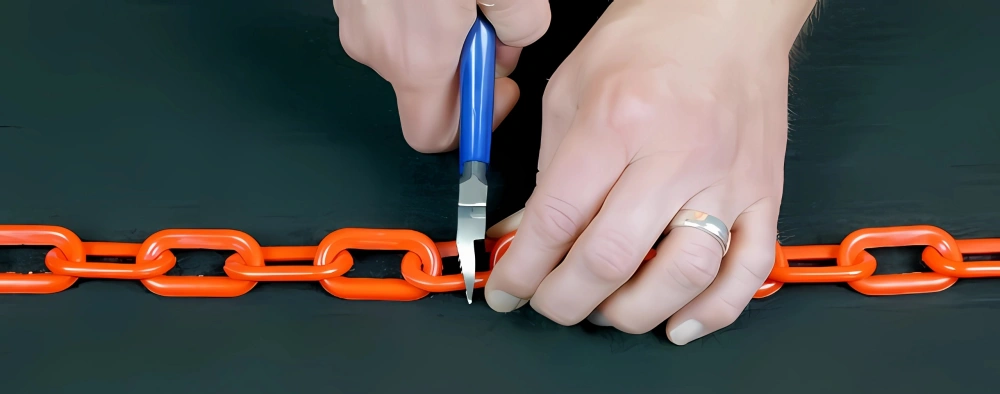
- Confirm the application. Proceed only if the chain is used as a visual barrier, guide, or decoration. Stop if it is supporting or restraining a load.
- Measure twice. Lay the chain in its intended path or measure it under light hand tension. Account for the connector and attachment hardware before selecting the cut link.
- Mark the sacrificial link. Use a marker or tape on the link that will be removed. This protects the finished length from an off-by-one-link error.
- Support the link. Place the marked link on a stable surface. Keep the neighboring links free of the cutter or clamp so they are not crushed or scored.
- Put on suitable protection. Wear safety glasses. Use close-fitting work gloves when they improve grip without reducing control. Add hearing or dust protection only when the selected tool and worksite require it.
- Make a controlled cut. Position the blades square to the plastic and cut steadily. With a hand saw, use short, light strokes until a groove forms, then continue without forcing the blade.
- Remove the discarded link. If one cut does not release a rigid link, make a second cut through the same sacrificial link and remove the small section. Do not overbend the adjacent links to pull them free.
- Deburr the edge. Trim loose material and smooth the cut surface with a fine file or fine-grit abrasive. Remove chips and dust from the work area.
- Inspect before installation. Check both neighboring links for whitening, cracks, deep tool marks, distortion, or sharp edges. Replace the affected section if any damage extends beyond the discarded link.
- Fit the correct connector. Use a connector that matches the link dimensions and intended barrier setup. Confirm that it closes fully and cannot detach during normal handling.
Safety Checks That Matter
- Never cut a chain while it is tensioned or while people are leaning on the barrier.
- Keep fingers and the supporting hand outside the line of the blades or saw.
- Wear eye protection because clipped plastic can eject without warning.
- Use a tool with enough capacity. A tool that must be twisted or forced can slip and can crack the link you intend to keep.
- Do not heat the link or use an open flame. Avoid breathing cutting dust and clean the work surface after sawing.
- Treat ‘non-conductive’ as a material description, not an electrical safety rating. Plastic chain is not personal protective equipment and must not be used as an insulating safeguard.
- Follow site-specific PPE, lockout, access-control, and waste-disposal rules where they apply.
How Material and Condition Affect the Cut?
Flexible polyethylene-type links often cut with shears or cutters when the tool fits correctly. Harder plastic, cold material, or weathered links may chip or crack, making a fine-tooth saw or a test cut on a spare link the safer choice. You cannot reliably identify the exact resin or its remaining strength by appearance alone; check the product specification when material matters.
Do not reuse a link that is cracked, chalky, heavily faded, flattened, or permanently distorted. Cutting does not restore a deteriorated chain. If application strength is part of the buying decision, read how plastic chain strength should be evaluated and confirm the actual product data before installation.
When Should You Replace the Connector?
Replace a connector if it is cracked, distorted, badly worn, chemically attacked, or no longer closes as designed. The connector must fit the link without forcing the opening wider. Do not treat glue, heat, or wire wrapped around a cut link as a repair unless the chain manufacturer has approved that method for the product and application.
After Cutting: Final Installation Check
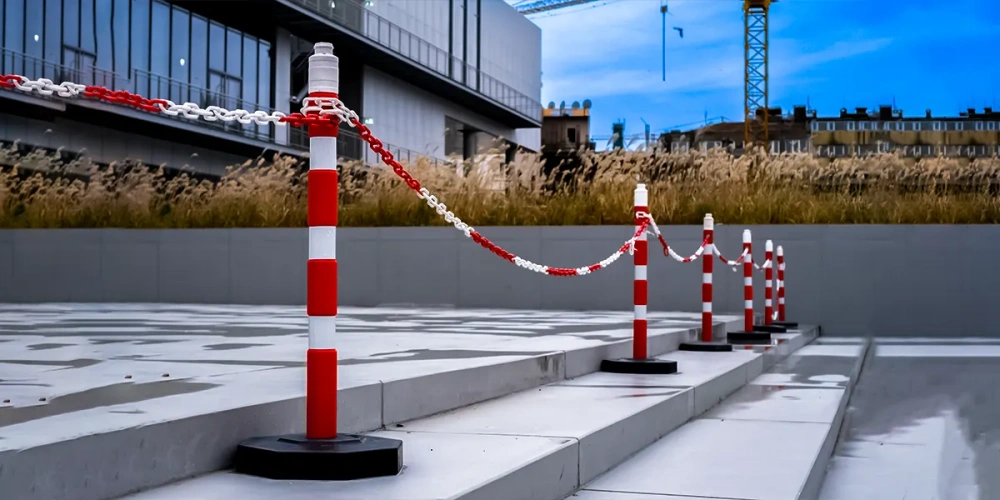
- Confirm that the finished length reaches both attachment points without being stretched tight.
- Check that the connector is fully engaged and that no cut edge faces a hand-contact area.
- Keep the barrier visible and positioned so it does not create a trip or entanglement hazard.
- Store usable offcuts by size and material. Dispose of damaged pieces according to local recycling and waste rules.
Need chain supplied in a particular size, color, or length? Review the available plastic chain specifications or request samples or a quote. Include the link size, material if known, color, finished length, quantity, indoor or outdoor use, and connector type in your request.
FAQ
Can you cut plastic chain with regular scissors?
Only thin, flexible links should be cut with scissors, and the blades must fully capture the section without twisting. Use heavy-duty shears, cutters, or a fine-tooth saw when ordinary scissors cannot close cleanly.
Should you make one cut or two cuts through the link?
One cut may be enough when the discarded link opens without stressing the neighboring links. For a rigid link, make a second cut through the same sacrificial link and remove the small section instead of forcing the adjacent links apart.
Can you cut plastic chain while it is installed?
Remove tension and isolate the work area first. If the chain cannot be placed on a stable surface and controlled safely, take it down before cutting.
What should you do if the link turns white or cracks while cutting?
Stop and inspect the neighboring links. Whitening, cracking, or permanent distortion indicates stress in the plastic. Remove more of the affected section or replace the chain rather than installing a damaged end.
Can a cut plastic link be glued back together?
Do not rely on a glued cut link. Remove the sacrificial link and join the intact end links with a compatible connector intended for the chain and barrier setup.
Is plastic chain suitable for lifting after it has been cut?
No. Plastic barrier chain is not lifting, towing, fall-protection, or load-restraint equipment, whether cut or uncut.