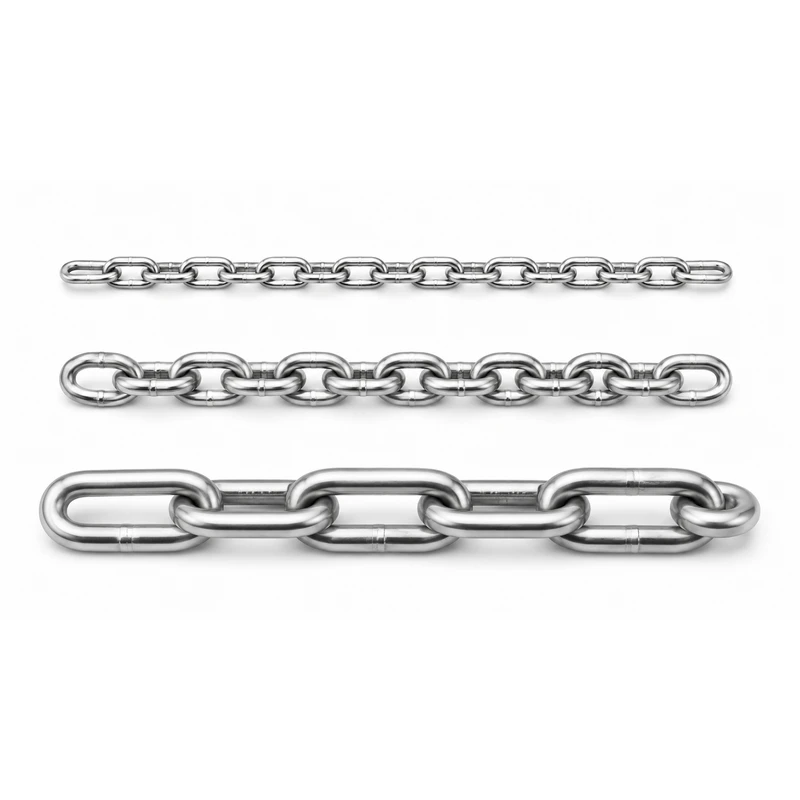
A chain sling inspection should confirm that the complete assembly is identifiable, free from visible damage, dimensionally acceptable, and suitable for its next planned lift. The inspection must cover the tag, master link, every chain link, coupling components, shortening devices, hooks, and other end fittings. If a defect is found, the sling should be removed from service and controlled so it cannot be used by mistake.
This guide provides a practical inspection sequence and a printable checklist. It does not replace the current rules that apply at your site, the sling manufacturer’s instructions, or an assessment by the person your employer designates to perform the inspection.
Chain Sling Inspection: Quick Answer
- Before use: inspect the sling, fastenings, and attachments for damage or defects.
- During use: inspect again when service conditions create a reason to do so.
- Periodically: perform a documented, thorough inspection at an interval based on use, service severity, lift type, and service experience.
- If identification is missing or damage is found: remove the sling from service and follow the site’s quarantine and evaluation process.
- Use the exact rejection limits in the applicable regulation, current standard, manufacturer data, or documented inspection procedure; do not invent a universal percentage for every component system.
Which Rules Apply?
For U.S. general industry, 29 CFR 1910.184 covers sling identification, daily pre-use inspection, periodic inspection, records, proof testing, repair, wear, and certain removal criteria for alloy steel chain slings. Construction work may fall under different provisions, including 29 CFR 1926.251. Other jurisdictions and company systems may use different requirements.
Do not treat OSHA, ASME, EN, ISO, ASTM, and manufacturer instructions as interchangeable certificates. Identify the jurisdiction, application, product scope, edition or revision, and controlling document before publishing a rejection value or setting an inspection interval.
How Often Should Chain Slings Be Inspected?
| Inspection stage | When | Purpose |
| Before-use / daily | Before the sling is used; additional checks during use where conditions warrant | Find obvious damage, defects, missing identification, or unsafe conditions before exposure to load. |
| Periodic thorough inspection | Set from frequency of use, severity of service, nature of lifts, and service-life experience; under U.S. general-industry rules, no interval may exceed 12 months | Document the condition of the full assembly and identify wear, defective welds, deformation, increase in length, and other applicable defects. |
| Event-driven inspection | After an overload, shock load, heat or chemical exposure, abnormal event, suspected damage, repair, or prolonged storage, as required by the controlling procedure | Determine whether the sling must remain quarantined, be evaluated, repaired by an authorized entity, proof tested, or discarded. |
For U.S. general industry, the employer designates the competent person who performs the daily and thorough inspections. Do not replace that defined role with the vague phrase “certified inspector” unless a particular program or jurisdiction actually requires a certification.
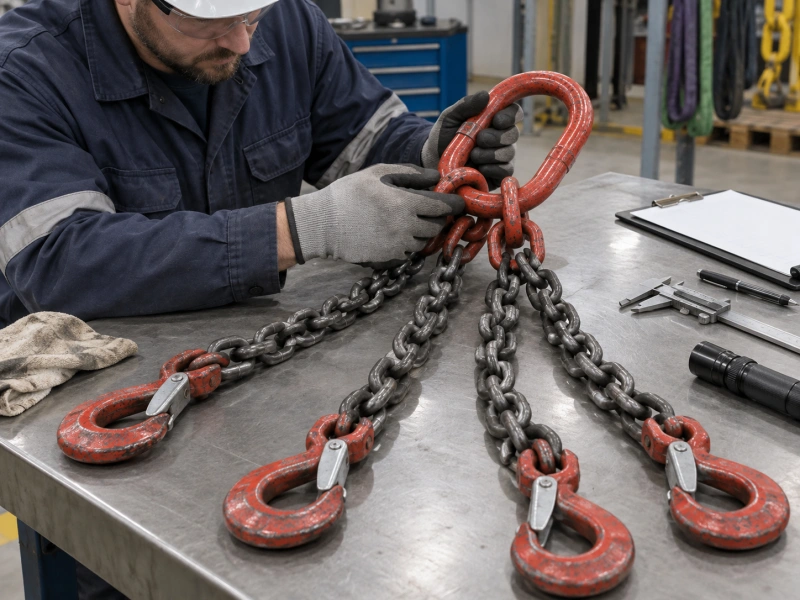
How to Inspect a Chain Sling Step by Step
- Isolate and clean the sling. Move it to a well-lit inspection area. Remove dirt or coatings only by a method that will not damage the chain or hide evidence. Do not inspect a sling while it is supporting a load.
- Verify the identification. Match the sling to its record. Confirm that the durable tag is attached and legible. For U.S. alloy steel chain slings, the tag must state size, grade, rated capacity, and reach.
- Compare the assembly with its specification. Confirm leg count, chain size and grade markings, reach, top fitting, lower fittings, shortening devices, and other components. Look for unauthorized substitutions or makeshift fasteners.
- Inspect the master link and top assembly. Check for cracks, distortion, collapse, twist, wear, gouges, heat evidence, corrosion, damaged welds, and restricted articulation.
- Inspect every chain link. Work link by link along each leg. Check both sides and the bearing areas for wear, stretch, deformation, bends, twists, nicks, gouges, cracks, corrosion, heat damage, weld defects, or links that do not move freely.
- Inspect couplers and shortening devices. Confirm pins and retainers are present and secure. Check pockets, saddles, latches, and load-bearing surfaces for wear, damage, incorrect seating, seizure, or distortion.
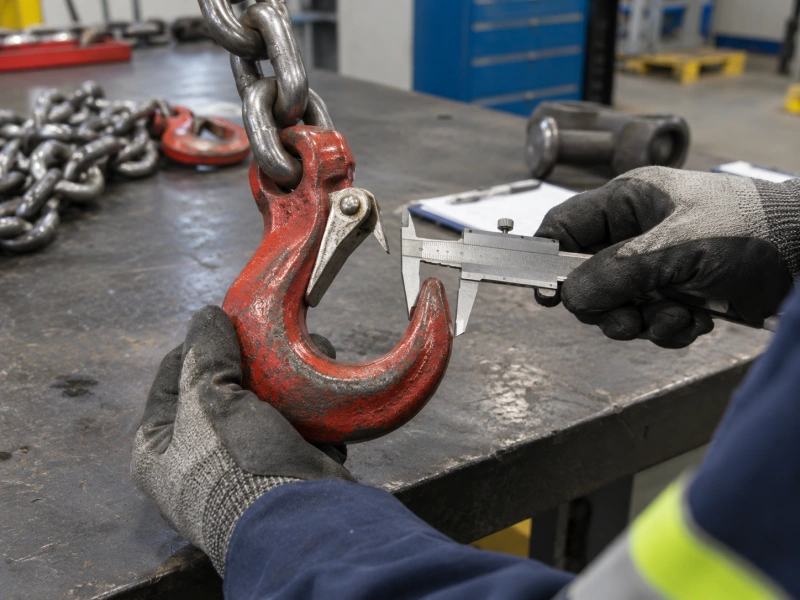
- Inspect hooks and end fittings. Check for cracks, twist, increased throat opening, wear, deformation, damaged latches where fitted, and evidence of tip loading or side loading. Measure when the governing limit requires it.
- Measure and compare. Use suitable gauges or measuring tools and compare results with the current regulation, standard, manufacturer limit, or recorded baseline. A visual guess is not a dimensional inspection.
- Record the result. Identify the sling, date, inspector, condition, measurements, decision, and any corrective action. Keep the record required by the applicable rules and company procedure.
- Release or quarantine. Return the sling to service only when it meets the applicable criteria. Otherwise, tag it out, segregate it, and prevent use pending authorized evaluation or disposal.
If you need a component-by-component refresher before inspecting, review the guide to chain sling components.
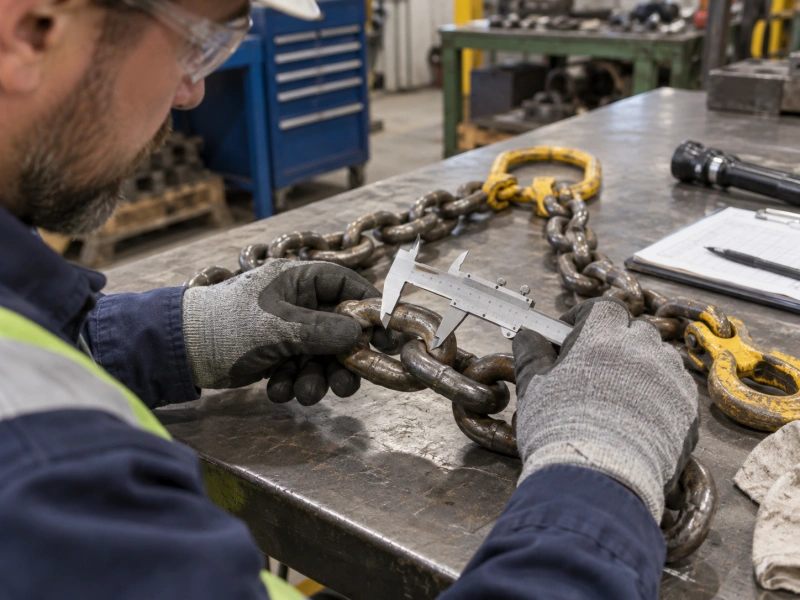
Chain Sling Defects and Removal Criteria
Some conditions clearly require removal from service; others require measurement against the controlling limit. When evidence is incomplete, quarantine the sling instead of assuming that it is acceptable.
| Condition | Action | Source/control |
| Missing or illegible identification | Remove from service; do not estimate the rating from appearance. | 29 CFR 1910.184(c)(14), (e)(1) for U.S. general industry |
| Wear below the minimum allowable chain size | Remove from service when measurement is below the applicable limit. | 29 CFR 1910.184(e)(8) and Table N-184-1, or the controlling current limit |
| Cracked or deformed master link, coupling link, or other component | Remove from service. | 29 CFR 1910.184(e)(9)(i) |
| Hook crack | Remove from service. | 29 CFR 1910.184(e)(9)(ii) |
| Hook opened more than 15% at the narrowest normal throat opening | Remove from service under the cited U.S. rule. | 29 CFR 1910.184(e)(9)(ii) |
| Hook twisted more than 10° from the plane of the unbent hook | Remove from service under the cited U.S. rule. | 29 CFR 1910.184(e)(9)(ii) |
| Wear, defective welds, deformation, or increase in length found during thorough inspection | Immediately remove from service under the cited U.S. rule. | 29 CFR 1910.184(e)(3)(iii) |
| Nicks, gouges, corrosion, heat evidence, seized articulation, damaged latch, or suspected overload | Quarantine and evaluate against the applicable standard, manufacturer limits, and site procedure. | Do not publish a universal numerical limit without a controlled source |
Regulatory values above are presented for U.S. general industry and were checked against the current eCFR text on 8 September 2026. Confirm the current version and applicability before publication or use. Where another current standard or manufacturer requirement is more restrictive, follow the controlling requirement.
What to Do When a Sling Fails Inspection?
- Stop use. Do not attach the sling to another load or leave it in a shared rigging area.
- Tag out and segregate. Mark the sling clearly and move it to a controlled quarantine location.
- Record the finding. Document the sling ID, defect, location, measurements or photographs, inspector, date, and immediate action.
- Obtain authorized evaluation. The manufacturer or an equivalent qualified entity should determine whether repair or reconditioning is permitted.
- Control the disposition. Record return to service, repair and proof-test evidence, or destruction/disposal so the sling cannot re-enter service informally.
Do not weld, heat-treat, replace links, or improvise a repair in the field. Review these chain sling repair limitations before arranging an evaluation.
Inspection Records and Proof-Test Documents
A useful inspection record identifies the actual sling and the decision made. At minimum, record the sling ID, inspection date, inspection type, person performing the inspection, components examined, defects and measurements, disposition, and the next due date where your procedure uses one.
Under U.S. general-industry rules, the employer must keep a record of the most recent month in which each alloy steel chain sling received its thorough inspection. New, repaired, or reconditioned alloy steel chain slings must be proof tested before use by the sling manufacturer or an equivalent entity, and the employer must retain the proof-test certificate.
Printable Chain Sling Inspection Checklist
| Inspection item | Pass | Fail | N/A | Notes/measurement |
| Identification tag is attached, legible, and matches the sling record | ☐ | ☐ | ☐ | |
| Size, grade, rated capacity, and reach are identifiable | ☐ | ☐ | ☐ | |
| Assembly matches the specified leg count, fittings, and configuration | ☐ | ☐ | ☐ | |
| Master link and top assembly show no cracks, deformation, excessive wear, or heat evidence | ☐ | ☐ | ☐ | |
| Every chain link has been examined on both sides and at bearing areas | ☐ | ☐ | ☐ | |
| No link shows unacceptable wear, stretch, bend, twist, nick, gouge, crack, corrosion, or weld defect | ☐ | ☐ | ☐ | |
| Couplers, pins, retainers, and shortening devices are present, secure, compatible, and free-moving | ☐ | ☐ | ☐ | |
| Hooks and end fittings show no cracks, unacceptable throat opening, twist, wear, or deformation | ☐ | ☐ | ☐ | |
| Required dimensions were measured and compared with the controlling limits | ☐ | ☐ | ☐ | |
| No unauthorized repair, makeshift link, bolt, rod, weld, or substituted component is present | ☐ | ☐ | ☐ | |
| Inspection result and disposition have been recorded | ☐ | ☐ | ☐ |
Sling ID: ____________________ Inspection date: ____________________ Inspector: ____________________
Inspection type: ☐ Before-use ☐ Periodic ☐ Event-driven Disposition: ☐ Release ☐ Quarantine
FAQ
How often must a chain sling be inspected?
Inspect it before use and again during use when conditions warrant. Set the thorough periodic-inspection interval based on use, service severity, lift type, and service experience. Under U.S. general-industry rules, that interval cannot exceed 12 months.
Who can inspect a chain sling?
Use the role required by the applicable rule and your employer’s procedure. Under 29 CFR 1910.184, inspections are performed by a competent person designated by the employer. Do not assume that a generic third-party certificate replaces this responsibility.
Can a sling be used if the tag is missing?
No. A sling without affixed and legible identification should be removed from service. Do not estimate its capacity from chain diameter or color.
Does every defect have the same rejection limit?
No. Some conditions require immediate removal, while others require measurement against a current regulation, standard, manufacturer limit, or baseline. Use the controlling source for the exact component system.
Can a damaged chain sling be repaired on site?
Do not make an improvised field repair. Where repair is permitted, it must follow the applicable requirements and be completed by an authorized entity. Welding or heat treatment triggers specific repair, reconditioning, and proof-test requirements.
How often should a chain sling be replaced?
There is no universal replacement age. Remove it when it fails inspection, reaches a controlling rejection limit, cannot be identified, or is otherwise judged unsafe under the applicable procedure.
Selecting or Replacing a Chain Sling
Inspection confirms condition; it does not establish capacity for a new lift. If the load, hitch, number of legs, or angle changes, verify the selection separately using approved data. This guide explains how chain sling capacity changes with configuration and angle.
To compare standard assemblies, review the chain sling range. For a made-to-order assembly, use the guide on how to specify a custom chain sling RFQ and state the required tag, inspection instructions, traceability, and proof-test documents in the inquiry.