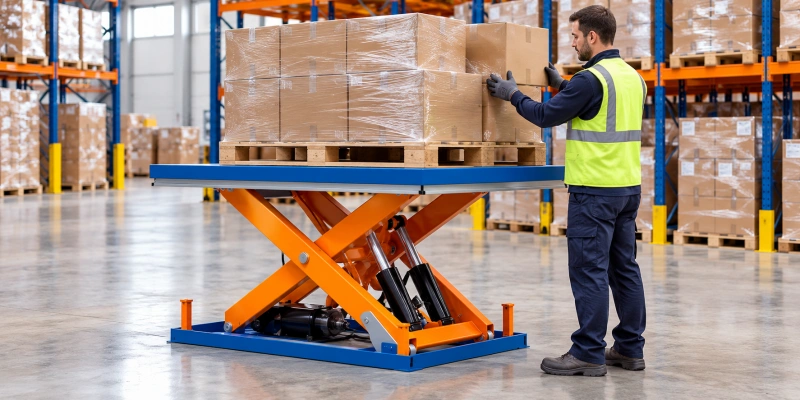
Scissor lift table manufacturers serve different needs. Some offer a broad range of standard tables; others develop platforms around a particular load, floor layout, or production process. This comparison covers industrial tables that lift and position materials in factories, warehouses and assembly lines. It excludes mobile elevating work platforms designed to raise people.
The ten companies below publish relevant lift-table products. Use the comparison to narrow your shortlist, then check the proposed model against your load, travel, duty cycle and site requirements.
The power labels need care: an electric motor often drives a hydraulic pump, while a pneumatic table uses compressed air. If a catalog model does not fit, ask for an application review and a drawing of the proposed custom scissor lift table.
Scissor Lift Table Manufacturers at a Glance
Use this table to build a shortlist. Product lines and options vary by model and market; confirm the configuration in each quote. The numbering is for navigation, not a quality ranking.
| Manufacturer | Location | Main lift table types | Power options | Custom engineering | Best for |
| Powerful Machinery | China | Hydraulic, double-scissor; broader custom concepts | Manual hydraulic; other drives by project review | Custom size, capacity, travel and platform scope to confirm | Export RFQs requiring a project-specific table |
| Southworth Products | United States | Industrial, low-profile and tandem lift tables | Electric-hydraulic and application-specific | Standard and custom positioning solutions | Ergonomic work positioning |
| Vestil Manufacturing | United States | Lift, tilt, portable, low-profile, air tables | Electric-hydraulic, air, manual by family | Broad catalog; model-specific options | Comparing many standard configurations |
| Presto Lifts | United States | Hydraulic, pneumatic, portable, extended travel | Hydraulic, shop air, manual and battery by family | Modified units described by maker | Mixed standard and modified needs |
| Advance Lifts | United States | Single, wide, multistage and custom | Electric-hydraulic; pneumatic options | Published custom table program | Industrial engineering projects |
| Bishamon | United States | Compact, low-profile, mobile, pneumatic | Electric-hydraulic, air, foot pump, battery | Configuration varies by series | Workstation and mobile positioning |
| Autoquip | United States | Heavy duty, wide, high-travel, lift and tilt | Hydraulic, pneumatic and mechanical actuation by family | Custom integration and special platforms | Oversize or integrated loads |
| Pentalift | Canada | Pre-engineered, tandem, high-lift and custom | Hydraulic; confirm each special design | Published custom lift/positioning work | Long loads and engineered handling |
| Marco | Sweden | Single, high-lift, low-built and mobile | Powered fixed; foot-pump mobile by model | Custom solutions; confirm changes to standard models | European engineered applications |
| Sax Lift | Denmark | Stationary, mobile and custom tables | Electric-hydraulic; manual mobile by model | Custom size and functions advertised | Standard and modified European supply |
Need a product-level starting point? Review Powerful Machinery scissor lift tables alongside the comparison, then ask for the model drawing and duty rating that fit your load.
How We Selected These Manufacturers
We included companies with identifiable industrial lift-table ranges on their own websites. Their published product families and custom options give buyers useful points of comparison. We did not audit factories, test equipment or assign a performance score. Since many manufacturers sell through distributors, confirm who will design, supply, commission and service the quoted unit.
Top 10 Scissor Lift Table Manufacturers
1. Powerful Machinery
The Qingdao-based company publishes scissor lift tables, a hydraulic scissor lift table, and a double-scissor design. For custom work, send a load and site brief covering weight distribution, platform size, lowered height and lift travel. Ask which low-profile, tilting or extra-wide arrangement can be engineered for your application, and request its drawing before ordering.
Before ordering, confirm the rated load at its intended position on the deck, the controls and protective features, documents required at the destination, installation scope and service arrangements.
2. Southworth Products
Southworth publishes standard, low-profile and tandem lift tables, as well as examples of custom work positioning. Check how the proposed platform is loaded and whether it remains accessible throughout the task.
For a workstation or pallet-handling application, confirm edge-load limits, controls, and service coverage for the quoted model.
3. Vestil Manufacturing
Vestil catalogs electric-hydraulic, pneumatic, portable, low-profile, and double-scissor tables. Its range is useful for comparing forms, but capacity and available accessories must be checked against the specific model.
Ask the seller to confirm the allowable load position and the support route for the unit you select.
4. Presto Lifts
Presto lists hydraulic, pneumatic, portable, floor-height and extended-travel tables and offers modifications to standard units. Its portable range includes manual foot-pump and battery-powered models.
If more than one drive or mobility option could work, compare site power, lift frequency, platform details and the limits of the proposed modification.
5. Advance Lifts
Advance Lifts publishes single-scissor, multistage, wide and custom tables. Its custom range includes hydraulic and pneumatic projects, with higher-travel and larger-platform designs elsewhere in its catalog.
For a high-travel or unusual platform, send the loading pattern and installation drawing. Confirm anchorage, pit or floor details, and cycle duty in the proposal.
6. Bishamon
Bishamon lists electric-hydraulic, pneumatic, compact, low-profile, manual mobile and battery mobile series. Compare these at the series level because their actuation and operating requirements differ.
Where floor space, entry height, or mobility drives the choice, check minimum platform height, footprint, controls, and model-specific support.
7. Autoquip
Autoquip offers wide, long, high-travel and low-profile tables, plus pneumatic and mechanically actuated designs. Its catalog also shows custom fixtures and material-handling integration.
For an oversized or integrated load, request checks for the load center, platform deflection, controls, guarding, and maintenance access.
8. Pentalift
Pentalift publishes hydraulic, tandem, multistage, and custom lift tables. Its project examples can help buyers frame long-load support and transfer geometry.
For a long or concentrated load, establish support points, platform deflection, and the receiving site’s installation requirements.
9. Marco
Marco offers single-scissor, high-lift, low-built and mobile tables alongside custom solutions. Its standard Economy Line and project-specific ranges have different ordering paths; confirm which range can meet your requested changes.
Check the proposed configuration, electrical supply, local distributor and service arrangement before ordering.
10. Sax Lift
Sax Lift publishes stationary, mobile and custom tables. It offers changes to dimensions, capacity, and functions, subject to the particular design.
Compare a standard model with the proposed modification, and confirm the approved drawing, delivery destination, and service route.
Custom Scissor Lift Tables: What Can Be Engineered?
A custom lift table starts with the load and the way it enters, moves across, and leaves the platform. An extra-wide deck, low closed height, long travel, tilting top, or line-integration interface changes the engineering problem.
A nominal capacity alone is not enough when weight sits near an edge or moves during the cycle. Scissor lift design explains the underlying geometry; a project drawing must still establish the offered machine.
| Parameter | What to tell the manufacturer |
| Load and distribution | Maximum operating mass, footprint, center of gravity, point/edge loads, any shifting load. |
| Platform | Minimum usable length and width; rollers, turntable, tilting surface, restraints, or conveyor interface. |
| Heights and travel | Required closed height and raised deck height; vertical travel is their difference for the same reference point. |
| Motion and controls | Cycle count, lift frequency, speed expectations, control location, emergency stop and interlocks. |
| Drive and location | Available electricity or compressed air; hydraulic fluid constraints; indoor/outdoor exposure. |
| Installation | Fixed or mobile, pit or surface mount, floor capacity, anchors, loading and unloading methods. |
| Documents | Destination rules, drawings, operating manual, test/certificate requirements to agree in the quote. |
Ask the manufacturer to confirm what is feasible for the chosen drive, duty, and site. Lift table modifications can help frame changes to an existing hydraulic arrangement, but a new custom design still needs its own engineering review.
Hydraulic vs Electric vs Pneumatic Scissor Lift Tables
Hydraulic Scissor Lift Tables
Hydraulic pressure extends a cylinder to raise the scissor mechanism. A foot pump or an electric motor may supply that pressure, so an electric-hydraulic table belongs in both descriptions. Compare hydraulic lift tables by the quoted model’s capacity, closed height, cycle rating, fluid containment, and maintenance access. For more detail, see how a hydraulic lift table works.
“Electric” describes the power input, not necessarily the lifting mechanism. A motor may drive a hydraulic pump, or a different actuator may raise the platform mechanically. Ask for the actual drive schematic, voltage, controls, cycle rating, and maintenance requirements. Specify an oil-free requirement only when the quoted design has no hydraulic circuit.
Ask what “electric” drives. An electric motor may run a hydraulic pump, while an electromechanical actuator uses a different arrangement. The distinction affects service, power supply, and contamination controls. For frequent push-button positioning, define voltage, cycles, controls, and the load profile. Do not assume an electric table is oil-free unless its specified design has no hydraulic circuit.
Pneumatic or Air Lift Tables
Pneumatic tables use compressed air to raise the platform, often through an airbag or other air actuator. They can suit sites with a suitable air supply or a reason to avoid hydraulic fluid. Check air pressure and flow, load behavior at intermediate heights, operating frequency, and maintenance needs. Compressed-air actuation alone does not establish approval for a hazardous area.
Manual and Mobile Lift Tables
A foot-pump table can suit intermittent work; a battery-powered mobile table removes the trailing mains cable but needs charging. Confirm caster and floor suitability, brakes, and whether the manufacturer permits moving the unit with a raised load. For frequent operation at a fixed station, compare a powered stationary design against the mobile option.
Manufacturer vs Supplier: What Should Industrial Buyers Look For?
A manufacturer may design and produce the table; a supplier or distributor may offer several brands, local stock, installation, and nearby service. The roles often overlap. Before choosing a route, establish who approves the design, issues the warranty, supplies spare parts, and handles service at the installation site.
Choosing a Scissor Lift Table by Application
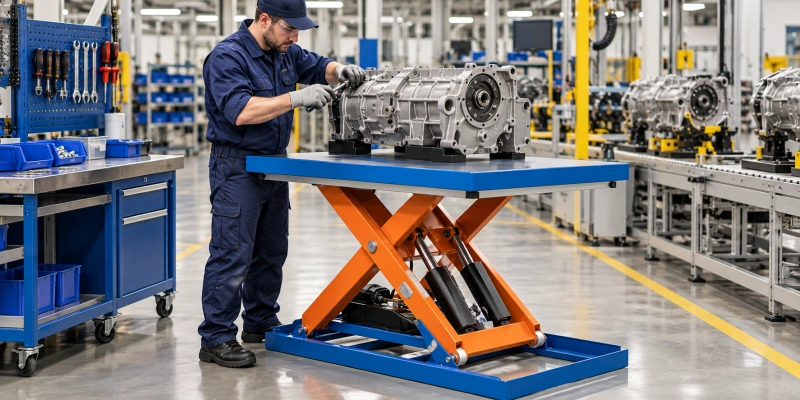
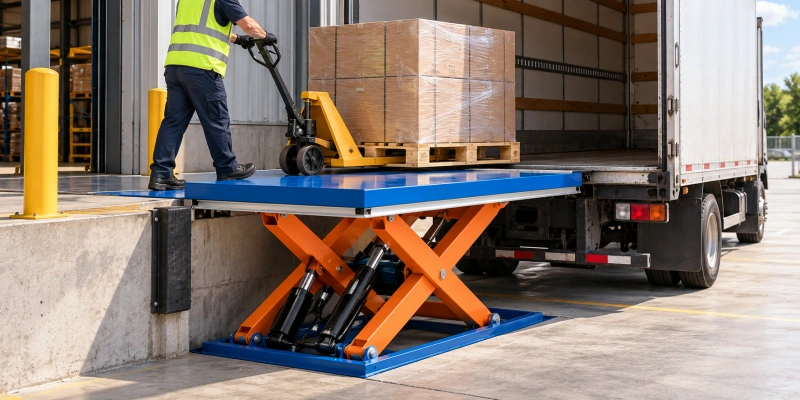
For warehouse or packaging work, start with the way pallets or containers enter the platform. A pallet truck may require a low-profile deck, ramp, or pit; a conveyor needs a defined transfer height and interface. Assembly lines may also need position signals and interlocked controls. For equipment maintenance, specify the supported component and any off-center loading.
Long, irregular, or oversized loads need a plan for support points, overhang, and changing center of gravity. A wider or tandem platform may be appropriate, but the manufacturer must check stability and platform structure. Outdoor or wet installations add corrosion, electrical enclosure, drainage, and maintenance questions. For a broader equipment shortlist, see material handling lifting equipment.
What to Confirm Before Ordering
Compare quotations against the same application brief and request a drawing for each proposed configuration. Then check what the quoted price actually includes: guarding, controls, documentation, shipping, installation, and commissioning. Ask who handles warranty claims and supplies spare parts in your market. A general brochure cannot settle these order-specific responsibilities.
Discussing a Custom Lift Table With Powerful Machinery
The scissor lift table range offers a starting point for an application review. Send a load sketch and site layout, especially if the deck must interface with a pallet truck, conveyor, or fixture. Ask which drive and platform arrangement Powerful can quote, and request the drawing, rating, and available documents for that exact configuration.
What to Specify When Requesting a Scissor Lift Table Quote
Send the following details with your inquiry or attach them to a drawing:
• Maximum load weight, dimensions, center of gravity, and whether the load shifts.
• Required platform length and width; any tilt, rotation, conveyor, roller, fixture, or restraint.
• Required lowered height, raised height, and vertical travel, using one consistent deck reference point.
• Cycles per hour or shift, operating hours, lift frequency, and required speed if critical.
• Available power: voltage and phase, compressed-air pressure and flow, or manual preference.
• Fixed or mobile installation; floor or pit details; forklift or pallet-truck loading.
• Indoor or outdoor location, dust, washdown, temperature, corrosion, and any classified area.
• Controls, guards, interlocks, maintenance access, and site interfaces.
• Destination country, applicable standard/documentation request, quantity, and delivery location.
Attach photos or a layout drawing where possible. State whether the table handles materials only. For a quote tied to the actual application, send your scissor lift table RFQ.
FAQs
What is a scissor lift table?
A scissor lift table raises and lowers materials on a platform supported by linked scissor arms. Select it for the load and installation. Do not assume a material lift table is approved to carry people.
How do I choose a scissor lift table manufacturer?
Ask each company to quote the same load and duty brief. Compare the resulting drawings, allowable load positions, controls, documentation, and service responsibility for your destination.
What is the difference between a manufacturer and a supplier?
The terms describe different roles, although one company can perform both. Identify the party responsible for design approval, the sales contract, and support after installation.
Are hydraulic scissor lift tables better than electric models?
They are not always competing types: many electric tables use hydraulic cylinders. First identify the actuator, then compare the power supply, load, cycle duty, and maintenance requirements of the actual models.
When should I consider a pneumatic lift table?
Consider air power if suitable compressed air is available or hydraulic fluid is undesirable. Ask about air demand and positioning under load, and check site-specific equipment approvals separately.
Can a scissor lift table be customized?
Platform geometry, travel, load rating, controls, and line interfaces may be designed around the application. Feasibility depends on the whole configuration; request a reviewed drawing and its stated rating.
What information should I provide for a custom quote?
Give the load footprint and center of gravity, required deck size and height range, cycles, available utilities, and installation layout. State the destination and any required documents. Photos of the loading path help reveal clearance problems.