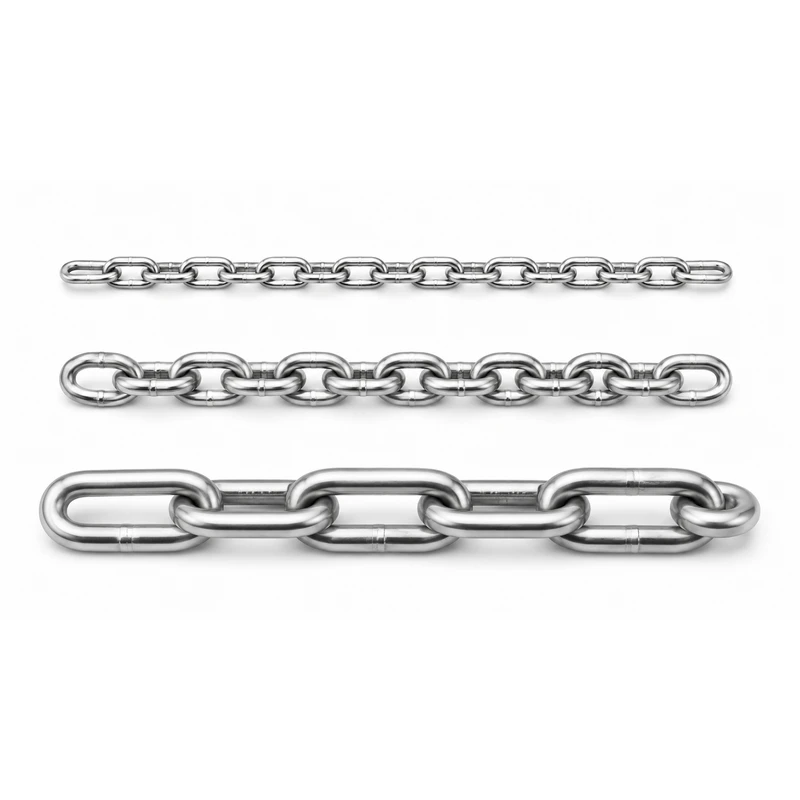
Hoist chain replacement starts with identifying the exact hoist and confirming an approved replacement load chain. If the load chain is damaged or its condition is uncertain, keep the hoist out of service until it has been assessed. Matching only the visible chain diameter or selecting a higher chain grade does not establish compatibility.
This guide covers replacement decisions and service preparation for manual chain hoists operated by a hand chain and used for ordinary vertical material lifting. It does not provide chain removal, reeving, or installation instructions. Electric hoists, lever hoists, and special applications require model-specific instructions and service arrangements.
Identify Which Chain Needs Attention
In a manual chain hoist, the operator pulls the hand chain to drive the lifting mechanism, while the load chain supports and moves the load. The two chains perform different functions. A replacement request should identify the affected component rather than asking only for a chain of a particular size.
| Component | Function | Replacement Question |
| Load chain | Carries the suspended load through the hoist mechanism | Which approved load chain and part number are specified for this exact model? |
| Hand chain | Transfers operator input to the hand wheel | Which hand chain specification and arrangement does the manual specify? |
| Hook latch | Helps retain the load attachment in the hook when fitted | Which latch assembly is specified for this hook? This is not a chain replacement. |
If you cannot identify the component or the hoist model, send photographs of the nameplate and the complete unit to the manufacturer or service provider. Do not dismantle the hoist simply to obtain a photograph. If identification remains uncertain, pause the order until the component and model are confirmed.
When to Stop Using the Hoist?
Visible cracks in the load chain, bent or twisted links, significant corrosion, abnormal chain travel, or a suspected overload require assessment before further use. A slipping brake, damaged load-chain attachment, or missing identification also requires attention even if the chain itself appears sound. [4]
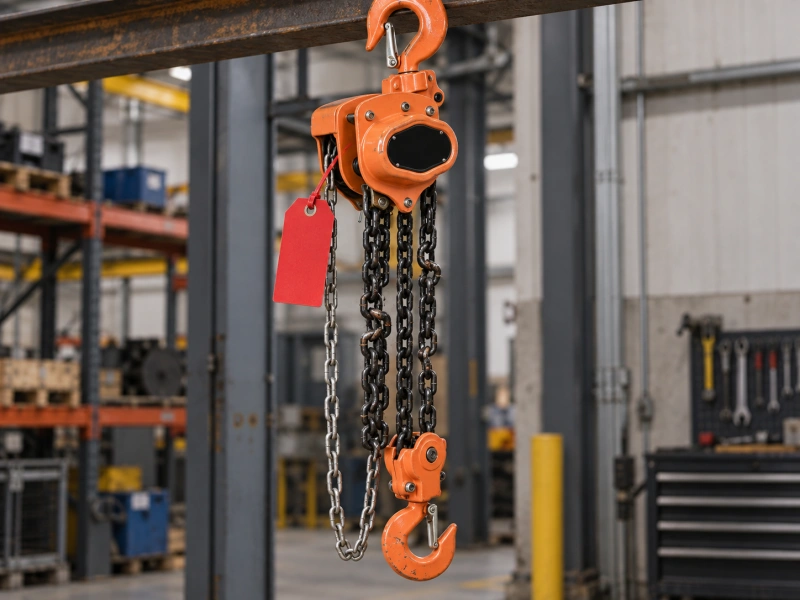
Report the defect and identify the hoist as out of service in accordance with your site procedure. If a load is already suspended, secure the area and arrange a controlled recovery by competent personnel. Do not remove chain connections under load or assume that a faulty hoist can safely lower the load.
Measurements must follow the method and acceptance criteria specified for the exact model. A wear percentage without a defined dimension, original value, and measurement method is not a usable discard criterion. Ask the assessor to record the findings and state whether the chain, associated components, or complete hoist requires replacement.
Use the chain block inspection checklist to organize observations, but do not treat it as a substitute for the manufacturer’s manual.
Confirm a Compatible Replacement Load Chain
Obtain written confirmation that the replacement load chain is approved for the hoist manufacturer, exact model, and configuration. The supplier should identify the approved part number or specification and explain any proposed substitution. A quotation that lists only chain diameter and price leaves the primary compatibility question unresolved.
A hoist load chain is dimensionally matched to the pocket wheel that drives it. RUD instructions require the chain and wheel to be accurately matched, including the specified chain tolerances. They also distinguish hoist chain from sling chain. Compliance with a chain standard alone does not establish approval for every assembled hoist.
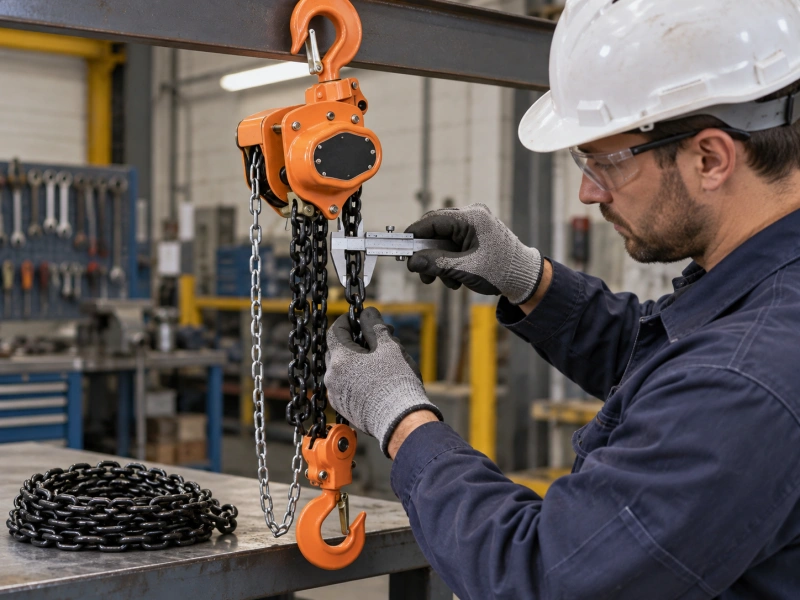
When ordering a replacement load chain for a chain hoist, request written confirmation of:
- The hoist manufacturer, complete model designation, and serial number or asset identification.
- The approved chain part number, specified diameter and pitch, and applicable dimensional tolerances.
- The required chain type and material specification, and compatibility with the installed load wheel.
- The required lift height, number of load-chain falls, and complete replacement length or chain assembly.
- The chain-end connections, stops, and any associated replacement parts specified by the manual.
- The replacement chain’s identification, traceability, and supplied documentation.
Use measurements and photographs only as identification aids. Do not use a worn chain as the sole dimensional reference, and do not calculate order length from lift height alone. Ask the manufacturer or repair provider to resolve any missing details before parts are supplied.
You can review our hoist chain range when preparing an inquiry. Specify the existing hoist and request compatibility confirmation before ordering; a product listing does not approve a chain for use on another manufacturer’s equipment.
Prepare the Hoist for a Qualified Service Provider
HSE maintenance guidance for Great Britain calls for competent personnel, adequate instructions, and planned maintenance work. Manufacturer instructions should form the basis of the safe working method. These principles do not turn a general article into a service manual.
Provide the service provider with the unit identification, previous inspection records, and a concise description of the fault. Include any known overload, shock event, jamming, chemical exposure, or unauthorized modification. Describe what occurred before the problem appeared rather than offering an unverified diagnosis.
Ask for a quotation that separates chain supply, assessment, associated parts, installation, and any required examination or testing. Request an estimated turnaround time and a clear explanation if the unit cannot be economically restored. Do not assume that purchasing a chain authorizes its installation.
For faults involving the brake or other mechanisms, use the chain block repair guide to prepare questions for the service provider. Keep the replacement request tied to the identified defect rather than proposing an upgrade to the hoist rating.
Installation Must Follow the Exact Model Instructions
The service provider must follow the approved procedure for load-chain routing, orientation, attachments, and any required associated parts. These arrangements vary by hoist configuration, so a generic chain-reeving sequence or universal fastener instruction is inappropriate.
Secure the equipment and work area in accordance with the approved maintenance plan. A manual hoist still presents mechanical and falling-load hazards even without an electrical supply. Powered equipment requires its own isolation procedure.
Do not weld, straighten, or otherwise modify load-chain links to keep a damaged chain operating. RUD instructions prohibit structural modifications such as welding and bending and restrict surface treatments such as galvanizing. [1] A suspected damaged link should be referred for the specified replacement decision, not an improvised repair.
Ask the technician to inspect the chain path and related components within the service scope. Replacing the chain without identifying the cause of the damage can leave the underlying fault unresolved. The service report should describe the defect, corrective work, and any remaining restrictions.
What Must Happen Before the Hoist Returns to Service?
A chain certificate documents the supplied chain; it does not, by itself, establish that the repaired hoist is ready for service. Agree on the required examination and testing with the service provider before work begins. Keep the hoist out of service until those requirements have been completed and documented.
In Great Britain, HSE identifies replacement or repair of critical parts as circumstances that may require thorough examination. Testing should be determined from the risk assessment and manufacturer information; some overload tests can damage equipment. Do not apply a universal test-load percentage from a general guide.
For equipment subject to U.S. requirements or project specifications, confirm the applicable standard and edition. ASME B30.16 covers overhead underhung and stationary hoists, including hand-chain-operated hoists. Lever hoists fall under the separate scope of ASME B30.21. Citing a standard does not provide a model-specific service procedure.
A useful service record should include:
- The hoist identification, replacement chain, and associated parts fitted.
- The instructions and acceptance criteria used for the work.
- The defect findings and corrective actions.
- The examination or test performed, where required, including the method and result.
- Any outstanding restrictions and the person who authorized service return.
If the provider cannot identify the approved replacement or explain the release requirements, do not return the hoist to service. Smooth no-load operation is not a substitute for the required assessment.
Care After Replacement
Resume the inspection and maintenance program specified for the hoist and its service conditions. Record the replacement date so that later measurements and defect reports can be linked to the correct chain. Ask the service provider to identify any changes to the maintenance instructions.
Follow the approved lubrication instructions. RUD guidance also calls for consultation with the manufacturer when abrasive contaminants affect lubricant selection. Do not apply a protective coating or cleaning treatment simply because it is marketed for general-purpose chain.
The chain block maintenance guide covers routine care. If the hoist will be stored instead of returned to immediate service, consult the chain block storage guide and keep the service records with the unit.
Questions About Hoist Chain Replacement
Can I Replace a Hoist Chain Myself?
Undertake the work only if you are trained and authorized for the exact hoist, have the required instructions, and can meet the applicable inspection and testing requirements. Otherwise, arrange service by qualified personnel. A general guide cannot establish your competence or authorization.
Is the Same Diameter Enough to Confirm Compatibility?
No. Obtain approval for the exact model and chain specification. Diameter is only one identification detail; the quotation should also identify the approved part number or specification.
Can I Fit a Higher-Grade Chain to Increase Capacity?
Do not use a chain replacement to change the hoist’s rated capacity. Request the approved replacement chain for the existing configuration and continue to observe the marked rated capacity and applicable operating limits.
Can One Damaged Link Be Repaired?
Do not weld, straighten, or improvise a repair to a load-chain link. Keep the hoist out of service and obtain the manufacturer’s replacement decision. Do not install a general-purpose joining link in the load-chain path.
Does Every Replacement Require a 125% Load Test?
No universal test percentage should be assumed. Confirm the required procedure for the exact hoist, applicable requirements, and service circumstances before testing. Do not perform an improvised overload test.
What Should I Send With a Replacement Inquiry?
Send the manufacturer and exact model, a nameplate photograph, rated capacity, lift height, chain configuration, and a description of the defect. Include the approved part number if available, and ask the provider to resolve any missing information.