You need more than a nominal shackle size to select a shackle for a lifting connection. The working load limit (WLL) must be adequate for the actual force on the shackle, and the pin, opening, and body dimensions must fit the components it connects.
This guide explains how to read a shackle size chart using selected examples from Powerful Machinery’s catalogue. Use the exact model drawing, marked rating, and current product data for your final selection.
Key Takeaways
- Start with the required WLL and intended load direction, then check the nominal size and the dimensions that control fit.
- A nominal size is a size designation within a product pattern. It does not define every clearance or guarantee a particular capacity across different models.
- Compare like-for-like units and model types. The sample tables below retain the catalogue’s “TON” label because the supplied catalogue does not define its ton convention.
- If you need to measure an existing item, identify the model first and compare your measurements with its corresponding drawing. Never assign a WLL from dimensions alone.
Understanding Shackle Sizes
What Are Shackle Sizes?
Shackle sizes refer to the dimensions and size designations used to identify a shackle for lifting and rigging. Size is not just the overall length. Relevant dimensions can include the body diameter, the width between the eyes, and the pin diameter.
Each measurement affects how the shackle fits with mating equipment. The nominal size shown in a chart may correspond to one dimension, but the complete geometry is defined by the exact product pattern and model.
Do not assume that a one-inch bow shackle and a one-inch Dee shackle are interchangeable. They may have a similar nominal body size and even a similar marked WLL while providing different clearance for a sling eye or lifting lug. Likewise, the same pattern made to a different specification may use a different pin, opening, or rating.
Read across a single manufacturer’s model table rather than combining dimensions from unrelated charts.
How Are Shackle Sizes Measured?
Body diameter, pin diameter, inside width at the pin, internal clearance, and the overall envelope are common chart dimensions. The symbols used for these measurements vary by drawing. On the supplied G-209 chart, for example, the nominal size and P both identify the body size, while other lettered dimensions describe the opening and envelope.
Check the diagram associated with that table before interpreting A, B, or C.
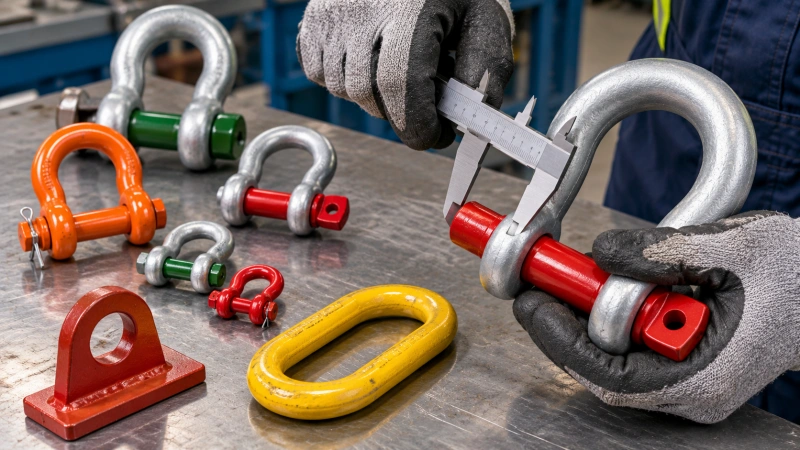
If you are identifying an existing shackle for replacement, compare its markings and measured dimensions with the exact product drawing. For caliper positions and the full procedure, see how to measure a shackle. Measurement can confirm fit or flag a discrepancy; it cannot restore an unreadable WLL or turn an unidentified connector into a rated lifting shackle.
Why Size Matters?
Choosing the correct size matters because the connection needs both adequate rated capacity and usable clearance. An undersized pin may not bear correctly in a lug; an oversized body may not fit the available space.
A sling eye can also be pinched by a connection that appears roomy from the outside. If the load path is angled, consult the manufacturer’s allowable loading directions and any required WLL reduction for the specific shackle.
Establish the force at the shackle for the planned rigging configuration, including sling-angle effects where relevant, and choose a marked WLL that is not exceeded. A larger nominal diameter is not a substitute for checking the rating. Compare the mating component’s hole, eye, or hook geometry with the shackle’s pin and inside-width dimensions before ordering.
Common Shackle Sizes and Types
Standard Shackle Sizes
Powerful Machinery offers metric and inch-based shackle patterns. The tables below are selected examples, not a universal conversion chart or a complete list of available sizes. Their WLL values reproduce the catalogue’s “TON” unit label exactly. Confirm the current product revision and the ton convention with the supplier before using a numeric value in a lifting calculation.
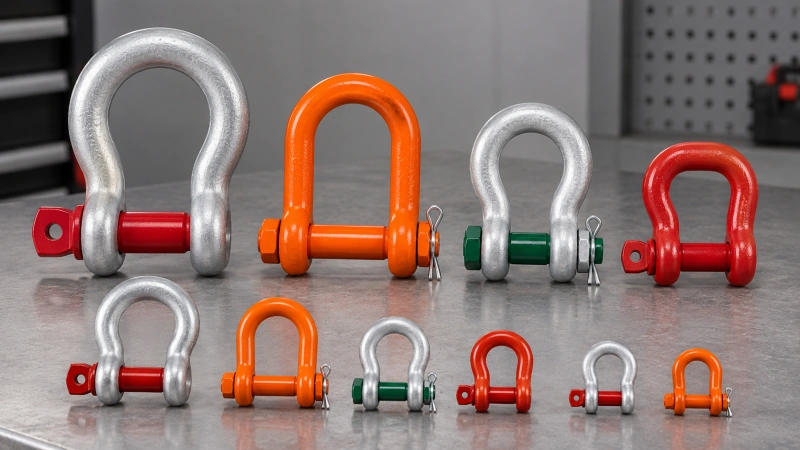
Selected Grade S bow shackle examples from the catalogue’s AS 2741-pattern table:
| Nominal size P (mm) | WLL (catalogue TON) | Pattern |
| 6 | 0.5 | Grade S bow |
| 10 | 1 | Grade S bow |
| 16 | 3.2 | Grade S bow |
| 25 | 8.5 | Grade S bow |
| 32 | 12 | Grade S bow |
| 44 | 25 | Grade S bow |
| 63 | 55 | Grade S bow |
Selected U.S.-type G-209 screw-pin anchor shackle examples from its own inch-based table:
| Nominal size (in) | WLL (catalogue TON) | Pattern |
| 3/16 | 1/3 | G-209 bow |
| 3/8 | 1 | G-209 bow |
| 1/2 | 2 | G-209 bow |
| 3/4 | 4-3/4 | G-209 bow |
| 1 | 8-1/2 | G-209 bow |
| 2 | 35 | G-209 bow |
| 3 | 85 | G-209 bow |
These rows show the relationship between size and WLL within each named product range. They do not mean that every shackle of a given nominal size has the same WLL, pin geometry, or material. The supplied catalogue contains separate tables for Grade S Dee, G-210 Dee, G-2130 safety-bolt bow, and G-2150 safety-bolt Dee patterns.
Use the table for the exact product being compared rather than applying a G-209 row to a different body style or pin arrangement. The live G-209 screw-pin anchor shackle page shows the complete inch table for that named pattern.
Shackle Types Available from Powerful Machinery
Powerful Machinery lists bow (anchor) and Dee (chain) body styles with screw-pin and safety-bolt pin arrangements. A bow shackle typically provides more space at the crown for certain connections, while a Dee shackle has a narrower profile and is generally used where the connection and load remain aligned with the shackle body.
A safety-bolt arrangement uses a bolt, nut, and cotter pin for positive pin retention. The correct choice still depends on the exact model, marked WLL, connection geometry, permitted load direction, and manufacturer instructions.
For example, the catalogue identifies G-209 as a screw-pin anchor shackle pattern and G-2150 as a safety-bolt Dee shackle pattern.
Review the G-2150 bolt-type Dee shackle table for its own pin and opening dimensions, or browse the full shackle product range to compare available patterns. Do not infer that G-2150 is stainless steel from its model number; the supplied catalogue does not state that material for this pattern.
Typical Applications
Shackles are used across many industries. In construction, they may connect suitable slings and lifting points. Marine and industrial applications also use shackles in a range of rated lifting and non-lifting connections.
In every case, the product must be specified for the actual duty and service environment. A towing component, for example, is not automatically suitable for overhead lifting simply because it has a familiar shape.
Fit requirements change with the mating component. With a lifting lug, check the lug-hole diameter and thickness against the shackle pin and inside width. With a sling eye, check the eye dimensions and required bearing area against the shackle and sling manufacturer’s instructions.
If a standard bow shackle does not provide a suitable bearing surface, do not describe it as a wide-body model unless the specific product is documented and rated for that application.
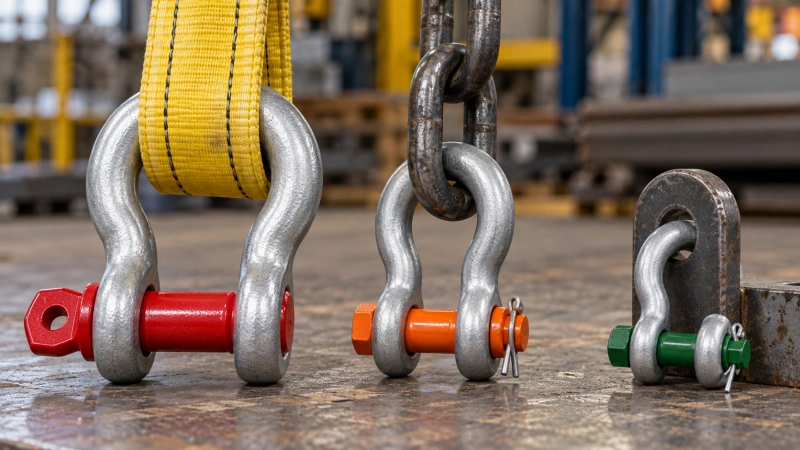
Choosing Shackle Sizes
Selection Steps
Selecting the correct shackle size is a step-by-step process that helps you match a rated shackle to the connection. Use the following sequence when comparing catalogue rows or preparing a request for quotation:
- Determine the actual force at the shackle for the intended lift, including the effect of the rigging arrangement. State the required WLL and the unit.
- Choose the body style and pin arrangement appropriate to the connection. Confirm whether the manufacturer permits the planned load direction and any angular loading.
- Read the marked WLL and the exact model data. Do not exceed the applicable rating or substitute nominal size for a capacity check.
- Compare the pin diameter, opening, inside length, bearing area, and outside envelope with every mating component. Allow sufficient clearance for assembly without forcing the fit.
- Inspect the complete shackle body and its correct matching pin before use, then secure the pin or bolt exactly as specified for that design.
If the marked WLL, product identity, or model drawing cannot be confirmed, stop and obtain the manufacturer’s data. A similar-looking pin from another shackle is not a valid replacement. For a more detailed pre-use review, follow the shackle inspection checklist.
Dimensions and Units to Check
| Chart Item | What You Need to Verify |
| Nominal Size | The model-specific body-size designation, in mm or inches; it is not a complete fit specification. |
| Pin Diameter | Compatibility with the lifting lug or other bearing surface, with the approved fit and clearance. |
| Jaw or Inside Width | Space for the mating component without binding, pinching, or unapproved stacking. |
| Internal Length and Bow Clearance | Room for the sling eye, link, or fitting through the expected range of movement. |
| WLL and Unit | The marked load rating and the unit convention stated in the controlled product data. |
| Outside Envelope | Space for installation and operation without contact with adjacent hardware. |
Chart letters are not universal. Read the dimension sketch that belongs to the same model and revision as the table. If a customer specification requires millimetres but the selected model is charted in inches, request an approved metric drawing instead of silently rounding a fraction to the nearest convenient size. The product designation, marking, and drawing should all refer to the same hardware.
Factors to Consider
When selecting a shackle, consider more than nominal size. Material, finish, service environment, pin retention, inspection access, and load direction all matter. Galvanizing can improve corrosion resistance, but it does not make a product suitable for every marine or chemical environment.
Stainless steel is a separate material choice, not a property of every G-series pattern. Ask for the material grade and finish of the exact item being purchased.
Also consider whether a repeated or long-term connection requires positive pin retention and whether the sling eye or lug will bear on the intended surface. Do not apply a generic percentage reduction for side loading. Only the specific manufacturer’s instructions can establish whether angular or side loading is permitted and how the WLL changes in that configuration.
Mistakes to Avoid
Many rigging problems begin with simple selection, fit, or use errors. Reduce the risk by avoiding these common mistakes:
- Choosing the wrong sling or shackle for the job.
- Attaching the load incorrectly or using the shackle in the wrong orientation.
- Exceeding the applicable WLL or confusing the unit in a chart.
- Using a bent pin, deformed body, damaged threads, or illegible required markings.
- Forcing or hammering a shackle into a connection that does not fit.
- Assuming that a screw pin will remain secure when the application may cause it to rotate or loosen.
If you are uncertain about fit or loading, consult the manufacturer or a qualified rigging professional before the lift. A larger shackle may solve a clearance problem in one location while creating interference elsewhere. Recheck the complete assembly whenever the shackle size changes.
Shackle Markings and Safety
Reading Markings
Read and verify the markings before using a shackle. The manufacturer’s identification and rated load provide a more reliable basis than an estimate based on appearance. The exact marking requirements depend on the model, product specification, and applicable rule; do not assume that every shackle body carries an angle indicator, certificate number, or identical symbol layout.
For U.S. construction material handling, OSHA 29 CFR 1926.251 requires manufacturer-prescribed, permanently affixed, legible identification markings on rigging equipment and prohibits the use of shackles above the applicable rated capacity. If the required identity and rating cannot be established, keep the item out of the ready-to-use rigging pool until it can be evaluated.
Understanding WLL
The working load limit (WLL) is the rated load assigned to the product under specified conditions of use. Do not calculate it from nominal diameter, a competitor’s table, or a universal breaking-strength ratio. A shackle with an apparently adequate WLL can still be unsuitable if its pin does not seat correctly in the lug, its body pinches a sling eye, or the load direction is outside the manufacturer’s permitted arrangement.
Use the chart for initial comparison, then request the controlled product specification and check the marking on the supplied shackle. Where a project requires a particular standard, proof-test report, certificate, or traceability record, state those requirements in the purchase order and confirm which documentation applies to the exact batch. Reference to ASME B30.26 or an AS 2741 pattern by itself is not a certificate for every product.
Inspection Tips
Inspect the body, eyes, pin, and retention components before the shackle is used. Look for distortion, cracks, unusual wear, severe corrosion, damaged threads, and mismatched parts. For U.S. construction work covered by OSHA 1926.251(a)(1), rigging equipment is inspected before use on each shift and as necessary during use, with defective equipment removed from service.
Additional periodic examinations and record requirements depend on the governing requirements, service conditions, and site program; this page does not establish a universal six-month interval or product lifespan.
Powerful Machinery Shackle Solutions
Product Highlights
You can compare Grade S bow and Dee patterns, U.S.-type G-209 and G-210 screw-pin models, and G-2130 and G-2150 safety-bolt models in Powerful Machinery’s published shackle range. The example charts above cover only Grade S bow and G-209.
For another model, request its separate current size, WLL, and dimension table. Do not copy a G-209 capacity into a G-210, G-2130, or G-2150 purchase specification simply because the nominal size matches.
Customization and Support
A project may require a different pin arrangement, finish, marking, packaging, or connection dimension. Send the intended use, required WLL and units, body style, pin type, mating-component dimensions, service environment, quantity, and documentation requirements with your inquiry. Powerful Machinery can then confirm a specific configuration and current availability.
A custom dimension or alternate pin should be reviewed and rated as part of the actual product design, not treated as an on-site modification.
Conclusion
Choosing the correct shackle size means matching a rated product to the complete connection. Start with the force and intended load path, use the correct model’s chart to check the pin and opening dimensions, and verify the marking and condition of the supplied hardware.
The selected catalogue rows provide a starting point for comparing product patterns, while the current product drawing and manufacturer instructions govern the final selection.
FAQs
What Size Shackle Should You Use for Lifting?
Choose a shackle whose marked WLL is adequate for the force in the intended configuration, then check its pin diameter, jaw opening, inside clearance, and bearing fit. The required nominal size comes from that specific model’s chart; it cannot be determined from load weight alone.
Does the Same Nominal Size Always Have the Same WLL?
No. The rating depends on the exact design, material, product specification, and conditions of use. Compare rows within the named model range and verify the marking on the actual shackle. The examples in this article should not be transferred to another manufacturer’s product.
Is Pin Diameter the Same as Nominal Shackle Size?
Not necessarily. A chart often names the shackle by a body dimension while listing the pin diameter separately. Check the model’s drawing and pin dimension before matching it to a lifting lug or another component.
How Do You Know Whether a Shackle Fits?
Compare the mating component’s dimensions with the pin, inside width, internal length, and outside envelope in the exact model drawing. Check the bearing area and expected movement under the intended load. Do not use a generic ±5% tolerance as permission to accept a questionable connection.
Where Can You Find Current Specifications and Certificates?
The linked product pages show published examples, but request the current controlled model drawing, WLL unit convention, and any required order-specific test or certification documents from the supplier. Confirm those details against the marking on the delivered item before use.