To release a come-along, first identify the tool in your hands: a wire-rope ratchet puller or a lever chain hoist. Check its model and rated capacity, make sure the load will remain controlled as tension eases, and use the release or lowering method specified for that model. If the control jams or the model cannot be identified, stop.
Do not force a pawl or select a free-running mode under load. Start by checking the mechanism and the load before operating any release control.
First, Identify What Type of Come-Along You Have
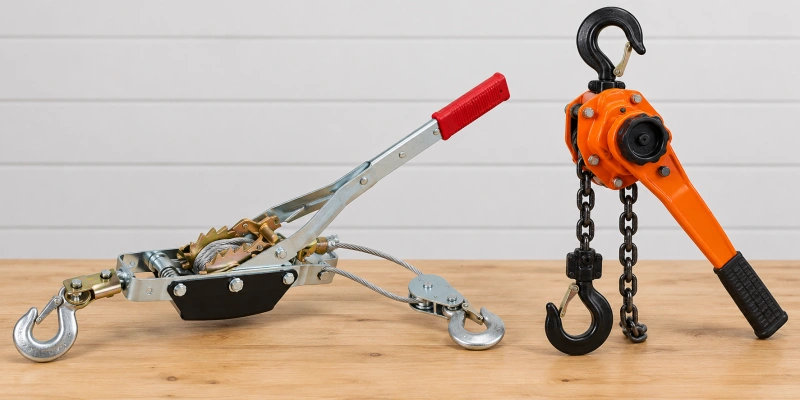
“Come-along” may refer to a cable puller or a lever chain hoist. Look for wire rope or load chain before choosing a procedure. Our comparison of a come-along and a lever hoist explains the differences in more detail.
Wire-Rope Ratchet Puller
A drum-type cable puller winds wire rope onto a drum as you work the handle. Its ratchet wheel and pawls control the movement. Typically, a drive pawl advances the wheel, and a holding pawl or locking lever prevents unintended reverse movement. These parts and their control positions vary by design.
Before touching a control, find the model marking and the instructions for that model. Check whether the label describes pulling, tensioning, or an approved lifting duty. A pulling rating is not, by itself, approval for a suspended lift. QDPowerful lists several come-along tools and wire-rope pullers; the category name alone does not establish a common release procedure for all of them.
Lever Chain Hoist
A lever chain hoist moves a load chain through the hoist body with an operating lever, direction selector and load-holding brake. Some models also allow free chaining to position slack chain when unloaded. QDPowerful’s VA and VL lever hoists belong to this group; their controls do not work like the pawls on a cable puller.
Before You Try to Release the Tension
Before easing tension, decide where the load will go. A taut line may keep a wheeled object from rolling or hold parts in alignment. Provide suitable support or restraint wherever release could allow uncontrolled movement. Keep people clear of the line of pull and pinch points, and wear suitable hand and eye protection.
Check these points before operating the release mechanism:
- Load and support: Is the load stable, supported or otherwise restrained? Will it stay controlled throughout the planned unloading movement?
- Anchor and connections: Are the anchor, hooks and connecting hardware suitable and seated correctly? Has a hook latch been damaged or forced to carry the load?
- Tool identity: Can you read the model and capacity marking, identify the control, and obtain the matching instructions? Check the permitted application and line arrangement.
- Wire rope or chain: Look for broken wires, a kink, crushing, severe corrosion, a jammed drum, or a twisted, damaged load chain. Do not reach into a tensioned mechanism to clear a jam.
- Controls and body: Check the handle, ratchet wheel, pawls, selector, hooks and frame for bending, cracks, missing parts or abnormal movement.
If the load may move unexpectedly, a pawl slips, a hook or handle is deformed, the rope or chain is damaged, or you lack the correct procedure, stop. Keep others clear and have a competent person plan how to support or transfer the load. Do not force the control, improvise another puller setup, or extend the handle with a pipe.
How to Release a Wire-Rope Come Along?
For a serviceable cable puller, first establish where the load will settle or how it will be restrained. Identify the marked model, inspect the line and controls, then use that model’s controlled-release method. The objective is to reduce tension gradually while keeping the load stable. The control positions and handle movements depend on the model.
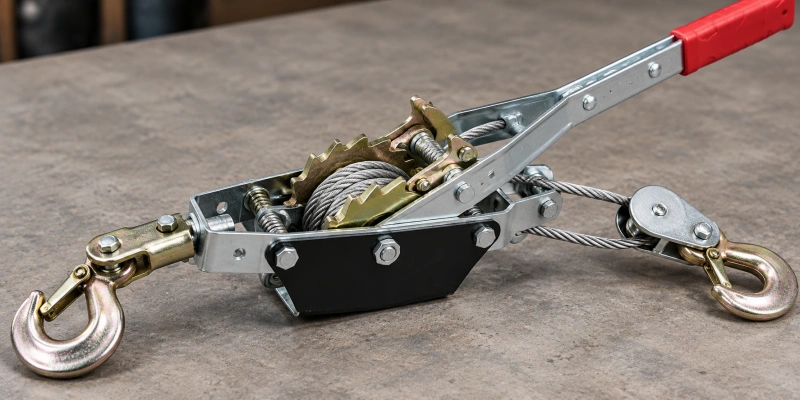
On many drum-type pullers, the drive pawl turns the ratchet wheel, and a holding pawl or locking lever restrains reverse movement. During a designed release, the mechanism lets the wheel move backward in controlled increments before it holds again. Do not lift or hold a pawl by hand unless the instructions for your tool explicitly direct it.
Confirm the load’s support or restraint, the line setup, and the model instructions before operating a control. Watch the load as tension eases. If the handle behaves abnormally, the cable binds, or the load shifts unexpectedly, stop. Disconnect only after the line is slack and the load is stable.
Never use a free-running drum to unload a tensioned puller. Bypassing a holding mechanism can allow sudden movement of the rope or handle. An audible click alone does not prove that the load is secure.
If the marking is unreadable or the instructions are unavailable, ask the manufacturer or supplier to identify the tool. Provide clear photos of its label, mechanism, hooks, and rope path before attempting to release it.
How to Loosen a Come Along Cable?
A taut cable may be keeping a load in place. In that case, “loosen” means reducing tension through the tool’s controlled-release mechanism. Pulling out slack cable by hand or using free-spool is a separate, unloaded operation available only on models designed for it.
Plan how the load will remain controlled, then follow the marked model’s release procedure. If the rope crosses, traps, or kinks on the drum, stop. Pulling harder can damage it or conceal a fault.
Once the line is slack and the load is stable without the puller, follow the model instructions to extend the cable. If it has a free-spool feature, use it only in the specified unloaded condition. Keep hands clear of the drum and pawls. If the rope still will not pay out, inspect the routing rather than forcing it.
Releasing a Lever Chain Hoist Is Different
A lever chain hoist uses its direction selector, operating lever, and load-holding brake to lower or ease a load. Free chaining, if provided, positions the unloaded chain; it is not a way to lower a loaded hoist. Use the instructions for the marked hoist to identify the correct controls.
Check the support, capacity marking, chain path, hooks, and intended landing point before lowering. Keep the load controlled throughout the movement. If the brake slips or the lever responds abnormally, stop and arrange a controlled recovery. Do not apply a cable puller’s pawl procedure to the hoist.
For the wider setup and operating sequence, see how to use a lever chain hoist. The VA and VL lever hoist range shows the product family, but the range page is not a substitute for the instructions supplied with the unit in your hands.
What If Your Come-Along Won’t Release?
If a come-along will not release, keep people clear of the line and identify the tool. The causes below are possibilities, not a diagnosis from a distance.
| Symptom | Possible Cause | Safe Next Action |
| Release control will not move | Pawl, spring, or ratchet tooth damage may be present. | Stop. Do not pry or force the control. Keep the load restrained and consult the marked model’s procedure. |
| Handle is unusually hard to move | Excessive load, poor alignment, a jam or a mechanical fault. | Stop operation. Reassess the setup; never add a cheater bar to the handle. |
| Cable will not unwind | Holding mechanism remains engaged, or wire rope is trapped or crossed on the drum. | Do not force the cable. Support or transfer the load by a planned method before inspecting the rope path. |
| Pawl skips or fails to hold | Pawl, spring or ratchet tooth damage may be present. | Keep the load controlled; after safe unloading, tag the tool out of service for inspection. |
| Chain routing, brake, or internal mechanism may be faulty. | Wire rope has been damaged in service or on the drum. | Stop and keep people clear. After safe unloading, withdraw the tool for rope assessment or replacement. |
| Chain binds or hoist brake behaves abnormally | Chain routing, brake or internal mechanism may be faulty. | Stop lowering or pulling. Use the exact hoist instructions and a competent recovery plan. |
| Hook, latch, handle or frame is deformed | Overload, side loading, impact or wear may have occurred. | Stop and remove from service once the load is independently secured. Arrange inspection before reuse. |
If the tool still holds a load, do not detach it. A planned transfer to another rated device may be possible, but the anchor, capacity, attachment geometry, and sequence need assessment by a competent person. Do not open a brake, cut the line, or dismantle a ratchet to free the tool.
After controlled unloading, tag the tool and record the fault. Lubrication does not make a slipping pawl or faulty brake fit for service; follow the manufacturer’s inspection and repair instructions before reuse.
When to Remove a Come-Along From Service
Stop using a puller if its wire rope is kinked, crushed, birdcaged, visibly broken, or badly corroded, or if it is trapped in the mechanism. Broken-wire discard limits depend on the rope and the manufacturer’s rules; do not apply a universal count.
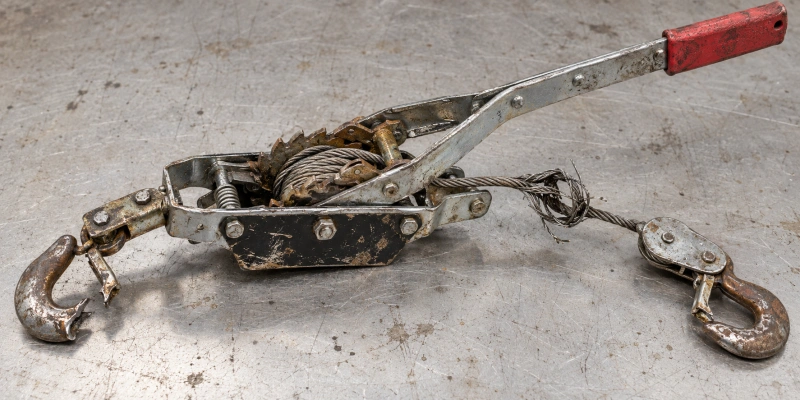
Pawls that slip or fail to seat, damaged ratchet teeth, missing springs, a cracked frame, bent handle, damaged hook, or defective latch also require the tool to be withdrawn. Do not attempt a repair while it is loaded. After safe unloading or transfer, tag it and arrange inspection under the applicable instructions. The hook saddle bears the load, not the latch.
For a lever hoist, a damaged load chain, irregular chain travel, or a slipping brake are stop conditions. Do not conduct a field load test to see whether a faulty tool still works. Factory proof tests do not provide a release method for an unknown tool.
After Release: Inspect, Clean and Store
After release, inspect the rope or chain, hooks and controls. Clean, lubricate, and store the tool as its instructions specify, keeping wire rope free of kinks and crossed wraps. Record any jam, slip, or damage. A tool that failed during release stays out of service until it has been assessed.
FAQ
How do you release a come along?
Identify the device and its model, control the load, then use its specified release or lowering procedure. Pawl and selector positions are not universal.
How do you loosen a come-along cable?
If the cable is tensioned, reduce that tension by the model’s controlled-release method while keeping the load stable. Extend the cable by hand or free-spool only when the tool is unloaded, and the design allows it.
Why won’t my come along release?
A loaded mechanism, crossed rope, or damaged pawl, ratchet, or handle may be responsible. Stop forcing the control and have the setup assessed before proceeding.
Can you release a come-along under tension?
A rated tool may allow controlled unloading under load according to its operating instructions. That is different from manually unlocking a holding pawl or selecting free-spool. If the load cannot be controlled or the mechanism is jammed, stop.
Can you free-spool a come-along cable?
Only if the model has that feature and its instructions permit use in the unloaded condition. Free-spool is not a release method for a tensioned puller.
Is a cable come-along the same as a lever hoist?
No. A cable puller uses wire rope; a lever chain hoist uses load chain and a brake. Identify the tool before selecting a release procedure.
Need help identifying a QDPowerful puller or lever hoist? Send us the model and capacity markings, photos of both sides of the mechanism, and a description of the application. We can help locate the appropriate product information before you plan the next operation.