A lever chain hoist, also called a lever hoist or lever block, uses a hand lever to lift, lower, pull, or position a load. Before you move anything, check the marked rated capacity, the support, the rigging, and the hoist itself. Position the load chain only while it is unloaded. Then connect the load, return the hoist to normal operation, and move it with controlled lever strokes.
The exact controls and free-chaining procedure vary by model. Follow the operating manual supplied with the specific hoist. This guide covers general operating principles for trained personnel handling material loads. If you need the mechanism explained in more detail, read how a lever hoist works.
How to Use a Lever Chain Hoist: Quick Steps
1. Inspect the hoist and rigging. Check the model marking and rated capacity against the task.
2. Check the anchor, load attachment, and intended line of force. Keep people clear of the load path.
3. Secure the upper hook to a suitable anchor. Seat the attachment in the hook saddle.
4. With the hoist unloaded, position the load chain using the method approved for that model.
5. Attach the lower hook with suitable rigging. Return the mechanism to normal load operation before applying tension.
6. Take up slack gradually. Check the hooks, chain, anchor, load balance, and brake as directed by the manual.
7. Move the load with controlled lever strokes. Stop if the chain binds, the load shifts, or the hoist behaves abnormally.
8. Lower onto stable support or release tension under control. Confirm the hoist is fully unloaded before disconnecting.
Never engage free chaining while the hoist is supporting a load.
Before Using a Lever Chain Hoist
Check the Rated Capacity
Read the capacity marking on the actual hoist and confirm the load or required pulling force. Include the weight of any attached rigging when assessing a lift. For a pull, friction, slope, and starting resistance can make the required force different from the object’s weight.
Use a suitable rated arrangement for the intended task. Do not treat a design safety factor or proof-test load as extra working capacity. If the marking is missing or the force is uncertain, stop and obtain a competent assessment.
Inspect the Hoist Before Use
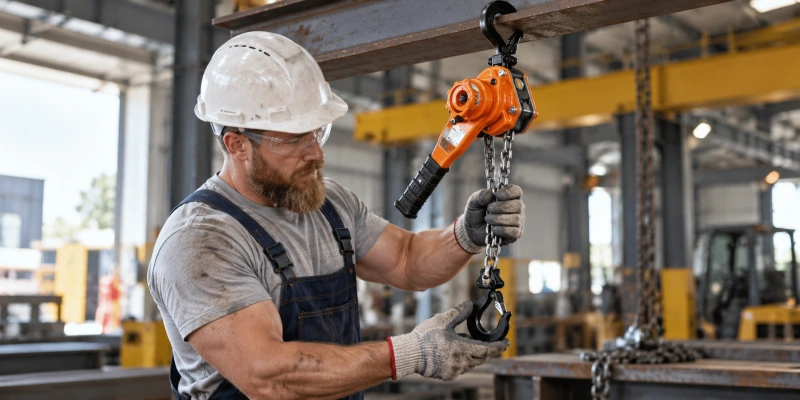
Look for damaged, stretched, worn, kinked, or twisted load chain; bent or cracked hooks; faulty latches; damaged body or lever; and illegible identification. With no load attached, check operation as specified by the model manual.
A brake that slips, a stiff control, unusual noise, or a chain that does not feed correctly calls for assessment before use. Do not try to correct a defect by forcing the lever. The lever hoist inspection checklist covers inspection points and removal decisions in more detail.
Pre-use checks do not replace the periodic inspections required by the manufacturer, site rules or applicable regulations. Frequency depends on the equipment and its service conditions. Do not set a universal annual interval from a general article.
Check the Anchor Point and Rigging
Confirm the supporting structure, anchor, and connectors are appropriate for the force and the direction of pull. Check the load’s center of gravity and the route it will take. Use rated slings, shackles or designated lifting points where needed. The load chain is part of the hoist mechanism; do not wrap it around the load as a sling.
Plan a position where the operator has firm footing and clearance for the lever. Keep hands clear of moving chain and pinch points. Keep people away from a suspended load and from the path of a pull. For a vertical lift, place the hoist so the intended line of force does not impose unintended side force on either hook.
Understand Free Chaining Before Applying a Load
Follow the Specific Model Manual
A selector, handwheel, or free-chain control can work differently from one lever chain hoist to another. Do not copy the selector positions or knob directions from another brand or a similar-looking model. Read the instructions supplied with your exact hoist, including how to enter and leave the unloaded adjustment mode and how to check normal operation.
The catalogue identifies a free-wheeling or idling feature for Powerful Machinery VA and VL units, but does not establish an exact control sequence for this article.
What Is Free Chaining?
Free chaining lets you move the unloaded load chain and lower hook quickly into position before applying a load. It saves time while setting reach. It is not a way to lower a suspended load, release stored tension, or make a loaded adjustment. If the control resists movement, stop. Do not pull harder or manipulate it to bypass the brake.
Free Chaining vs Load Operation
| Operating condition | Purpose | Load condition |
| Free chaining / free-wheeling | Position the load chain and lower hook | Unloaded only |
| Normal load operation | Lift, lower, pull, tension, or position with controlled lever strokes and load brake | Loaded or tensioned |
| Model-specific control change | Enter or leave the permitted operating mode | Follow the exact model manual before applying force |
Once the load is connected and slack is taken up, treat the system as tensioned. Never engage free chaining while the hoist is supporting a load. Use the model-approved operating method to lower or release tension.
How to Use a Lever Chain Hoist Step by Step
Step 1 — Secure the Upper Hook
Attach the upper hook to the approved anchor or connector. Make sure the fitting rests in the hook saddle, not on the tip or latch. The latch should close as intended; it does not carry the load. Check that the hoist body can align with the planned pull and that the lever has room to move. Do not attach to a support of unknown capacity.
Step 2 — Position the Unloaded Chain
Before loading the hoist, bring the lower hook near the connection point. If the model permits free chaining, follow its unloaded procedure. Check that the chain runs through the hoist without twists and that the hook and chain travel will stay within the model’s limits. If your model has no confirmed free-chaining instructions, use only the normal control procedure supplied with it.
Step 3 — Connect the Load Correctly
Connect the lower hook to the rated lifting point or suitable rigging. Seat the attachment in the hook saddle and confirm that the latch closes. Do not tip-load the hook or fasten the load by wrapping the hoist’s chain around it. Check that the attachment cannot slip when the load begins to move. For lifting, consider whether the load may rotate, swing, or shift as it leaves its support.
Step 4 — Return to Load Operation and Take Up Slack
Leave the unloaded adjustment mode by the exact procedure in the model manual. Confirm that normal operation is engaged before putting the chain under tension. Take up slack slowly with the approved lifting or pulling control.
As the rigging becomes taut, pause and recheck each attachment. Check the load brake using the procedure specified for your model before continuing. Do not use free chaining to take up a loaded line.
Step 5 — Check Chain, Hook and Load Alignment
Check the hook-to-hook line of force and make sure neither hook is bearing on its latch, tip or side. The load chain should feed without a kink or twist. Watch for contact between the hoist body, lever, chain, load and surrounding structure. For a vertical lift, check the load’s balance close to its support as the manual and lifting plan require. If anything shifts unexpectedly, stop and secure the situation before proceeding.
Step 6 — Lift, Pull or Position the Load
Operate the lever with steady strokes and watch the load throughout its travel. Do not jerk the lever, shock-load the hoist, or extend the handle with a pipe. Do not use another person to force a lever that needs excessive effort.
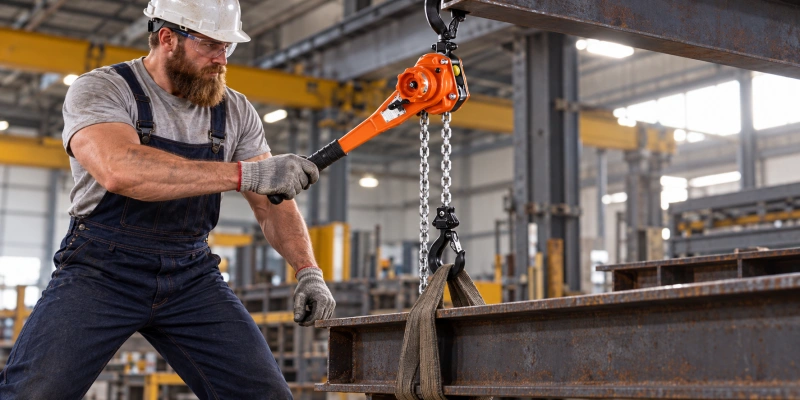
Stop if you notice binding, slip, unusual sound, unexpected movement, or rising resistance. Keep people clear of the load and its potential fall or travel zone. Do not leave a suspended load unattended.
Step 7 — Lower the Load Safely
Confirm the landing point or final position is ready. Use the model-approved lowering or tension-release control. Lower in small, controlled movements while keeping people clear. Never switch to free chaining to release a loaded hoist. If the normal control cannot safely lower or release the load, follow the site’s contingency plan and have qualified personnel assess it. Do not dismantle or repair a loaded hoist.
Step 8 — Fully Support the Load Before Disconnecting
Place the load on stable support, or confirm that tension has been safely removed from a pulling setup. Verify that the hoist and both hooks are unloaded before removing any attachment. Only then disconnect the lower and upper hooks. Keep the chain free of tangles as you put the equipment away.
Common Lever Hoist Mistakes to Avoid
| Do not | Use this practice instead |
| Exceed the marked rated capacity | Check the load or pulling force and select a suitable rated system. |
| Engage free chaining under load | Use it only for unloaded chain positioning; lower by the approved control. |
| Load a hook tip or latch | Seat the attachment in the hook saddle and check alignment. |
| Use the load chain as a sling | Connect through a suitable rated sling, connector, or load point. |
| Shock-load or force a binding hoist | Take up slack gradually; stop and assess abnormal resistance. |
| Extend the lever handle | Use only the designed handle and a correctly sized hoist. |
| Operate with twisted chain or unapproved side loading | Correct the rigging and planned line of force before moving the load. |
| Stand under a load or in its travel path | Keep personnel clear of the fall and movement zones. |
Can You Use a Lever Hoist for Horizontal Pulling?
A lever chain hoist may be used for pulling or load positioning when its specific model instructions, anchorage, rigging, and intended line of force permit the application. Establish the required line pull and a safe route for the load. Check that the hoist and both hooks align with that line, and that no chain or connector is bent around an edge. A horizontal pull does not permit unrestricted side loading.
If the model manual does not cover the planned arrangement, ask the manufacturer or a qualified person to review it before use. Do not assume that a model approved for vertical lifting works at every angle or in every pulling setup.
What to Do After Using a Lever Hoist?
After disconnecting the unloaded hoist, check the chain, hooks, latches, and body for damage noticed during the job. Remove debris and moisture. Clean and lubricate only as the specific manual directs; keep friction brake surfaces free of lubricant where the design requires it.
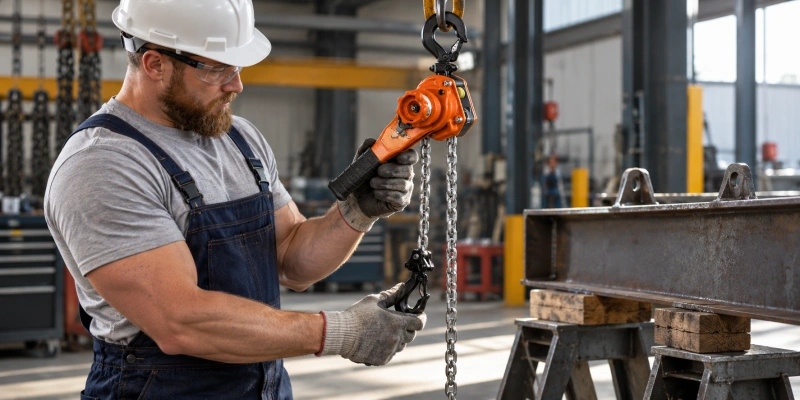
Store the hoist in a clean, dry location without leaving the chain tangled. Mark and isolate suspect equipment so nobody returns it to service by mistake. For defects or abnormal operation, follow the lever chain hoist repair and maintenance guidance and the specific model manual; qualified personnel must assess repairs and return-to-service checks.
Notes for Powerful Machinery Lever Hoists
Powerful Machinery lists VA and VL lever chain hoist series in its product catalogue and lever hoist range. The published VA models are rated from 0.75 to 9 t; the VL range also includes a 1 t model. Each listed model has a 1.5 m standard lift.
The catalogue describes forged upper and lower hooks with safety latches, a high-tensile alloy-steel load chain, a double-pawl brake system, a Weston-style automatic load brake, and free-wheeling or idling for unloaded chain adjustment. It also lists a 360-degree rotating handle and EN 13157.
These are range-level catalogue statements, not a substitute for the instructions supplied with the actual hoist. Check the capacity marking and the current model documentation before operation.
The catalogue does not establish a universal selector position, knob direction, or free-chaining sequence for VA and VL models. Ask for the exact manual and the relevant current documents when specifying a hoist for your site. Do not assume that overload protection or special-environment suitability is fitted to every model.
Lever Chain Hoist FAQs
How do you use a lever chain hoist?
Inspect the hoist, confirm its rated capacity and anchor, position the unloaded chain, connect the load, return to normal operation, and take up slack. Check alignment and load control, then move and lower with controlled lever strokes. Fully support the load before disconnecting. Follow the manual for the exact model throughout.
Is a lever block the same as a lever chain hoist?
Yes. Lever block is a common name for a manually operated lever chain hoist. Confirm the actual equipment type and model before using a generic “how to use lever block” guide. A hand chain block uses a different operating method; the lever hoist and chain block comparison explains that distinction.
What is free chaining on a lever hoist?
Free chaining is a method of quickly repositioning the load chain and lower hook when the hoist is unloaded. The control and the way you return to normal operation depend on the exact model. Read its manual before using the feature.
Can you use free chaining while the hoist is under load?
No. Never engage free chaining while the hoist supports a load or holds tension. Lower or release tension through the approved operating control. If that control fails, keep people clear and use the site’s contingency procedure.
Can a lever hoist be used horizontally?
Sometimes. The specific model must permit the task, and the anchor, rigging, and hook-to-hook force line must suit the pull. Horizontal use does not permit unapproved side loading. Confirm an uncertain setup before operating.
Can the load chain be used as a sling?
No. Do not wrap the hoist’s load chain around a load or attach it back to itself as a sling. Use suitable rated rigging and the intended attachment point.
Can you extend the lever handle for more leverage?
No. A pipe or improvised extension can apply excessive force and hide an overload or mechanical problem. Stop if the designed lever requires abnormal effort, then reassess the load and equipment.
Use the marked rated capacity and the supplied model manual for every job. For VA or VL specifications and an application review, see Powerful Machinery lever hoists.