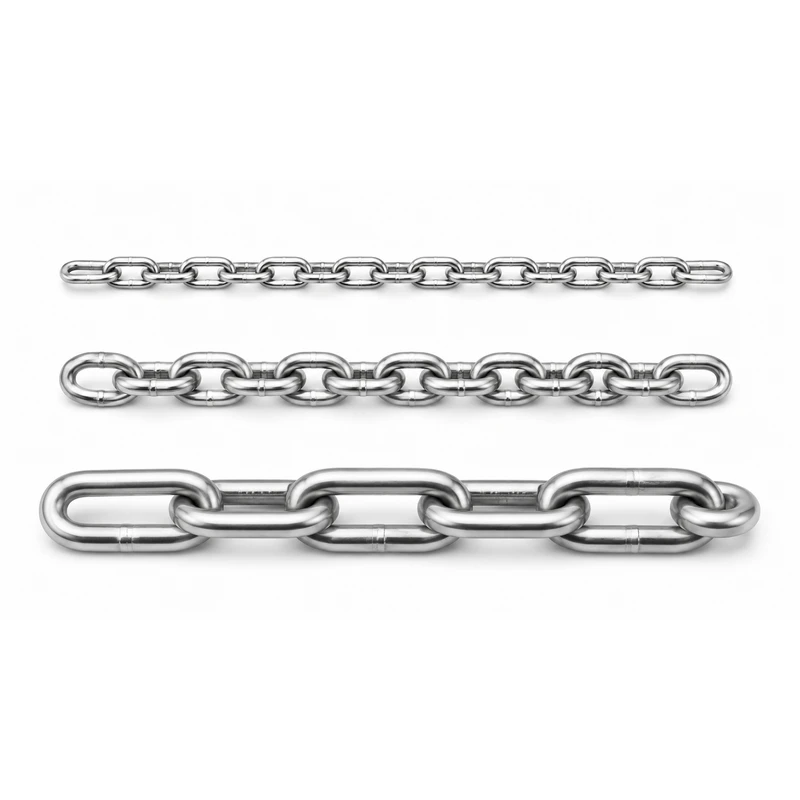
A “come along” is not a universally defined product category. In some markets, the term is used for a lever hoist; in others, it refers to a cable-style hand puller. If both terms refer to the same rated lever hoist, there is no fundamental product difference between them.
For this comparison, “come along” means a hand-operated cable puller, while “lever hoist” means a chain lever hoist. The practical differences are the load-bearing medium, travel arrangement, marked rating, and manufacturer-approved application—not simply whether the force is applied vertically or horizontally.
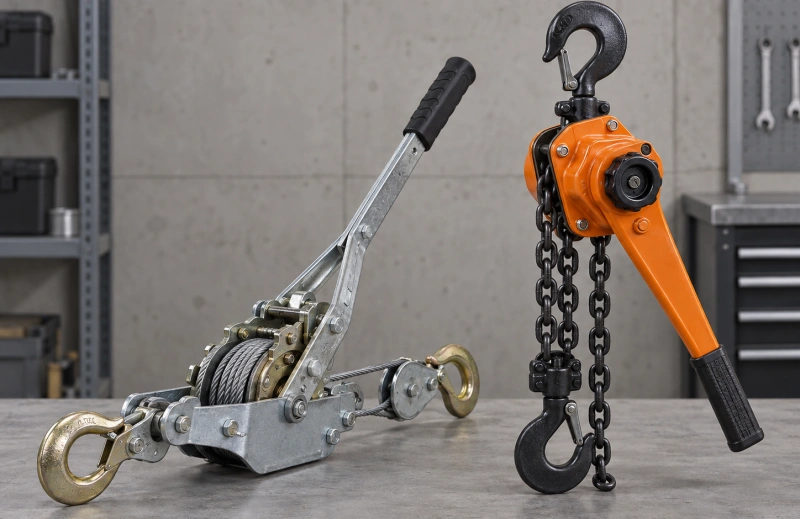
Quick Comparison
| Selection Point | Cable-Style Come Along | Chain Lever Hoist |
| Product identity | Hand puller using wire rope/cable that is wound onto a drum or routed through the pulling mechanism, depending on design | Lever-operated hoist using calibrated load chain over a pocketed load sheave |
| Typical task | Pulling, tensioning, and positioning; lifting only when the exact model is marked and documented for it | Lifting, lowering, pulling, or positioning, as the exact model permits |
| Operator input | Reciprocating handle operates a ratchet or lever mechanism | Reciprocating lever operates the ratchet, gearing, load sheave, and load-holding or braking mechanism |
| Rating to check | Do not confuse working or pulling capacity, hoisting capacity, and breaking force | Use the marked rated load or working load limit (WLL), as specified by the manufacturer |
| Travel | Limited by cable length, take-up capacity, and reeving; verify usable travel in the planned setup | Specified lift or reach; additional chain changes weight, effort, and handling |
| Headroom and clearance | Check body length, hook spacing, cable path or reeving, and handle sweep | Check the closed hook-to-hook dimension, hook clearance, and lever sweep |
| Speed and control | Short movement per stroke; performance varies with reeving and load | Short, controlled movement per stroke; effort and speed vary by capacity and number of chain falls |
| Installation | Requires rated, aligned anchor points and a clear cable path | Requires rated support or anchor points and an aligned chain-and-hook load path |
| Slack adjustment | Cable payout and release procedures are model-specific | Free chaining, if fitted, is for unloaded slack-chain adjustment only |
| Environment | Inspect wire rope for broken wires, deformation, corrosion, and damaged terminations; verify temperature and contamination limits | Inspect load chain for wear, damage, twist, and corrosion; verify temperature and contamination limits |
| Main limitation | The nickname does not establish approval for lifting a suspended load | A lifting rating does not authorize overload, side loading, or every operating orientation |
What Is a Come Along?
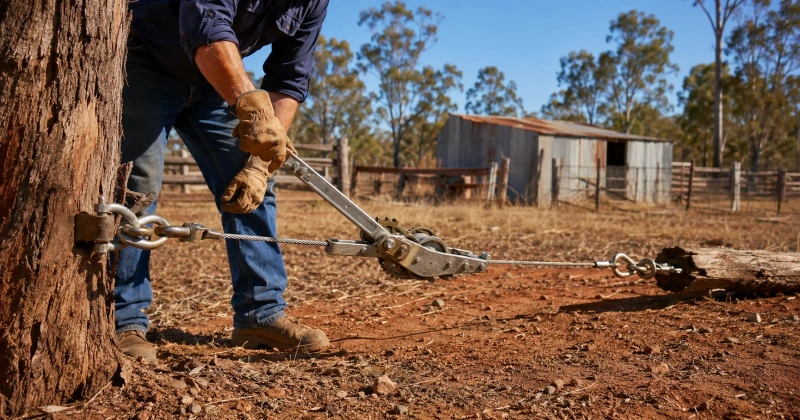
“Come along” is an informal trade term for a portable, hand-operated pulling or hoisting device actuated by a reciprocating lever. Depending on the manufacturer and region, it may use wire rope (cable), chain, or web strap. The term alone therefore does not identify the load rating or establish whether the device is approved for lifting a suspended load.
The cable-style device discussed here takes up wire rope through a ratcheting lever mechanism. It is commonly used for controlled pulling, tensioning, and positioning between suitable anchor points. Some products list separate hoisting, working or pulling, and breaking-force values. These values are not interchangeable, and breaking force is not a permissible working limit.
For a broader definition of the nickname and common mechanisms, see what a come-along is. Always return to the exact product label and manufacturer’s instructions for the intended task.
What Is a Lever Hoist?
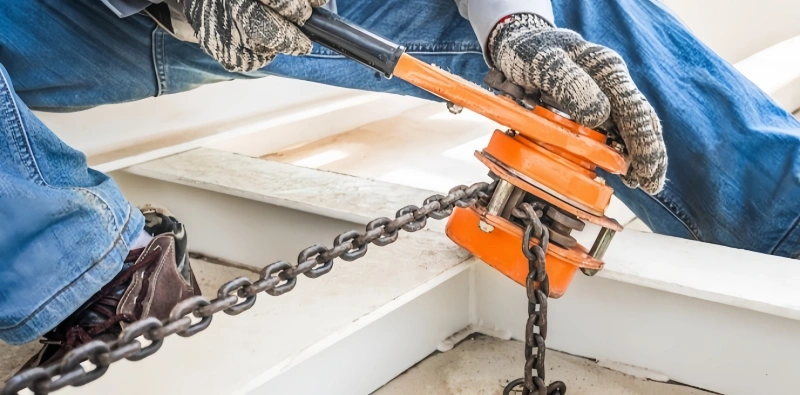
A chain lever hoist uses a reciprocating operating lever, a ratchet and gear train, calibrated load chain, and a model-specific load-holding or braking mechanism to move and hold a load. It is also called a lever block, ratchet lever hoist, or lever chain hoist. Many models are intended for lifting as well as pulling or positioning, but permitted applications and orientations remain model-specific.
The lever hoist working-principle guide explains the operating lever, selector, load-holding or braking mechanism, load sheave, chain, and hooks in more detail.
Is a Come Along the Same as a Lever Hoist?
Sometimes. “Come along” is a nickname that may describe several product types, whereas “lever hoist” identifies a lever-operated hoisting device. A seller may call a chain lever hoist a “chain come along,” or may use the same term for a cable hand puller. Similar-looking tools can therefore have different ratings, holding or braking arrangements, travel, and approved uses.
Before comparing or substituting equipment, identify five things: the manufacturer and model, the load-bearing medium, the marked rating, the manufacturer-approved application and orientation, and the current operating instructions. If any one of these cannot be confirmed, the products should not be treated as interchangeable.
Key Differences That Affect Selection
1. Load Medium and Movement
A cable-style come-along takes up or stores wire rope in its pulling mechanism. A chain lever hoist moves calibrated load chain over a pocketed load sheave. Cable length, drum or take-up capacity, reeving, and minimum required wraps can limit usable travel on one design; specified lift, number of chain falls, and load-chain tail clearance can limit the other.
Use the manufacturer’s published usable-travel or lift figure, not the loose length of cable or chain.
2. Approved Task and Operating Direction
Do not choose by the rule “lever hoist for vertical work, come-along for horizontal work.” Lever hoists may be designed for lifting, pulling, and tensioning, and lever-operated rope hoists also exist. The deciding evidence is the exact nameplate or marking and the manufacturer’s manual.
A pulling rating does not establish approval for lifting a suspended load, and a lifting rating does not permit side loading, tip loading, or an unapproved mounting orientation.
3. Capacity and Rating Language
Determine the maximum load or line pull and how the rigging arrangement changes the forces. Compare like with like: rated load with rated load, or manufacturer-approved pulling capacity with pulling capacity. Never select equipment based on breaking force, and do not assume that a double-line or two-part-line arrangement simply doubles the permissible load.
Anchor reactions, hook loads, system efficiency, and the manufacturer’s reeving instructions still apply.
4. Lift, Reach, and Headroom
A chain lever hoist is normally specified by lift or reach and a closed hook-to-hook dimension. A cable-style come-along may be specified by cable length, maximum take-up, single-line or double-line configuration, and minimum or maximum hook spacing.
Measure the actual start and finish positions, allow clearance for the body and handle, and confirm that the device can complete the movement without running out of usable travel.
5. Speed, Effort, and Control
Both tools trade speed for manual control. A chain lever hoist can provide small, repeatable movements, but handle effort and travel per stroke vary with capacity and number of chain falls. A cable-style come-along may gain mechanical advantage through reeving while reducing available travel.
Published operating effort is model-specific; high handle effort is not a load indicator and must never be overcome with a pipe, cheater bar, or other handle extension.
6. Inspection and Environment
Cable and chain exhibit different damage modes. Wire rope may show broken wires, kinks, crushing, birdcaging, corrosion, or damaged terminations. Load chain may show wear, elongation, gouges, bent or twisted links, corrosion, or poor seating on the load sheave.
For either product, also inspect hooks, latches, fasteners, the handle, markings, the ratchet, and the holding or braking mechanism. Apply only the rejection criteria and inspection intervals specified for the exact product, service, and jurisdiction.
Which Tool Should You Choose?
| If the Job Requires… | Prefer… | Only When… |
| Overhead lifting with short, controlled movement | A chain lever hoist | Its marked rated load, support, rigging, operating orientation, and manual approve the lift |
| Pulling or tensioning within the cable device’s usable travel | A cable-style come along | The marked working or pulling capacity, anchor reactions, cable path, and release method are verified |
| Very limited headroom | Compare exact model dimensions | The closed length, hooks, body, and handle can fit and operate without interference |
| Fine alignment of machinery or fabricated parts | Usually a chain lever hoist | The load remains controlled and the hoist is aligned with the load path |
| A nickname-based replacement for equipment already on site | Neither by name alone | The model, load-bearing medium, rating, task, and instructions match the requirement |
| Transport load restraint | Purpose-designed cargo-restraint equipment | A hoist is used only when the manufacturer specifically approves it for restraint service |
If a chain hoist rather than a chain lever hoist is also under consideration, use the separate chain hoist vs come along selection guide so that hand-chain and powered-hoist cases are not mixed into this comparison.
Powerful Machinery Catalogue Examples
The supplied Powerful Machinery catalogue demonstrates why ratings must be read by model. Its VA chain lever hoist table lists capacities from 0.75 to 9 tonnes and a standard lift of 1.5 m; operating effort, load-chain diameter, number of chain falls, dimensions, and net weight vary by model. The separate SY hand-puller table lists “hoisting capacity,” “working capacity,” “breaking force,” and steel-cable size as distinct fields.
Those catalogue labels should not be collapsed into a single generic “capacity.” For example, the SY10 entries list 500 kg hoisting capacity and 1,000 kg working capacity, while the VA-0.75 entry lists 0.75 t capacity. These are source-labelled catalogue examples, not evidence that the products are interchangeable or suitable for a specific application.
For model selection, compare the current lever hoist product range and the VA Series chain lever hoist. Reconcile every web specification with the current approved data sheet, nameplate, and manufacturer’s manual before publishing or quoting.
Safe-Use Boundaries for Both Tools
- Determine the load or line pull and every relevant anchor reaction before tensioning the system.
- Use only equipment with legible identification, the correct marked rating, and current operating instructions.
- Seat hook or attachment loads in the hook saddle and keep the body, hooks, chain, or cable aligned with the intended force path.
- Never exceed the marked rating, shock-load the device, stand in the line of pull or tension, or use a handle extension.
- Never lift people, permit people under a suspended load, or use a pulling-only device for lifting a suspended load.
- Do not kink wire rope, knot load chain, wrap a hoist load chain around the load, or use the load-bearing medium as an improvised sling.
- Stop operation and inspect the equipment if you observe slipping, load drift, abnormal noise, binding, damaged hooks, distorted chain, damaged cable, unreadable markings, or unexpected operation.
Use the lever hoist inspection checklist for the chain-hoist inspection workflow and the lever chain hoist operating guide for setup and operating boundaries. The exact manufacturer’s manual takes precedence.
FAQ
Can a Come Along Be Used for Lifting?
Only if the exact product is marked and documented by the manufacturer for that lifting application. Many cable pullers are sold primarily for pulling or tensioning. A working or pulling capacity, or a breaking-force value, does not establish a rated lifting capacity.
Can a Lever Hoist Be Used Horizontally?
Many lever hoists can pull or position loads in nonvertical orientations when the exact model permits it. Horizontal use does not permit side loading of the hoist body or hooks; the load path and anchors must remain suitable, aligned, and within the manufacturer’s rated conditions.
Is a Chain Come Along a Lever Hoist?
Usually, “chain come along” refers to a chain lever hoist, but the product label must be verified. The nickname is not a technical specification and should not replace the manufacturer, model, rated load, and operating instructions.
Which Has More Capacity?
Neither product type always has more capacity. Compare the marked rating for the intended task on specific models. Do not compare a cable puller’s breaking force with a lever hoist’s rated load.
Which Offers More Travel?
It depends on the model and setup. Cable length is not necessarily usable pull, and chain length is not necessarily effective lift. Compare usable travel, hook spacing, take-up or reeving, headroom, and clearance for the complete movement.
Does Every Lever Hoist Have Overload Protection?
No. Load-holding or braking mechanisms and overload-limiting devices are separate features, and their design and availability vary by model. Verify the actual design and never use handle effort as a proxy for whether the load is within the permitted rating.
Choose from Verified Application Data
Start with the intended task, maximum load or line pull, direction, required travel or lift, available headroom, anchor or support points, environment, and required market documents. Then compare Powerful Machinery lever hoist models. If the correct product type or rating is unclear, send Powerful Machinery the application details for model-specific confirmation.