You need the right material handling equipment to boost efficiency in your warehouse. If you handle lifting pallets in tight aisles or focus on stacking pallets at moderate heights, pallet stackers deliver reliable performance. Reach trucks excel in high-racking environments with greater lift heights.
Timely access to specialized equipment, such as pallet stackers or reach trucks, aligns workflow demands and supports smooth operations. The Pallet Stackers vs Reach Trucks decision depends on your space, load, and operational goals.
Key Takeaways
Pallet stackers are ideal for narrow aisles and moderate stacking heights, making them cost-effective for small warehouses.
Reach trucks excel in high-bay environments, offering greater lift heights and load capacities for efficient handling of heavy pallets.
Hybrid stackers combine features of both pallet stackers and reach trucks, providing flexibility for diverse warehouse needs.
Consider your warehouse layout, load requirements, and budget when selecting between pallet stackers and reach trucks for optimal efficiency.
Regular training and safety checks are essential for safe operation and maintenance of both pallet stackers and reach trucks.
Pallet Stackers vs Reach Trucks Overview
What Is a Pallet Stacker?
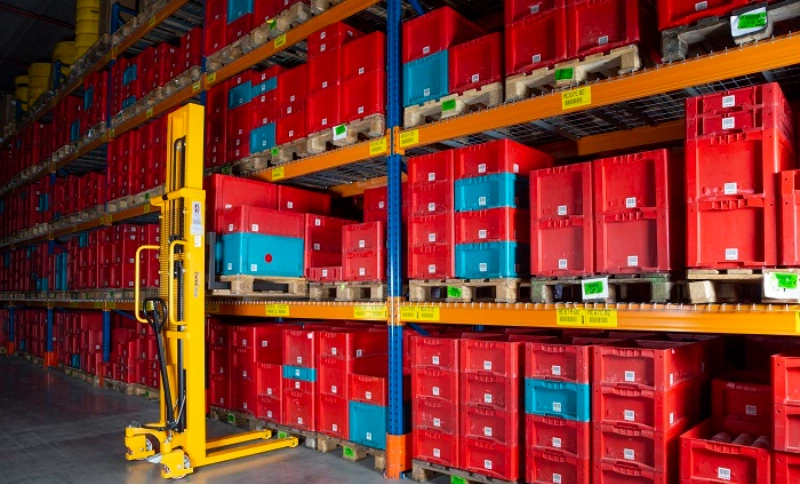
You use a pallet stacker to lift and stack pallets in tight spaces. This equipment helps you move goods vertically and organize inventory efficiently. Pallet stackers work best in narrow aisles and compact storage areas. You can choose from manual, semi-electric, or fully electric models based on your daily needs.
These stackers offer a cost-effective solution for medium-height stacking tasks. Powerful Machinery provides a range of pallet stackers designed for reliability and safety. Their stackers feature strong steel frames, ergonomic controls, and easy maintenance.
You can trust these stackers to improve your workflow and reduce operating costs.
What Is a Reach Truck?
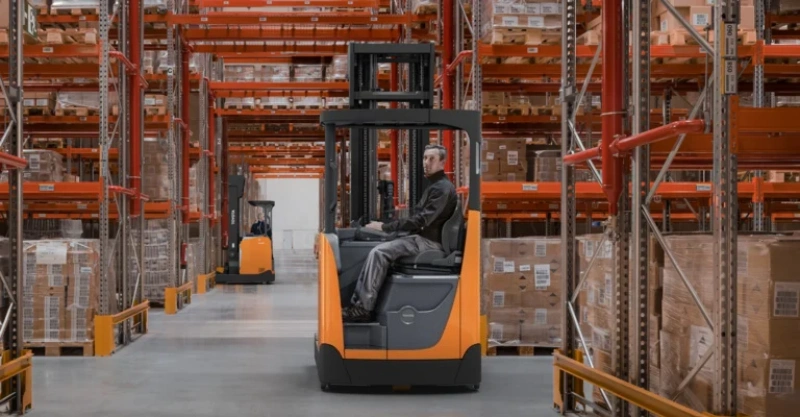
A reach truck gives you the ability to handle pallets at greater heights. You use this equipment in high-bay racking systems where vertical space matters most. Reach trucks have an extending mast that lets you reach deep into racks. These stackers offer higher lift capacity and flexibility in load placement.
You often see reach trucks in large distribution centers and warehouses with tall shelving. The design focuses on maximizing storage density and accessing hard-to-reach pallets. When you compare pallet stackers vs reach trucks, you notice that reach trucks excel in environments that require frequent high-level stacking.
Comparison Table: Pallet Stackers vs Reach Trucks
Feature | Pallet Stackers | Reach Trucks |
|---|---|---|
Lifting Capacity | Up to 1,600 kg | Up to 2,500 kg or more |
Maximum Lift Height | About 6 meters | 13 meters or more |
Maneuverability | Excellent in narrow aisles | Less maneuverable, but flexible in load placement |
Ideal Use | Vertical stacking in narrow aisles | High-bay warehouse operations |
Hybrid Stackers for Flexibility
Hybrid stackers combine the strengths of both pallet stackers and reach trucks. You benefit from versatile equipment that adapts to changing warehouse needs. These stackers handle moderate loads and reach higher shelves without sacrificing maneuverability.
You can use hybrid stackers in mixed storage layouts or facilities with varying racking heights. As industry trends shift toward automation, electrification, and e-commerce growth, you see more demand for flexible solutions.
Hybrid stackers help you keep pace with rising labor costs and the need for efficient material handling. When you evaluate pallet stackers vs reach trucks, hybrid stackers offer a smart choice for dynamic operations.
Key Features Comparison
Lift Height and Load Capacity
You need to understand the differences in lift height and load capacity when comparing stackers. Pallet stackers offer lift heights from 1.3 meters to 3.5 meters. You can handle loads of up to 2,000 kg with these stackers. Reach trucks provide much higher lift heights, usually ranging from 9 to 15 meters.
Some models reach up to 16.8 meters. You can handle heavier loads with a reach truck, making it ideal for high-bay warehouse operations. These differences help you select the right equipment for your handling needs.
Pallet stacker lift heights: 1.3 m – 3.5 m
Pallet stacker load capacity: 1,000 kg – 2,000 kg
Reach truck lift heights: 9 m – 16.8 m
Reach truck load capacity: higher than stackers
Maneuverability in Warehouse Spaces
You notice clear differences in maneuverability between stackers and reach trucks. Pallet stackers excel in narrow aisles and tight spaces. You can operate these stackers efficiently without needing extra clearance. Reach trucks require additional space, usually an extra 12 inches, to prevent collisions with racks.
Operating reach trucks in tight spaces increases the risk of damage and operator stress. You achieve higher productivity with stackers in compact layouts. Reach trucks suit wider aisles and tall shelving.
Operator Comfort and Ergonomics
Modern stackers and reach trucks include features that improve operator comfort. You benefit from ergonomically shaped tiller heads and large lift/lower rocker buttons on pallet stackers. These features make handling easier and reduce fatigue.
Reach trucks offer servo-assisted electric steering and high-torque motors for rapid acceleration. Ergonomic handles minimize strain during handling tasks. You experience less physical exertion and greater efficiency with these features.
Ergonomic tiller head for comfort
Large rocker buttons for easy handling
Speed control surface fits all hand sizes
Servo-assisted steering in reach trucks
Ergonomic handles reduce strain
Cost and Maintenance Factors
You see differences in cost and maintenance between stackers and reach trucks. Pallet stackers require lower upfront investment and simpler maintenance. You spend less on energy and repairs with stackers. Reach trucks cost more due to advanced features and higher lift capacity.
Maintenance for reach trucks involves more complex systems. You choose stackers for cost-effective handling in smaller warehouses. Reach trucks justify their cost in large-scale, high-bay operations.
Tip: Evaluate your handling volume, warehouse layout, and budget before selecting between pallet stackers and reach trucks. Powerful Machinery offers stackers with reliable features and easy maintenance for efficient handling.
Application Scenarios in Warehouse Operations
When to Use a Pallet Stacker?
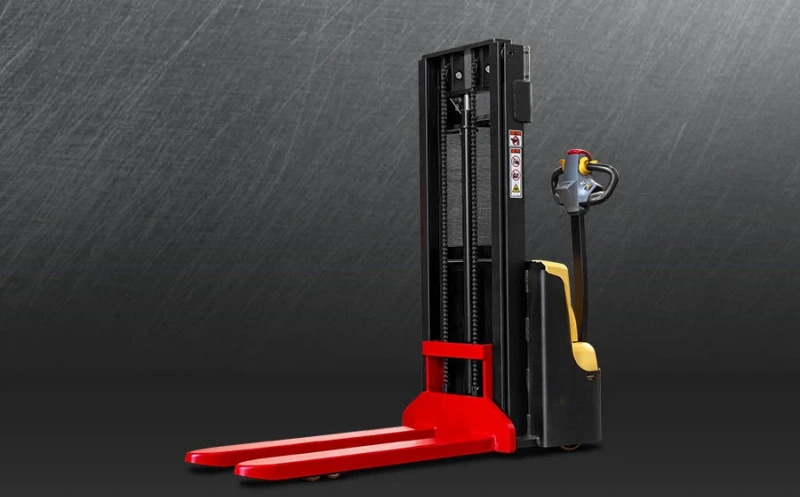
You select a pallet stacker when your warehouse has narrow aisles and limited storage space. This equipment works best in environments where you need to move pallets vertically without disrupting other operations.
Pallet stackers offer efficient material handling equipment for light-duty applications and moderate stacking heights. You benefit from lower operating costs and simple maintenance. Powerful Machinery pallet stackers excel in tight spaces, providing reliable performance and enhanced safety.
These stackers help you maximize storage and streamline warehouse operations. You find ideal scenarios for stacker usage in small warehouses, retail backrooms, and facilities with frequent inventory rotation.
When to Use a Reach Truck?
You choose a reach truck for optimal applications in high-bay warehouses with tall storage racks. This equipment allows you to access pallets at greater heights and handle high-volume inventory efficiently.
Reach trucks perform well in open warehouse layouts, where their larger size and flexibility of a reach truck support quick transportation of goods. You achieve speed and efficiency in environments that require frequent stacking and retrieval. The table below highlights common scenarios:
Scenario Type | Description |
|---|---|
Tall Storage Racks | Reach trucks are ideal for high-level stacking in tall storage racks. |
Open Warehouse Layouts | They suit open layouts that allow for larger equipment and maneuverability. |
Speed and Efficiency | Reach trucks enable fast movement of goods within the warehouse. |
Hybrid Solutions for Versatile Warehouses
You gain flexibility by using hybrid stackers in warehouses with diverse storage needs. These stackers adapt to various applications and offer advanced features like adjustable forks and telescoping masts. Hybrid stackers come in stand-up, sit-down, or walkie models, fitting different operator preferences.
You benefit from high-speed operations and minimal energy consumption. Hybrid stackers provide versatility, supporting both vertical stacking and horizontal movement. You optimize storage and improve warehouse operations with equipment that meets changing demands.
Case Studies and Industry Examples
You see the effectiveness of Powerful Machinery pallet stackers in real-world applications. In Mumbai, a safety equipment warehouse faced space constraints and needed a solution for storing materials in tight aisles. The Electric Pedestrian Stacker addressed these challenges with a small turning radius and easy operation.
The client improved safety, achieved efficient operation, and found the stacker ideal for light-duty storage. You recognize the value of stackers in maximizing storage and supporting safe warehouse operations.
Advantages and Limitations
Pallet Stacker Benefits
You gain several advantages when you choose a pallet stacker for your warehouse. These stackers offer a cost-effective solution for efficient material handling, especially in small and medium-sized facilities. You can lift, load, and transport pallets without the high costs of traditional forklifts.
The compact design allows you to navigate narrow aisles and perform precise lifting in tight spaces. Manual pallet stackers feature smooth hydraulic lifting and ergonomic handles, making operation easy and comfortable.
Safety remains a priority with controlled lowering valves and stable support frames that help prevent accidents. Electric stackers produce zero emissions, which makes them ideal for indoor use and reduces your operational costs.
Powerful Machinery pallet stackers deliver reliable performance, simple maintenance, and energy efficiency, helping you achieve efficient material handling every day.
Reach Truck Strengths
A reach truck brings unique advantages to high-bay warehouse environments. You can access multi-level racking systems and handle pallets at greater heights. The advanced design improves operator visibility, which enhances safety during load handling.
Many reach trucks integrate with warehouse management systems, streamlining inventory tracking and supporting efficient material handling. The table below highlights key advantages of reach trucks:
Advantage | Description |
|---|---|
High Lift Capabilities | Reach higher racks for multi-level storage |
Enhanced Visibility | Ergonomic design improves operator sightlines |
Automation Compatibility | Integrates with warehouse management systems for efficient operations |
You benefit from these features when your operations require frequent high-level stacking and fast movement of goods.
Hybrid Stackers Pros and Cons
Hybrid stackers combine the advantages of both pallet stackers and reach trucks. You experience flexibility in handling various load sizes and stacking heights. These stackers adapt to changing warehouse needs, supporting efficient material handling in mixed storage layouts.
Hybrid stackers offer energy-efficient operation and reduced maintenance due to electric motors. You also enjoy precise load placement, which minimizes the risk of damage to stock or infrastructure. This versatility makes hybrid stackers a smart choice for dynamic warehouse environments.
Tip: Choose the equipment that matches your operational needs and space constraints. Powerful Machinery pallet stackers provide reliable and efficient material handling solutions for a wide range of applications.
Safety and Training Considerations
Pallet Stacker Safety
You must prioritize safety when operating pallet stackers in your warehouse. Modern pallet stackers include advanced safety features that help you avoid accidents and protect both operators and inventory. High maneuverability allows you to work efficiently in narrow aisles, reducing the risk of collisions.
Automatic shut-off systems stop the stacker when not in use, which minimizes accident risks. Stability control keeps the equipment balanced during operation, especially at higher speeds. Ergonomic design reduces operator fatigue, while anti-roll back mechanisms prevent unintended movement on ramps.
Neutral braking systems and adjustable tiller arms further enhance control and comfort. These advanced safety features create a safer environment and support productivity.
Reach Truck Safety
Reach truck operations require special attention to safety considerations, especially when handling high-lift tasks. Manufacturers have introduced advanced safety features to address the unique challenges of reach truck use. The table below highlights some of the most important features and their benefits:
Feature | Safety Benefit |
|---|---|
Linde Curve Assist | Adjusts speed around bends for safer maneuvering |
Enhanced visibility | Doubles the field of vision for better load handling in tight spaces |
Rack Protection Sensor | Slows the truck near racks to prevent collisions |
Dynamic Mast Control | Stabilizes the mast during high lifts |
Multifunction Lever | Integrates controls to reduce operator error |
Automatic lifting actions | Improves safety during load handling |
Adjustable steering | Matches resistance to driver habits for better control |
Dual-pedal control | Enables quick direction changes for safer operation |
You benefit from these advanced safety features, which help you maintain control and reduce risks during high-level stacking. Enhanced visibility and rack protection sensors are especially valuable in busy warehouse environments.
Operator Training Needs
Proper training ensures that you and your team use pallet stackers and reach trucks safely and efficiently. Training programs should cover the following areas:
Pre-operation safety checks, including equipment inspection and fluid level checks
Use of personal protective equipment, such as safety shoes and high-visibility vests
Understanding load handling and capacity limits to prevent overloading
Mastering advanced operating techniques for maneuvering in tight spaces
Performing routine maintenance and reporting equipment issues
Emergency procedures for stopping and securing the equipment
Operator assist technologies now play a key role in training and daily use. These advanced safety features reduce physical strain and help you focus on productive tasks. Slowdown functionality and stability controls improve accuracy and safety, making your warehouse a safer place to work.
Tip: Regular training and refresher courses keep your team updated on the latest advanced safety features and best practices.
Choosing the Right Equipment for Your Warehouse
Assessing Warehouse Layout and Space Constraints
You must evaluate your warehouse layout and space constraints before selecting equipment. The layout determines how quickly and safely you move goods. Narrow aisles increase storage density and favor reach trucks, while wider aisles suit counterbalanced forklifts.
Very narrow aisle reach trucks operate efficiently in spaces as tight as 5 to 7 feet with guidance systems. Consider these points:
Narrow aisles improve storage density and efficiency.
Reach trucks excel in aisles between 8 and 10 feet.
Counterbalanced forklifts require 10 to 12 feet for safe operation.
Very narrow aisle reach trucks maximize efficiency in tight spaces.
You optimize efficiency by matching equipment to your warehouse layout. Powerful Machinery offers pallet stackers designed for confined spaces, helping you maximize storage and streamline operations.
Matching Equipment to Operational Needs
You must align equipment selection with your operational needs. Start by identifying the types of materials you handle and the frequency of movement. Evaluate space utilization, including aisle width and vertical storage capacity.
Safety and compliance remain essential considerations. Energy efficiency impacts your daily operations and long-term costs. Consider these steps:
Assess warehouse requirements and material types.
Understand the volume and frequency of material movement.
Evaluate space utilization for optimal efficiency.
Ensure compliance with safety standards.
Review energy efficiency and operational efficiency and cost considerations.
Compare upfront costs, maintenance, and operating expenses.
Check compatibility with warehouse management systems.
Plan for future expansion and adaptability.
Choose suppliers with reliable products and strong after-sales support.
Powerful Machinery provides pallet stackers that meet diverse operational needs, offering reliable performance and adaptability for changing business demands.
Budget and Total Cost of Ownership
You must consider budget constraints and the total cost of ownership when choosing equipment. Pallet stackers and reach trucks differ in initial investment, operating costs, labor efficiency, productivity, and maintenance. Review the following table for a clear comparison:
Aspect | Pallet Stackers | Manual Stackers |
|---|---|---|
Initial Cost | Higher initial investment | Lower upfront cost |
Operating Costs | Electricity costs, but efficient | No energy costs, but higher labor costs |
Labor Efficiency | Reduces the need for personnel, faster work | More labor-intensive, slower handling |
Productivity Impact | Higher throughput, less worker strain | Potential delays due to slower speeds |
Maintenance | Battery management required | Minimal maintenance |
You achieve greater efficiency and productivity with pallet stackers, especially in environments where speed and reliability matter. Reach trucks justify their higher investment in high-bay warehouses with frequent vertical stacking. Powerful Machinery delivers equipment that balances cost, efficiency, and reliability.
Quick Decision Checklist
You streamline your decision-making process by following a checklist. Avoid common mistakes such as using inappropriate equipment, neglecting cost-benefit analysis, ignoring scalability, and overlooking safety. Review these essential items:
Warehouse size and layout
Type, weight, and size of products stored
Storage and transportation needs
Safety gear and compliance considerations
Regular equipment maintenance and inspections
Adequate training for all warehouse staff
Clear signage and labeling for hazardous areas
Proper storage of dangerous substances
Storage systems, automation, lift equipment, dock equipment, conveyors, facility equipment, bins, containers, and packaging equipment
You enhance efficiency and safety by considering each item. Powerful Machinery supports your decision with certified, high-performance pallet stackers and reliable after-sales service.
Tip: Choosing the right equipment for your warehouse requires careful assessment of layout, operational needs, budget, and safety. You improve efficiency and productivity by selecting solutions from Powerful Machinery that match your unique requirements.
Conclusion
You make the best choice by matching equipment to your warehouse needs. Review the main factors in the table below:
Factor | Pallet Stackers | Reach Trucks |
|---|---|---|
Maneuverability | Compact spaces | Narrow aisles |
Load Capacity | Moderate loads | Heavy loads |
Lift Height | 10-15 feet | 30 feet or more |
Cost | Lower investment | Higher ROI potential |
Keep operations flowing with the right equipment.
Protect workers and meet customer demands.
Consider Powerful Machinery for reliable solutions and operational savings.
FAQ
What is the main difference between a pallet stacker and a reach truck?
You use a pallet stacker for efficient lifting in tight spaces. Reach trucks handle higher stacking tasks and access tall racks. Choose based on your storage height and aisle width.
Do you need special training to operate a pallet stacker?
You must complete basic safety training before using a pallet stacker. Training covers equipment controls, safe lifting practices, and routine inspections. This helps you prevent accidents and maintain productivity.
Can you use a pallet stacker in every warehouse layout?
You can use a pallet stacker in most layouts with narrow aisles and moderate stacking heights. For high-bay storage or wide aisles, you may need a reach truck or hybrid equipment.
How do you maintain a pallet stacker for reliable performance?
You inspect the hydraulic system, check battery levels, and test brakes regularly. Clean the equipment and monitor wear on chains and wheels. Routine maintenance ensures safe operation and extends service life.
Why should you choose Powerful Machinery pallet stackers?
You gain certified quality, reliable performance, and strong after-sales support. Powerful Machinery offers solutions that fit your warehouse needs and help you optimize material handling efficiency.