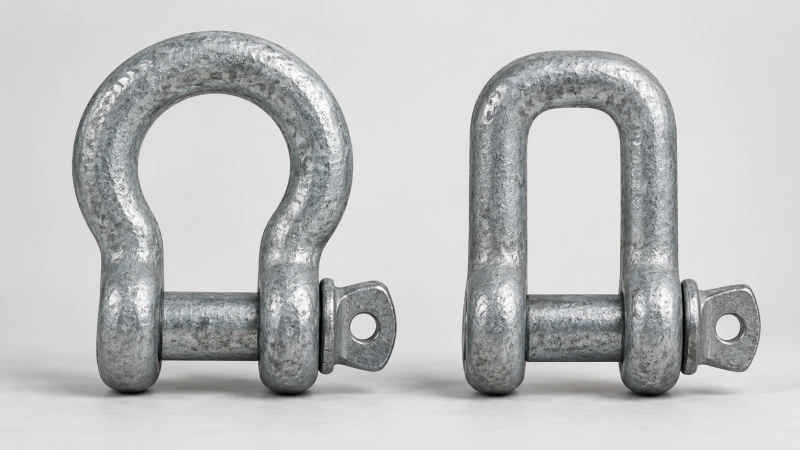
The main difference between a bow shackle and a D shackle is the body geometry. A bow shackle has a wider, rounded crown that provides more room for compatible sling eyes, links, and approved multiple-leg sling connections.
A D shackle has a narrower body that is generally better suited to a single, aligned connection. Choose between them by checking the load path and the components to be connected, then confirm the exact model’s working load limit (WLL) and manufacturer instructions.
A rounded body does not permit loading in any direction. Bow shackles still have model-specific limits for angular loading, side loading, and sling-leg arrangement. This guide explains the practical differences so you can compare suitable models without confusing body shape with rated capacity or pin security.
Key Takeaways
- Choose a bow body when an approved connection requires more room around the crown.
- Consider a Dee body for a compact connection with a single, aligned load path.
- Select the pin arrangement separately. Both body shapes may be supplied with screw-pin or safety-bolt closures, depending on the model.
- Check the marked WLL, connection geometry, and permitted loading for the actual model. Neither body shape is automatically stronger or safer.
Bow Shackle vs D Shackle at a Glance
| Comparison | Bow Shackle | D Shackle |
| Body shape | Wider, rounded crown | Narrower, D-shaped body |
| Common name | Anchor shackle | Dee or chain shackle |
| Connection space | More crown space for compatible fittings | Compact space for an aligned connection |
| Multiple sling legs | Multiple legs only in a manufacturer-approved arrangement | Generally unsuitable for gathering multiple legs unless specifically approved |
| Load direction | Check model-specific limits for angular and side loading | Generally selected for inline loading |
| Pin options | Screw pin or safety bolt, depending on model | Screw pin or safety bolt, depending on model |
| Capacity | Use the marked WLL and applicable manufacturer instructions | Use the marked WLL and applicable manufacturer instructions |
Use the table as a starting point. It summarizes common design differences; it does not constitute approval for a specific lift. You still need to verify the complete connection, including the sling or lifting point, against the applicable product instructions.
Bow Shackles and D Shackles Overview
What Are Bow Shackles?
You can recognize a bow shackle by its rounded body and wider crown. The curved body provides more seating space for a compatible sling eye or fitting than a narrow Dee pattern typically provides. Bow shackles are also commonly called anchor shackles, although the term does not limit them to anchoring applications.
The additional crown space can be useful when an approved lifting arrangement includes more than one sling leg. However, the legs must fit and bear only in the positions permitted by the shackle manufacturer. Check the included angle between the sling legs and the resulting force on the shackle. Physical fit alone does not establish that a multiple-leg arrangement is acceptable.
As a product example, Powerful Machinery lists the G-209 screw-pin anchor shackle. Its bow body and screw-pin closure are separate features: the body defines the connection geometry, while the closure defines how the pin is retained. Compare the current product drawing and specification with the intended connection.
What Are D Shackles?
A D shackle, also written as a Dee shackle, has a narrower body with sides that transition into a tighter crown. It is also commonly described as a chain shackle. Its compact profile is often useful for a straightforward connection between compatible components when the load remains aligned with the shackle.
The narrower body does not, by itself, prevent lateral movement. The rigging arrangement must maintain correct alignment. If a sling eye, link, or lug binds against the side of the body, reconsider the fit and load path rather than assuming the Dee shape will keep the connection centered.
Powerful Machinery’s G-210 screw-pin Dee shackle is an example of this body style. A familiar model designation does not make products from different suppliers interchangeable; use the specification for the exact item being ordered.
Key Differences That Affect Your Selection
Shape and Connection Space
The first visible difference is the space inside the body. A bow may provide more room around the crown for a larger sling eye or a manufacturer-permitted group of eyes. A Dee may fit a compact assembly more neatly. Neither advantage matters if the pin cannot pass through the mating hole or the body interferes with adjacent equipment.
Check the pin diameter, jaw opening, internal clearance, and overall envelope dimensions. With a lifting lug, also consider lug thickness and the intended bearing arrangement. With a sling, check the eye dimensions and the bearing surface specified by the sling manufacturer. A standard bow shackle is not automatically a wide-body sling shackle; these are distinct product designs.
Load Direction and Sling Arrangement
Consider where the force enters and leaves the connection. A single, aligned load path is the usual starting point for a Dee shackle. A bow can accommodate certain approved arrangements that require more crown space, but an approved multiple-leg connection is not the same as an unapproved side pull. These are different loading conditions.
For multiple sling legs, confirm the permitted seating positions and the included angle between the legs for the exact shackle model. The force at the connection depends on the complete rigging geometry, including sling angles. Do not determine the required capacity simply by dividing the total load by the number of legs and assuming equal load sharing in every condition.
Tip: If the connection can rotate, shift, or develop angular loading during the lift, review the full range of movement before selecting the body style. Use only the manufacturer’s permitted configuration and apply any required WLL reduction. A derating chart from another brand is not evidence that your selected model permits the same loading.
Working Load Limit and Strength
You cannot determine which shackle is stronger from body shape alone. WLL depends on the specific design, material, dimensions, and product specification. Models with similar nominal sizes may have different ratings, and different body shapes may also be offered with the same marked WLL.
Compare the marked WLL of the exact shackle with the force it will carry in the planned arrangement. Verify the stated units and any application restrictions. Proof load and minimum breaking load are not working ratings, and a design factor is not spare capacity that can be used to justify overloading.
For help interpreting nominal size and connection dimensions, review the shackle sizes and WLL guide. Keep the exact model drawing beside the rating data so you do not apply a bow body’s dimensions to a Dee body’s specification, or vice versa.
Screw Pin or Safety Bolt
Body style and closure type address different selection questions. A screw pin threads into the shackle body and is convenient where the connection requires regular assembly and removal. Install and secure it in accordance with the manufacturer’s instructions, and verify that movement of the connected components cannot loosen it during the intended operation.
A safety-bolt shackle uses a bolt, nut, and cotter pin for positive retention. This arrangement is often considered when the connection will remain assembled or when additional pin retention is required. It still requires the correct components and proper installation; positive retention does not remove loading limits.
The Powerful Machinery catalogue identifies G-209 and G-210 as screw-pin bow and Dee patterns, and G-2130 and G-2150 as safety-bolt bow and Dee patterns, respectively. Select the body style for the load path, then select the closure for the duty. Do not substitute a pin from a similar-looking shackle.
Applications and Practical Examples
When a Bow Shackle May Fit Better?
Consider a bow when a compatible sling eye or fitting requires additional room at the crown. For example, an approved multiple-leg arrangement may need enough space for the eyes to seat correctly without bunching or bearing on unintended surfaces. Confirm that the exact bow shackle model is permitted for the proposed arrangement.
Bow shackles are used in industrial lifting and other connection duties, but an industry label is not a selection criterion. A product described for construction or marine use is not automatically suitable for your specific lift, environment, or loading angle. Request the exact model data and describe the intended connection.
When a D Shackle May Fit Better?
Consider a Dee when you have a single, aligned connection and limited surrounding space. A compatible link or lifting point may fit neatly within the narrower body. Verify that the mating component has sufficient room to seat and articulate as intended without wedging against the sides.
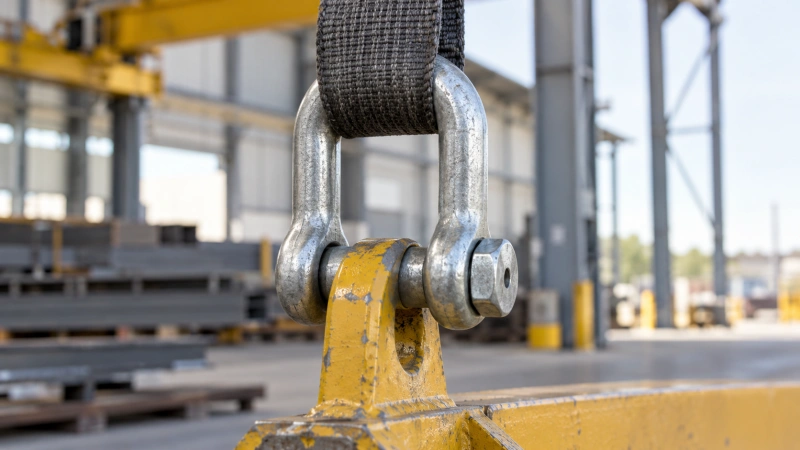
If several sling eyes must enter the connection, do not force them into a compact Dee. Review a suitable bow shackle or another approved connector with the person responsible for the rigging design. Conversely, changing to a bow will not correct an inadequate WLL or a lifting point that is unsuitable for the load direction.
Material and Service Environment
Bow and Dee describe body shape, not material. In the wider market, you may encounter forged-steel shackles with protective finishes as well as separate stainless-steel ranges. Confirm the grade, finish, and rated duty of the exact model instead of assuming that a G-series designation identifies a stainless-steel product.
Service conditions such as corrosion exposure, temperature, and repeated articulation can affect product suitability and inspection requirements. A galvanized finish does not make every shackle suitable for unlimited seawater exposure, and corrosion resistance does not establish lifting capacity. Include the service environment in your enquiry so the supplier can review it against the selected product.
How to Choose the Right Shackle?
Start with the connection rather than choosing a body shape from a picture. A clear description of the job helps eliminate models that do not fit or are not permitted for the planned load direction. Use the following sequence to compare bow and Dee options:
- Establish the required WLL from the actual force acting on the shackle in the planned rigging arrangement.
- Identify every mating component and provide the relevant dimensions, including the geometry of the sling eye or lifting lug.
- Compare the available body space with the load path. Select a bow or Dee only after confirming that the exact model permits the proposed arrangement.
- Choose the closure type based on assembly frequency, expected movement, and pin-retention requirements.
- Confirm the current drawing, material, finish, loading instructions, markings, and required documentation for the model being ordered.
Before use, verify that the correct shackle body and matching pin are assembled together, and check readable identification, condition, and secure engagement. Follow the shackle inspection checklist for a focused pre-use review. Inspection of the hardware does not replace verification that the selected design is suitable for the connection.
Comparing Powerful Machinery Product Options
Powerful Machinery lists bow and Dee patterns with screw-pin and safety-bolt closures. Its catalogue also distinguishes Grade S AS 2741 patterns from U.S.-type and European-type patterns. These names identify product ranges; they do not mean that every range shares the same dimensions, WLL, or documentation.
You can review the bow and Dee shackle product range after deciding which connection geometry you need. For a quotation, provide the required WLL and units, preferred body style and closure type, mating-component dimensions, intended load direction, service environment, quantity, and documentation requirements. Include a drawing or clear connection sketch when fit is critical.
For repeat orders, identify the approved model and drawing revision in the purchase specification. This helps maintain the required fit and reduces the risk of accepting a visually similar substitute with different pin or jaw dimensions.
FAQs
Is a Bow Shackle Stronger Than a D Shackle?
Not necessarily. Compare the marked WLL and permitted loading conditions of the exact models. Body shape mainly affects connection space and geometry; it does not establish capacity by itself.
Can You Use a Bow Shackle for Side Loading?
Only when the manufacturer specifically permits it for that model, and you apply the stated restrictions or WLL reduction. A wider crown does not permit unrestricted side loading or out-of-plane loading.
Are D Shackles and Dee Shackles the Same?
Yes. D shackle and Dee shackle are common names for the same general body shape; “chain shackle” is another common term. Confirm the drawing because the name alone does not define the dimensions, pin type, or rating.
Can You Replace a D Shackle with a Bow Shackle?
Only after checking the complete connection. The replacement must have adequate WLL, correct pin and jaw dimensions, sufficient surrounding clearance, suitable pin retention, and manufacturer-permitted use for the actual load direction. Matching nominal size alone is insufficient.
Which Pin Type Should You Specify?
Consider how often the connection will be assembled and what movement could loosen the pin. Screw-pin and safety-bolt arrangements are available in both body styles. Specify the closure according to the duty and the selected manufacturer’s instructions.
Making Your Final Choice
Choose a bow when its additional crown space suits an approved connection. Choose a Dee when a compact body suits a single, aligned load path. In either case, complete the comparison by checking the exact WLL, drawing, closure, and loading instructions. Those checks turn a general body-style preference into a product specification that can be ordered and used correctly.