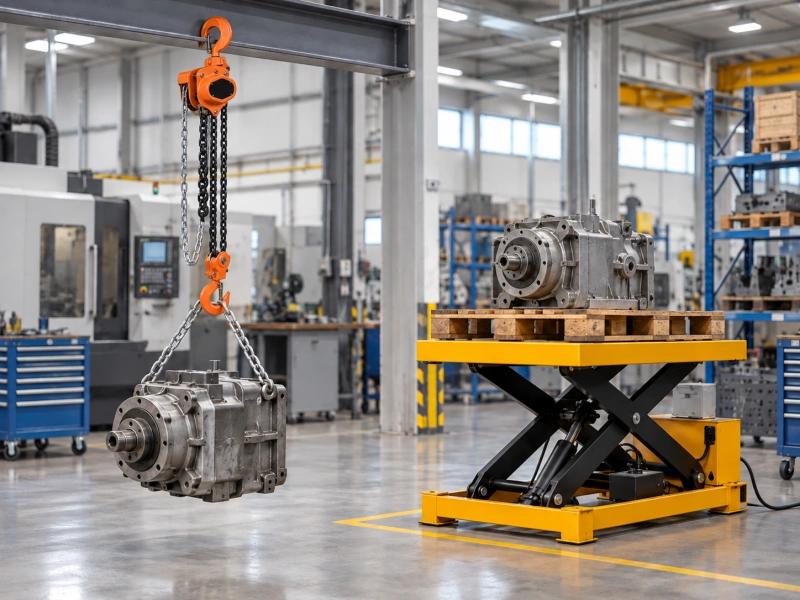
A chain hoist and a hydraulic lift can both move heavy loads vertically, but they support the load in different ways. A chain hoist suspends the load from a hook and raises or lowers it by means of a load chain. An industrial hydraulic lift generally supports the load on a platform or lifting surface and raises that surface with a hydraulic actuator.
This fundamental difference affects the supporting structure, floor-space requirements, rigging, travel, maintenance points, and how the operator interacts with the load.
This guide compares chain hoists with industrial hydraulic lift tables and other platform-type lifts used for material positioning. It does not treat a hydraulic hoist, vehicle lift, passenger lift, or aerial work platform as the same type of equipment. If you are still deciding between different hand-operated hoists, start with our manual hoists category.
If you already know that you need a hand-chain lifting device, review the available manual chain blocks.
Quick Answer: What Is the Main Difference?
- Choose a chain hoist when the load must be suspended from a hook and a rated overhead suspension point is available.
- Choose a hydraulic lift when the load can be supported on a platform or lifting surface, and the installation has enough floor space and a suitable base.
- Do not choose based on capacity alone. Rated load, lift or travel, headroom or lowered height, duty, load distribution, support structure, power, environment, and required movement all matter.
- Manual chain hoists and electric chain hoists differ in power source and duty requirements. Treat “chain hoist” as an equipment family, not as one fixed specification.
- A hydraulic hoist is not the same as a hydraulic lift. A hydraulic hoist still suspends the load from a hoisting mechanism; the hydraulic lift discussed in this article supports the load on a platform.
Chain Hoist vs Hydraulic Lift: Quick Comparison
| Selection factor | Chain hoist | Industrial hydraulic lift |
| How the load is carried | Load is suspended from a hook or lifting attachment | Load is supported on a platform, table, carriage, or other lifting surface |
| Main lifting path | Load chain passes over the load sheave through the hoist mechanism | Hydraulic pressure actuates one or more cylinders, directly or through a scissor/linkage mechanism |
| Typical support | Rated overhead suspension point, beam, trolley, crane, or other supporting structure | Rated floor, foundation, base, or installed supporting structure with adequate stability |
| Power options | Hand chain for manual hoists; electric or air drive for powered chain hoists | Manual pump or powered hydraulic power unit, depending on the lift design |
| Vertical space | Check required lift, hook positions, and headroom | Check lowered height, raised height, vertical travel, and overhead clearance |
| Floor space | Usually limited at the hoist location, but clearance is required for the suspended load, operator, and rigging | Platform footprint and access around the lift are major layout requirements |
| Horizontal movement | Available only when the hoist is mounted on a compatible trolley, crane, or other designed travel system | A stationary lift raises and lowers in place; a mobile lift may be repositioned only as its design permits |
| Repeated cycles | Model- and duty-dependent; powered hoists may be more suitable when manual effort or cycle time becomes impractical | Model- and duty-dependent; many industrial lift tables are designed for repeated positioning tasks |
| Main maintenance areas | Load chain, hooks, brake, load sheave, gearing, suspension, and controls on powered units | Hydraulic cylinder, hoses, fittings, pump or power unit, valves, pivots or scissor mechanism, platform, guarding, and controls |
| Personnel use | Do not use a material hoist to lift or support people unless the exact equipment is designed and approved for that use | Personnel use depends on the exact lift design and applicable rules; never infer personnel rating from the word “hydraulic” |
Scope: What “Hydraulic Lift” Means in This Comparison
The term “hydraulic lift” covers several different equipment types in search results. In material handling, it commonly refers to hydraulic lift tables and industrial scissor lifts that raise a supported load between elevations. Vehicle lifts, mobile elevating work platforms, passenger lifts, hydraulic engine cranes, and hydraulic hoists have different structures and safety requirements.
Mixing these categories in one comparison can produce misleading claims about capacity, mobility, and safety.
The distinction matters because a hydraulically powered hoist can still be a hoist: the load remains suspended from a hook while hydraulic power drives the hoisting mechanism. That load path is different from the platform-type hydraulic lift discussed here.
How a Chain Hoist Carries the Load?
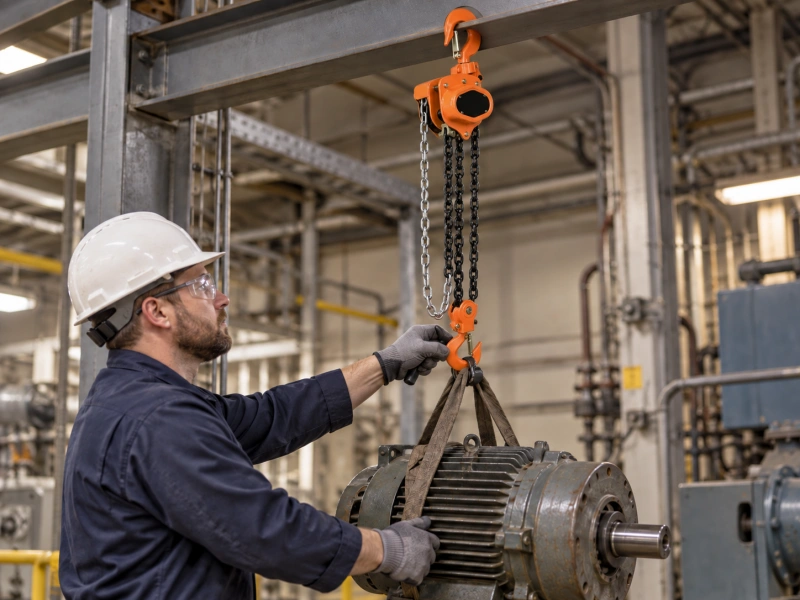
A chain hoist raises a freely suspended load through a load chain. On a hand chain block, the operator pulls the hand chain, the gearing multiplies the input force, and the load sheave moves the load chain. A load brake holds and controls the suspended load when the operator stops.
Powered chain hoists replace hand-chain input with a motor and controls, but selection still depends on rated load, lift, suspension, headroom, chain configuration, duty, and operating environment.
If you need a clearer component-level explanation, see the chain block components guide. For a basic definition of hand chain blocks and their operating principle, read what a chain block is.
The hoist itself primarily provides vertical hook travel. Horizontal travel is a separate function. If the load must move along a beam, the hoist can be combined with a compatible trolley or crane system, provided the supporting structure, trolley, beam profile, travel limits, and controls are designed for the application.
How a Hydraulic Lift Carries the Load?
An industrial hydraulic lift supports the load on a platform or lifting surface. A pump pressurizes hydraulic fluid, and the resulting pressure acts on one or more cylinders. Depending on the design, the cylinder may raise the platform directly or move a scissor mechanism that converts cylinder motion into vertical travel. Lowering is controlled through the hydraulic circuit and the lift’s mechanical design.
This architecture is useful when the workpiece, pallet, fixture, or material can remain supported during the lift. The critical layout parameters are not hoist headroom and hook reach; they are platform size, lowered height, raised height, vertical travel, load distribution, base or pit requirements, approach space, and any guarding or operator interface required for the exact lift.
Detailed Comparison
1. Load Path and Supporting Structure
This is usually the first decision. A chain hoist needs a rated suspension point above the load. The supporting beam, trolley, crane, anchorage, or other structure must be suitable for the load and the forces created by the lifting arrangement. Because the load remains suspended, rigging, hook engagement, load control, and the exclusion area remain important throughout the lift.
A hydraulic lift transfers the load through its platform into the base and supporting floor or foundation. Instead of checking an overhead suspension point, you must verify the floor or foundation capacity, platform loading, load distribution, stability, and access around the lift. Neither system is automatically safer; each creates a different load path that must be designed and operated correctly.
2. Power and Operator Effort
A manual hand chain hoist requires no electrical supply at the lifting point, but the operator provides the input through the hand chain. This can be practical for intermittent lifting, maintenance work, or sites where powered lifting is unnecessary. As lifting frequency increases, operator effort and cycle time become more important selection factors.
For repeated powered lifting, compare the application with available electric hoists rather than assuming that every chain hoist performs like a manual chain block. Electric chain hoists introduce motor, controls, power-supply, duty-rating, speed, and electrical-environment requirements.
A hydraulic lift may use a hand pump or a powered hydraulic power unit, depending on the product. The motor, pump, reservoir, valve arrangement, cylinder size, control method, and duty must be specified for the actual design. “Hydraulic” describes the actuation method; it does not, by itself, define capacity, speed, travel, or personnel suitability.
3. Movement, Headroom, and Footprint
A chain hoist is often useful when floor space around the lifting point is limited, and an overhead support is available. The critical vertical dimensions are the required hook travel and the available headroom at the highest load position. If the hoist travels on a trolley, beam clearance and horizontal travel become part of the system design.
A hydraulic lift uses floor or structural space for its base and platform. The key dimensions are lowered height, raised height, vertical travel, platform size, approach direction, and clearance for the moving mechanism. A low lowered height can be valuable for loading, but that dimension is model-specific and should be verified on the exact product drawing.
4. Duty Cycle and Lifting Speed
Do not assume that “hydraulic is faster” or “chain hoist is slower.” Both categories include designs with very different speeds and duty capabilities. A manual chain block is generally selected for intermittent hand-operated work, while a powered chain hoist may be suitable for repeated production lifting when its duty rating, speed, controls, and thermal limits match the process.
Hydraulic lifts likewise range from occasional manual units to powered industrial equipment intended for repeated positioning.
For either system, define the actual process: lifts per hour, operating hours per day, typical and maximum load, required travel, acceptable cycle time, and required positioning accuracy. These inputs are more useful than a generic speed claim.
5. Installation and Mobility
An apparently portable hoist is not automatically a portable lifting system. The hoist may be compact, but it still requires an approved support wherever it is installed. Moving it to a different beam or structure requires the new suspension and installation to be suitable for the rated load and application.
Likewise, some hydraulic lifts are stationary, and others are mobile. Mobility must be confirmed from the exact design, including whether the unit may be moved while loaded, what floor conditions are required, and how stability is maintained. Do not infer mobility from photographs or from the presence of wheels alone.
6. Maintenance and Service
Chain hoists and hydraulic lifts have different maintenance points, but neither category has a universal service interval or lifecycle cost. Chain hoist inspection may involve the load chain, hooks, brake, suspension, load sheave, gears, chain guides, markings, and controls on powered models.
Hydraulic lift maintenance may involve the cylinder, hoses, fittings, pump, reservoir, valves, pivots, scissor components, platform, guards, and controls.
Use the manufacturer’s instructions and applicable site requirements to establish inspection and maintenance frequencies. For hand chain equipment, our chain block inspection checklist can help organize the items to verify before use and during periodic inspection, but the criteria for the exact model remain controlling.
7. Safety and Standards
Both systems can create serious hazards when they are overloaded, incorrectly supported, poorly maintained, or used outside their intended function. The controls differ because the load paths differ. With a chain hoist, important considerations include rated suspension, rigging, hook engagement, chain condition, brake function, side pulling, and keeping people clear of suspended loads.
With a hydraulic lift, important considerations include rated capacity, load distribution, stability, crush and pinch zones, hydraulic integrity, mechanical restraint or maintenance provisions, guarding, and the platform’s intended use.
Applicable standards depend on the equipment and jurisdiction. In the United States, ASME B30.16 covers overhead underhung and stationary hoists within its scope, including hand-chain-operated, electric-powered, and air-powered hoists used for vertical lifting of freely suspended loads.
Industrial scissor lifts are covered by a different standards framework, including ANSI MH29.1 for equipment within that standard’s scope. Do not substitute a company quality-management certificate for model-specific product compliance.
Never assume that material-handling equipment is suitable for lifting people. Personnel lifting requires equipment specifically designed and approved for that purpose and compliance with the rules that apply to the application and location.
When a Chain Hoist Fits the Job?
A chain hoist is a suitable candidate when the load must be suspended from a hook, a suitable overhead support exists, the work area cannot accommodate a platform beneath the load, or the load must be lifted from an irregular position using approved rigging. Manual chain blocks are especially relevant for intermittent lifts where a power supply is unnecessary.
Powered chain hoists become more relevant when lifting frequency, speed, or operator-effort requirements exceed what is practical with hand operation.
Before requesting a chain hoist quotation, provide the maximum load, required capacity, lift, headroom, top and bottom connection details, suspension or trolley arrangement, operating frequency, working environment, required documents, quantity, and destination. The chain block product range shows the type of model-specific data that should be compared instead of relying on a generic tonnage claim.
When a Hydraulic Lift Fits the Job?
A platform-type hydraulic lift is a suitable candidate when the load can remain supported, the process benefits from raising a pallet or workpiece to a controlled working height, and the installation has enough floor or structural space for the lift.
Typical selection inputs include rated capacity, platform dimensions, load distribution, lowered and raised heights, vertical travel, cycle time, power source, control method, floor or pit requirements, environment, and whether the application involves materials only or requires purpose-designed personnel equipment.
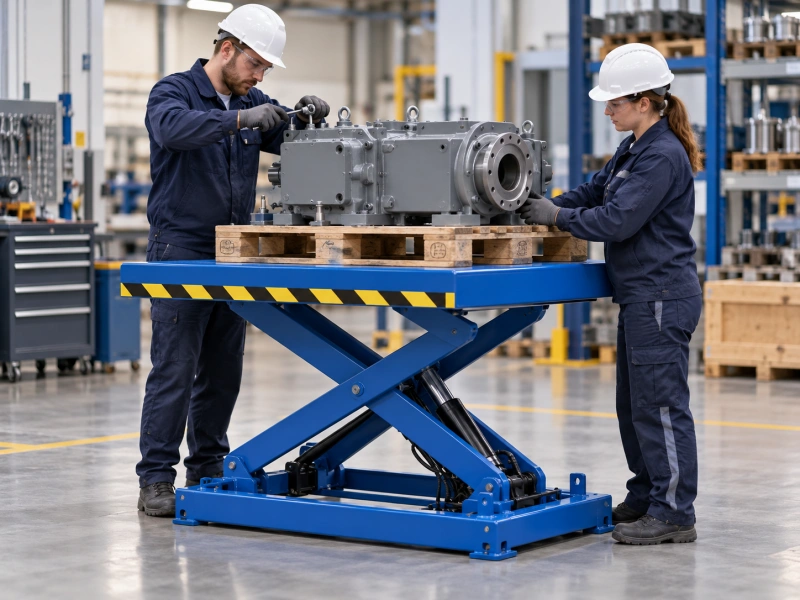
Powerful Machinery’s current lifting portfolio focuses on hoists, chains, rigging hardware, blocks, slings, jacks, trolleys, and related equipment. This article should therefore explain the comparison accurately without implying that every type of hydraulic platform lift is a Powerful Machinery product.
Selection Scenarios
| Application | Starting point | Why |
| Lift a machine from above for maintenance | Chain hoist | Suspended-hook lifting is usually the more direct architecture when a rated overhead support and suitable rigging are available. |
| Raise a pallet to an ergonomic work height | Hydraulic lift table | The load can remain supported on a platform while its working height changes. |
| No electrical power at the lifting point | Manual chain hoist or manual hydraulic lift, depending on load support | First decide whether the load must be suspended from a hook or can be supported on a platform; then compare manual operating effort. |
| Move a suspended load along a beam | Chain hoist + compatible trolley/crane | Horizontal travel is provided by the travel system, not by the chain hoist alone. |
| Repeated production lifting | Powered chain hoist or powered hydraulic lift | Compare duty, cycle time, speed, travel, layout, controls, and load support. No category is preferred by default. |
| No rated overhead structure, but floor space is available | Hydraulic lift may fit better | A platform lift can transfer the load into the base and supporting floor instead of an overhead structure, subject to floor or foundation requirements. |
| Lift people | Use purpose-designed personnel equipment only | Do not infer personnel suitability from a material chain hoist or a generic hydraulic-lift label. |
| Hazardous or special environment | Project-specific rated equipment | Confirm environmental classification, materials, protection, and local requirements for the exact model. |
What to Specify Before Buying or Quoting?
For a chain hoist, provide:
- Maximum gross load and required rated capacity.
- Required lift and available headroom.
- Fixed hook or clevis suspension, or trolley/crane requirements, including beam data if horizontal travel is needed.
- Operating frequency, typical load spectrum, and required lifting speed for powered models.
- Indoor or outdoor conditions, temperature, moisture, dust, corrosion, and any special-area classification.
- Power supply and control method for powered hoists.
- Required documents and markings, quantity, destination, and delivery schedule.
For an industrial hydraulic lift, provide:
- Maximum load and its distribution across the platform.
- Platform size, lowered height, raised height, and required vertical travel.
- Floor, foundation, pit, or mounting conditions, and available footprint.
- Cycle frequency and acceptable raising/lowering time.
- Power source, control method, and required operator interface.
- Environment, access, guarding, and required maintenance clearance.
- Whether the lift is for materials only or for an application that requires purpose-designed personnel equipment.
Common Selection Mistakes
- Comparing capacity only. Two devices with the same rated load can require completely different support, workspace, rigging, platform, and duty arrangements.
- Treating a hydraulic hoist and a hydraulic lift as synonyms. They describe different load paths in this comparison.
- Assuming every chain hoist has the same overload device, brake arrangement, lifting speed, duty rating, chain size, or environmental rating.
- Assuming every hydraulic lift is a personnel lift or every scissor mechanism is an aerial work platform.
- Ignoring the supporting structure. A chain hoist needs a suitable overhead suspension; a platform lift needs a suitable base, floor, or foundation.
- Using broad “low maintenance” or “cheaper” claims instead of comparing the actual installation, inspection, service parts, downtime, energy, labor, and lifecycle requirements.
FAQ
What Is the Main Difference Between a Chain Hoist and a Hydraulic Lift?
A chain hoist suspends the load from a hook and raises it through a load chain. A platform-type hydraulic lift supports the load on a platform and raises that platform with a hydraulic actuator. The primary selection question is therefore how the load must be supported, not which device has the larger advertised capacity.
Is a Hydraulic Hoist the Same as a Hydraulic Lift?
No. A hydraulic hoist uses hydraulic power to operate a hoisting mechanism while the load remains suspended. In this article, “hydraulic lift” refers to a platform-type industrial lift that supports the load. Search results often mix these terms, so verify the actual equipment architecture before comparing specifications.
Can a Chain Hoist Move a Load Horizontally?
The hoist mechanism provides lifting and lowering. Horizontal movement can be added when the hoist is mounted on a compatible trolley, monorail, bridge crane, or other designed travel system. The beam, trolley, supporting structure, end stops, clearances, and controls must be suitable for the application.
Which Is Better for Repeated Lifting?
There is no universal answer. A powered chain hoist can be suitable for repeated suspended-load lifting when its duty, speed, controls, support, and environment are appropriate. A powered hydraulic lift can be suitable for repeated platform positioning when its travel, duty, platform, and hydraulic system match the process. Compare the actual duty cycle and load path instead of choosing by category name.
Which Requires More Maintenance?
Maintenance requirements are model- and service-dependent. Chain hoists and hydraulic lifts have different wear, inspection, and service points. Compare the manufacturer’s required inspections, service intervals, parts availability, downtime, access, and maintenance skills for the exact equipment rather than assuming that one category is always lower maintenance.
Can a Chain Hoist or Hydraulic Lift Be Used to Lift People?
Do not use material-handling equipment for personnel unless the exact product is specifically designed and approved for that purpose and the applicable rules permit the use. Hand chain hoist standards such as ASME HST-2 exclude lifting or supporting people from their stated scope. Hydraulic equipment also requires a purpose-specific design and applicable personnel-lift requirements when people are involved.
Conclusion
The practical difference between a chain hoist and a hydraulic lift begins with the load path. A chain hoist is designed around suspended-load lifting from an overhead support. An industrial hydraulic lift is designed around supporting a load on a platform and raising that platform from below.
Once that difference is clear, selection becomes more disciplined: rated load, lift or travel, headroom or platform height, duty, speed, support structure, footprint, controls, environment, inspection, and maintenance.
If your application points to a chain hoist, review the manual chain block range for hand-operated lifting or the electric hoist range for powered lifting. For a project-specific quotation, contact our technical team with the load, lift, headroom, suspension, duty, environment, documentation, quantity, and destination.