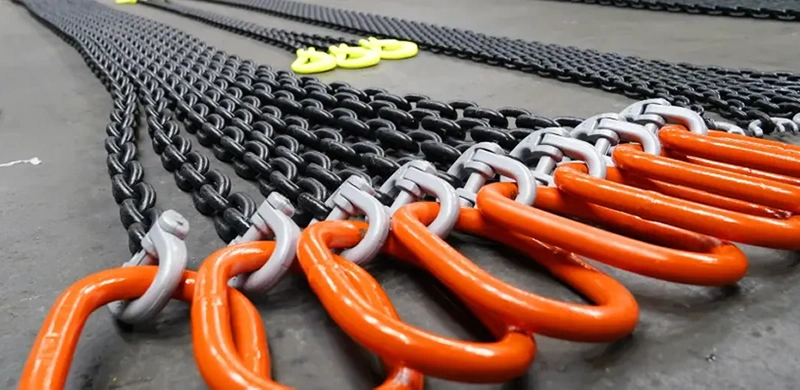
Powerful Machinery manufactures lifting chain sling assemblies for industrial load handling. Choose from single-, two-, three-, and four-leg configurations using Grade 80 lifting chain or Grade 100 lifting chain. Top links, connectors, shortening devices, and lower fittings are selected as a compatible assembly.
A chain sling should be specified around the lift, not around an assumed chain diameter. Please provide the maximum gross load, center of gravity, pick-point layout, hitch type, worst-case sling angle, required reach, available headroom, connection dimensions, service conditions, applicable standard or market requirement, quantity, and required documentation. We will review the configuration and confirm any additional details needed before quotation.
For procurement teams comparing chain sling suppliers, the quotation should be evaluated against the complete assembly – not only the chain itself – including chain grade and size, leg configuration, compatible fittings, assembly WLL and rating basis, identification, required documentation, and delivery requirements.
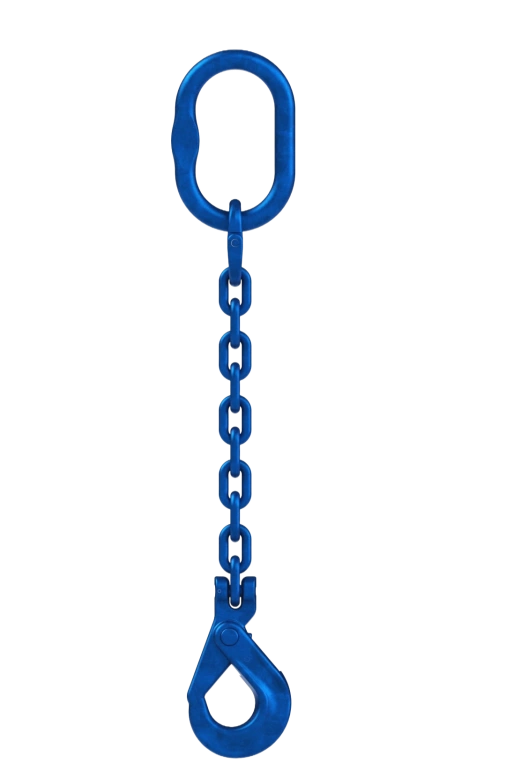
A single-leg chain sling provides a direct connection between the lifting device and one rated lifting point. Specify the vertical load, finished reach, top-link dimensions, lower fitting, and whether shortening or adjustment is required.
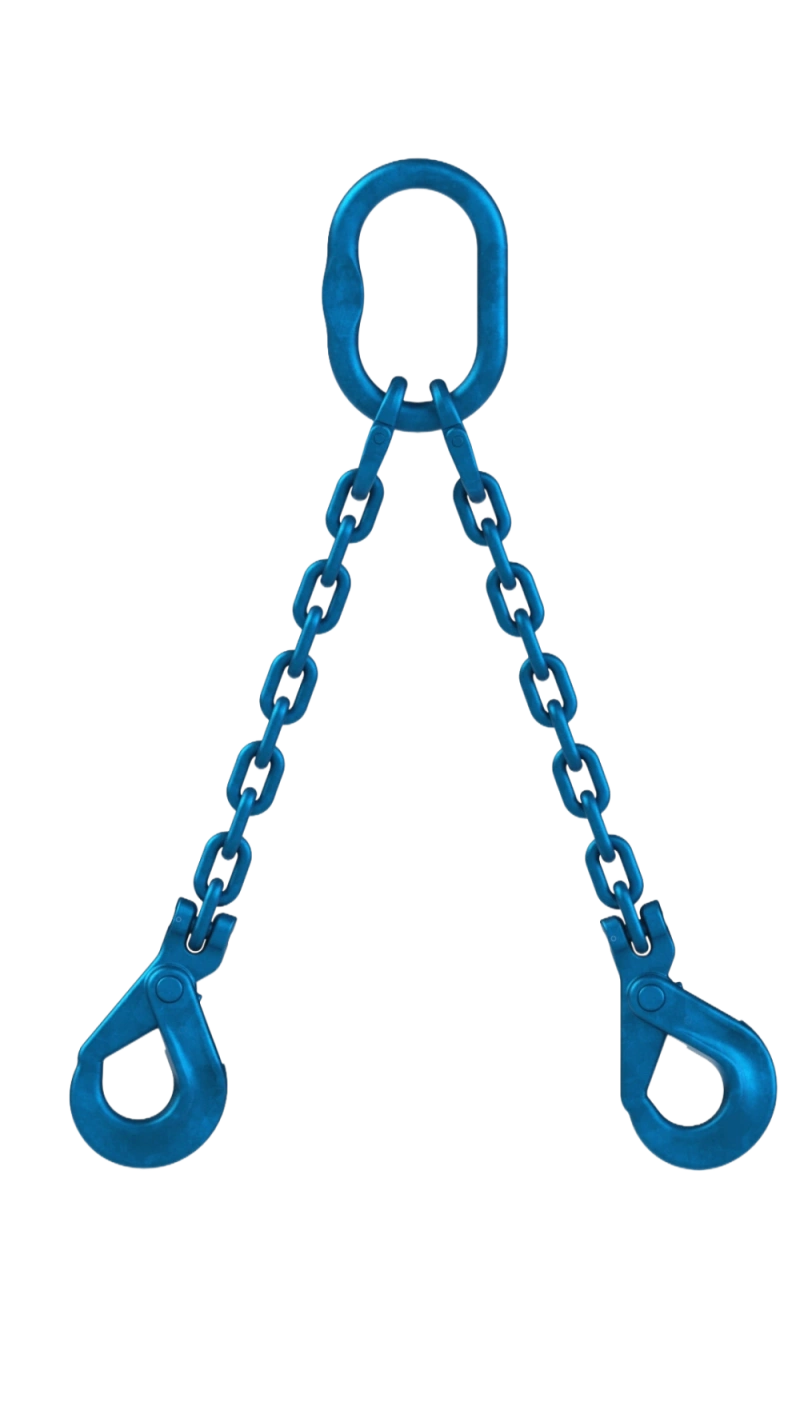
A two-leg chain sling connects two lifting points to a master link and can provide better load control when the center of gravity and pick points are known. Capacity changes with sling angle, so include the pick-point spacing, vertical height, and angle convention in the RFQ.
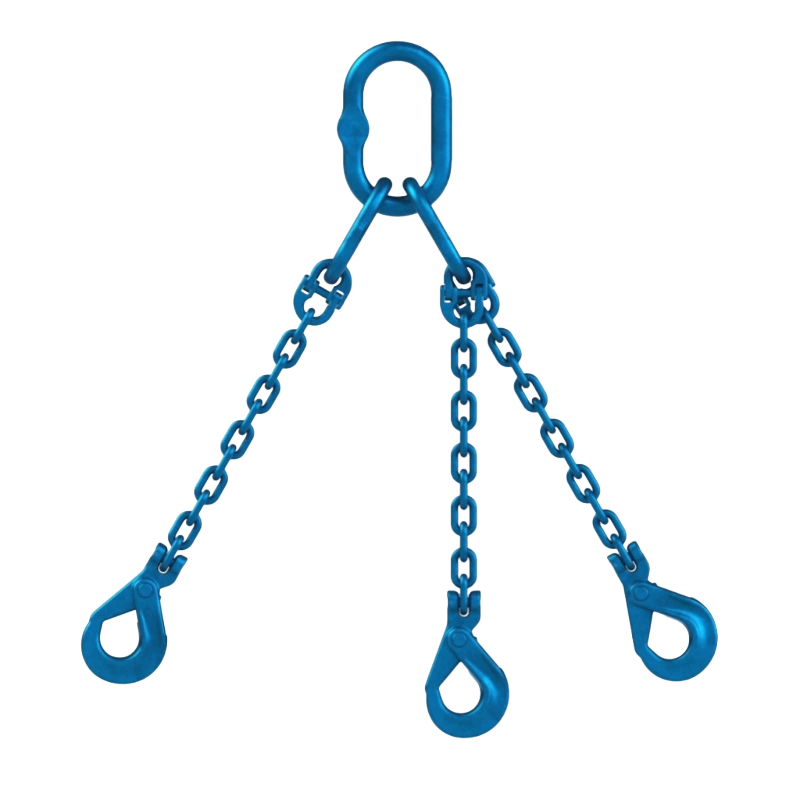
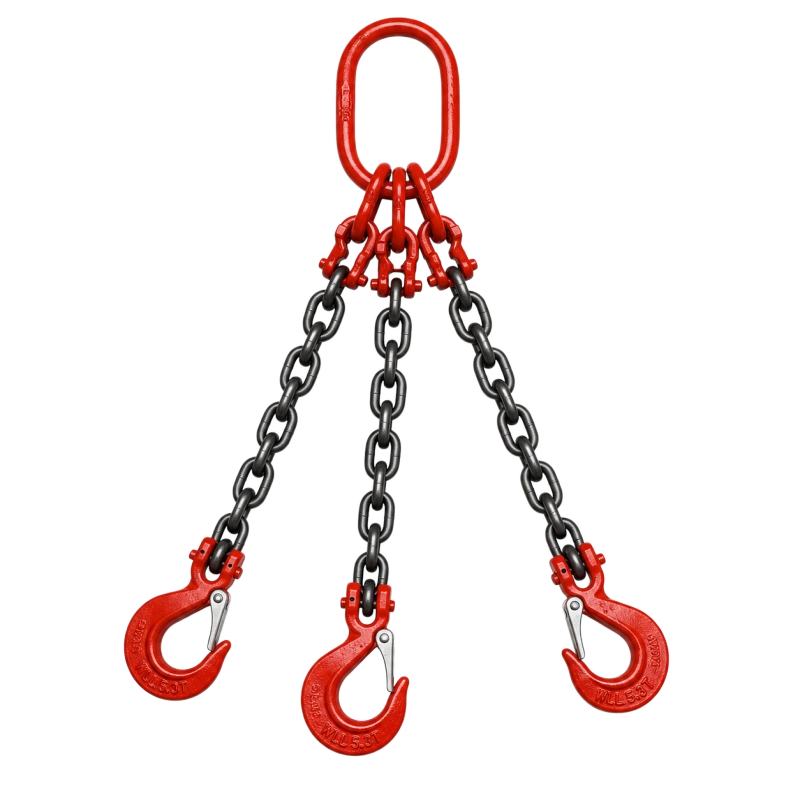
A three-leg chain sling is used for loads with three rated attachment points. The sling should be selected for the actual geometry and expected load distribution. The capacity cannot be determined by simply multiplying the single-leg WLL by three.
A four-leg chain sling can help stabilize large or irregular loads with four lifting points, but the legs may not share the load equally. Provide a drawing showing the center of gravity, pick-point elevations, and the least favorable operating angle. The quotation should clearly state the rating method and any assumptions used.
| Configuration | Typical Use | Information to Send |
|---|---|---|
| Single Leg | Direct vertical connection to one rated lifting point | Gross load, required reach, crane-hook fit, lower connection, hitch type |
| Two Leg | Loads with two rated pick points | Gross load, center of gravity, pick-point spacing, sling angle, required reach, fittings |
| Three Leg | Loads designed for three pick points | Load geometry, expected load sharing, sling angle, matched or unequal leg reach, fittings |
| Four Leg | Large or irregular loads with four pick points | Load drawing, center of gravity, pick-point elevations, rating method, sling angle, required reach |
| Adjustable / Custom | Repeated lifts with different elevations or off-center geometry | Required adjustment range, approved shortening method, complete lifting geometry range |
Grade 80 and Grade 100 are established alloy lifting-chain systems. Grade 100 can provide a higher WLL than Grade 80 at the same nominal diameter, but grade is only one selection input. Availability, component compatibility, chain size, temperature limits, site rules, handling weight, and the applicable standard also matter. Review Grade 80 vs Grade 100 chain, then compare the manufacturer’s approved WLL tables for the exact assembly.
WLL and sling angle: The rated capacity of a finished chain sling depends on the chain, leg count, hitch, angle, fittings, temperature, and the lowest-rated component. State whether the sling angle is measured from the horizontal, from the vertical, or as the included angle between legs. A flatter bridle increases leg tension and reduces available capacity.
The upper fitting must seat correctly in the crane or hoist hook without crowding or point loading. Lower fittings must fit the load connection and suit the required retention method. Depending on the lift, an assembly may use master links, coupling links, approved shortening devices, lifting hooks, self-locking hooks, foundry hooks, grab hooks, or other rated fittings. See the chain sling components guide for terminology.
Do not specify “hook” or “master link” without dimensions. Provide the crane-hook opening and saddle dimensions, lifting-lug hole and thickness, shackle size, trunnion diameter, required hook throat, and any swivel, latch, locking, or orientation requirement. Every component must match the chain grade and nominal size, and the finished assembly is limited by its lowest-rated component.
The upper fitting must seat correctly in the crane or hoist hook without crowding or point loading. Lower fittings must fit the load connection and suit the required retention method. Depending on the lift, an assembly may use master links, coupling links, approved shortening devices, lifting hooks, self-locking hooks, foundry hooks, grab hooks, or other rated fittings. See the chain sling components guide for terminology.
Do not specify “hook” or “master link” without dimensions. Provide the crane-hook opening and saddle dimensions, lifting-lug hole and thickness, shackle size, trunnion diameter, required hook throat, and any swivel, latch, locking, or orientation requirement. Every component must match the chain grade and nominal size, and the finished assembly is limited by its lowest-rated component.
When comparing chain sling suppliers, focus on whether the supplier can review, rate, assemble, identify, and document the finished sling for your actual lift. A wide catalog alone does not confirm that the proposed chain, master link, connectors, shortening devices, and lower fittings form a compatible rated assembly.
| What to Verify | What the Supplier Should Confirm | Why It Matters |
|---|---|---|
| Chain Grade and Configuration | Proposed Grade 80 or Grade 100 system, chain size, leg count, hitch, reach, and adjustment method. | The finished assembly must match the actual lift, not a generic chain size. |
| Assembly WLL and Rating Basis | WLL for the proposed leg count, hitch, sling angle convention, temperature or service limits, and rating method. For background, review how chain sling capacity changes with configuration and angle . | Capacity changes with geometry and operating conditions. |
| Component Compatibility | Master links, coupling links, shortening devices, hooks, and other fittings matched to the chain grade and nominal size. | The finished assembly is limited by its lowest-rated component. |
| Identification and Traceability | Tag and identification requirements, serial or batch information where required, and how the supplied assembly will be identified. | Supports receiving inspection, in-service inspection, and record control. |
| Testing and Documentation | Which drawings, conformity documents, proof-test records where required, inspection records, WLL tables, and traceability documents are included. | Avoids relying on a generic “certified supplier” claim. |
| Custom Technical Review | Review of load geometry, center of gravity, pick points, connection dimensions, service conditions, and customer drawings or marked-up photos. | Reduces mismatch between the quoted sling and the actual lift. |
| Quotation Assumptions and Deviations | Any design assumptions, component substitutions, dimensional limitations, or deviations from the RFQ stated clearly before production. | Prevents unapproved changes from being hidden in the quotation. |
| Lead Time | Production schedule confirmed against material availability, quantity, testing, documentation, and shipping requirements. | Creates a realistic delivery commitment for the actual configuration. |
Our quotation should state the proposed configuration, identify any assumptions, and list any deviations from the RFQ. If a requested fitting is not compatible, if the required reach changes the available headroom, or if the applicable standard changes the required documentation, our team will identify and resolve these points with the buyer before production.
For custom assemblies, send us the load geometry, pick points, hitch, sling angle convention, reach, connection dimensions, service conditions, and document requirements so we can review the complete application rather than quoting from chain diameter alone. The custom chain sling RFQ guide provides a practical list of information to send with your enquiry.
Name the destination market, end-user standard, and project specification in the RFQ. Request the exact documents needed for acceptance, such as an approval drawing, certificate of conformity, proof-test certificate where required, component or batch traceability, WLL table, dimensional inspection, tag details, and inspection/use instructions. The quotation should state what is included and list any deviations.
A legible identification tag and inspection records are part of safe sling management. Follow the chain sling inspection guidance and learn how to identify common chain sling defects. Remove a sling from service when damage or missing identification prevents safe use, and have repair decisions made by an authorized or qualified party under the applicable standard.
As a chain sling supplier, we base each quotation on the controls and documents that apply to the actual sling assembly rather than relying on a generic list of company or third-party certifications. We confirm the applicable market or project requirements, rating basis, identification and tagging requirements, and the test, inspection, and traceability records available for the quoted assembly. The agreed document package can also support your receiving checks and ongoing chain sling inspection process.
MOQ depends on the chain grade, diameter, fittings, finish, testing, packaging, and whether the assembly uses standard or custom components. Send the specification and required quantity for a practical production and price recommendation.
We confirm lead time against the reviewed sling configuration, required documentation, testing, quantity, and shipping requirements rather than making a generic “fast delivery” promise.
Yes. We accept drawings, samples, marked-up photos, and technical specifications for custom lifting chain slings. Include the load and connection geometry as well as the assembly dimensions; matching a sample’s appearance alone is not enough to confirm a safe WLL.
Measure from the load-bearing surface of the upper terminal component to the load-bearing surface of the lower terminal component. The finished measurement includes the fittings, not only the chain body.
Yes, when these deliverables are defined in the order. State whether you require proof-load testing, an inspection record, certificate of conformity, serial number, batch traceability, WLL table, tag content, or third-party inspection. We will confirm what applies to the proposed assembly before production.
Provide the gross load, center of gravity, pick points, hitch, leg count, worst-case angle and angle convention, required assembly WLL, bearing-to-bearing reach, headroom, top and bottom connection dimensions, service conditions, standard, quantity, destination, and document list.
No. Grade 70 transport chain is intended for cargo securement, not overhead lifting. Specify an alloy lifting-chain system and compatible components rated and documented for the applicable lifting standard.
Do not assume equal load sharing or multiply the single-leg WLL by four. The rating depends on the applicable method, geometry, sling angle, component system, and manufacturer data. Ask the quotation to state the rating basis.
Send the lift drawing or marked-up photos together with the load, geometry, connections, service conditions, standard, quantity, destination, and document requirements. Powerful Machinery will review the RFQ, identify missing inputs, and quote the proposed Grade 80 or Grade 100 chain sling assembly. Final sling selection and lift planning must be completed by qualified personnel using the applicable standards and manufacturer instructions.
After downloading the product catalogue, our dedicated technical experts will provide you with one-on-one service.