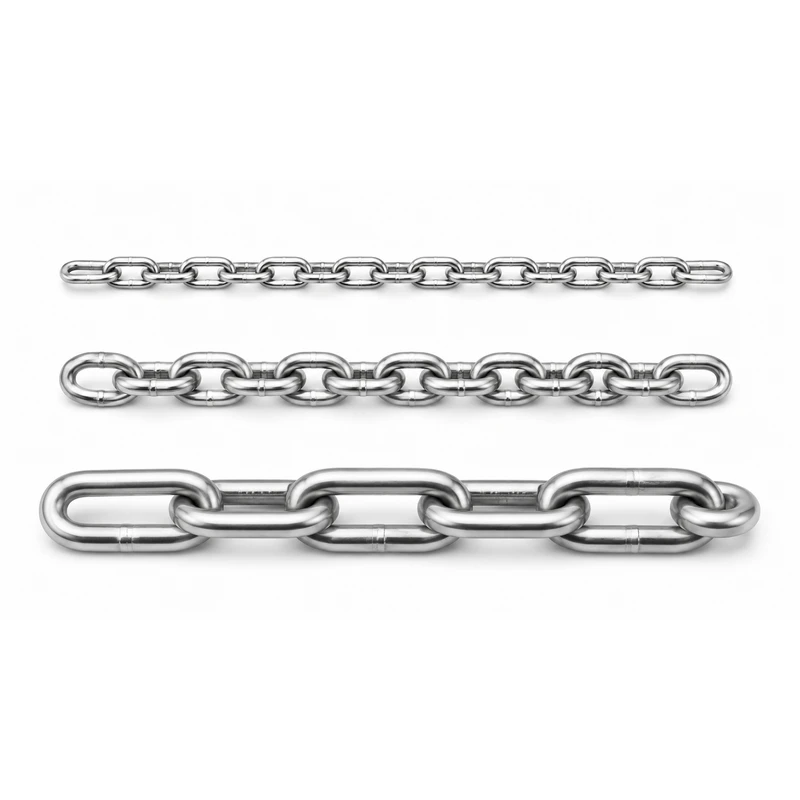
When you compare Grade 70 vs Grade 80 chain, start with the job rather than the number. Grade 70 is a heat-treated transport chain used for cargo securement, load binding, towing, and similar pulling applications. You must not use it for overhead lifting. Grade 80 is a heat-treated alloy chain grade commonly used in properly designed, identified, and rated lifting-chain systems.
The difference is not simply that one chain is ten points stronger. The grades use different material systems, tests, markings, component requirements, and working-load-limit rules. A chain can have an impressive breaking-force figure and still be the wrong product for your application.
This guide shows you how to compare material, working load limit, identification, standards, inspection, and total cost. It also explains why you should select the complete chain or sling assembly from its manufacturer data instead of assuming that every Grade 80 product has a higher rating than every Grade 70 product of the same advertised size.
Key Takeaways
- Use Grade 70 chain for cargo securement and other applications specifically allowed by the chain manufacturer. Never use Grade 70 transport chain for overhead lifting.
- Use Grade 80 alloy chain for overhead lifting only as part of a correctly rated system with compatible components, legible identification, and the required inspection and documentation.
- Do not treat the grade number as a carbon-percentage label. It identifies a strength class within the applicable chain specification, not a simple chemical-composition percentage.
- Compare published working load limits by exact product, dimensions, standard, hitch, angle, and assembly configuration. The weakest component controls the complete assembly.
- Identify a chain from permanent grade markings, tags, manufacturer data, and traceability. Color or finish alone is not reliable proof of grade.
- For cargo securement, calculate the required tiedown system from the applicable transport rules. For lifting, use the sling tag and manufacturer-rated capacity for the actual hitch and angle.
What Is the Main Difference Between Grade 70 and Grade 80 Chain?
The main difference in a Grade 70 vs Grade 80 chain comparison is intended service. Grade 70 is primarily a transport and load-securement chain. Grade 80 is an alloy chain grade used for lifting chain and chain-sling systems, although a Grade 80 product can also be supplied for certain tie-down or pulling applications when the manufacturer rates it for that use.
You should therefore separate two questions. First, is the chain grade suitable for the type of work? Second, is the exact chain or complete assembly rated for your required load and configuration? Passing the first test does not automatically answer the second.
| Comparison point | Grade 70 chain | Grade 80 chain |
| Primary role | Transport tie-down, load binding, towing, logging, and pulling where specified | Alloy lifting chain and chain-sling systems; may also be used for other rated applications |
| Typical material family | Heat-treated carbon steel | Heat-treated alloy steel |
| Overhead lifting | No | Yes, when the chain and complete sling assembly are designed, marked, rated, and used for lifting |
| Common identification | Grade 70 markings such as 7, 70, or manufacturer-specific marks | Grade 80 markings such as 8, 80, or manufacturer-specific marks; sling identification tag for an assembly |
| Common finish | Often yellow or gold chromate in North American transport products, but finishes vary | Often black, painted, powder-coated, or another manufacturer finish; color is not a universal grade code |
| Selection basis | Transport-chain WLL, chain size, binder and anchor compatibility, cargo-securement design | Sling or chain WLL, hitch, angle, number of legs, fittings, tag, environment, and documentation |
Important: Grade 80 does not mean that any untagged length of chain is automatically a compliant lifting sling. For an overhead lift, you need a lifting-rated chain or assembly with compatible components and verifiable capacity information.
What Do the Chain Grade Numbers Mean?
A chain grade number represents a strength class under the relevant product specification. It does not tell you that Grade 70 chain contains 0.70 percent carbon, and it does not provide a complete purchase specification by itself. The exact standard can also control link diameter, pitch, inside width, material, heat treatment, proof force, minimum breaking force, elongation, markings, and test records.
This is why you should not buy by the grade stamp alone. Start with the application and market, then state the standard, chain size, required WLL, dimensions, finish, markings, tests, certificates, and delivery form. For a broader overview of the numbering system, use the chain grades guide.
How Are Grade 70 and Grade 80 Chains Made?
Grade 70 Transport Chain
Grade 70 transport chain is commonly made from heat-treated carbon steel. The heat-treatment process raises its strength above lower transport-chain grades while retaining the toughness and wear resistance needed for truck, trailer, logging, and load-binding service.
Many North American products use a yellow or gold chromate finish for visibility and corrosion protection, but you should never use color as your only means of identification.
When you order Grade 70 transport chain, specify the chain standard, trade size, WLL, length, end fittings, finish, markings, packaging, and required documentation. Make sure your binders, hooks, and vehicle anchor points match the chain and securement plan.
Grade 80 Alloy Chain
Grade 80 chain is made from heat-treated alloy steel selected for the strength, toughness, and controlled performance expected in lifting service. A lifting chain is more than a strong welded link. Its material, weld quality, dimensions, heat treatment, proof testing, grade markings, and compatible component system all contribute to the assigned WLL.
For overhead lifting, use a product such as a properly specified Grade 80 lifting chain or a completed chain sling. The exact standard matters: medium-tolerance sling chain, fine-tolerance hoist chain, and lashing chain can share similar terminology while serving different equipment and applications.
Grade 70 vs Grade 80 Chain Working Load Limits
Working load limit, or WLL, is the maximum load assigned to a product for stated service conditions. It is not the proof force and it is not the minimum breaking force. If those terms are unfamiliar, review the difference between chain working load limit and breaking strength before you select a chain.
The original Grade 70 vs Grade 80 chain question often assumes that Grade 80 must carry more at every matching trade size. Published tables show why that shortcut can mislead you. Nominal trade sizes do not always have identical wire diameters or link geometry, and Grade 70 transport-chain WLL is not the same application rating as a Grade 80 chain-sling WLL.
| Nominal size | Grade 70 transport-chain WLL | Grade 80 single-leg vertical WLL | What you should notice |
| 1/4 in. G70 / 9/32 in. G80 | 3,150 lb | 3,500 lb | These are neighboring trade sizes, not identical wire diameters |
| 5/16 in. | 4,700 lb | 4,500 lb | The Grade 70 transport-chain value is slightly higher in these published examples |
| 3/8 in. | 6,600 lb | 7,100 lb | The Grade 80 single-leg value is higher |
| 1/2 in. | 11,300 lb | 12,000 lb | The Grade 80 single-leg value is higher |
| 5/8 in. | 15,800 lb | 18,100 lb | The Grade 80 single-leg value is higher |
These figures are examples from published Peerless product tables and are included to show why you must check the exact product. They do not authorize you to use Grade 70 for lifting or to treat a chain-only value as the rating of a finished sling or tiedown system. Your manufacturer table, product markings, identification tag, hitch, angle, temperature, attachments, and local rules control the final selection.
Weakest-component rule: The WLL of a sling, tiedown, or chain assembly cannot exceed the lowest-rated chain, hook, coupling link, master link, binder, shackle, anchor point, or other load-bearing component in that assembly.
Can You Use Grade 70 Chain for Overhead Lifting?
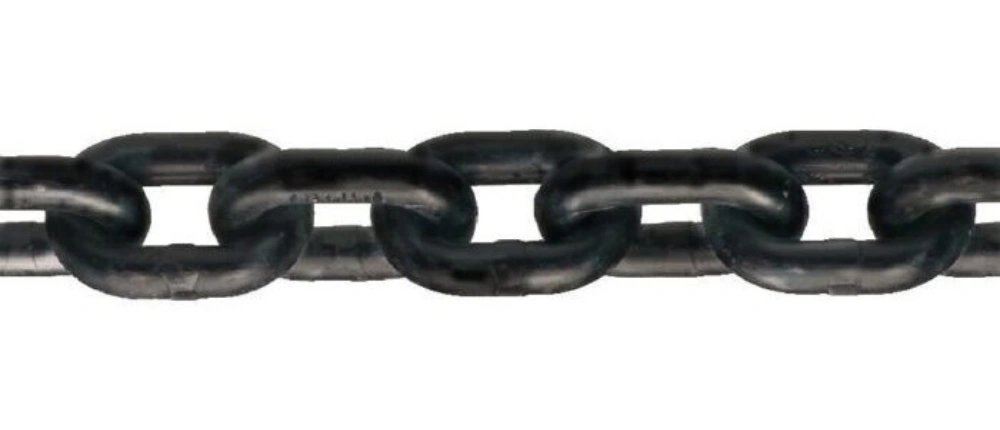
No. You should not use Grade 70 transport chain for overhead lifting. Its strength as a tie-down product does not make it a lifting chain, and proof testing a transport chain on your own does not convert it into a rated alloy steel chain sling.
For U.S. workplaces, OSHA addresses alloy steel chain slings and requires durable identification, rated capacities, compatible attachments, inspections, and applicable proof-testing records. OSHA guidance identifies Grades 80 and 100 as the common alloy grades used for chain slings.
Your project may also need ASME, EN, Australian, customer, or site-specific requirements, so the destination market and end user should be stated in the purchase specification.
If a chain has no reliable grade marking or the sling tag is missing or illegible, do not guess. Isolate the product until a qualified person or the manufacturer can verify its identity and suitability.
When Should You Use Grade 70 Chain?
Choose Grade 70 when you need a purpose-rated transport chain and your job does not involve overhead lifting. Common applications include securing heavy equipment to trailers, binding steel or fabricated loads, logging, towing, and pulling tasks specifically permitted by the chain and hardware manufacturers.
For commercial-motor-vehicle cargo in the United States, the securement system must meet the applicable FMCSA performance, condition, WLL, and tiedown requirements. The aggregate WLL is generally required to be at least one-half of the cargo weight, but tiedown count, attachment method, commodity-specific rules, load geometry, blocking, and anchor-point arrangements also matter.
Use the full process in the guide on how to secure a load with chains rather than choosing chain from cargo weight alone.
Grade 70 is often economical because you are not paying for a lifting-chain system that the transport job does not require. That advantage disappears if you use incompatible binders, damaged hooks, unidentified chain, or too few tiedowns.
When Should You Use Grade 80 Chain?
Choose Grade 80 when your lifting plan calls for a Grade 80 alloy chain or chain sling and the complete system is rated for the load. Typical uses include single-leg and multi-leg chain slings, machinery handling, construction lifts, foundry work within stated temperature limits, and other industrial rigging applications.
You still need to define the lift. State the gross load, center of gravity, lifting points, number of legs, hitch, worst-case sling angle, required reach, crane-hook dimensions, lower connections, environment, and documentation. A two-leg bridle at a shallow angle can place much more tension in each leg than a vertical lift. A Grade 80 stamp cannot correct an undersized sling or a poor rigging plan.
Grade 80 can also appear in recovery, pulling, or cargo-control products. Use it for those jobs only when the manufacturer supplies the relevant rating and instructions. Do not assume that a lifting sling is automatically the best tiedown, or that a tiedown assembly made with Grade 80 chain is automatically a lifting sling.
How Can You Identify Grade 70 and Grade 80 Chain?
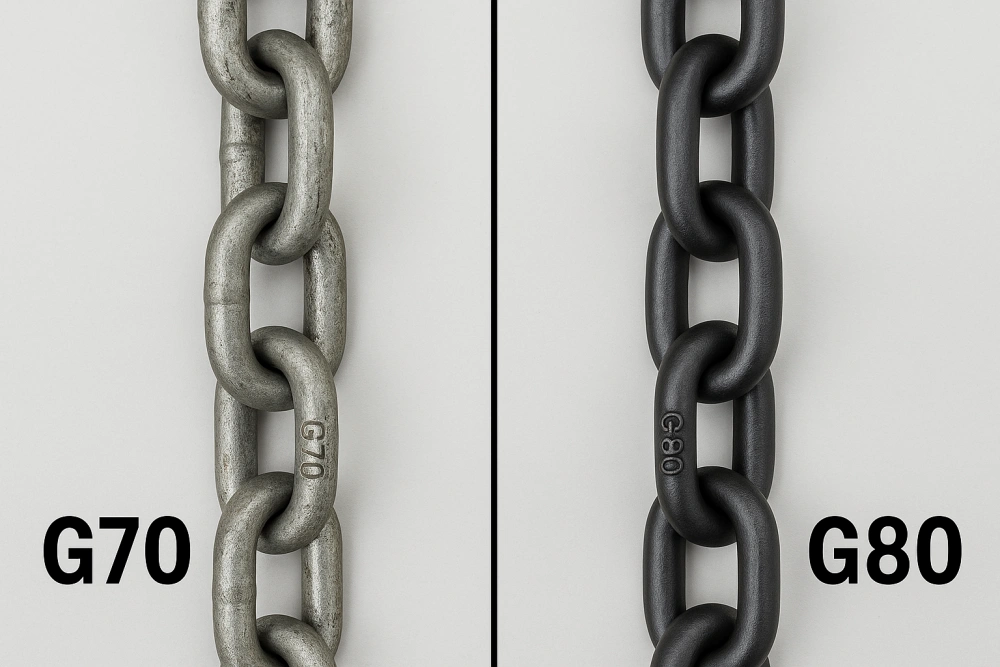
Start with permanent link markings. Depending on the manufacturer and market, Grade 70 may be marked with 7, 70, or a traceable manufacturer code. Grade 80 may be marked with 8, 80, or another manufacturer-specific grade mark. Check several links because markings are normally repeated at intervals rather than stamped on every link.
Then check the tag, certificate, packaging, and product data. A lifting-chain-sling tag should give you the information required by the applicable rules and manufacturer, such as grade, size, rated capacity, reach, configuration, angle basis, manufacturer, or serial reference. Use the detailed guide on how to identify chain grade when a chain’s history is uncertain.
Do not identify Grade 70 from a gold finish or Grade 80 from black paint alone. Coatings vary by manufacturer and market, and a chain can be repainted, plated, contaminated, or heavily worn. Surface color is a useful clue only after markings and records confirm the product.
Safety Standards, Inspection, and Documentation
Cargo Securement
For a Grade 70 tiedown, inspect the chain, hooks, binders, and anchor points before use. Remove components with cracks, deformation, severe corrosion, excessive wear, damaged threads, opened hooks, or any condition that can reduce performance. Attach and tension each tiedown so it cannot loosen, unfasten, open, or release in transit, and perform the required en-route checks.
Overhead Lifting
For a Grade 80 chain sling, check the identification tag and the rated capacity for the exact hitch and angle. Inspect the complete sling before use, including links, welds, master links, coupling links, hooks, pins, latches, and shortening devices. OSHA requires periodic inspections at intervals based on use and service severity, but not more than 12 months apart under its general-industry rule. Your site, standard, or manufacturer may require shorter intervals.
Removal From Service
Do not rely on one universal rule such as replacing every chain only after ten percent elongation. Removal criteria depend on the applicable regulation, standard, manufacturer, product dimensions, and defect. Common rejection conditions include wear below the permitted link dimension, cracks, nicks, gouges, defective welds, bends, twists, stretch or increased length, heat damage, severe corrosion, opened hooks, and missing identification.
Follow the manufacturer’s cleaning and lubrication instructions rather than imposing one monthly lubricant schedule on every chain. Coatings, operating temperature, chemical exposure, abrasive contamination, and component design can change the correct maintenance method. For a step-by-step lifting inspection workflow, see chain sling inspection.
How Do You Choose Between Grade 70 and Grade 80 Chain?
- Define the application. Decide whether you are restraining cargo, towing, pulling, recovering, or lifting a suspended load.
- Name the governing requirements. State the destination country, chain or sling standard, workplace or transport rules, and any customer specification.
- Calculate the required capacity. For transport, design the complete tiedown system. For lifting, calculate the assembly WLL for the load, hitch, angle, and number of legs.
- Check every interface. Confirm chain dimensions and compatibility with hooks, binders, coupling links, master links, shackles, anchor points, lifting lugs, or pocket wheels.
- Describe the environment. Include temperature, chemicals, corrosion, abrasion, sharp edges, outdoor exposure, and duty cycle.
- Request traceable documentation. Ask for the exact markings, test records, certificate of conformity, proof-test certificate when applicable, WLL table, instructions, and batch or serial traceability your project requires.
- Require the supplier to list deviations. A quotation should disclose any changed grade, size, finish, component, standard, test, or capacity assumption before production.
If the job is overhead lifting, the choice is not a price comparison between Grade 70 and Grade 80. Grade 70 is excluded. Your real comparison is between suitable lifting-chain systems, such as Grade 80 vs Grade 100 chain, based on capacity, weight, component availability, handling, and total cost.
Common Grade 70 vs Grade 80 Chain Mistakes
- Assuming a higher grade number automatically gives a higher WLL at every advertised trade size.
- Comparing transport-chain WLL with sling-assembly capacity without stating the different use basis.
- Using Grade 70 for overhead lifting because its breaking strength appears adequate.
- Using unmarked or unidentified chain and assigning a grade from color, link shape, or seller description.
- Mixing Grade 80 chain with lower-rated hooks, coupling links, master links, or shortening devices.
- Reading a chain-only WLL as the rating of a multi-leg sling without applying hitch and angle factors.
- Buying by nominal diameter without checking actual wire diameter, pitch, inside width, and fitting compatibility.
- Requesting an ‘OSHA-certified chain’ instead of listing the exact standard, rating, tests, markings, and documents you need.
- Repairing, welding, heating, galvanizing, or modifying heat-treated chain without manufacturer authorization and requalification.
- Setting one inspection or lubrication interval for every chain regardless of service severity and manufacturer instructions.
Which Chain Gives You Better Value?
Grade 70 usually gives you better value for standard transport securement because it is designed for that purpose and is widely compatible with transport hooks and load binders. Buying Grade 80 only for the higher grade number may add cost without improving a securement system that is limited by its binder, anchor point, or arrangement.
Grade 80 gives you better value when you need a proven alloy lifting system. You gain access to rated chain-sling configurations, compatible lifting components, and a documented capacity basis for the actual lift. The safer product is the one that matches the job, not the one with the lowest unit price or the largest minimum-breaking-force number.
How Powerful Machinery Supports Your Chain Specification
When you send Powerful Machinery an inquiry, start with the application and required standard. For transport projects, provide the cargo type, chain size or required WLL, binder interface, end fittings, length, finish, markings, packaging, and destination. For lifting projects, provide the load, hitch, leg count, sling angle, reach, connections, temperature, environment, and document requirements.
You can source chain, compatible fittings, and chain sling assemblies to a reviewed specification. Depending on the product and order, your requirements may include dimensional inspection, material and heat-treatment control, proof or production testing, grade and traceability markings, certificates, custom lengths, private labeling, and export packaging.
Ask for each deliverable explicitly so the quotation and final documentation match your quality system.
A short technical review before production is more valuable than a vague promise of certification. It lets you resolve size equivalence, link geometry, finish restrictions, component compatibility, WLL basis, and certificate wording while changes are still easy to make.
FAQ
Is Grade 80 chain stronger than Grade 70 chain?
Grade 80 belongs to a higher strength class and is made as an alloy-chain system for lifting and other rated uses. However, you should not assume that every published Grade 80 WLL is higher than every Grade 70 WLL at the same advertised trade size. Compare the exact product dimensions, standard, and rating basis.
Can you use Grade 70 chain for overhead lifting?
No. Use a purpose-rated alloy lifting chain and complete sling assembly. Grade 70 transport chain is intended for load securement and similar non-lifting applications.
Can Grade 80 chain be used for cargo securement?
It can be used when the exact Grade 80 chain, hooks, binder, and complete tiedown arrangement are rated and permitted for cargo securement. Confirm the manufacturer’s WLL and the applicable transport rules rather than substituting a lifting-sling rating.
Why can 5/16-inch Grade 70 have a higher published WLL than 5/16-inch Grade 80?
The trade-size label does not guarantee identical wire diameter, link geometry, product specification, or rating basis. In the Peerless examples used above, the 5/16-inch Grade 70 transport chain has a 4,700-lb WLL and the 5/16-inch Grade 80 single-leg lifting value is 4,500 lb. That comparison does not make Grade 70 a lifting chain.
How do you tell Grade 70 from Grade 80 chain?
Check repeated permanent link markings, the sling tag where applicable, manufacturer records, packaging, and traceability. Do not rely on gold, black, blue, or any other finish as universal proof of grade.
Can you mix Grade 70 and Grade 80 components?
Do not mix components unless the complete configuration is allowed and rated by the relevant manufacturers or a qualified system designer. The weakest component controls capacity, and incompatible dimensions can cause point loading or poor seating even when the stamped WLL looks adequate.
How often should you inspect Grade 70 and Grade 80 chain?
Inspect the chain and all attachments before use and whenever service conditions warrant. Grade 80 chain slings also need documented periodic inspections at the interval required by the applicable regulation, standard, site program, and manufacturer. Under OSHA’s general-industry rule, the interval cannot exceed 12 months.
Conclusion
The safest way to evaluate Grade 70 vs Grade 80 chain is to begin with intended use. Select Grade 70 for compatible cargo-securement, load-binding, towing, and pulling work. Select a properly marked and rated Grade 80 alloy chain or chain-sling system for overhead lifting when Grade 80 meets your lift plan and governing requirements.
Then verify the exact WLL, dimensions, fittings, hitch, angle, environment, markings, inspection criteria, and documents. Do not use grade, color, diameter, or breaking force as a shortcut for a complete specification.
When you need a manufacturer to review your Grade 70 transport-chain or Grade 80 lifting-chain requirements, send Powerful Machinery the application, required capacity, chain dimensions, connection details, standard, tests, and delivery documents. A clear specification gives you a chain that fits the equipment, the rules, and the job.