A clean wire rope cut is not just about appearance. It keeps the strands compact, protects your hands, and gives the rope end the round profile needed for clips, sleeves, swage terminals, sockets, and other fittings. The reliable answer to how to cut wire rope is simple: choose a cutter rated for the rope, bind or seize both sides of the cut, secure the rope, and cut through it in one controlled action.
This guide explains how to cut wire rope without fraying in six practical steps. It covers manual, ratcheting, hydraulic, and abrasive methods; the safety checks that matter; and the common errors that turn a usable length of steel wire rope into a crushed or unravelled end.
Quick answer: For most small- and medium-diameter rope, use a dedicated wire rope cutter whose capacity matches the rope material and diameter. Measure and mark the rope, place tight seizings or wraps on both sides of the mark, clamp the rope, make one complete cut, then inspect and prepare the end for its termination. For lifting, crane, or rotation-resistant rope, follow the rope manufacturer’s seizing instructions rather than relying on tape alone.
Manufacturer’s Note: Plan the Cut Around the Finished Assembly
From a manufacturer’s perspective, cutting starts before the tool reaches the rope. First confirm the diameter, construction, core, material or grade, coating, required finished length, and intended termination. Those details determine how tightly the end must be controlled, which cutter capacity applies, and whether the cut end needs additional preparation.
A flexible fiber-core rope and an IWRC rope of the same nominal diameter may not behave the same way under a cutter. Rotation-resistant constructions need particular care because an unsecured end can lose its lay or allow the core and strands to shift. Coated rope adds another question: how much coating, if any, must be removed for the selected fitting?
For a cut length or finished assembly, specify the rope designation, diameter, length reference, quantity, and end fitting before production begins. Then seize, support, cut, and inspect the rope as one controlled process. The goal is not merely to separate the rope. It is to deliver a compact, round end that is suitable for the next approved operation without forcing the fitting or hiding damage.
Why a Clean Cut Is Non-Negotiable?
Before we get to the “how,” it is worth understanding why the cut matters. Wire rope is a balanced structure of individual wires, strands, and a core. If the strands are allowed to open at the cut, the rope can lose its shape and become difficult—or unsafe—to terminate.
- Safety first: Loose wires create sharp points that can puncture gloves and skin. A controlled cut reduces handling injuries.
- Proper functionality: A flattened or frayed end may not enter a sleeve, terminal, socket, or thimble assembly correctly.
- Rope integrity: Keeping the lay and core in position prevents the end from opening while it is handled or installed.
- Professional results: A compact, square end is easier to measure, terminate, and inspect.
Tools and Materials You Need
The best tool is not simply the largest cutter available. It must be designed for steel wire rope and rated for the rope’s diameter, construction, and material. Check the cutter manufacturer’s capacity before you start. A tool rated for copper cable may not be rated for steel rope.
| Tool | Best Use | What to Know |
| Dedicated manual wire rope cutter | Small to medium rope within the cutter’s stated capacity | Curved or shear-type jaws keep the rope round and can produce a clean one-action cut. |
| Ratcheting wire rope cutter | Tougher or larger rope within the tool rating | Adds mechanical advantage and keeps the cutting action controlled. |
| Hydraulic wire rope cutter | Large-diameter, high-strength, or repetitive shop work | Provides high cutting force with less operator effort; use the correct die or cutting head. |
| Angle grinder with thin cut-off wheel | Abrasive alternative when a rated shear is unavailable | Fast, but creates sparks, heat, noise, and wheel hazards. Seizing and firm clamping are essential. |
Preparation and Safety Checklist
- Eye and face protection: Wear safety glasses; add a face shield when using an abrasive wheel or powered cutter.
- Hand protection: Wear close-fitting, cut-resistant gloves. Keep hands out of the cutting line and away from freshly cut ends.
- Stable support: Use a vise or clamps with suitable soft jaws. Support both sides so the offcut cannot whip, fall, or spring toward anyone.
- Tool inspection: Check blades, pivot, guards, hoses, battery, and abrasive wheel condition. Do not use damaged equipment.
- Safe work area: Keep bystanders clear. Remove flammable materials before grinding and control the direction of sparks.
- Stored energy: Never cut rope that is tensioned, carrying a load, installed on an energized machine, or connected to equipment that could move. Isolate and de-tension the system first.
Critical lifting-use rule: Before cutting wire rope used with cranes or derricks, place seizings on each side of the cut in the length and number specified by the wire rope manufacturer. Rotation-resistant and non-rotating constructions can lose their lay or suffer core movement if the end is not secured correctly.
How to Cut Wire Rope Without Fraying: 6 Steps
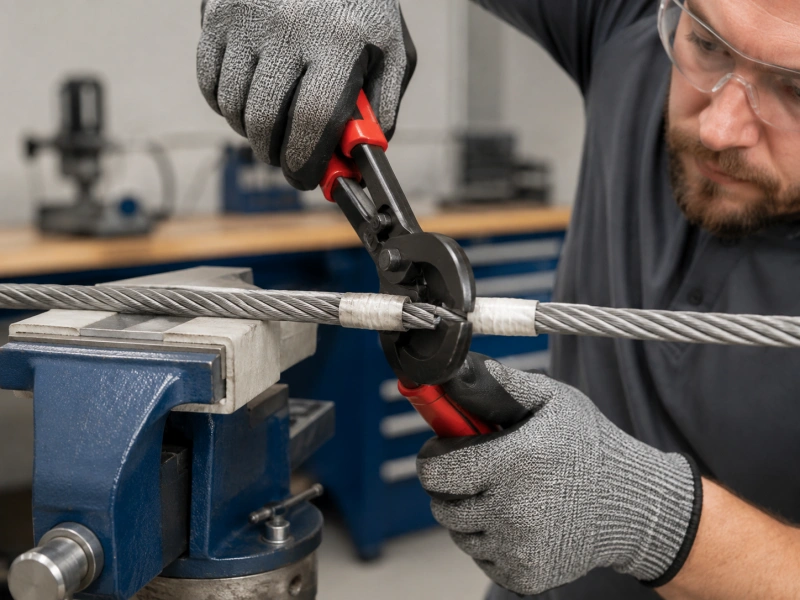
The preparation is what separates a clean cut from a frayed one. Follow the sequence below and do not skip the securing step.
Step 1: Identify the Rope and Choose a Rated Cutter
Confirm the rope diameter, material, construction, and intended termination. If you are not sure of the diameter, measure across the crowns of opposite strands—not across the valleys. Our guide to measuring wire rope explains the correct measurement position.
Match those details to the cutter manufacturer’s stated capacity. A dedicated manual cutter is normally the cleanest choice for rope within its rating. Move to a ratcheting or hydraulic model when the rope is too large or hard for a controlled one-action hand cut.
- Small rope: Use a sharp, purpose-built hand cutter only if the tool is rated for that rope.
- Thick or high-strength rope: Use a rated ratcheting or hydraulic cutter, or have the rope cut by a qualified shop.
- Rotation-resistant rope: Confirm the manufacturer’s end-preparation and seizing procedure before cutting.
Step 2: Measure Twice and Mark the Cut
Lay the rope straight and relaxed on a stable surface. Measure the finished length from the correct reference points for the planned assembly—not automatically from raw end to raw end. Allow for any length consumed by the terminal, eye, sleeve, or socket.
Use a fine permanent marker or chalk to draw a clear line around the rope. Recheck the measurement before applying the seizings. A visible, square mark helps you position the blades without hesitation.
Step 3: Seize or Wrap Both Sides of the Mark
This is the most important anti-fraying step. Place a tight seizing on each side of the cut line, leaving only enough space for the blade or cut-off wheel. The purpose is to hold the strands and core in their original position while the rope is separated.
For general, non-critical small-rope work, tightly stretched vinyl or filament tape can keep the strands compact. For lifting rope, crane rope, large diameters, and rotation-resistant constructions, use the seizing material, number, and length specified by the rope manufacturer. See our detailed guide on when seizing should be applied to wire rope.
- Do not leave a loose gap: The wraps must be tight enough to compress the strands without distorting the rope.
- Do not depend on a single loose tape band: It can slide as the cutter closes or the grinder touches the rope.
- Do not remove both securing bands after the cut: Keep the end controlled until the termination is installed or the end is otherwise secured.
Step 4: Clamp the Rope and Control the Offcut
Place the rope in a vise or clamp it to a solid bench. Position the jaws close enough to the cutting point to prevent vibration, but do not crush or flatten the rope. Soft jaws or protective blocks help preserve the outer wires.
Support the offcut as well as the retained length. Stand out of the line of the rope, keep other people clear, and make sure neither end can drop, whip, or roll after separation.
Step 5: Make One Controlled Cut
With a dedicated cutter: open the jaws fully, place the rope in the deepest part of the curved or shear-type blades, and align the blades with the mark. Close the handles in one firm, continuous action. Do not nibble at individual strands or twist the cutter sideways.
With a ratcheting or hydraulic cutter: keep the cutting head square to the rope and operate it exactly as the tool manufacturer specifies. Keep fingers clear of the blades and confirm the head has fully retracted before removing the rope.
With an angle grinder: use a thin metal cut-off wheel rated for the grinder speed. Fit and use the guard, hold the grinder with both hands, direct sparks away from people and combustibles, and let the wheel cut without side-loading or forcing it. Because grinding introduces heat, sparks, and a less-controlled finish, it is an alternative—not the first choice for a termination-ready end.
Step 6: Inspect, Finish, and Prepare the Termination
Let the cut end cool before touching it if an abrasive method was used. Check that the rope remains round, the strands are compact, the core has not protruded, and there are no loose wires. Remove only sharp burrs with a light, controlled filing action; do not grind deeply into the rope or change its diameter.
Leave the end seizing in place until the termination method says it can be removed. Then install the specified sleeve, swage terminal, socket, thimble, or clip assembly. If you are building a finished cable, review the available wire rope fittings before cutting so the end preparation matches the hardware. For an eye formed with clips, follow the separate wire rope clip installation guide and the clip manufacturer’s instructions.
Engineering Example: Preparing a 6×36 IWRC Rope for Termination
For a 6×36 IWRC rope that will receive a controlled termination, begin with the termination drawing and the required finished length. Confirm the rope diameter and grade against the cutter’s published capacity, then apply the seizing procedure required for that rope construction. Support both the retained length and the offcut so neither side can rotate or drop during separation.
After the cut, check three things before the rope moves to the next operation: the strands remain compact, the steel core has not shifted, and the rope is still round enough for the specified fitting. If the end has opened, flattened, or developed core protrusion, do not force it into a sleeve or socket. Stop and have the end evaluated under the approved fabrication procedure.
This engineering example is intentionally construction-based and does not claim a specific production result. Replace it with a verified Powerful Machinery cutting record when the production team can supply the actual rope designation, diameter, tool, seizing method, photos, and result.
Which Cutting Method Should You Use?
The right method depends on the rope and the result you need. The table below keeps the comparison practical without replacing the cutter manufacturer’s capacity chart.
| Method | Advantages | Limitations | Best Fit |
| Manual wire rope cutter | Clean, compact end; portable; low setup time | Requires hand force; limited by tool rating | Small and medium rope within rating |
| Ratcheting cutter | More leverage and controlled progress | Slower than a powered cutter | Tougher rope within rating |
| Hydraulic cutter | High force; repeatable cuts; suitable for large rope | More equipment, inspection, and setup | Large rope or production work |
| Angle grinder | Common and fast on many diameters | Sparks, heat, noise, wheel hazards, more finishing | Non-preferred alternative when properly controlled |
| Ordinary bolt cutter | Readily available | Crushes and flattens rope; often frays strands | Avoid for termination-ready cuts |
| Hacksaw or side cutters | May be available in an emergency | Catches strands, takes time, and often deforms the end | Avoid unless an approved procedure specifically calls for it |
Cutting Considerations by Wire Rope Construction
Construction changes how a rope bends, holds its lay, and responds at the cut. Use the rope maker’s procedure as the controlling instruction. For construction fundamentals, see our wire rope construction guide.
| Wire rope type | Cutting consideration | Seizing priority | Practical approach |
| 6×19 class | Generally less flexible; larger outside wires can demand more cutting force | High for lifting use | Use a sharp cutter rated for the exact diameter, material, and grade |
| 6×36 class | More flexible, with more and smaller wires; control the end so strands do not spread | High | Keep the rope supported and make one complete, square cut |
| IWRC | The steel core must remain controlled with the outer strands | High | Inspect for core movement or protrusion before termination |
| Fiber core | The core can shift, pull out, or deform if the cut is uncontrolled | Medium to high | Preserve the rope’s round profile and confirm the end condition |
| Rotation-resistant | More sensitive to loss of lay and relative movement between layers | Very high | Follow the rope manufacturer’s specified number, material, and length of seizings |
| Coated rope | The coating may tear or conflict with the fitting’s stripping length | Depends on construction | Plan coating removal around the termination specification |
Common Wire Rope Cutting Mistakes
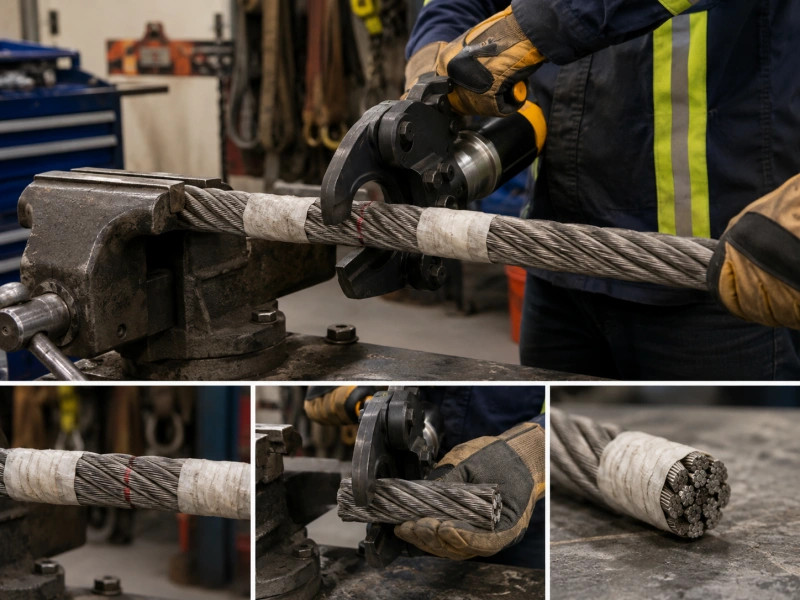
- Cutting before seizing: The strands can spring open and the core may move. Bind both sides before the blade touches the rope.
- Using ordinary bolt cutters: Their opposing jaws tend to pinch and flatten the rope. Use a cutter specifically rated and shaped for wire rope.
- Choosing a cutter by diameter alone: Material and construction matter. Stainless or high-strength rope may exceed a tool’s capacity even when the diameter appears acceptable.
- Clamping too far from the mark: The rope vibrates or twists during the cut. Support it close to the cut while preserving its round profile.
- Nibbling through individual strands: Repeated partial cuts distort the lay and create uneven wire ends. Use one complete, square cutting action.
- Grinding near combustibles: Sparks can travel farther than expected. Clear the area and provide appropriate fire controls before abrasive cutting.
- Cutting rope under tension: Stored energy can release without warning. De-tension, isolate, and support the rope before work begins.
- Forcing a damaged or dull tool: More force increases slipping and crushing. Stop and repair, sharpen, or replace the tool as permitted by its manufacturer.
- Treating a neat end as ready for lifting: A clean cut does not create a rated termination. Use the specified fitting and have critical assemblies made or verified by qualified personnel.
What a Properly Cut Wire Rope End Should Look Like?
Inspect the cut before removing the end control or installing a fitting. A good-looking end is not proof of rated capacity, but it quickly reveals whether the cut process preserved the rope’s geometry.
| Good cut | Bad cut |
| Strands remain compact | Strands flare or broom outward |
| Rope remains round | Rope is flattened or pinched |
| Core remains in position | Core protrudes or pulls back |
| Wires are sheared cleanly | Wires are bent, torn, or uneven |
| End suits the planned next operation | Coating tears excessively or the fitting must be forced |
How to Cut Different Wire Rope Sizes and Types?
Diameter gives you a starting point, but the cutter’s published rating remains the deciding factor. Rope grade, construction, and material can change the force required.
How to Cut 1/16-Inch and 1/8-Inch Wire Rope?
A sharp manual wire rope cutter is usually the most convenient option when it is rated for the material. Tape can help control small rope in non-critical work, but a tight seizing provides better security when the end must stay compact for a fitting. Avoid general-purpose diagonal pliers; they often flatten stainless or hard wire rope.
How to Cut 3/16-Inch Wire Rope?
Use a high-quality manual, long-handled, or ratcheting wire rope cutter with a capacity that specifically includes 3/16-inch steel rope. Place the rope deep in the jaws and make one continuous cut. If the tool requires extreme force or the blades stop closing, do not add makeshift handle extensions—move to a higher-capacity tool.
How to Cut 3/8-Inch Wire Rope?
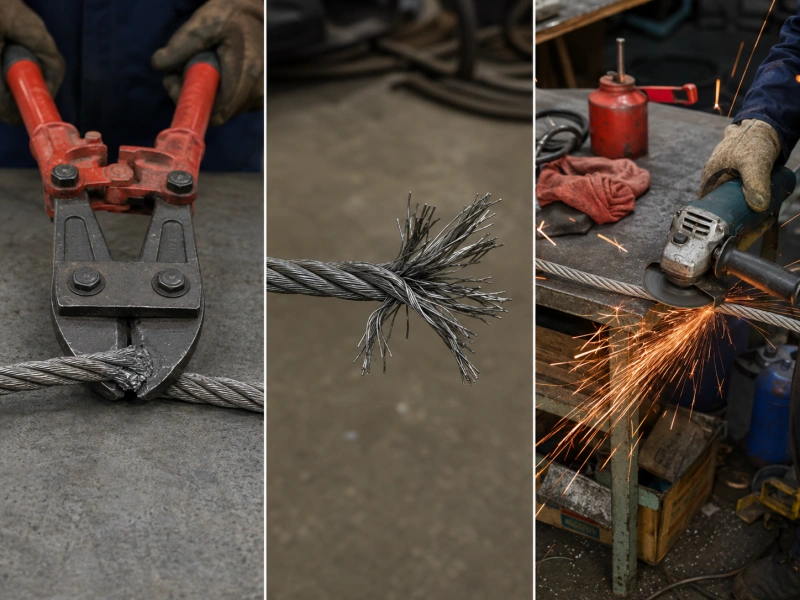
For 3/8-inch wire rope, use a ratcheting or hydraulic wire rope cutter rated for the rope’s grade and construction. A properly controlled abrasive cut may work when a rated shear is unavailable, but it requires firm clamping, correct seizing, full PPE, spark control, and careful inspection afterward. For lifting or crane rope, follow the manufacturer’s cutting procedure.
Galvanized, Stainless, Coated, and Rotation-Resistant Rope
- Galvanized wire rope: Use the same measure-seize-clamp-cut sequence. Protect the freshly exposed steel end from corrosion as required by the assembly specification. Explore galvanized steel wire rope when corrosion resistance is part of the selection.
- Stainless steel wire rope: Confirm that the cutter is rated for stainless. Stainless can be harder to shear than a softer cable of the same diameter.
- Vinyl-coated wire rope: Mark the coating without cutting it away prematurely. Use a method that controls both the steel rope and the coating, and check the termination manufacturer’s stripping length.
- Rotation-resistant or non-rotating wire rope: Use the manufacturer’s specified seizings or end treatment before cutting. These constructions require extra control to prevent loss of lay and core movement. Learn more about rotation-resistant wire rope.
After the Cut: Match the End to the Fitting
Plan the termination before measuring and cutting. A ferrule, swage terminal, wire rope clip, thimble, or socket may require a particular tail length, end condition, or installation procedure. The cut itself does not establish the working load limit of the finished assembly.
- For a broad product overview, compare wire rope end fittings and termination options.
- For eye protection and bend support, choose a correctly sized wire rope thimble.
- For permanent cable ends, review available swage terminals and follow the terminal supplier’s swaging specification.
- For clip-secured terminations, use properly sized wire rope clips and apply the required number, spacing, orientation, and torque.
When You Should Not Cut Wire Rope Yourself?
Stop and obtain the rope manufacturer’s procedure, a qualified shop, or competent technical review when any of the following applies:
- The rope is still carrying load, under tension, or connected to equipment that can move.
- A crane, hoist, or lifting-equipment manufacturer specifies a controlled end-preparation process.
- The required seizing procedure for a rotation-resistant, non-rotating, compacted, or other special construction is unknown.
- The rope is too large, too hard, or too high-strength for a verified cutter rating.
- The finished lifting assembly requires a controlled or certified termination process.
- The rope is damaged and the remaining length has not been assessed for serviceability.
Cutting off visible damage does not prove that the remaining rope is safe. Review the full rope against the equipment and rope manufacturer’s criteria, and use a documented wire rope inspection process before reuse.
Conclusion
Cutting steel wire rope does not have to end in a frayed mess. The cleanest results come from two things: controlling the rope before the cut and using a cutter designed and rated for the job. Measure carefully, secure both sides of the mark, clamp the rope, and make one square, controlled cut.
For ordinary small-rope work, a dedicated manual wire rope cutter is usually the simplest option. For thick, high-strength, crane, or rotation-resistant rope, use the manufacturer’s procedure and the appropriate ratcheting, hydraulic, or professional cutting equipment. Avoid ordinary bolt cutters, never cut a tensioned rope, and remember that a neat end still needs the correct rated termination.
FAQs
What is the best tool to cut wire rope?
A dedicated wire rope cutter rated for the rope’s material and diameter is the best general choice. Use a ratcheting or hydraulic model when the rope exceeds the capacity of a manual cutter.
How do you cut wire rope without fraying?
Place tight seizings or wraps on both sides of the cut mark, clamp the rope without crushing it, then use a sharp, rated cutter to make one complete cut. For lifting and rotation-resistant rope, follow the manufacturer’s seizing instructions.
Can you cut wire rope with an angle grinder?
Yes, an angle grinder with a thin metal cut-off wheel can cut wire rope, but it creates sparks, heat, noise, and additional wheel hazards. Clamp and seize the rope, wear full eye and face protection, clear combustibles, and inspect the end afterward.
Can bolt cutters cut wire rope?
Ordinary bolt cutters may force their way through some rope, but they commonly crush the profile and spread the strands. Do not use them when you need a clean, termination-ready end. A purpose-built wire rope cutter may have long handles, but its jaw geometry and rating are different.
Can I cut wire rope with a hacksaw?
A hacksaw can separate some wire rope, but the back-and-forth motion tends to catch individual wires and produce an uneven end. A rated wire rope cutter is safer and more reliable. Use a saw only under an approved procedure with the rope tightly secured and seized.
Should I tape wire rope before cutting?
Tape is useful for small, non-critical work because it helps hold strands together. It is not a universal substitute for proper seizing. For crane, lifting, large-diameter, or rotation-resistant rope, follow the rope manufacturer’s required seizing method.
Can I reuse a wire rope after cutting off a damaged section?
Not automatically. Cutting off visible damage does not prove that the remaining rope is serviceable or that the new termination is rated. Inspect the full rope and end connection under the applicable manufacturer, equipment, and safety requirements before reuse.