Use this checklist for a manual lever-operated chain hoist before it is placed in service. It covers the load chain, hooks, body, operating lever, direction selector, brake response, attachment points, and inspection records. It does not cover electric hoists, hand chain blocks, wire-rope lever hoists, web-strap lever hoists, or crane systems.
A web checklist cannot replace the instructions and discard limits for the exact model. If the hoist has no readable model or rated-load identification, has an unresolved defect, or behaves abnormally, remove it from service. For equipment terminology, first review what a lever hoist is and how it works.
Inspection Levels and Timing
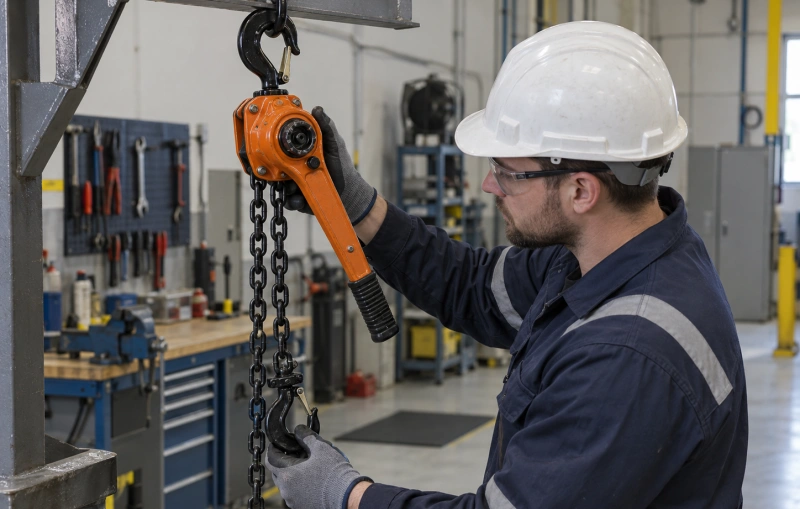
A sound inspection program separates quick operating checks from detailed examinations. The responsible person, inspection scope, interval, and record requirements must come from the current model manual, actual service conditions, site procedure, and governing jurisdiction.
| Inspection Level | Purpose | When It Applies | Record Approach |
| Initial | Confirm that a new, altered, or modified hoist is suitable before use | Before first use or as required after an authorized change | Keep purchase information, model data, baseline dimensions, and required acceptance records. |
| Pre-Operational | Identify visible damage or abnormal operation before work starts | Before the first use of a shift or as the applicable program requires | Record the check if site rules require it; always report a failed item. |
| Frequent | Review operating mechanisms, brake action, hooks, chain, body, and attachments | At an interval set for normal, heavy, severe, or special service | Document defects and their disposition according to the inspection program. |
| Periodic | Examine load-suspension and internal parts and take model-specific measurements | At the interval assigned by a designated or qualified person for the actual service | Create a dated inspection record with findings and measurements. |
| Event-Triggered | Reassess after overload, shock, impact, unauthorized alteration, long idle time, or abnormal operation | Before return to service after the event | Record the event, evaluation, repair, testing, and release decision. |
Do not publish one monthly, quarterly, or annual schedule for every reader. For example, an ASME-based manufacturer manual may assign different intervals to normal, heavy, and severe service. Those intervals are evidence for that model and inspection program, not universal Powerful Machinery model limits.
Before Starting the Inspection
- Identify the exact model, serial or lot reference, rated load, lifting medium, and current manual.
- Ensure the hoist is unloaded and stable. Keep people clear of the load path and any stored energy.
- Check the inspection status, open defect reports, repair history, and any out-of-service tag before operating the controls.
- Clean only enough to see the parts. Do not dismantle covers or brake components during an operator pre-use check.
- Use the intended lever chain hoist operating procedure and site risk controls. Inspection does not make an unsuitable anchor, rigging arrangement, or task acceptable.
Pre-Use Lever Hoist Checklist
| Item | What to Check | Remove From Service When |
| Identification and Status | Model, rated load, and warning labels are present and readable; inspection status and equipment ID match the unit. | Identity or rating is missing, the unit is tagged out, or an open defect has not been resolved. |
| Upper Attachment and Support | Hook, clevis, or other approved suspension point and any trolley or support are seated, secure, and suitable for the task. | The support is unverified, damaged, or loose, or the attachment is side-loaded or seated on a hook tip or latch. |
| Upper and Lower Hooks | Surfaces, throat, shank, neck, swivel, and retaining parts show no crack, twist, opening, gouge, deep nick, heat damage, or significant corrosion; fitted latches close correctly. | Any damage, deformation, or measurement exceeds the exact model criterion, or a required latch or retaining part is missing. |
| Load Chain | Accessible chain is lubricated as specified and free of twist, wear, stretch, bent links, nicks, gouges, corrosion, heat damage, weld spatter, or unauthorized repair. | Any defect is visible, chain identity is uncertain, or the chain has been welded, spliced, substituted, or used as a sling. |
| Reeving and Chain Ends | Chain follows the correct path and number of falls; multiple-fall lower blocks are not capsized; the stopper and end attachments are present and secure. | The chain is twisted, incorrectly reeved, jammed, detached, or missing its specified stopper or end connection. |
| Body, Covers, and Fasteners | Housing, covers, bolts, nuts, pins, and guards are present, secure, and free of cracks, impact damage, serious corrosion, or distortion. | A cover or fastener is missing or loose, or the body shows cracking, deformation, or impact damage. |
| Operating Lever and Direction Selector | Lever and grip are secure and undamaged; selector markings are legible and the selector engages the intended position positively. | The lever is bent or loose, the selector will not engage, markings are unreadable, or movement is erratic. |
| Free-Chaining Function | If the exact model has free chaining, check it only while unloaded and follow the model instructions for disengaging and resetting it. | Free chaining binds, slips, will not reset, or has been engaged while the hoist carries a load. |
| No-Load Operation | After the visual checks pass, operate the hoist through a short unloaded travel in raise and lower modes; the chain should feed correctly without binding or abnormal sound. | The lever is unusually hard to move, the chain jumps or binds, travel is irregular, or new clicking, grinding, or other abnormal sound occurs. |
| Brake Response | Check brake operation only by the method authorized in the exact manual and site procedure. | The load creeps or slips, brake response changes, or an authorized functional check cannot be completed safely. |
| Optional Devices | Lever and grip are secure and undamaged; selector markings are legible, and the selector engages the intended position positively. | The device activates unexpectedly, is damaged, or has been adjusted without authorization. |
| Environment and Contamination | Look for water, salt, chemicals, dust, abrasive material, excessive heat, or other conditions outside the model rating. | Suitability cannot be confirmed or contamination may have reached the chain, brake, or internal mechanism. |
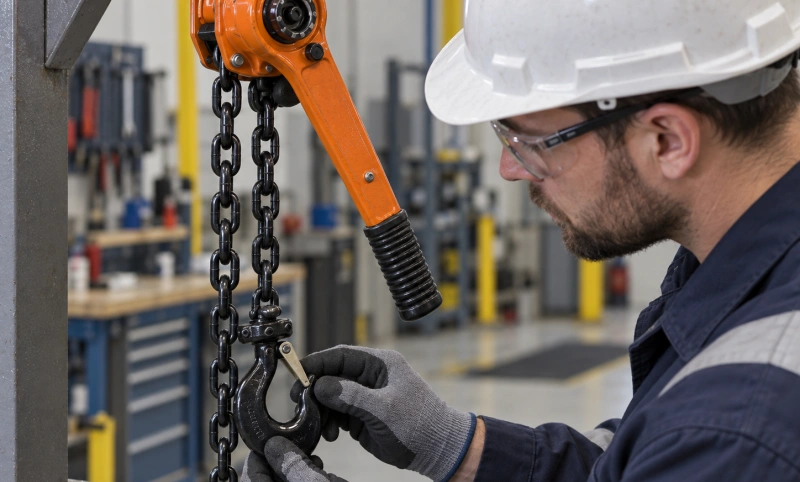
Do not use a production load to improvise a brake test. Never stand beneath a suspended load, lift people, exceed the rated load, or continue pulling harder when the mechanism binds. A latch is not a load-bearing point, and a hook tip is not an approved seating surface.
Periodic Inspection Boundary
A periodic inspection extends beyond the operator checklist. Depending on the model and governing program, it may require a qualified or designated person to examine load-suspension parts, gears, shafts, bearings, pins, pawls, ratchet components, friction components, springs, load sheaves, and retaining members. Disassembly should occur only when the exact procedure, parts data, tools, and required competence are available.
Hook opening, hook section, chain pitch, chain diameter, cumulative chain length, friction-part thickness, and spring dimensions are model-specific. Record the measurement method, reference drawing, limit, and result from the controlled manual. Do not copy a discard percentage or dimension from another brand or capacity.
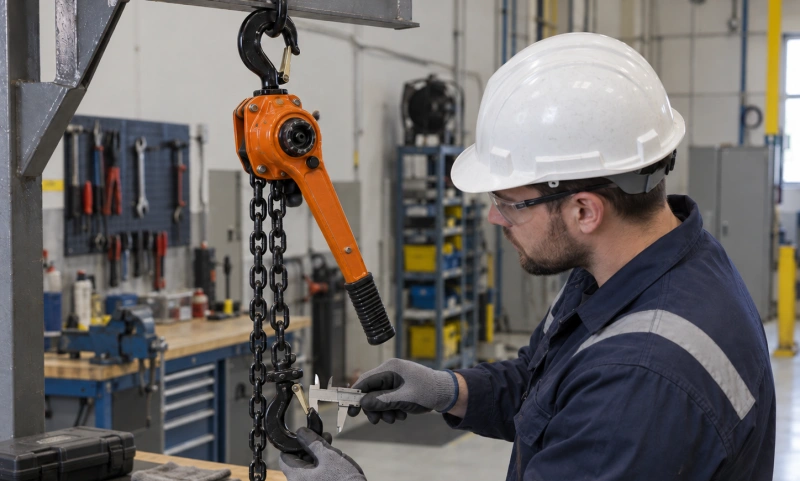
The current Powerful Machinery VA and VL lever hoist range covers catalogue-listed capacities from 0.75 to 9 t and lists a 1.5 m standard lift. Those commercial specifications help identify the unit, but they do not provide the wear limits or internal inspection procedure needed to release a used hoist.
What to Do When an Item Fails?
1. Stop operation and place the load in a safe condition if this can be done without increasing the risk.
2. Isolate and clearly tag the hoist so another person cannot use it.
3. Record the equipment ID, date, defect, operating conditions, and event that revealed the problem.
4. Send the unit through the authorized technical review process for model-specific evaluation. Do not adjust the brake, selector, clutch, or chain based on a general article.
5. Use approved parts and qualified service. Follow the lever hoist repair and maintenance guidance for escalation rather than turning this inspection page into a repair manual.
6. Complete any required post-repair inspection and load test under the exact manufacturer procedure and applicable rules. Do not apply a universal test percentage from this page.
7. Return the hoist to service only after the authorized person records and signs the release decision.
Inspection Record Fields
A blank record is more useful than a fictional completed example. Include these fields in the site form or digital register:
| Field Group | Fields to Capture |
| Equipment | Asset ID, manufacturer, model, serial or lot reference, rated load, lift, chain size, and number of falls |
| Inspection Context | Inspection level, date, location, task, service class, environment, and triggering event |
| Inspector | Name, role, employer, and competence or designation basis required by the program |
| References | Manual revision, procedure, jurisdiction or site rule, drawing, and measurement table used |
| Findings | Each checklist item, observed condition, measurements with units, photographs, and defect classification |
| Disposition | Pass, restricted, quarantined, or out of service; tag number and immediate controls |
| Corrective Action | Work order, approved parts, repair provider, post-repair test, and supporting certificate when required |
| Release and Next Due | Authorized release name and date; next-inspection basis and due date from the approved program |
Questions About Lever Hoist Inspection
How Often Should a Lever Hoist Be Inspected?
Use the interval in the exact model manual and the inspection program for the actual service. A pre-operational check before the first use of a shift is common in ASME-based manufacturer procedures. Frequent and periodic intervals change with normal, heavy, severe, outdoor, special, or infrequent service and with local requirements.
Who Can Inspect a Lever Hoist?
A trained operator or other designated person may perform pre-operational or frequent visual checks when the governing program allows it. Periodic inspection, disassembly, measurement, repair, and return-to-service decisions require the competence specified by the manufacturer, employer, and jurisdiction. A universal “certified technician” label or 2,000-hour rule cannot be confirmed for every location.
Can Free Chaining Be Checked With a Load Attached?
No. Free-chain mode releases the brake for unloaded chain adjustment on models that provide the function. Do not engage it while a load is applied, and remove from service any unit that will not reset correctly.
Does Every Damaged Latch Require a New Hook?
If the selected model is designed with a latch and it is missing or damaged, remove the hoist from service and follow the model instructions. The inspection result does not by itself authorize hook or latch replacement, and the latch must never carry the load.
Which Hook and Chain Measurements Should Be Used?
Use only the dimensions, baseline method, and discard limits for the exact model and rated capacity. The supplied Powerful Machinery catalogue does not provide controlled hook, chain, brake, or spring discard tables for VA or VL models, so universal values cannot be confirmed.
Is a Load Test Required After Every Inspection?
A routine visual inspection does not automatically justify an improvised load test. Testing after alteration, disassembly, or repair must follow the exact manufacturer procedure, applicable standard, site controls, and jurisdiction, using suitable equipment and authorized personnel.
Does This Checklist Prove OSHA or Legal Compliance?
No. Legal and inspection requirements depend on the equipment, workplace, country, state or province, site program, and adopted standards. Use this page as a practical inspection aid, then verify the applicable requirements before making a compliance claim or returning equipment to service.
Selecting or Replacing a Lever Hoist
If inspection shows that the existing unit is unsuitable or beyond approved repair limits, compare the required task, rated load, lift, operating effort, and environment in the lever hoist and chain block selection guide. For a replacement quotation, send the equipment and application details, including the model, rated load, required lift, use frequency, environment, and requested documents.