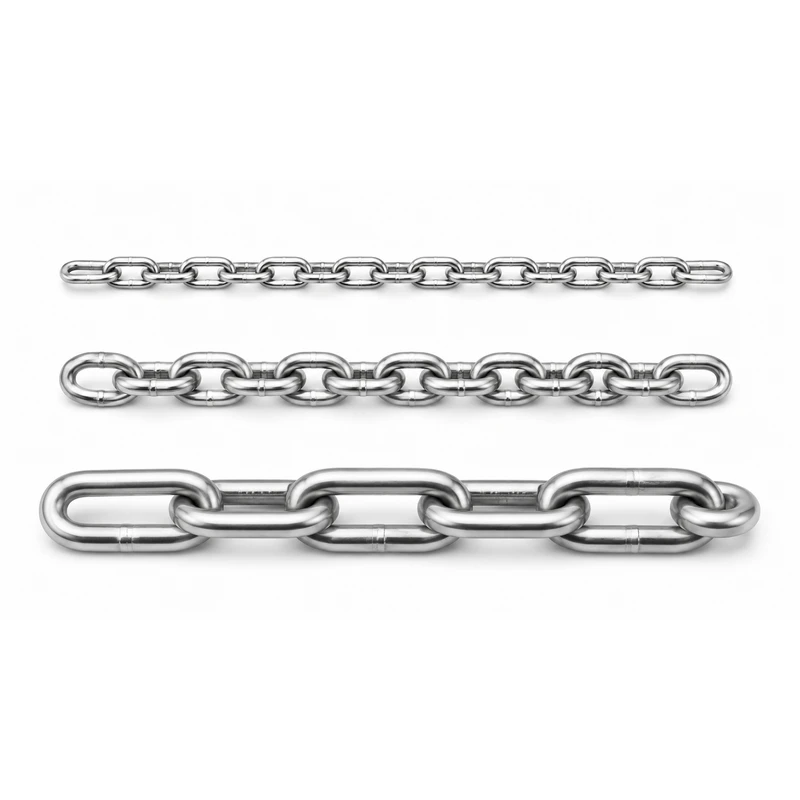
A chain sling is a lifting assembly made from one or more lengths of alloy steel chain joined to a master link and fitted with hooks, links, or other end components. It connects a load to lifting equipment and is selected as a complete assembly, not as chain alone.
Chain slings are often used where abrasion resistance, durability, adjustable configurations, or demanding working conditions make them suitable. The correct assembly depends on the total load, number of legs, hitch, sling angle, reach, attachment points, operating environment, and the rated data supplied for the exact sling.
Chain Sling Definition: The Short Answer
- A chain sling combines lifting chain, a top fitting, connecting components, and load-end fittings.
- Common configurations have one, two, three, or four legs, but more legs do not automatically mean a higher usable capacity.
- The working load limit applies to the complete tagged assembly in a stated configuration and angle range.
- Selection and use must follow the sling identification, manufacturer instructions, applicable standard, and site lifting plan.
What Are the Parts of a Chain Sling?
A chain sling is an assembly of compatible load-bearing components. A typical sling includes a master link at the top, one or more alloy-chain legs, coupling or shortening components where specified, load hooks or other end fittings, and a durable identification tag.
| Component | Function |
| Master link | Connects the sling to a crane hook or lifting point. |
| Chain legs | Carry the load between the top and lower fittings. |
| Coupling components | Join compatible chain and fittings within an approved component system. |
| Shortening devices | Allow the effective reach to be adjusted when the sling design permits it. |
| End fittings | Connect to the load and may include sling hooks, self-locking hooks, foundry hooks, or other specified fittings. |
| Identification tag | Provides the information needed to identify and rate the finished assembly. |
Compatibility matters. Chain grade, diameter, links, hooks, connectors, and shortening devices should come from an approved system or be verified by the sling manufacturer. See this illustrated guide to chain sling components for a closer look at each part.
Common Types of Chain Slings
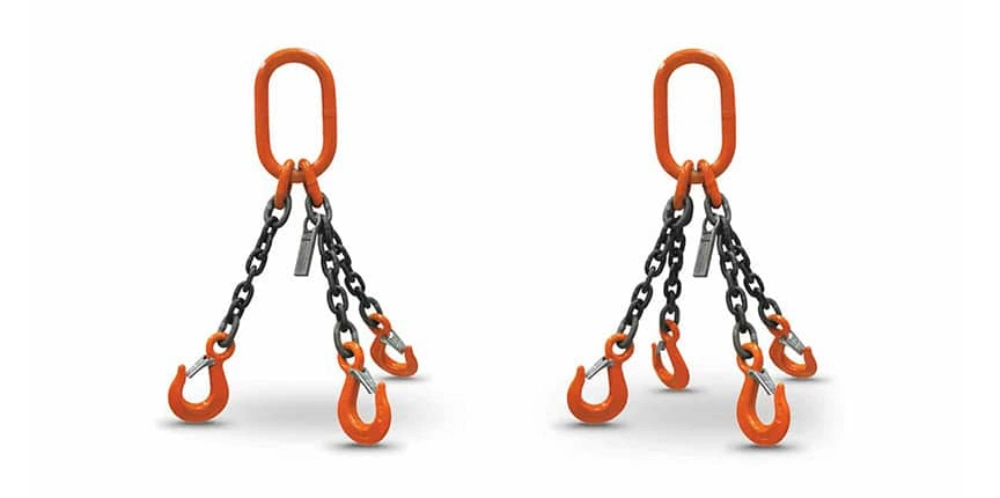
Chain slings are commonly described by leg count, hitch, adjustability, and end fittings. Single-leg assemblies connect one lifting point. Multi-leg assemblies connect two or more points and may help control load orientation when the lift is properly planned.
| Configuration | Basic layout | Typical selection context |
| Single-leg | One connection to the load | Straight lifts and loads with one engineered lifting point |
| Double-leg | Two connections to the load | Loads with two suitable lifting points |
| Three- or four-leg | Multiple connections | Loads requiring several attachment points and controlled orientation |
| Adjustable | Includes approved shortening hardware | Applications where reach or load balance must be adjusted within rated limits |
Leg count alone does not determine capacity or stability. Load distribution can be uneven, and the rated capacity changes with the sling design, included angle, hitch, and component data. Review the main types of chain slings, then confirm the selected configuration against the tag and manufacturer-rated table.
How Are Chain Slings Used?
Chain slings are used to connect cranes, hoists, and other lifting equipment to loads that have suitable lifting points. Their modular construction can support different leg counts, hook styles, reaches, and approved shortening arrangements. Common settings include fabrication shops, foundries, construction sites, ports, warehouses, and heavy-equipment handling.
Suitability must be assessed for the actual lift. Sharp edges, heat, chemicals, restricted headroom, unstable loads, and inadequate lifting points can change the selection or require additional controls. A familiar application does not remove the need to verify the load, sling rating, geometry, and condition before use.
What Does Working Load Limit Mean for a Chain Sling?
The working load limit (WLL) is the maximum load assigned to a specific sling assembly under stated conditions. It is not the breaking force, and it should not be calculated from chain diameter alone. The assembly rating is limited by its chain, fittings, configuration, hitch, angle basis, temperature, and any manufacturer restrictions.
Grade 80 and Grade 100 are common alloy-chain grades for lifting assemblies, but the grade name does not replace a complete rating. Always identify the exact chain size, component system, leg count, reach, hitch, and angle range. Use the manufacturer’s current rated-capacity table and the sling tag.
Why Sling Angle Matters
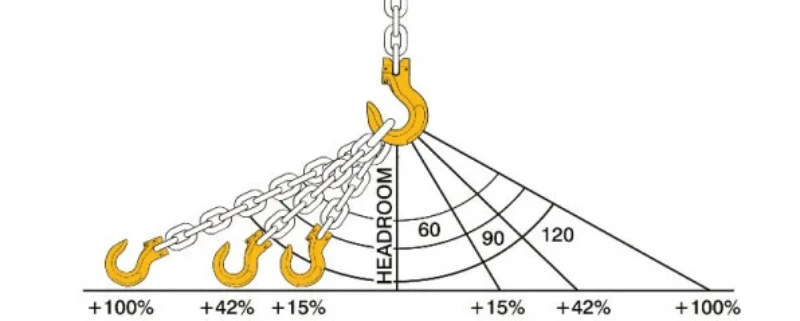
In a multi-leg sling, changing the leg angle changes the force in each leg. As the legs move farther from vertical, leg tension generally increases. Angle statements are only useful when the reference is clear: some tables measure the angle from horizontal, while others measure it from vertical. Use the convention shown on the applicable rated-capacity table; do not transfer values between different angle conventions.
For calculation concepts and qualified examples, read how chain sling capacity changes with configuration and angle. Final selection must be based on approved product data, not a generic online formula.
What Information Should Be on a Chain Sling Tag?
The identification tag connects the physical sling to its rated information. Required markings vary by governing rules and product system, but a useful tag normally identifies the manufacturer or supplier, the sling or serial identity, chain size and grade, number of legs, reach where applicable, and rated capacities for the permitted configurations and angle ranges.
If the tag is missing or illegible, do not estimate capacity from appearance. Remove the sling from service and follow the applicable identification and inspection procedure before it is considered for further use.
How Do You Select a Chain Sling?
- Define the load. Record gross weight, center of gravity, dimensions, lifting points, and whether the load can shift.
- Define the geometry. State the hitch, number of legs, reach, required headroom, attachment points, and expected sling angles.
- Define the service. Include frequency, temperature, moisture, chemicals, abrasion, sharp edges, and other site conditions.
- Compare complete assemblies. Verify WLL, component compatibility, hook fit, identification, required documents, and manufacturer restrictions.
- Confirm the lift plan. Check that the chosen sling, lifting equipment, load-control method, and exclusion zone match the planned operation.
Pre-Use Inspection and Basic Safety
Inspect the sling before use under the applicable site procedure and manufacturer instructions. Confirm that the tag is legible, then examine the complete assembly rather than checking only the chain.
- Look for stretched, bent, twisted, cracked, gouged, worn, or heat-damaged chain links.
- Check master links, coupling links, shortening devices, hooks, latches, and other fittings for deformation, wear, cracks, or restricted movement.
- Confirm that components are compatible and correctly assembled, with no improvised repairs or substitutions.
- Check that hooks and attachment points seat correctly and that the load will not bear on a hook tip, latch, or unintended surface.
- Remove the sling from service when identification is missing or any condition meets the applicable rejection criteria.
Use the dedicated chain sling inspection guide for inspection steps and rejection criteria. Never use a larger sling as a substitute for missing load information, and keep people clear of suspended loads.
Chain Sling Limitations
Chain slings are durable, but they are not suitable for every load or environment. Capacity can be reduced by configuration, temperature, wear, edge loading, shock loading, chemical exposure, or components used outside their approved system. Restrictions differ by product, so universal temperature or chemical-resistance claims should not be applied to every sling.
Do not knot, twist, weld, or field-modify a sling unless the work is specifically authorized and completed under an approved procedure. Do not drag the sling from beneath a load or allow uncontrolled loading. When conditions are unusual, obtain guidance from the sling manufacturer, a qualified supplier, or the responsible lift planner.
FAQ
Is a chain sling the same as a length of lifting chain?
No. A chain sling is a rated assembly that includes chain and compatible load-bearing fittings, plus identification for the finished configuration.
Does a four-leg chain sling always lift more than a two-leg sling?
No. Capacity depends on the rated assembly, angle, hitch, component system, and how the load is distributed. Not every leg can be assumed to share the load equally.
Can WLL be calculated from chain diameter?
Not safely. Chain size is only one input. Use the tag and the manufacturer’s current rated-capacity data for the complete sling.
Can chain slings be used at high temperatures?
Only within the limits specified for the exact chain and component system. Temperature may reduce capacity or require withdrawal from service, so verify the manufacturer’s instructions.
What should I do if the tag cannot be read?
Remove the sling from service and follow the applicable identification and inspection procedure. Do not estimate its rating from appearance.
Choosing the Right Chain Sling
A chain sling is a complete, tagged lifting assembly whose capacity and permitted use depend on its components and configuration. Start with the load and lift geometry, then verify the exact sling’s WLL, reach, fittings, angle basis, environmental limits, and inspection requirements.
When you are ready to compare assemblies, review Powerful Machinery’s chain sling range. For a made-to-order assembly, send the load, leg count, hitch, angle, reach, fittings, working environment, quantity, and required documentation.