A hand chain hoist, often called a chain block or chain fall, is a practical choice when an application requires controlled vertical lifting without an electric or pneumatic power supply.
Its principal advantages come from its operating method: the operator pulls the hand chain, the internal gearing multiplies the input force, and the load chain raises or lowers the freely suspended load. For a deeper explanation of the mechanism, see how a chain block works.
These benefits are real but application-dependent. A hand chain hoist is not automatically the cheapest, safest, lightest, or most suitable option for every site. Rated capacity, lift, headroom, operating frequency, supporting structure, environment, and operator access all matter.
The seven advantages below explain where manual chain hoists are practical and where a powered or lever-operated hoist may be more suitable.
Quick Answer: The 7 Main Advantages
| Advantage | Why it matters | Important limit |
| 1. No External Power Supply | Useful where an electric or pneumatic supply is unavailable or unnecessary. | No-power operation does not make every model suitable for hazardous atmospheres. |
| 2. Simpler Installation for Intermittent Lifting | No motor controls or power cabling at the hoist; useful for fixed or temporary lifting points. | The suspension point and supporting structure must still be adequately rated for the load. |
| 3. Controlled, Incremental Load Positioning | Hand-chain input allows deliberate raising and lowering during alignment work. | Not intended for fast, high-cycle production lifting. |
| 4. Compact Options at Lower Capacities | Smaller hand-chain models can be convenient to move, store, and reposition. | Higher-capacity units can be heavy and may require planned handling. |
| 5. Fewer Power-System Components | No electric motor, pendant-control circuit, or compressed-air supply at the hoist. | Inspection, load-chain and brake maintenance, and qualified repair are still required. |
| 6. Useful for Remote, Temporary, or Backup Lifting Points | Can operate during outages or where a permanent power installation is impractical. | Environmental suitability must be confirmed for the exact model. |
| 7. Broad Manual-Lifting Configurations | Available in multiple capacities, lifts, headrooms, and suspension arrangements. | Capacity alone is not sufficient for hoist selection. |
1. A Hand Chain Hoist Does Not Need an External Power Supply
The clearest advantage is independence from external power. A hand chain hoist is manually operated, so the hoisting mechanism does not require an electrical connection, battery, compressed-air line, or powered control system at the hoist.
This can be useful during maintenance shutdowns, temporary installations, remote work, construction projects, and occasional lifting operations where adding power infrastructure would be unnecessary.
Do not overstate this benefit. “No electricity required” is not equivalent to “approved for explosive or hazardous locations.” Environmental suitability depends on the exact hoist design, materials, markings, and manufacturer’s instructions. If the site includes flammable gases or dusts, corrosive chemicals, unusual temperatures, or other hazards, specify those conditions before selecting a model.
2. Installation Can Be Simpler for Intermittent Vertical Lifting
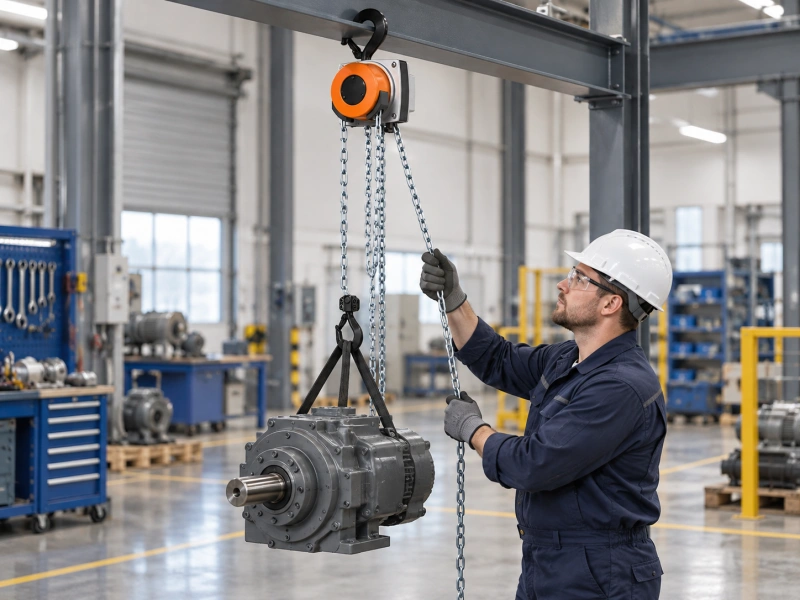
A manual chain hoist does not require motor wiring, a pendant station, a control cable, or a compressed-air connection. At an occasional lifting point, this can reduce the amount of power and control infrastructure required around the hoist. Depending on the model, the hoist may be hook-suspended or installed on a compatible trolley.
The supporting structure remains critical. The hoist must be attached to an adequately rated suspension point, and the load line must remain properly aligned with the hoist for the intended vertical lift.
The hoist’s rated capacity does not establish the adequacy of the beam, trolley, clamp, sling, or any other load-path component. When specifying a new unit, compare required lift, available headroom, and connection details in addition to rated capacity. The manual chain hoist range lists current QDPowerful model and specification examples.
3. Manual Operation Provides Controlled Load Positioning
For maintenance, installation, and alignment work, speed is not always the priority. Pulling the hand chain allows the operator to raise or lower the load incrementally. This can be useful when a component must be brought into position gradually rather than moved quickly.
The trade-off is hoisting speed and operator effort. A hand chain hoist is generally better suited to intermittent lifts than repetitive, high-cycle production. If the application requires frequent lifting, faster hoisting, or powered controls, compare the manual option with a powered hoist rather than assuming manual operation will be more efficient.
4. Compact Options Are Available at Lower Capacities
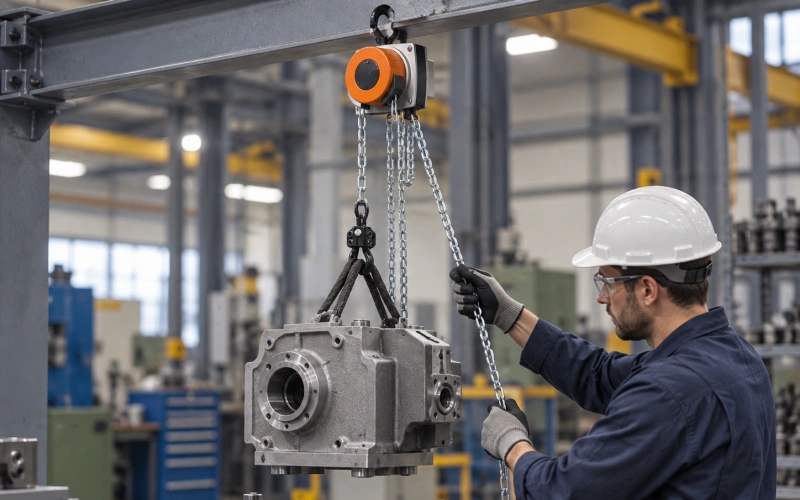
Hand chain hoists are available in compact sizes, and lower-capacity models can be convenient to move between maintenance points or store when not in use. For example, QDPowerful currently lists the MINI-0.25 at 0.25 t rated capacity, with a 2 m standard lift, 215 mm minimum headroom, and a 3.5 kg net weight. The SK-1 is listed at 1 t rated capacity, with a 2.5 m standard lift, 270 mm minimum headroom, and a 10 kg net weight.
This does not mean every hand chain hoist is lightweight. Higher-capacity units can be substantially heavier, so transport and installation must be planned accordingly. The useful advantage is that compact manual options exist, not that every chain block can be carried by one person.
If physical size and headroom are major constraints, compare the types of chain blocks and model-specific dimensions before ordering.
5. Manual Operation Reduces Power-System Hardware
Because a hand chain hoist has no electric motor or pneumatic drive, there is no hoist motor, power cable, pendant-control circuit, or compressed-air supply to maintain at the hoist. For low-frequency lifting, this simpler operating arrangement can be attractive, especially where the lifting point must remain independent of the facility power system.
However, manual operation does not mean maintenance-free. The load chain, hooks, brake, gears, fasteners, and other load-bearing or operating components still require inspection and maintenance in accordance with the manufacturer’s instructions and the applicable inspection program.
Damaged equipment or equipment showing abnormal operation should be removed from service rather than kept in use. Use the chain block inspection checklist for inspection planning and the chain block maintenance guide for preventive-maintenance topics.
6. Manual Chain Hoists Suit Remote, Temporary, and Backup Lifting Points
Power independence also gives hand chain hoists flexibility. A suitable unit can be useful at temporary work areas, field-maintenance locations, construction sites, or facilities where a permanent power feed is not justified. It can also remain available during a power outage, provided the lifting area, suspension, load, and hoist are otherwise suitable and safe for operation.
Again, the advantage is independence from a power source, not automatic resistance to water, dust, salt, chemicals, or explosive atmospheres. State the operating environment when requesting a quotation and ask which ratings, materials, markings, or documents apply to the exact model offered.
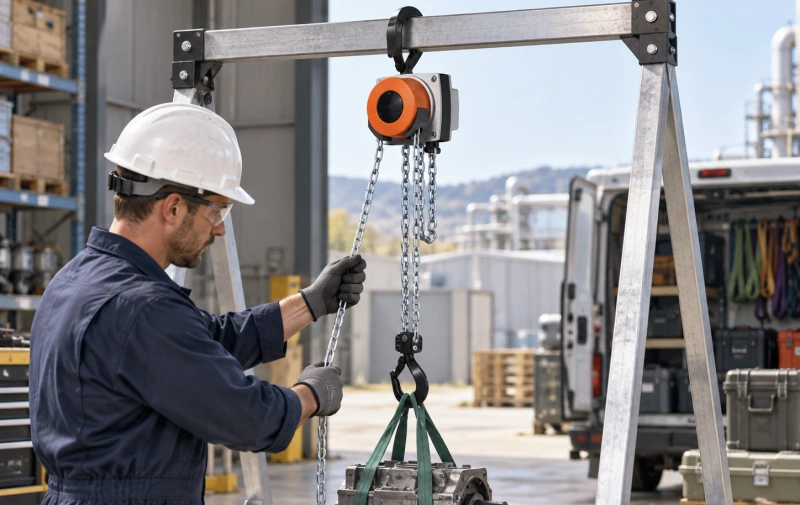
7. Multiple Capacities and Configurations Are Available
Hand chain hoists are available in multiple rated capacities, standard lifts, headroom dimensions, load-chain configurations, and suspension arrangements. QDPowerful’s current chain-block page, for example, lists HS-VL variants from 0.5 t through 10 t, with model-specific values for standard lift, test load, minimum hook distance, hand-chain pull, number of load-chain falls, load-chain diameter, and unit weight.
This range allows the buyer to match the hoist to the application instead of treating “chain block” as a single fixed specification. Rated capacity is only the starting point. A practical RFQ should also include the required hook travel, available headroom, suspension or trolley arrangement, operator position, operating frequency, environment, and required documentation.
Where the Advantages Are Strongest?
A hand chain hoist is often a suitable candidate when the application has several of the following characteristics:
- The load requires controlled vertical lifting from a suitable overhead support.
- Lifting is intermittent rather than continuous or high-cycle.
- Electric or pneumatic power is unavailable, inconvenient, or unnecessary.
- The operator can safely reach and operate the hand chain throughout the required lift.
- A compact, lower-capacity unit would simplify temporary or maintenance work.
- The required lift, headroom, and suspension arrangement fit a standard manual-hoist configuration.
When a Different Hoist May Be Better?
A hand chain hoist is not the default answer for every lifting or positioning task. For frequent production lifting, a powered hoist may reduce manual effort and increase cycle speed.
If the application involves short movements, pulling, tensioning, or load positioning rather than straightforward vertical lifting, a lever hoist may be more appropriate when the selected model permits that service. The lever hoist vs chain block guide explains these differences in more detail.
If you are not yet sure which manual-hoist mechanism fits the application, start with the manual hoist category and compare the task, direction of movement, rated capacity, lift, headroom, installation, and environment before selecting a product family.
How to Choose a Hand Chain Hoist?
Before requesting a quotation, record the following application data:
- Total suspended load and required rated capacity, with units.
- Required vertical lift or hook travel.
- Available minimum headroom.
- Top and bottom connection details, including the supporting structure.
- Fixed suspension or trolley-travel requirements.
- Operator position and required hand-chain drop.
- Expected operating frequency and typical load.
- Water, dust, chemicals, temperature, or other environmental conditions.
- Quantity, destination, documentation, markings, packaging, and spare-parts requirements.
For operating procedures and pre-use considerations, refer to how to use a chain block safely and the instructions supplied with the exact hoist.
Conclusion
The main advantages of hand chain hoists are practical rather than absolute: they operate without an external power supply, can simplify occasional lifting points, provide controlled manual positioning, are available in compact lower-capacity formats, eliminate powered-drive hardware at the hoist, suit many remote or temporary applications, and are offered in a broad range of manual-lifting configurations.
These advantages matter only when the hoist matches the application. Check rated capacity, lift, headroom, suspension, operator access, duty, and environment before selecting a model. To compare currently available specifications, review the manual chain hoist range or send QDPowerful the load and installation details for a technical quotation.
FAQ
What Is the Main Advantage of a Hand Chain Hoist?
Its main practical advantage is controlled lifting without an external electric or pneumatic power supply. This can simplify intermittent, temporary, or remote lifting points when a suitable overhead support is available.
Is a Hand Chain Hoist the Same as a Chain Block?
In many markets, “hand chain hoist,” “manual chain hoist,” “chain block,” and “chain fall” refer to the same general type of hand-chain-operated lifting device. Exact terminology varies by manufacturer and region.
Are Hand Chain Hoists Maintenance-Free?
No. Manual operation removes the powered drive system, but the load chain, hooks, brake, gears, and other components still require inspection and maintenance. Follow the exact manufacturer’s instructions and the site’s applicable inspection program.
Can a Hand Chain Hoist Be Used in an Explosive Atmosphere?
Do not assume so. The absence of an electric motor does not automatically make a hoist suitable for an explosive or otherwise hazardous atmosphere. The exact model and its documentation must be verified for the intended environment.
When Is an Electric Hoist Better Than a Hand Chain Hoist?
A powered hoist may be more appropriate when lifting is frequent, cycle speed is important, manual effort is impractical, or the process requires powered controls. The correct choice depends on duty, load, lift, headroom, and installation.
What Information Should I Provide When Buying a Manual Chain Hoist?
Provide the total suspended load, required rated capacity, lift, headroom, connection and suspension details, operator position, operating frequency, environment, quantity, destination, and required documentation. These application data are more useful than capacity alone.