You want to know what the best equipment is for heavy-duty material handling in 2026. Industry leaders choose solutions that deliver safety, efficiency, and reliability. The global material handling equipment market shows strong growth, especially in Asia Pacific, North America, and Europe.
Powerful Machinery stands out with certified products and custom-engineered options that help you reduce risk and improve productivity. When you select equipment, consider the total cost of ownership and how each tool fits your operation.
Key Takeaways
Evaluate load capacity and performance to ensure safety and efficiency in material handling. Choose equipment that matches the weight and size of your materials.
Consider automation and energy-efficient systems to boost productivity and reduce costs. Automated vehicles can work faster and incur lower labor expenses.
Prioritize safety features in equipment design. Look for products that meet safety standards and include modern features like remote operation and ergonomic designs.
Assess lifecycle costs and environmental impact when selecting equipment. Opt for durable, energy-efficient solutions that support sustainability goals.
Customize equipment to fit your specific operational needs. Collaborate with manufacturers to design solutions that enhance efficiency and address unique challenges.
Key Criteria for Best Equipment
Load Capacity & Performance
You must evaluate material handling and storage solutions based on application and load requirements. The weight and size of materials determine the equipment you need. Load capacity is essential for safety and prevents accidents. Overloading risks decrease when you select the right equipment for your operational use.
Forklifts, cranes, and hoists offer different capacities for off-road material handling and indoor tasks.
You should check performance benchmarks such as power output, torque consistency, and emissions compliance.
The table below highlights key performance factors:
Performance Factor | Description |
|---|---|
Power Output | Measures engine strength under load. |
Torque Consistency | Ensures stable delivery during operation. |
Fuel Efficiency | Reduces operational costs and environmental impact. |
Durability | Guarantees reliability and long service life. |
Emissions Compliance | Meets environmental standards for sustainability. |
Manufacturer Support | Provides global service and technical resources. |
Operational Feedback | Reflects real-world use and professional insights. |
Efficiency & Productivity
Material handling and storage equipment must optimize workflow. Automation reduces labor costs and increases throughput. You benefit from energy-efficient systems that lower expenses and minimize waste.
Automated guided vehicles and robotics improve productivity by working faster and more accurately than humans.
Real-time monitoring and predictive maintenance enhance operational efficiency and reduce downtime.
Logistics optimization through IoT integration allows you to track goods and detect issues early.
Safety & Technology
Safety-driven design is a major trend for 2026. You need equipment that reduces risks through engineering solutions.
Safety-driven design focuses on minimizing operator exposure and improving safety by using engineered transporter solutions and alternatives to traditional forklifts.
OSHA regulations safeguard worker health and safety in material handling and storage operations.
Powerful Machinery’s products meet strict certifications, including ISO9001, OSHA, and TUV Rheinland, ensuring reliable safety features and advanced capabilities.
Modern safety features include remote operation capabilities, ergonomic equipment, and regular safety audits. You prevent injuries by using equipment designed for safe lifting and storage.
Sustainability & Cost
You must consider lifecycle costs and environmental impact when selecting material handling and storage equipment.
Electrification and sustainability mandates drive industry trends.
Lithium batteries offer longer lifespan and lower maintenance needs, making them cost-effective compared to traditional options.
Off-road material handling solutions with energy-efficient designs support your sustainability goals.
Durability and manufacturer reliability reduce maintenance costs and ensure long-term value.
Powerful Machinery’s commitment to quality, safety, and innovation ensures you receive material handling equipment that meets the toughest demands and supports your operational goals.
Top Industrial Material Handling Solutions in 2026
Automated Guided Vehicles (AGVs) & AMRs
You see AGVs and AMRs leading industrial material handling in 2026. AGVs operate 24/7, optimize space, and deliver predictable costs. They offer flexibility and safety, making them ideal for heavy-duty environments. AMRs navigate dynamic layouts without fixed tracks.
You deploy them quickly and adapt them to changing workflows. Their advanced navigation systems detect obstacles and choose alternative routes, ensuring continuous material flow.
Advantage | Description |
|---|---|
24/7 Operation | AGVs operate continuously, reducing downtime and enhancing productivity. |
Space Optimization | Efficient movement minimizes aisle space, optimizing storage. |
Predictable Costs | AGVs provide consistent costs and quick ROI by lowering labor costs. |
Flexibility | Easily reprogrammable for changing tasks in dynamic environments. |
Safety | Reduces accident risks by handling material transport. |
AMRs adapt to complex layouts and avoid obstacles.
You benefit from rapid deployment and improved productivity.
Electric Forklifts & Rough Terrain Forklifts
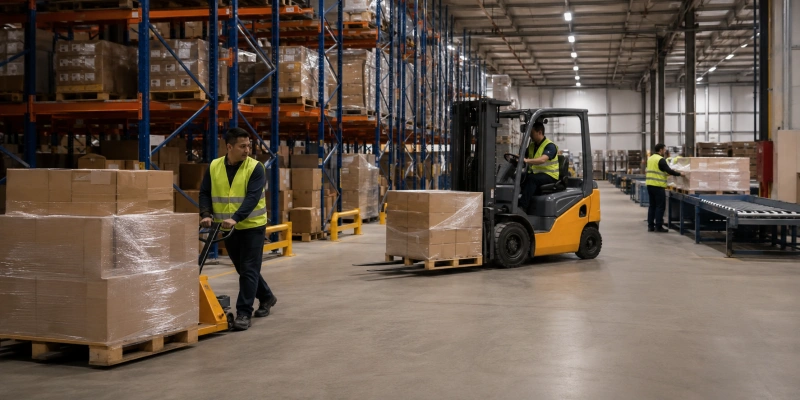
You rely on forklift solutions for both indoor and outdoor industrial material handling. Electric forklifts excel in warehouses. They offer faster lifting speeds, better handling, and lower fuel expenses. You reduce maintenance costs and boost productivity in tight spaces.
Rough terrain forklift models handle outdoor tasks. Their large pneumatic tires and reinforced chassis provide stability on uneven surfaces. You use rough terrain forklift equipment for construction and agriculture, where high-demand tasks require durability.
Electric forklifts are cost-effective for indoor operations.
Forklift maneuverability improves workflow in confined areas.
Rough terrain forklift models deliver stability in challenging environments.
You choose rough terrain forklift options for outdoor projects.
Rough terrain forklift designs support heavy loads and harsh conditions.
Heavy-Duty Cranes & Attachments
You select heavy-duty cranes and specialized attachments for complex industrial material handling. Powerful Machinery offers hoisting equipment that meets strict safety standards. You handle steel, automotive components, mining materials, waste, and woodworking products with precision.
Use Case | Features and Benefits | Best Applications Environments |
|---|---|---|
Steel and Metal Handling | High load capacity, magnetic cranes, and customized attachments | Steel mills, metal fabrication facilities |
Automotive Components | Specialized hooks, advanced controls | Automotive manufacturing plants |
Mining Materials | Heavy-duty cranes, durability in harsh conditions | Mining sites, quarries |
Waste Management | Efficient lifting and moving of waste materials | Recycling centers, waste treatment |
Woodworking Products | Attachments for large beams and logs | Lumber mills, woodworking shops |
Powerful Machinery’s material handling and hoisting equipment delivers reliability and safety for every industrial material handling scenario. You gain access to certified products and custom solutions that fit your operational needs.
What is the Best Equipment for Heavy-Duty Material Handling?
Equipment Comparison Table
You need to compare the top options to answer what is the best equipment for heavy-duty material handling. Your choice depends on operational requirements, material properties, and the environment.
Powerful Machinery offers solutions that fit diverse needs, from automated guided vehicles to electric forklifts and heavy-duty cranes. The table below helps you evaluate each option based on key criteria.
Equipment Type | Load Capacity | Efficiency | Safety Features | Flexibility | Cost Management | Best Use Case |
|---|---|---|---|---|---|---|
AGVs & AMRs | High | 24/7, automated | Sensors, remote operation | Trackless, adaptable | Lower labor costs | Warehouses, logistics centers |
Electric Forklifts | Medium-High | Operator-driven | Ergonomic controls, safety alarms | Maneuverable, indoor/outdoor | Moderate labor costs | Manufacturing, distribution |
Rough Terrain Forklifts | High | Operator-driven | Reinforced chassis, stability | Outdoor, uneven surfaces | Durable, long-term value | Construction, agriculture |
Heavy-Duty Cranes | Very High | Rail-based, operator-driven | Safety latches, limit switches | Fixed, requires layout changes | High initial investment | Steel mills, mining, and large-scale lifting |
Tip: You should consider the primary function of each piece of equipment, the personnel available, and the layout of your facility. These factors influence efficiency, safety, and cost.
Key Differences & Use Cases
You must understand the differences between each equipment type to decide what is the best equipment for heavy-duty material handling. AGVs operate without breaks and adapt to changing layouts. You gain flexibility and reduce labor costs. Sensors improve safety and lower incident rates.
AGVs integrate with management systems for real-time tracking.
Electric forklifts require trained operators. You benefit from versatility and maneuverability in tight spaces. However, labor costs increase over time. Visibility limitations can raise accident risks in crowded areas.
Rough terrain forklifts handle outdoor tasks. You use them for construction and agriculture. Their reinforced design ensures stability on uneven ground. You achieve durability and long-term value.
Heavy-duty cranes lift the heaviest loads. You rely on them for steel mills and mining sites. Cranes require rail layouts and structural modifications. Operator attention is critical for safety.
When you select what the best equipment for heavy-duty material handling is, you must evaluate your environment, load characteristics, and working intensity. Safety standards and long-term costs also play a role. You improve productivity, manage costs, and enhance your competitive position by choosing the right equipment.
Evaluate your facility layout and material properties.
Consider the impact on labor efficiency and safety outcomes.
Analyze how each equipment type contributes to flexibility and productivity.
You find that Powerful Machinery’s offerings cover every scenario. You receive certified solutions that match your operational needs. You achieve safer, more efficient material handling and gain a competitive edge in your industry.
Choosing the Right Equipment for Your Needs
Assessing Your Operation
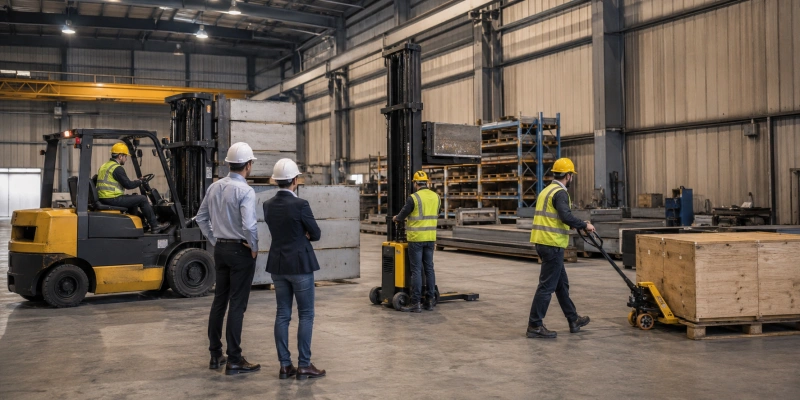
You start by evaluating your operation. Consider the weight and size of your loads. Analyze your workflow and set clear goals for throughput and speed. Review space constraints and decide if you need compact or vertical storage solutions. Check lifecycle costs, including maintenance and long-term savings.
Safety remains a priority. Select equipment with proper weight capacity and features like anti-lock brakes and load sensors. Verify regulatory compliance to meet safety and training standards. Plan for future expansion to avoid costly retrofits.
Customize equipment to fit your needs, such as platform sizes or fork dimensions.
Evaluate load weight and size.
Analyze workflow and operational goals.
Consider space constraints.
Assess lifecycle costs.
Ensure safety features and regulatory compliance.
Plan for future growth.
Customize equipment for flexibility.
Matching Equipment to Tasks
You match equipment features to your specific tasks by analyzing material characteristics. Inspect the weight, size, and fragility of your materials. For example, pallet trucks work well for palletized items, while lift tables suit heavier loads. Hoisting equipment handles large or awkward materials.
Task analysis helps you select the right tools for each job, optimizing productivity and safety.
Equipment Type | Purpose |
|---|---|
Pallets | Move and store goods easily, optimize space. |
Racks | Enable efficient vertical storage. |
Shelving Units | Adaptable storage for various items. |
Drawers | Secure storage for small or high-value items. |
Custom Solutions from Powerful Machinery
You benefit from custom solutions when standard equipment does not fit your needs. Powerful Machinery’s engineers design special sizes, materials, and features tailored to your project.
Their team works closely with you to solve unique lifting challenges in industries like construction, marine, and cargo handling. Custom options improve efficiency and address specific operational demands.
Request special sizes, materials, or designs.
Collaborate with engineers for tailored solutions.
Enhance efficiency with custom features.
Future-Proofing Your Investment
You secure long-term value by investing in future-proof equipment. Choose machines that optimize workflow and improve throughput. High-quality fabrication reduces downtime and maintenance needs. Custom systems adapt as your operation grows, supporting scalability.
Consider cost efficiency, space utilization, and flexibility. Invest in ergonomically designed equipment to prevent injuries. Transition to electric-powered machines and sustainable practices to lower environmental impact. Train operators on new technologies and stay updated with automation and data analytics.
Key Benefits | Description |
|---|---|
Optimized workflow | Equipment supports actual processes, reducing delays. |
Improved throughput | Better alignment minimizes interruptions, boosting productivity. |
Reduced downtime | Quality fabrication leads to fewer breakdowns and lower maintenance. |
Flexibility for growth | Custom systems adapt as operations evolve, supporting scalability. |
Tip: You improve efficiency and safety by choosing equipment that fits your current needs and adapts to future demands.
Conclusion
You see the best heavy-duty material handling equipment in 2026 reflects four key trends:
Trend/Recommendation | Description |
|---|---|
Safety-driven design | Focus on reducing risk through engineering solutions. |
Automation | Practical automation for operational value. |
Electrification | Battery-powered technology for precision and reliability. |
Flexible engineering approaches | Custom solutions for unique facility needs. |
You make better decisions by using clear criteria and comparing options. This approach increases objectivity and helps you select equipment that fits your operation. Consult Powerful Machinery for expert advice and tailored solutions that support your goals.
FAQ
What factors should you consider when choosing heavy-duty material handling equipment?
You should evaluate load weight, material type, space constraints, and workflow needs. Check safety features and certifications. Review maintenance requirements and total cost of ownership. Consult with experts to match equipment to your operation.
How does Powerful Machinery ensure equipment safety?
Powerful Machinery tests every product to meet or exceed international safety standards. You receive equipment with features like safety latches, limit switches, and reinforced frames. Certifications include ISO9001, OSHA, and TUV Rheinland.
Can you customize material handling equipment for unique tasks?
Yes. You can request custom sizes, lifting capacities, or attachments. Powerful Machinery’s engineers collaborate with you to design solutions that fit your specific requirements.
Tip: Customization improves efficiency and safety for specialized applications.
What maintenance does heavy-duty equipment require?
You should perform regular inspections, clean moving parts, and lubricate components. Replace worn parts promptly. Schedule professional servicing to ensure long-term reliability and safe operation.
Which industries benefit most from Powerful Machinery’s solutions?
Industries such as construction, marine, logistics, manufacturing, and cargo handling benefit most. You gain reliable, certified equipment designed for demanding environments.