A lever hoist is a portable manual device that uses a reciprocating handle, gearing, and a mechanical load brake to lift, lower, pull, or position a load. The chain-equipped version is commonly called a lever chain hoist, lever block, ratchet lever hoist, or chain puller. It requires no electric, hydraulic, or pneumatic power.
This page focuses on lever hoists that use a calibrated load chain. Other lever-operated devices may use wire rope or web strap, so the name alone is not sufficient for equipment selection. Check the nameplate, load-bearing medium, rated load, and manufacturer’s instructions before use.
Lever Hoist Definition
A lever hoist multiplies the force applied through a short operating handle and moves a load chain in controlled increments, while a mechanical load brake holds the load when handle movement stops.
What Are the Main Parts of a Lever Chain Hoist?
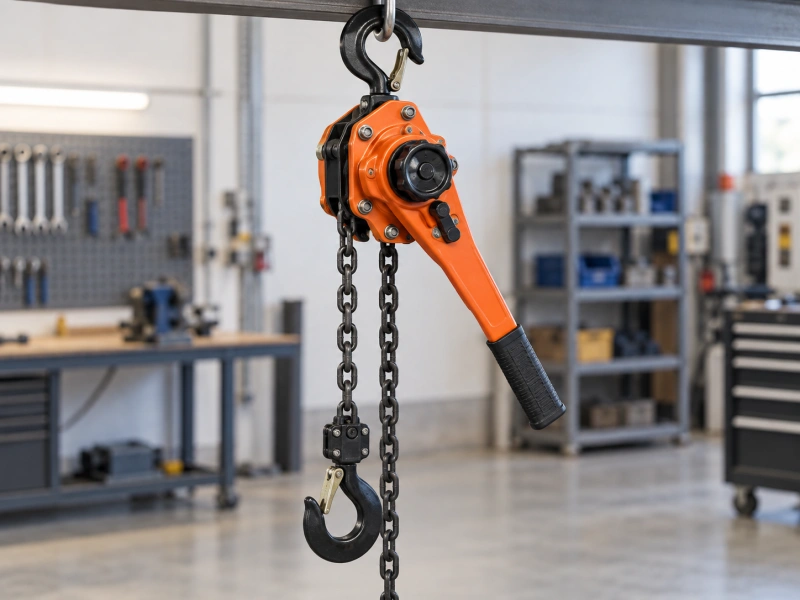
| Part | What It Does | Important Limit |
| Lever Handle | Provides the operator input that drives the mechanism. | Use the supplied handle only; never add an extension. |
| Direction Selector | Selects raising/pulling, lowering/releasing, or a model-specific neutral setting. | Positions and labels vary by model. |
| Gear Train | Multiplies manual input and turns the load sheave. | Internal repair requires an approved procedure. |
| Load Brake and Pawls | Control movement and hold the load as designed. | They do not permit overload or unattended suspension. |
| Pocketed Load Sheave | Engages the calibrated load chain and moves it through the hoist. | It is not a wire-rope drum. |
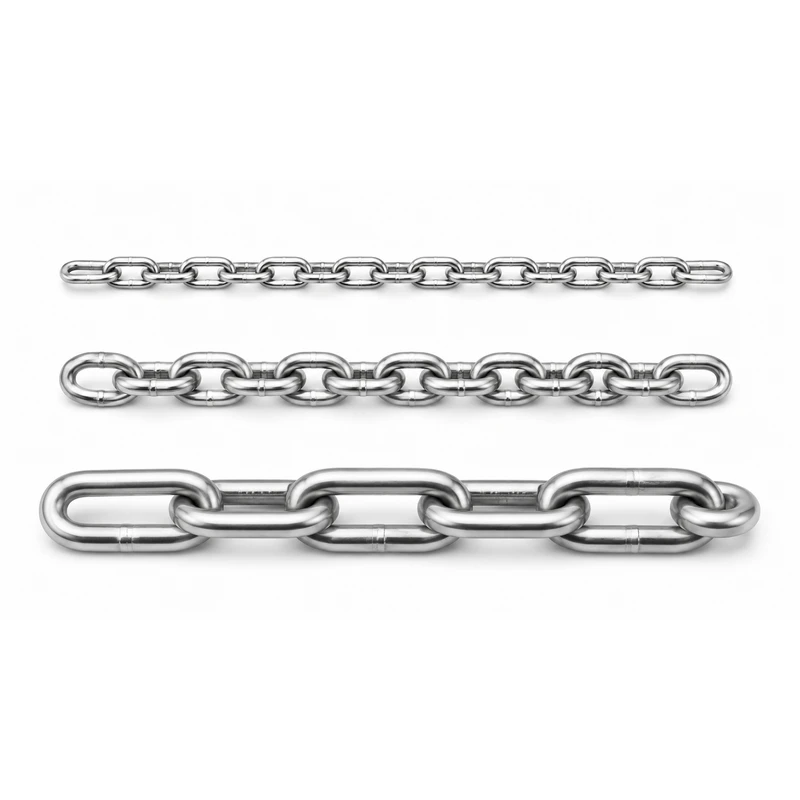
| Load Chain | Transfers force between the mechanism, hook, and load. | Never use it as a sling, knot it, or substitute general-purpose lifting chain. |
| Top and Bottom Hooks | Connect the hoist to the support and rigging. | Seat attachments in the hook saddle; never tip-load the hook or load the latch. |
| Free-Chain Control, If Fitted | Allows rapid adjustment of slack load chain without a load. | Use only when unloaded and exactly as the model manual permits. |
For model identification and current specifications, use the Powerful Machinery lever hoist range rather than assuming every lever hoist has the same components or options.
How Does a Lever Hoist Work?
- The operator attaches the hoist and rigging to suitable rated points and aligns the load chain with the intended force path.
- With the load still slack, a free-chain or idling mechanism may allow rapid chain positioning if the exact model includes and permits that feature.
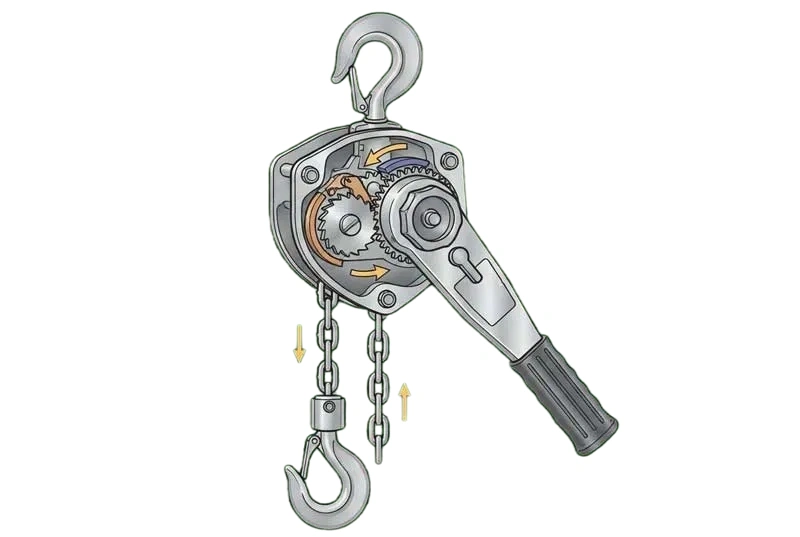
- The operator selects the marked raise or pull direction and moves the lever back and forth. The ratchet and gear train convert the short handle movement into incremental rotation of the load sheave.
- The pocketed load sheave engages the calibrated load chain and moves the load a controlled distance with each lever stroke.
- The mechanical load brake controls movement and is intended to hold the load when lever movement stops. The operator changes to the marked lowering or release direction to move the load in the opposite direction.
The exact selector positions, free-chain sequence, minimum load required for reliable brake engagement, and permitted operating orientations are model-specific. Do not copy those details from another brand or capacity.
What Is a Lever Hoist Used For?
A lever hoist is useful when controlled, short-distance movement is required, and external power is unavailable or impractical. Typical tasks include positioning machinery, aligning structural or fabricated parts, pulling components into place, tensioning during assembly, and lifting equipment for maintenance. The hoist must be selected and rigged for the actual force, travel, support, and operating environment.
| Task | Why a Lever Hoist May Fit | Required Boundary |
| Vertical Lifting | Compact manual control and short headroom on suitable models. | Use a verified overhead support and keep people clear of the load path. |
| Horizontal Pulling | A model approved for pulling can provide controlled movement. | Align hooks, body, and chain with the force path; avoid side loading. |
| Positioning and Alignment | Small load movements can help fit components. | Do not use a suspended load as a work platform or leave it unattended. |
| Tensioning During Work | The lever can incrementally change chain tension. | Do not treat the hoist as a measuring device or permanent restraint. |
| Confined or Remote Work | Portable equipment does not require external power. | Confirm access, reaction forces, clearances, and environmental suitability. |
Do not describe every lever hoist as suitable for any angle or position. Some manufacturers approve particular models for non-vertical use, but the rated load, mounting orientation, and correct line of pull still come from the exact model manual. Likewise, do not use a lifting hoist as a transport load binder unless the product is specifically identified and approved for that purpose.
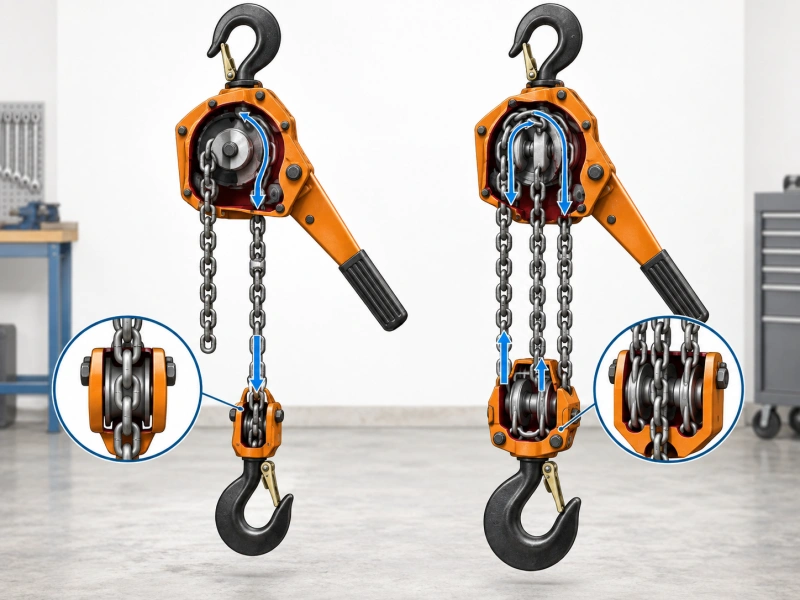
Lever Hoist Chain Falls Explained
“Chain fall” describes how the load chain is reeved through the hoist and lower hook block. A higher-capacity model may use more than one load-chain fall to support the lower block. These falls are not two sling legs, do not form a Y-shaped bridle, and do not create two anchor points. Never alter the reeving or replace the load chain with a different size or grade unless the approved model procedure specifies it.
Lever Hoist vs. Hand Chain Hoist
| Feature | Lever Hoist | Hand Chain Hoist or Chain Block |
| Operator Input | Reciprocating lever handle. | Continuous hand-chain loop. |
| Typical Advantage | Compact positioning, pulling, and short controlled movement. | Vertical lifting with the operator standing away from the hoist body. |
| Permitted Direction of Use | May support lifting or pulling as the exact model permits. | Normally intended for vertical lifting. |
| Working Space | Useful where there is room to sweep the handle. | Requires a clear hand-chain drop and pulling position. |
| Selection Factors | Rated load, reach, handle effort, headroom, orientation, and free-chain design. | Rated load, lift, hand-chain drop, headroom, and suspension. |
For a task-by-task comparison, use the lever hoist vs chain block guide.
Is a Lever Hoist the Same as a Come Along?
The term “come along” is used inconsistently. In some markets, it means a wire-rope hand puller; in others, it is used loosely for a lever-operated chain hoist. Identify the load-bearing medium, rating, intended use, and applicable standard from the nameplate and product documentation rather than selecting by nickname. The come-along vs. lever hoist comparison explains the practical differences.
How to Choose a Lever Hoist?
- Know the maximum force or load, including the effect of the rigging arrangement. Do not use operating effort as a substitute for known load weight.
- Confirm the required lift or pulling reach, minimum headroom, hook dimensions, and space for the lever stroke.
- Check whether the exact model is approved for vertical lifting, horizontal pulling, or the proposed mounting orientation.
- Match the hoist, load chain, hooks, suspension, and rigging to the temperature, corrosion, dust, moisture, or hazardous-area conditions.
- Obtain the current manual, parts information, and product-specific conformity documents required for the destination market.
- Plan inspection, maintenance, and traceable identification before the hoist enters service.
Powerful Machinery Catalogue Examples
The supplied Powerful Machinery catalogue lists VA and VL lever-hoist families with rated loads of 0.75, 1.5, 3, 6, and 9 tonnes and a catalogue standard lift of 1.5 m. The listed operating effort, chain diameter, number of load-chain falls, dimensions, and weight vary by model. These values show why rated load alone is not sufficient for selection.
Use the live VA Series chain lever hoist page for model-level information, but reconcile every online table with the current approved data sheet before publication. The catalogue also states design and test claims; however, the supporting test reports and market-specific certificates were not supplied, so those claims cannot be independently confirmed from the catalogue alone.
Basic Safety Boundaries
A definition page does not replace training or the model-specific manual. Before use, confirm the marked rated load, inspect the hoist and rigging, verify the support, and keep the load path clear. Seat attachments in the hook saddles, keep the load chain correctly reeved, and operate the supplied lever smoothly.
- Never exceed the marked rated load, shock-load the hoist, or add a cheater bar.
- Never lift people, lift over people, or leave a suspended load unattended.
- Never wrap the hoist load chain around the load or use it as a sling.
- Never use free chaining on a loaded hoist or use a neutral setting to release a load.
- Stop operation if you observe slipping, load drift, abnormal noise, binding, chain jump, damaged hooks, unreadable markings, or any unexpected change in operation.
Use the lever hoist inspection checklist before operation and the safe lever chain hoist operating guide for the full setup and stop-use procedure.
FAQ
What Is Another Name for a Lever Hoist?
Lever block and ratchet lever hoist are common names. Lever chain hoist identifies a lever hoist that uses load chain. “Come along” is ambiguous and may describe a different wire-rope pulling device.
Can a Lever Hoist Lift and Pull?
Many lever hoists are designed for lifting, pulling, or positioning, but permitted orientation and application depend on the exact model. Keep the hoist, hooks, and load chain aligned with the force path and follow the manufacturer’s instructions.
Can a Lever Hoist Be Used Horizontally?
Only when the exact model is approved for that pulling orientation, and the planned anchor, line of pull, and rigging are suitable. “Horizontal use” does not permit side loading of the hooks or hoist body.
What Does Free Chaining Do?
On a model equipped with the feature, free chaining allows rapid adjustment of slack load chain. It is used without a load and only through the sequence stated in the manual. It is not a method for lowering or releasing a supported load.
Does a Lever Hoist Use a Drum?
A lever chain hoist normally uses a pocketed load sheave that engages calibrated load chain. Wire-rope lever devices use a different mechanism, so their components and instructions should not be mixed into a chain-hoist description.
How Much Can a Lever Hoist Lift?
Capacity is the rated load marked on the exact hoist, not a universal value. Know the load and select the complete system so no hoist, support, or rigging component is overloaded.
Next Step
Compare verified rated load, lift or reach, operating effort, headroom, chain specification, environment, and documentation in the lever hoist product range. Contact Powerful Machinery with the load and application details when the correct model or approved operating orientation is unclear.