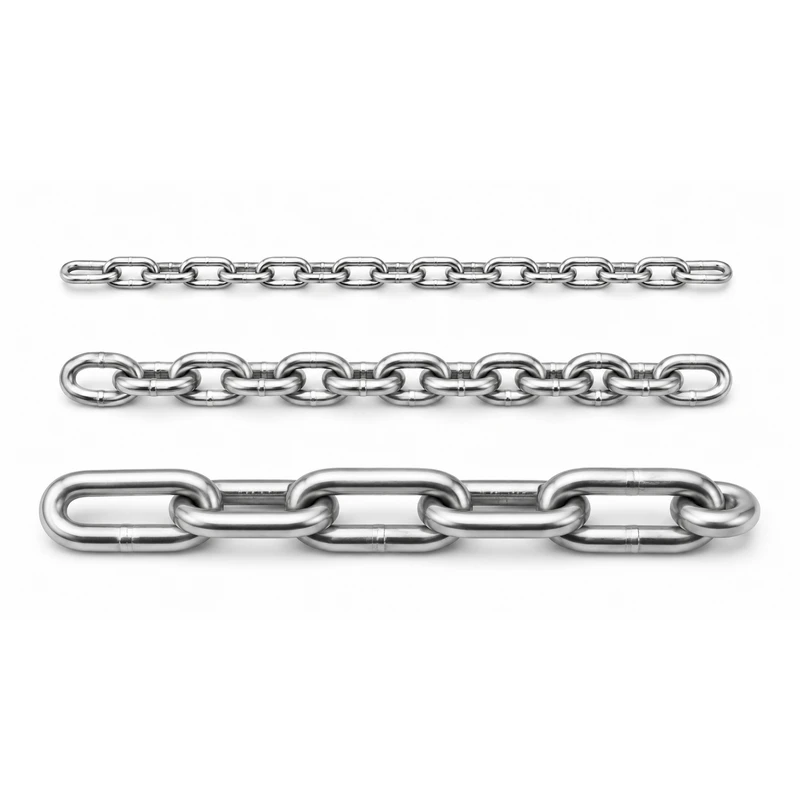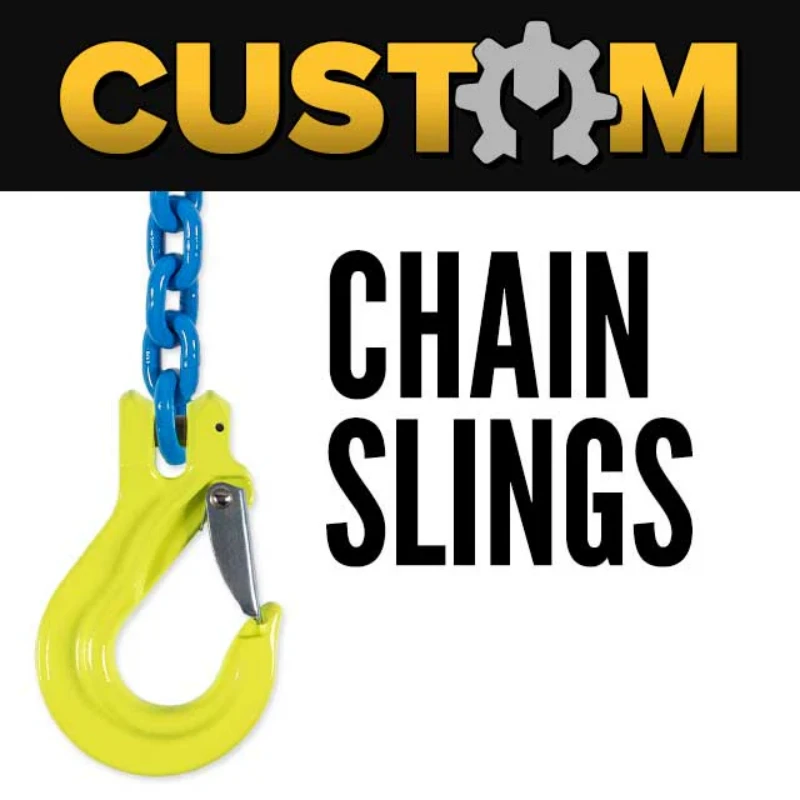
Choosing among Grade 80 chain manufacturers takes more than comparing a list of company names. If you buy chain for slings, stock a rigging range, or source lifting components for a project, you need to know which product a supplier actually offers, which specification it follows, and what evidence comes with the order. “G80” alone does not identify a chain’s diameter, working load limit, or permitted application.
We compare eight manufacturers and supplier brands with publicly documented Grade 80 offerings, including Powerful Machinery, the publisher of this article. You can use the product evidence and buyer questions below to build a shortlist, compare EN and North American specifications, and prepare a clearer RFQ.
Grade 80 Chain Manufacturers at a Glance
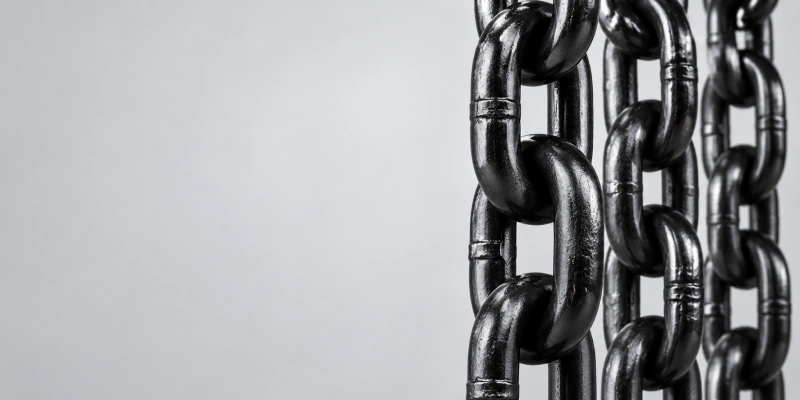
| Company or brand group | Market | Role | Public Grade 80 evidence | Specification context | A useful starting point |
| Qingdao Powerful Machinery | China and export | Manufacturer and supplier, per company catalogue | DIN EN 818-2 lifting chain and NACM2010 G80 alloy chain | European and North American product lines | Compare published metric and imperial ranges; request order documents |
| RUD | Germany | Manufacturer | Grade 80 chain with production and lot identification | EN 818-2 | Traceability and defined system components |
| THIELE | Germany | Manufacturer | TWN 0805 Grade 80 lifting chain | DIN EN 818-2 | Technical dimensions for sling assembly |
| Kito Crosby / Peerless | North America | Brand group and chain offering | Peerless Grade 80 Alloy Chain | NACM and ASTM A391/A391M | Published imperial WLL and marking data |
| Laclede Chain | United States | Chain manufacturer and supplier | Grade 80 overhead lifting welded chain | Product-specific US ratings | Domestic chain sourcing and product selection |
| Campbell Chain & Fittings | United States | Product brand and supplier | Grade 80 Cam-Alloy chain | Product-specific US ratings | Cam-Alloy chain and compatible sling products |
| SCIC / Chigong | China | Manufacturer and supplier, per company product pages | EN 818-2 G80 lifting chain | European metric specification | Comparing published dimensions and forces |
| pewag | Austria and international | Manufacturer and brand group | Official G8 / Grade 80 lifting-solutions catalogue | Confirm the current regional product sheet | System sourcing where G8 remains offered |
The table identifies a starting point, not interchangeable products. Availability, legal seller, chain marking, exact WLL, documentation, and the permitted use must be checked for the item and market in your quotation.
How We Selected These Grade 80 Chain Manufacturers?
Each entry has an official catalogue or product page identifying a Grade 80, G80, Grade 8, or G8 chain offering. We looked for a named product, published ratings or mechanical data, and a stated standard or specification. That evidence gives you a starting point; the quoted product and its documents still need to match your application.
Related brands appear together. Peerless is listed under Kito Crosby / CMCO rather than counted separately from other brands on the same corporate site. Campbell appears as a Grade 80 product brand and supplier; its public category page does not identify the legal manufacturer of every batch. Ask the seller to name the manufacturer when your purchasing specification requires that information.
The order below is editorial. It does not rank product quality, output, or market share. Use the eight entries to identify candidates, then compare the current product sheet, quoted SKU, application, and documentation.
What Is Grade 80 or G80 Chain?
Grade 80, often written G80 or Grade 8, is a strength grade for alloy steel chain used in specified lifting products.
The grade number is not a load capacity in tons. Your usable WLL depends on the chain’s nominal diameter, its product standard, and, for an assembled sling, the number of legs, hitch, angles, components, and any required derating. Start with the manufacturer’s product table and the rated assembly tag, not the appearance of a link.
Grade 80 appears in different products. EN 818-2 short-link chain for sling manufacture is distinct from the calibrated load chain specified for a hoist. G80 long-link lashing chain is for load securing; its grade marking does not make it an overhead lifting sling. If you need to compare product families first, see the lifting chains range and then check the specification for the chain you intend to buy.
Three figures serve different purposes. Working load limit (WLL) is the rated working load for the stated chain or assembly and conditions. Manufacturing proof force is a required test force, not a working rating. Minimum breaking force is the threshold specified for a breaking test.
Use the published WLL and the finished assembly’s instructions when selecting gear; a breaking-force figure alone does not establish a safe working load.
First establish what you are buying: chain sold by the length for sling manufacture, a completed chain sling, hoist load chain, or chain for load securing. Each has its own product requirements and, where applicable, assembly rating.
Grade 80 Chain Specifications Buyers Should Compare
Powerful Machinery’s catalogue lists a DIN EN 818-2 Grade 80 lifting-chain range with nominal size, link dimensions, WLL, manufacturing proof force, minimum breaking force, and unit weight. The selected rows below come from that specific range. They describe the chain; a completed sling needs its own rating for the chosen configuration.
| Nominal size (mm) | WLL (t) | Manufacturing proof force (kN) | Minimum breaking force (kN) | Weight (kg/m) |
| 6 | 1.1 | 28.3 | 45.2 | 0.802 |
| 8 | 2.0 | 50.3 | 80.4 | 1.416 |
| 10 | 3.2 | 78.5 | 126.0 | 2.216 |
| 13 | 5.3 | 133.0 | 212.0 | 3.749 |
| 16 | 8.0 | 201.0 | 322.0 | 5.571 |
| 20 | 12.5 | 314.0 | 503.0 | 8.641 |
| 26 | 21.2 | 531.0 | 849.0 | 14.640 |
| 32 | 31.5 | 804.0 | 1290.0 | 22.358 |
For example, the catalogue lists 10 mm chain at 3.2 t WLL, 78.5 kN manufacturing proof force, and 126.0 kN minimum breaking force. Keep these figures in their respective columns: the breaking force is not an allowable lifting load. See the DIN EN 818-2 Grade 80 lifting chain product page for the metric line, and request the latest sheet with your quotation.
The same catalogue separately lists US Type NACM2010 Alloy Chain (G80) for overhead lifting applications. Its imperial table gives, for example, 5/16 in chain at 4,500 lb WLL, 9,000 lb minimum proof test, and 18,000 lb minimum breaking force; 3/8 in chain is listed at 7,100 lb, 14,200 lb, and 28,400 lb, respectively.
These are values from the NACM2010 G80 line, not conversions to replace the EN 818-2 table. When the inquiry uses US trade sizes, specify the G80 alloy chain line explicitly.
The catalogue also lists a G80 long-link lashing-chain range. Its breaking-load figures must not be used as a lifting WLL. An inquiry that says only “G80, 10 mm” leaves the application unresolved. Link pitch and width also affect the fit of chain and fittings. The lifting chain sizes guide can help you prepare dimensional questions; confirm the answers against the current product drawing.
For a useful quotation, state the standard, diameter or load, application, length, quantity, destination, and required documents. For a completed sling, add the leg count, hitch, angle range, and end fittings. Send your Grade 80 chain specification for review.
8 Grade 80 Chain Manufacturers and Supplier Brands
1. Qingdao Powerful Machinery
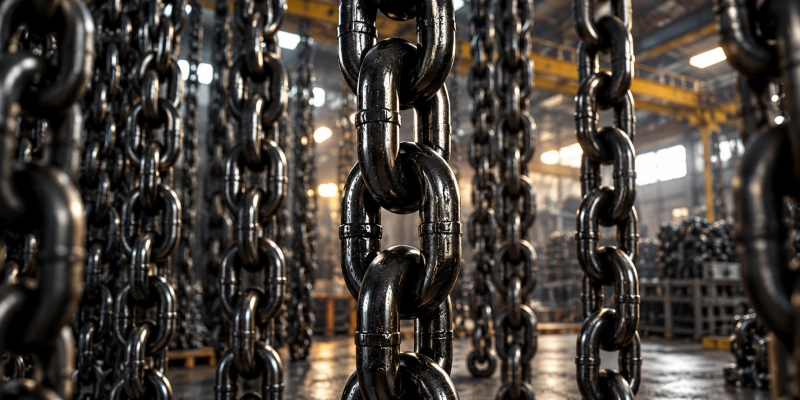
Qingdao Powerful Machinery, the publisher of this article, describes itself in its catalogue as a China-based manufacturer and supplier of welded chain, lifting chain, and rigging accessories. Its DIN EN 818-2 Grade 80 chain table covers 6–32 mm, while a separate US Type NACM2010 G80 alloy-chain table uses imperial trade sizes.
The catalogue also lists G80 hooks, connecting links, and master links, allowing buyers to discuss chain and fittings in the same inquiry.
Start by naming the required product line and application. Ask for the current technical sheet, chain markings, batch identification, and documents available with your order. If you need a finished sling, request the approved component references, assembly rating, tag, and instructions. Confirm lead time, minimum order quantity, and any custom marking or packaging in the quotation.
2. RUD
RUD publishes an EN 818-2 Grade 80 chain product with a reference number, nominal diameter, link dimensions, and WLL. Its product sheet describes H1-8 identification and production and lot numbers stamped at intervals. Those markings give buyers a defined route for checking the chain’s origin and related production records.
RUD may suit a project that calls for documented traceability within a defined chain-sling system. Compare the quoted chain’s dimensions and WLL with the intended assembly, then confirm the compatible hooks, connectors, and master links. Request the instructions and documents for the exact product and destination market.
3. THIELE
THIELE’s TWN 0805 is a Grade 80 lifting chain made from CrNiMo alloy steel. THIELE says its manufacturing and testing requirements are based on DIN EN 818-2 and the German Statutory Accident Insurance test principle GS-HM 37. Its product page lists nominal diameter, pitch, inside and outside width, weight, and WLL. Those dimensions help a sling builder check the proposed chain and fittings together.
For a metric chain-sling inquiry, give THIELE or its authorized channel the intended configuration and ask for the current TWN 0805 sheet, matching component references, assembly instructions, and order documents. Check the instructions for the specified finish and operating environment; temperature and corrosion limits depend on the actual product and assembly.
4. Kito Crosby / Peerless
The Kito Crosby / CMCO product site lists Peerless Grade 80 Alloy Chain and presents Peerless alongside other group brands. Its official product page says the chain is recommended for overhead lifting, is marked P and 8, and meets the stated NACM guidance and ASTM A391/A391M Grade 8 specification.
It publishes imperial trade sizes and WLLs, and says proof testing is at least twice the WLL, with certification for that product. The page identifies availability in the US, Canada, and Latin America.
Peerless provides a North American comparison point with imperial sizes, published WLLs, and stated markings. Ask the seller to identify the SKU and provide the certificate and instructions for the chain supplied. The product-page proof-test statement applies to that Peerless line; do not extend it to every chain or fitting sold under the wider brand group.
5. Laclede Chain
Laclede lists Grade 80 welded alloy chain for overhead lifting, with size-specific WLL information. It is a useful US source when you need to compare a named loose-chain product and its available sizes. State whether you want bulk chain, cut lengths, or a finished assembly so the quotation covers the correct item.
Request the current WLL table, finish, markings, length, and documents for the quoted size. If a distributor supplies the chain, confirm the original manufacturer and how the batch records follow cut lengths. Check component compatibility separately when another brand’s fittings are involved.
6. Campbell Chain & Fittings
Campbell’s Grade 80/100 Alloy category lists Grade 80 Cam-Alloy chain alongside separate Grade 100 products and directs buyers to a distributor. Its named Grade 80 line is relevant if you already use Campbell chain-sling components or are comparing North American chain and hardware through a local channel.
Compare the exact Cam-Alloy SKU rather than assuming that every diameter has the same finish, packaging, or paperwork. Request its current WLL and specification, grade markings, available test or batch documents, and assembly instructions where a completed sling is involved. If direct factory sourcing is required, have the distributor identify the legal manufacturer of the quoted batch.
7. SCIC / Chigong
SCIC / Chigong publishes an EN 818-2 G80 lifting-chain line with dimensional and mechanical-property tables. Its material description includes alloy steel, welding, and heat treatment. These published figures let a metric buyer compare the proposed diameter, WLL, proof force, and breaking-force requirement with another documented offer.
Ask for the current revision of the product sheet and drawing, then match the quoted size and grade to the chain markings and batch documents. If you are comparing two suppliers, use each supplier’s own data and records; a matching nominal grade does not establish that the products have identical dimensions or come from the same source.
8. Pewag
Pewag lists a G8 / Grade 80 range in its official lifting-solutions catalogue index. That makes it a candidate for buyers seeking a chain-and-component system from a European brand. Product selection should begin with the current regional catalogue and the exact part references rather than the G8 label alone.
Ask the local pewag channel which G8 chain sizes and compatible fittings are currently available, along with their WLLs, instructions, and documents. If the specified part cannot be supplied, review the proposed replacement as a new assembly choice and confirm its complete rating before purchase.
Manufacturer vs Supplier vs Distributor: Which Should You Choose?
A manufacturer produces the chain. A supplier sells it to you and may produce it, source it, or do both. A distributor generally sells a manufacturer’s line through a local channel and may hold stock or help obtain technical documents. One company can fill more than one role, so the seller’s name alone may not identify the plant that made your batch.
An authorized distributor can help when you need a specified replacement quickly, and the original chain and documents are traceable. For repeated orders to a defined specification or a custom requirement, direct technical contact with the manufacturer may simplify approval.
A supplier can also coordinate chain, fittings, and sling assembly, provided the finished product receives the correct rating, marking, and instructions.
Ask who made the quoted chain, which entity sells it, and who will assemble and document the sling if your order includes one. Put the product line, permitted substitutions, required records, and responsibility for the finished assembly in the purchase specification. Those answers matter more than a generic “factory direct” label.
How to Evaluate a Grade 80 Chain Manufacturer?
Start With the Exact Product and Application
State whether you need chain for sling manufacture, a finished chain sling, hoist load chain, or load-securing equipment. Identify the applicable specification and destination market before comparing prices. EN 818-2 chain, a NACM2010 Grade 80 alloy-chain product, and chain designed for a specific hoist are different purchase requirements. For overhead lifting, request an explicit lifting rating and the product instructions.
Then give the nominal diameter and required WLL. If you are designing a sling, provide the total suspended load, number of legs, hitch, angle range, and any expected temperature or chemical exposure to a competent designer.
The capacity of a complete assembly may be governed by a component or configuration rather than the bare-chain WLL. Check the rated tag and documentation for the assembly you actually receive.
Compare Test Values Without Confusing Their Purpose
Request the published WLL, manufacturing proof force or proof-test requirement, minimum breaking force, link dimensions, and applicable test records. Powerful Machinery’s DIN EN 818-2 table uses tonnes and kilonewtons; its separate NACM2010 table gives imperial working, proof, and breaking values.
A breaking value does not permit a lift above the WLL. Ask which tests apply to the production chain or to a completed assembly and what records the supplier will provide for your order.
Check Identification and Traceability
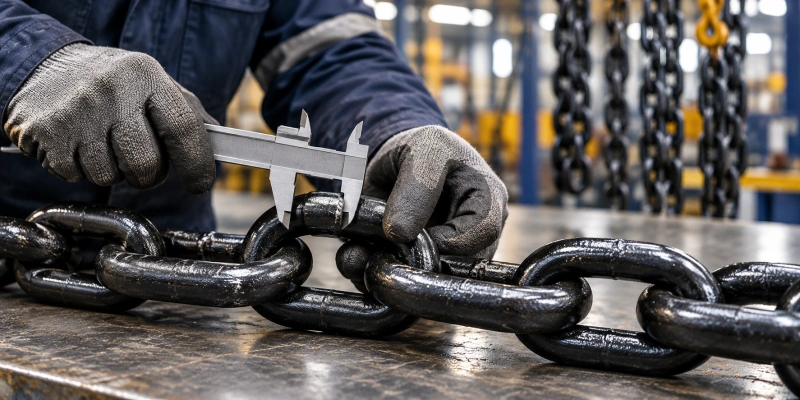
Specify the grade and manufacturer markings and the lot or batch records your project needs. Compare a sample document with the quotation: product name, standard, nominal size, batch reference, and test figures should agree. On receipt, match those details to the delivered chain. If the chain is cut into shorter lengths, ask how each length remains identifiable in your records.
Treat Components as a System
A sling may combine chain, master link, connecting link, shortening device, and end hook. Confirm that each component is suitable for the chain grade and diameter, and that the assembled configuration is rated and marked. A “G80” description on two separate components is not, by itself, an approval to combine them.
Powerful Machinery’s catalogue includes G80 hooks and G80 links, but the buyer should still request the exact compatible references and sling assembly instructions. Do not weld, repair, or substitute a load-bearing component without the manufacturer’s procedure and a qualified assessment.
Check Production and Delivery Details
Ask where the chain is made, where any sling assembly takes place, and who issues each document. For a factory review, request evidence relevant to your order, such as material records, welding and heat-treatment controls, inspection criteria, calibration, and a sample batch record. Agree on any visit or third-party inspection before placing the order.
Confirm the minimum order quantity, lead time, finish, packaging, and document package for the exact size and quantity. If you request a private mark or custom packaging, approve the marking layout and make sure the batch remains traceable. Compare these terms alongside unit price.
Plan for Inspection After Delivery
Check markings, dimensions, visible condition, and documents when the chain arrives. Check the sling tag as well if you ordered an assembly. Follow the manufacturer’s instructions and your inspection program during service; remove gear with missing identification or visible damage until a competent person assesses it. See the lifting chain inspection guide for a fuller checklist.
EN 818-2 vs North American Grade 80 Specifications
EN 818-2 specifies medium-tolerance short-link Grade 8 chain for chain slings. Its dimensions, mechanical properties, marking, and test requirements give buyers a basis for comparing chain products. The chain itself is only one part of a finished sling; the assembled sling and its fittings need their own applicable rating and documentation.
In North America, Grade 80 alloy-chain product sheets may cite ASTM A391/A391M and NACM welded-chain specifications. Peerless cites both on its product page; Powerful Machinery separately labels its US Type line “NACM2010 Alloy Chain (G80).”
Ask which edition and product specification the seller is quoting. Compare the published WLL and dimensions for each actual product rather than treating 8 mm and 5/16 in listings as interchangeable.
Use each term for its proper purpose. EN 818-2 and ASTM A391/A391M are product standards or specifications. NACM publishes welded-chain specifications. ISO 9001 concerns a quality-management system if the supplier holds a valid certificate.
OSHA sets US regulatory requirements; CE is a conformity marking where the relevant rules apply. A general list of “certifications” cannot replace the chain’s product specification and order documents.
Hoist load chain also needs separate treatment. It must match the hoist manufacturer’s specified dimensions and pocket wheel; chain intended for slings is not a universal hoist replacement. Give the supplier the hoist model and manufacturer’s chain specification when that is the application.
What to Include in a Grade 80 Chain RFQ?
| Field | Information to send |
| Application | Overhead lifting as loose sling chain, completed chain sling, hoist-specific replacement, or lashing; describe the load and duty |
| Product specification | EN 818-2, a named NACM/ASTM Grade 80 product, or the project’s required standard and edition |
| Rating and dimensions | Nominal diameter, required WLL, link dimensions if fit matters, and the rated assembly configuration |
| Quantity and length | Total metres or feet, length per piece, number of slings, and any cutting tolerance |
| Assembly and fittings | Number of legs, hitch and angle range, and compatible master links, connecting links, hooks, or shorteners |
| Finish and marking | Required finish, chain identification, batch traceability, labels, and any approved private mark |
| Documents | Product data sheet, relevant test or conformity records, assembly certificate and instructions as applicable |
| Commercial details | Destination, quantity, packaging, requested date, delivery term, and any inspection requirement |
If you do not know the chain diameter, send the load and complete lifting arrangement to a qualified supplier for a rated proposal, then request the technical basis in writing. State that any substitution needs approval. This prevents a lashing-chain or different-grade quotation from being accepted as the requested lifting product.
FAQs
Is Grade 80 the Same as G80?
In many lifting-chain catalogues, yes: both designate Grade 8 / Grade 80. The short label does not identify the applicable product standard, diameter, WLL, link geometry, or whether the item is intended for lifting. Check the full product designation and manufacturer’s instructions before ordering or using a chain.
Is Grade 80 Chain Suitable for Overhead Lifting?
A Grade 80 alloy chain specifically manufactured, marked, and rated for overhead lifting can be used within its stated WLL and instructions. The complete sling or lifting assembly must also be compatible and correctly rated. Do not use a transport or lashing chain overhead merely because its catalogue title contains G80.
What Is EN 818-2 Grade 80 Chain?
It is medium-tolerance short-link Grade 8 chain specified for chain-sling manufacture under EN 818-2. Compare the nominal diameter, dimensions, WLL, manufacturing proof force, and minimum breaking force on the actual manufacturer’s sheet. Separate standards and instructions apply to components and completed sling assemblies.
What Is the Difference Between Grade 80 and Grade 100 Chain?
They are different strength grades. For a comparable diameter, a Grade 100 product often offers a higher published WLL, but the exact difference depends on the applicable product and table. Do not combine grades or change an assembly’s rating based on that general comparison. See Grade 80 vs Grade 100 chain and verify compatible components and the finished tag.
How Do I Verify a Grade 80 Chain Manufacturer?
Ask for the legal manufacturer, production location, current product sheet, chain markings, relevant standard, batch traceability, and order-specific documents. Compare the certificate and labels with the delivered chain. If a supplier arranges assembly through another business, establish who rates and documents the finished sling.
What Documents Should I Request From a Grade 80 Chain Supplier?
Start with the product data sheet and instructions. State which batch or test record, material record, inspection report, and assembly certificate your project requires, then obtain written confirmation of what the supplier will provide. Requirements depend on the destination and whether you buy loose chain or a completed sling; the label “certified” alone is too vague.
Conclusion
Choose the chain and supplier against your actual lifting arrangement: standard, WLL, dimensions, compatible fittings, markings, and documents. The eight entries offer a shortlist; the quotation should identify the specific chain and any finished assembly.
To request a quotation from Powerful Machinery, send your Grade 80 chain requirements, including the application, standard, load or size, quantity, destination, and documents needed.