Wire rope clips work by clamping the turned-back dead end of a wire rope against the live, load-carrying part of the rope. On a standard U-bolt clip, the saddle supports the live end while the U-bolt fits over the dead end. Tightening the nuts creates contact pressure between the two rope sections, and that pressure helps resist relative movement and slippage.
The principle is simple, but a reliable termination depends on more than simply tightening two nuts. Clip type, rope diameter, clip count, spacing, turnback, and tightening torque all affect performance. Those values should come from the clip manufacturer or the applicable standard, not from one universal rule.
Key Takeaways
- A standard U-bolt wire rope clip has three basic parts: a U-bolt, a saddle, and two nuts.
- The live end is the part of the rope that carries the load; the dead end is the short tail after the rope is turned back.
- For a conventional U-bolt clip, the saddle belongs on the live end and the U-bolt goes over the dead end.
- Tightening the nuts creates clamping pressure that helps keep the live and dead ends from sliding relative to each other.
- The correct clip count, spacing, turnback, and torque depend on the clip, rope size, and application. Follow manufacturer instructions.
- Wire rope clips are not a universal substitute for engineered or factory-made terminations in lifting and other safety-critical applications.
What Is a Wire Rope Clip?
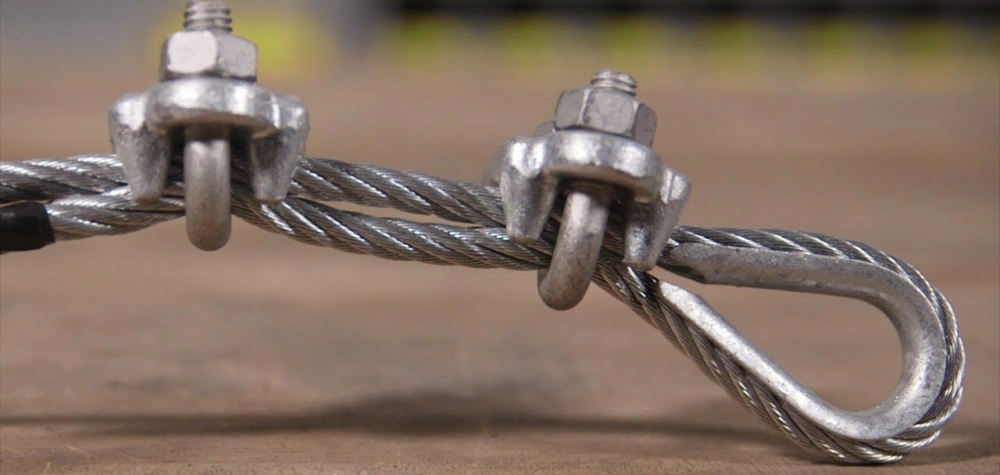
A wire rope clip is a mechanical fitting used to secure the end of a wire rope, most often after the rope is turned back to form an eye or loop. You may also hear it called a wire rope clamp, cable clamp, cable clip, or wire rope grip. The names vary by market, but the basic purpose is the same: hold two sections of wire rope together so the termination stays in position.
Wire rope clips are popular because they can be installed in the field with common hand tools and, in many non-critical applications, can be adjusted or removed. They are used in guy lines, fencing, railing, marine hardware, general industrial fastening, and other wire-rope assemblies where the specified termination permits clips.
A clip does not make the termination equivalent to an uninterrupted rope. The finished assembly must be evaluated according to the clip manufacturer’s efficiency data, installation instructions, and the requirements of the application.
Parts of a U-Bolt Wire Rope Clip
1. U-bolt. The U-bolt wraps around the rope assembly. In a conventional U-bolt installation, it is placed over the dead end. As the nuts are tightened, the U-bolt applies compressive force to the rope.
2. Saddle. The saddle is the shaped base that supports the rope. On a standard U-bolt clip, the live, load-carrying end rests in the saddle. This orientation is commonly remembered with the phrase “Never saddle a dead horse.”
3. Nuts. The two nuts draw the U-bolt and saddle together. Tightening them evenly develops the clamping force. Use a torque wrench when the manufacturer specifies a tightening torque.
Live End vs Dead End
Understanding the live end and dead end makes the working principle much easier to visualize.
The live end is the long part of the wire rope that continues into the working line and carries the applied load. The dead end is the shorter tail created when the rope is turned back to make an eye or termination.
With a conventional U-bolt clip, the saddle sits on the live end and the U-bolt bears on the dead end. This arrangement follows the installation guidance used by major clip manufacturers and OSHA for U-bolt clips in applicable assemblies.
If you remember one orientation rule, make it this: saddle on the live end, U-bolt on the dead end.
How Do Wire Rope Clips Work?
Wire rope clips hold a termination through controlled clamping pressure. When the nuts are tightened, the U-bolt and saddle squeeze the live and dead rope sections together. The resulting contact pressure increases resistance to sliding, helping the dead end remain fixed relative to the live end.
1. The clip creates contact pressure. Tightening the nuts pulls the U-bolt and saddle together. The two rope sections are pressed firmly against each other and against the clip surfaces.
2. Friction resists relative movement. The clamping pressure increases friction at the contact surfaces. When the termination is loaded, that friction helps prevent the turned-back end from pulling through the clips.
3. The saddle supports the load-carrying side. The saddle gives the live end a broader supporting surface than the U-bolt alone. Correct orientation therefore matters to the way the rope is compressed.
4. Multiple clips form a complete termination. Where more than one clip is required, the clips are installed in the number and arrangement specified for the rope and clip. They do not simply add a fixed percentage of strength per clip; the complete termination works as a system.
This is why a wire rope clip should not be treated as a generic “tighten it until it feels secure” fitting. Rope diameter, rope construction, clip design, turnback, clip count, spacing, and torque all influence how the termination performs.
How Do Wire Rope Clips Prevent Slippage?
A properly specified clip assembly resists slippage by maintaining enough clamping pressure and friction to keep the dead end from moving relative to the live end under the intended service conditions.
Slippage becomes more likely when the wrong clip size is used, nuts are under-tightened, a conventional U-bolt clip is installed backward, the rope has insufficient turnback, too few clips are used, or the assembly is not rechecked after the rope seats.
Initial loading can cause the rope and clip assembly to settle. For that reason, manufacturer instructions commonly require the nuts to be checked and re-torqued after the first load. Clips should also be inspected during service for loosening, corrosion, deformation, wear, or visible rope movement.
What Are Wire Rope Clips Used For?
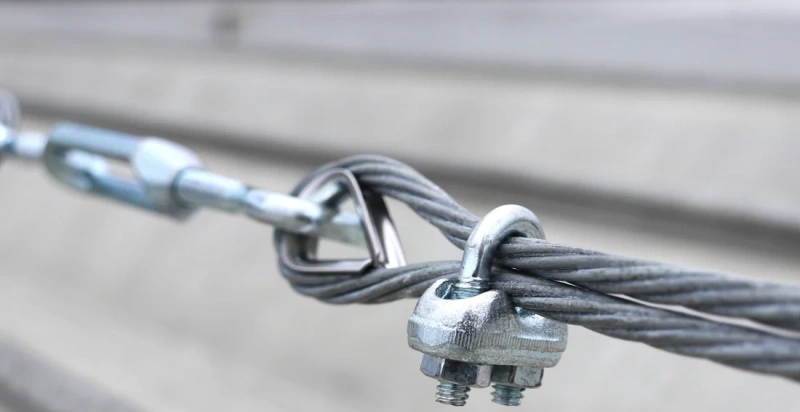
Wire rope clips are used when a removable or field-installed wire rope termination is appropriate. Typical applications include:
- forming an eye around a thimble;
- securing wire rope ends in guy-line and support-line assemblies;
- fencing, guardrail, and barrier cable systems;
- marine and outdoor cable fastening when the material is suitable for the environment;
- general industrial wire-rope fastening and maintenance;
- temporary or adjustable assemblies where the governing specification permits clips.
The correct clip depends on the job. Galvanized steel is common for general outdoor service, stainless steel is often selected where corrosion resistance matters, and forged clips may be specified for higher-duty applications. Material alone, however, does not determine whether a clip is suitable for a particular load or lifting task.
How Are Wire Rope Clips Installed?
The basic orientation is straightforward: form the required eye or turnback, place the saddle on the live end, place the U-bolt over the dead end, install the required number of clips, and tighten them evenly to the specified torque.
That summary is intentionally brief. Installation values are not universal. The required number of clips, rope turnback, spacing, and torque change with rope diameter, clip design, manufacturer, and application.
For the complete procedure, see our Wire Rope Clamp Installation Guide.
For clip quantity and sizing guidance, see How Many Wire Rope Clips to Use?
Why “Never Saddle a Dead Horse” Matters?
“Never saddle a dead horse” is a simple reminder for conventional U-bolt wire rope clips. The “horse” is the live, load-carrying end of the rope, so the saddle belongs on that side. The U-bolt goes over the dead end.
Reversing the clip changes where the rope is compressed and can reduce the reliability of the termination. On an assembly with several U-bolt clips, keep all clips oriented consistently according to the manufacturer’s instructions.
The phrase applies specifically to conventional U-bolt clips. Other designs, such as double-saddle or fist-grip clips, have different geometry and should be installed according to their own instructions.
Do All Wire Rope Clips Work the Same Way?
No. Most wire rope clips rely on mechanical clamping, but their construction and installation can differ.
U-bolt clips use a U-bolt, saddle, and nuts. Double-saddle or fist-grip clips clamp the rope between two saddle-like bodies and do not use the same “saddle on live end” geometry. Simplex and duplex clips are compact fittings used in lighter fastening applications, while choices such as forged steel, malleable iron, galvanized steel, and stainless steel affect strength, corrosion resistance, and intended service.
If you are choosing a fitting rather than studying the mechanism, see our guide to Wire Rope Clamp Types.
Wire Rope Clips vs. Ferrules: What Is the Difference?
A wire rope clip makes a bolted mechanical termination. It can be installed in the field and may be removable, depending on the application and condition of the hardware.
A ferrule, or swage sleeve, is compressed permanently around the rope with suitable swaging equipment. It produces a compact termination and is commonly used where a permanent, controlled fabrication process is preferred.
Neither option should be selected simply because one looks stronger or is easier to install. Rope construction, load case, required termination efficiency, inspection regime, applicable standard, and manufacturer approval should determine the termination method.
For a broader comparison of termination approaches, see our Wire Rope Clamping Method guide.
When Should You Not Rely on Wire Rope Clips?
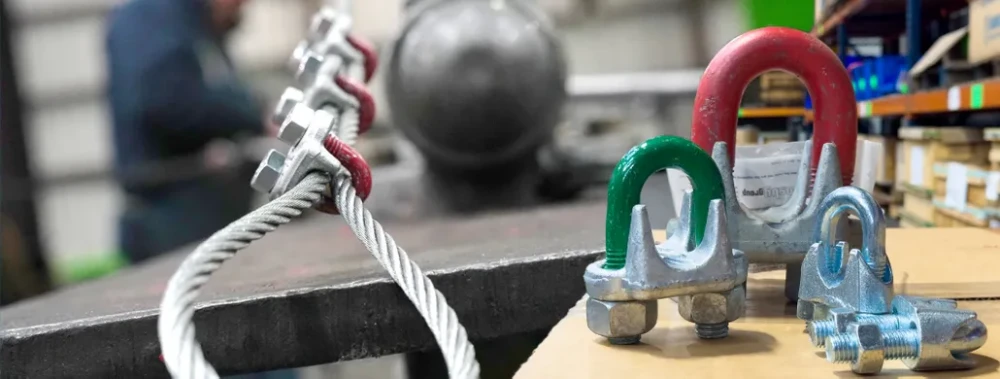
Wire rope clips are useful hardware, but they are not suitable for every wire-rope termination.
Do not assume a field-installed clip termination is acceptable for a lifting sling, personnel-support system, crane, elevator, suspension system, or other safety-critical application simply because the clip physically fits the rope.
OSHA’s wire-rope sling guidance states that wire rope clips generally should not be used to fabricate wire rope slings except where the application prevents use of a prefabricated sling and a qualified person designs the sling for that specific application. OSHA also directs users to install clips according to the manufacturer or qualified person’s recommendations and to obtain spacing, clip count, and torque values from the clip manufacturer.
For critical work, the application standard, equipment manufacturer, rope manufacturer, clip manufacturer, and qualified person take priority over generic online instructions.
Common Mistakes That Change How a Wire Rope Clip Performs
Wrong orientation. Putting the saddle on the dead end of a conventional U-bolt clip changes how the live rope is supported and compressed.
Wrong size. A clip that does not match the rope diameter may not develop the intended clamping geometry.
Guessing the torque. Too little torque can allow movement. Excessive tightening can also damage components or the rope. Use the specified value for the actual clip and rope.
Using one fixed clip count for every rope. There is no universal “always use three clips” rule for every clip, rope diameter, and application. Follow the applicable manufacturer’s table.
Ignoring settling after the first load. The rope can seat under load, which is why re-torquing may be required by the manufacturer’s procedure.
Using the wrong termination for the application. A mechanically secure-looking eye is not automatically an approved lifting or safety-critical termination.
FAQ
Do wire rope clips weaken wire rope?
A clip termination normally has a termination efficiency below the breaking strength of an uninterrupted rope. The exact efficiency depends on the clip system, rope construction, installation, and manufacturer. Use the manufacturer’s rated efficiency or engineering data rather than a generic percentage.
Which way should a wire rope clip face?
For a conventional U-bolt wire rope clip, place the saddle on the live end and the U-bolt over the dead end. Follow the manufacturer’s instructions for other clip designs.
How many wire rope clips should I use?
It depends on rope diameter, clip type, manufacturer, and application. Do not use one fixed number for every rope.
See our detailed guide: How Many Wire Rope Clips to Use?
Can wire rope clips be used for lifting?
Do not treat wire rope clips as a universal lifting-sling termination. OSHA limits the use of clips for fabricating wire rope slings and requires manufacturer or qualified-person guidance. For lifting and other safety-critical applications, use the termination specified by the governing standard and qualified person.
Are wire rope clips and wire rope clamps the same thing?
The terms are often used interchangeably for hardware that clamps wire rope. “Wire rope clip” is common in U.S. rigging terminology, while “wire rope clamp,” “cable clamp,” and “wire rope grip” are also widely used. Identify the actual fitting design and specification rather than relying on the name alone.
Can you reuse a wire rope clip?
Some clip hardware may be reusable in appropriate non-critical applications if the manufacturer permits it and the clip passes inspection. Do not reuse a clip that has damaged threads, deformation, corrosion, cracking, or other defects. For critical applications, follow the governing procedure and manufacturer’s replacement criteria.
Conclusion
Wire rope clips work by turning tightening force at the nuts into controlled clamping pressure on two sections of wire rope. On a standard U-bolt clip, the saddle supports the live end and the U-bolt clamps the dead end. The resulting pressure and friction help keep the turned-back end from slipping.
The mechanism is easy to understand; specifying the termination correctly is the important part. Match the clip to the rope and application, use the manufacturer’s clip count, spacing, turnback, and torque values, and inspect the assembly after loading and during service.
If you are sourcing clips for industrial, marine, construction, or OEM applications, explore Powerful Machinery’s Wire Rope Clamps and Clips.