To read anchor chain leading correctly, observe where the cable leaves the hawsepipe relative to the vessel, then report its direction using clear shipboard terms. In merchant-ship operations, the standard IMO SMCP answers are leading ahead, astern, to port, to starboard, round the bow, or up and down.
Do not mix direction with cable condition or anchor holding. “Slack,” “tight,” and “coming tight” describe how the cable is growing. Short, medium, and long stay describe its visible angle and extension when those terms are used by your vessel. Whether the anchor is holding must be confirmed separately by the bridge or anchor watch through position monitoring.
Quick Answer
Read the cable in this order: lead → growing/condition → stay → amount of cable out → bridge report. A complete report might be: “Starboard cable leading ahead, coming tight, medium stay, four shackles in the water.” Use the exact wording required by your vessel’s SMS and the bridge team. The cable angle alone does not prove that the anchor is holding.
Key Takeaways
- Observe the anchor cable from the hawsepipe and report its direction relative to the vessel.
- Use ahead, astern, to port, to starboard, round the bow, or up and down for standardized leading reports.
- Keep cable growing—slack, tight, or coming tight—separate from short, medium, or long stay.
- Report the amount of cable out as a separate item, normally in shackles.
- Never use a steady or taut cable as the only evidence that the anchor is holding.
Anchor Cable Leading vs Growing, Stay, Holding, and Cable Out
The word “cable” is common in merchant-ship anchoring communication even when the deployed cable is stud-link anchor chain. The terms below answer different questions and should not be treated as interchangeable.
| Term | What it tells you | Typical wording | What it does not prove |
| Cable leading | Direction from the hawsepipe relative to the vessel | Ahead, astern, to port, to starboard, round the bow, up and down | Anchor holding |
| Cable growing / condition | Current slackness or loading change | Slack, tight, coming tight | Direction or stay |
| Stay | Visible angle and extension toward the water | Short, medium, long; up and down where used | A fixed tension value or holding guarantee |
| Anchor holding | Whether the vessel remains safely brought up | Confirmed by bridge/anchor-watch procedure | Cannot be decided from one cable observation |
| Cable out | Amount deployed | Four shackles in the water / out | Scope calculation by itself |
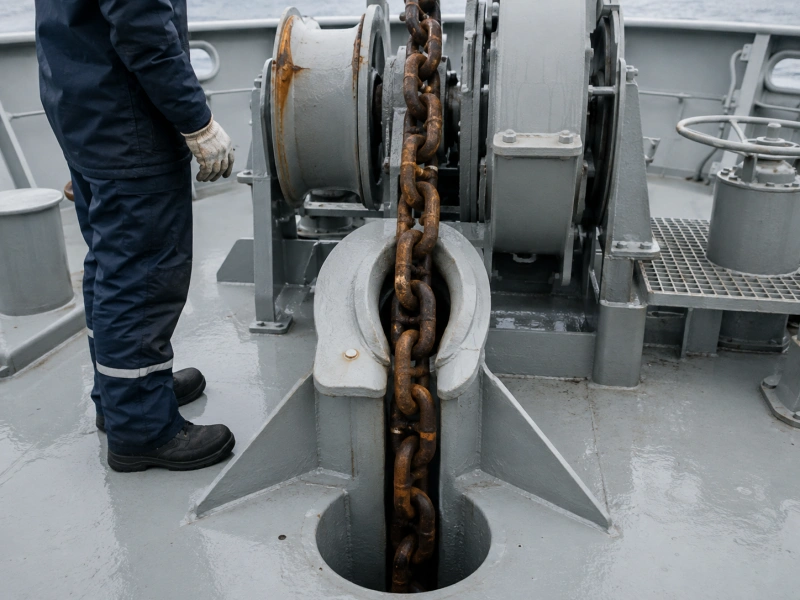
Importance of Reading Anchor Chain Leading
Clear communication about the anchor chain leading helps the forecastle and bridge teams understand how the cable is behaving. A prompt report can warn the bridge about a change in direction, a cable coming tight, unusual movement, or a developing operational problem.
Your report is an observation, not an independent command or a final diagnosis. If the leading or cable behaviour changes unexpectedly, report it immediately and follow the Master’s orders, the vessel’s SMS, and the established anchoring procedure.
How to Read Anchor Chain Leading Step by Step
Step 1: Observe the Cable From the Hawsepipe
Take the designated safe forecastle position and watch where the cable leaves the hawsepipe. Keep clear of the cable, windlass, wildcat, stoppers, bights and snap-back or pinch zones. Do not place yourself over or in line with a loaded cable.
Use the vessel’s bow as the reference. You are reporting the direction of the lead relative to the ship, not a geographic compass bearing.
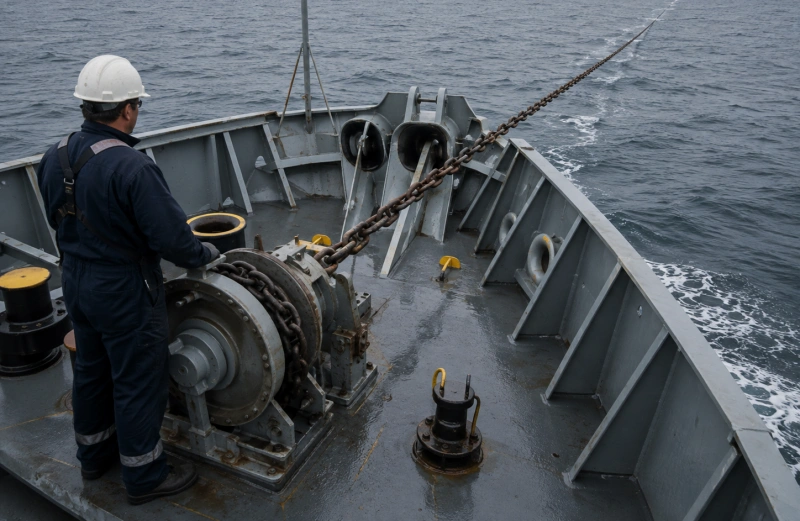
Step 2: Report the Leading Direction
IMO Standard Marine Communication Phrases use the following answers to “How is the cable leading?”
- The cable is leading ahead / astern.
- The cable is leading to port / to starboard.
- The cable is leading round the bow.
- The cable is leading up and down.
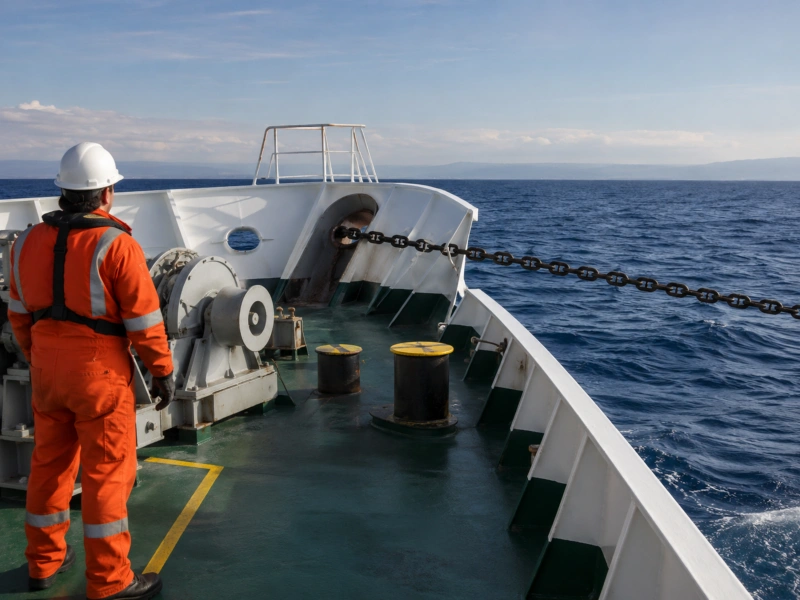
Report the side first when needed—for example, “Starboard cable leading to port” or “Port cable leading ahead.” Follow the vessel’s approved phrasing if it differs.
Step 3: Report Cable Growing or Condition
Answer “How is the cable growing?” separately. The IMO SMCP terms are “The cable is slack,” “The cable is tight,” and “The cable is coming tight.” These describe condition or change in loading; they are not directions and should not be used as stay categories.
Step 4: Add the Stay Description When Required
Some vessels use short stay, medium stay, and long stay as practical forecastle descriptions. Add the stay after the lead and condition only if it is part of the vessel’s procedure. Do not invent fixed degree ranges; the terms are visual seamanship descriptions, not universal angle standards.
Step 5: Report the Amount of Cable Out Separately
Report the deployed cable in shackles as required by the bridge: for example, “Four shackles in the water.” If you need the calculation method, use how to calculate how many shackles to drop anchor.
A shackle is also a unit of anchor-cable length. See how long a shackle of anchor chain is for the unit explanation. Do not repeat scope rules in a leading report unless the bridge asks for them.
Step 6: Give a Clear Bridge Report
Keep the report short, ordered, and unambiguous: cable side → lead → growing/condition → stay if used → shackles out. Repeat or confirm the report when requested. If visibility, noise, spray, darkness, or equipment position prevents a reliable observation, say that the condition cannot be confirmed instead of guessing.
Short Stay vs Medium Stay vs Long Stay
| Stay | Practical visual meaning | Important boundary |
| Up and down | Cable is nearly vertical beneath the hawsepipe. It is commonly reported while weighing anchor as the ship approaches the anchor position. | Interpret it with the current operation; it is not automatically a holding result. |
| Short stay | Cable is taut but leads relatively steeply downward, closer to vertical than a long stay. | It does not mean low risk or prove secure holding. |
| Medium stay | Cable has a visible lead between short and long stay. | There is no universal fixed angle; follow vessel practice. |
| Long stay | Cable is taut and extends toward the water at a flatter, more nearly horizontal lead. | Do not define it as “maximum tension”; report changes promptly. |
The same cable may move between these descriptions as the vessel, tide, wind, seabed interaction, or windlass operation changes. Report what you observe; do not convert the stay into an unsupported load estimate.
Points on the Bow vs Clock-Face Reporting
“Points on the bow” describes the cable’s direction relative to the vessel. In traditional compass-point language, one point equals 11.25 degrees, so a report such as “two points on the starboard bow” is not the same as saying north-east. North, east, south, and west are geographic directions and should not replace relative shipboard leading terms unless the vessel’s procedure specifically requires a bearing.
Some vessels or training programs may use a clock-face reference as a local visual aid, with the bow at 12 o’clock. This is not the IMO SMCP reporting backbone. For standardized bridge–forecastle communication, use the vessel’s approved procedure and IMO SMCP terminology first.
How to Report Anchor Chain Leading to the Bridge?
Use examples only as models; the bridge may require a different order or wording.
| Observed condition | Example report |
| Cable leads forward and is loading | “Starboard cable leading ahead, coming tight.” |
| Cable leads aft with a moderate stay | “Port cable leading astern, medium stay.” |
| Cable is nearly vertical while heaving | “Starboard cable up and down.” |
| Cable crosses around the bow | “Port cable leading round the bow.” |
| Amount deployed must be included | “Starboard cable leading to starboard, tight, long stay, five shackles in the water.” |
What Anchor Chain Leading Does Not Tell You?
A taut, steady, or consistently angled cable does not by itself prove that the anchor is holding. A dragging anchor can also keep the cable highly loaded. The bridge or anchor watch must evaluate vessel position using the ship’s approved methods, which may include visual bearings, radar, GNSS/GPS, electronic alarms, traffic and environmental conditions.
The forecastle team should report changes in lead, cable growing, vibration, surging, snatching, unusual noise, or equipment behaviour. The bridge determines whether the vessel is brought up or the anchor is holding according to the operational picture and vessel procedure.
What Should You Do If the Anchor May Be Dragging?
Report the suspected dragging or abnormal cable behaviour to the bridge or Master immediately. Continue monitoring the vessel position and cable only from a safe location. Do not independently order more cable, start the engine, operate the windlass, or redeploy the anchor unless you are authorized and instructed under the vessel’s anchoring procedure.
The correct response depends on the anchorage, traffic, weather, seabed, equipment condition, bridge-team plan, and the vessel’s SMS. This article is not a shipboard emergency checklist.
Common Anchor Chain Leading Reporting Mistakes
- Using north, east, south, or west as the default replacement for ahead, astern, port, or starboard.
- Calling slack, tight, or coming tight a stay or direction.
- Treating short, medium, and long stay as fixed angles or load values.
- Assuming that a taut cable proves the anchor is holding.
- Reporting a clock position as though it were an IMO standard phrase.
- Mixing the amount of cable out with scope calculations or chain markings.
- Guessing when the cable cannot be seen clearly or communication is uncertain.
Manufacturer Note: Chain Specification vs Operational Reporting
Anchor-chain diameter, grade, stud or studless construction, joining arrangement, proof load, breaking load, and unit weight are equipment or purchasing specifications. Leading, growing, stay, holding, and shackles-out reports are operational communication terms. Changing the chain grade does not change the standard language used to describe its direction. Powerful Machinery supplies anchor chains in stud-link and studless configurations; confirm the vessel, class, grade, diameter, certificate and component requirements before ordering.
For specification research, use the separate anchor chain grades guide. For deployed-length recognition, use the anchor chain marking guide. Those pages own grade and marking detail so it is not duplicated here.
Conclusion
You can read anchor chain leading accurately by separating five observations: direction, cable growing, stay, amount out, and holding confirmation. Start at the hawsepipe, use relative IMO SMCP terms, add the vessel’s approved stay description, report the number of shackles separately, and let the bridge or anchor watch confirm holding from position data.
Clear, consistent reporting matters more than adding extra terminology. If the observation is uncertain, report the limitation and follow the vessel’s SMS and the Master’s instructions.
FAQ
What does “anchor cable leading” mean?
It means the direction in which the anchor cable leaves the hawsepipe relative to the vessel. Standard answers include ahead, astern, to port, to starboard, round the bow, and up and down.
What does “up and down” mean for an anchor cable?
It means the cable is leading nearly vertically below the hawsepipe. It is often heard while weighing anchor as the vessel approaches the anchor, but its meaning must be read with the current operation.
What is the difference between short stay and long stay?
A short stay leads steeply downward and is closer to vertical. A long stay is taut and extends toward the water at a flatter angle. Neither term provides a universal tension value or proves that the anchor is holding.
What does “cable coming tight” mean?
It describes the cable’s condition changing from slack toward tight. It belongs to cable growing or condition, not to the direction of leading.
Should I report anchor chain direction by clock position?
Only if the vessel’s procedure uses it as a local aid. For standardized communication, prioritize the approved shipboard procedure and IMO SMCP terms.
Does a tight anchor chain mean the anchor is holding?
No. A tight cable can occur while the anchor is holding or dragging. Holding must be confirmed by the bridge or anchor watch using position monitoring and the vessel’s procedure.