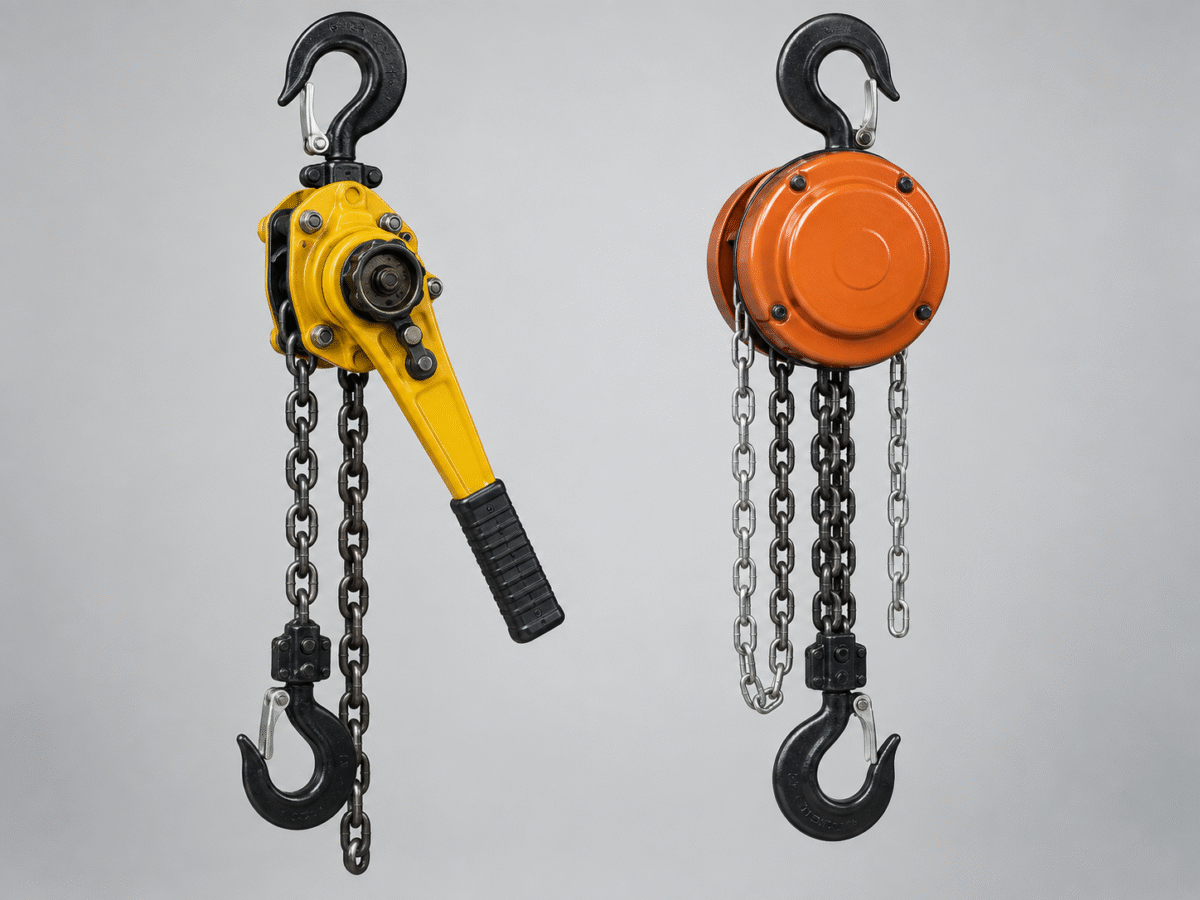
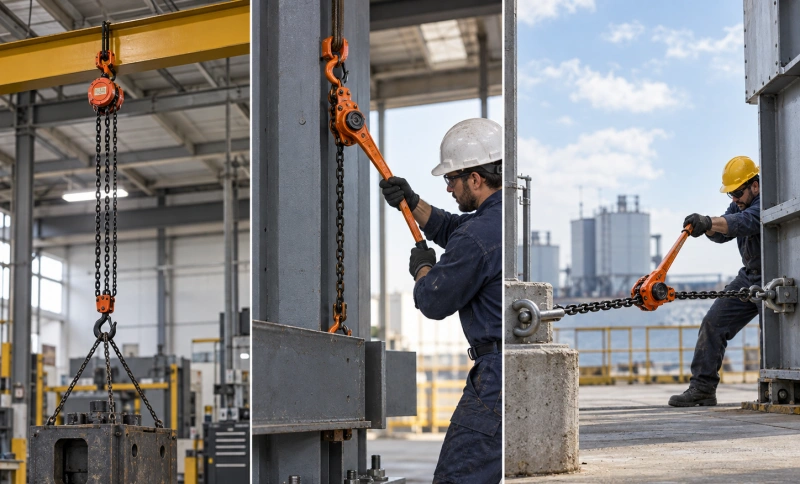
Lever hoists and chain blocks are both manually operated chain hoists, but their operating methods suit different tasks. A chain block uses a separate hand chain and is normally suspended from a rated overhead support to lift a freely suspended load vertically.
A lever hoist uses a ratcheting handle and may be selected for short lifts, pulling, tensioning, or close positioning when the manufacturer permits the intended application.
Choose according to the actual job requirements rather than a general claim that one type is stronger or safer. Load path, movement direction, rated capacity, travel, headroom, operator position, handle clearance, operating effort, duty, environment, and technical documentation all affect the selection.
The Short Answer
- Start with a chain block for controlled vertical lifting below a properly rated overhead support, especially when a separate hand chain gives the operator a practical working position.
- Start with a lever hoist for short, incremental movement, pulling, tensioning, or alignment work when the exact model is approved for the intended load path, and the operator has enough clearance to stroke the handle safely.
- Do not assume one type has greater capacity, less headroom, lower operating effort, or lower cost. Compare approved data for the specific models under consideration.
Does Chain Hoist Mean Chain Block?
The term chain hoist can confuse. A chain block, hand chain hoist, and manual chain hoist usually describe the same hand-operated device in this context. Chain hoist is a broader term and may also refer to an electric or pneumatic unit.
This guide compares a lever hoist with a manual chain block. If the alternative uses a motor, review an electric hoist for repeated lifting instead of treating it as a hand chain block.
Lever Hoist vs Chain Block: Key Differences
| Decision Factor | Chain Block | Lever Hoist |
| Primary task | Raise, hold, and lower a freely suspended load vertically | Lift, pull, tension, or position when the model permits the intended application |
| Operator input | Continuous pull on a separate hand chain | Repeated strokes of an integrated ratcheting handle |
| Normal load path | Vertical below a rated suspension point | Model-approved vertical, horizontal, or angled work may be possible; maintain in-line loading and follow the model instructions |
| Operator position | Hand-chain drop may allow the operator to work below and away from the hoist body | Operator must remain close enough to move the handle through a safe arc |
| Travel | Often practical for longer vertical lifts | Often practical for short, incremental movement; long travel requires repeated handle strokes |
| Headroom and clearance | Check hook-to-hook headroom and hand-chain access | Check hook-to-hook headroom, body clearance, and handle-swing space |
| Operating effort | Compare rated-load hand-chain pull | Compare rated-load lever pull and handle length |
| Rated capacity | Model-specific; use the nameplate and approved data sheet | Model-specific; use the nameplate and approved data sheet |
| Portability | Portable designs exist, but the hand chain adds bulk | Often convenient for field positioning; verify actual weight, dimensions, and reach |
| Price | Compare like-for-like capacity, lift, documents, options, and delivery terms | Compare like-for-like capacity, reach, documents, options, and delivery terms |
The table describes normal selection patterns. It does not authorize a particular orientation or application. Keep the load path aligned through the suspension hook, hoist body, load chain, and load hook, and do not side-load the hoist body or hooks.
How Does Each Manual Hoist Move the Load?
Chain Block Operation
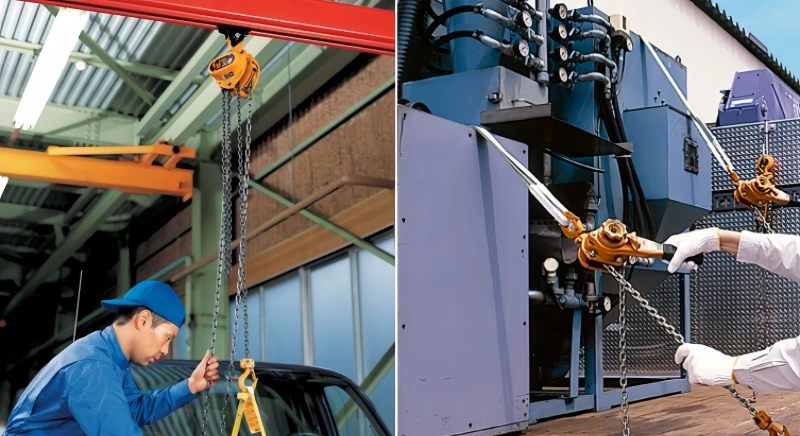
Pulling the hand chain rotates the hand wheel and internal gear train. The geared load sheave advances the calibrated load chain and moves the bottom hook. The load brake controls and supports the suspended load when hand-chain movement stops or reverses.
See what a chain block is and how it works for a parts and working-principle overview.
Lever Hoist Operation
Stroking the handle drives a ratchet-and-gear mechanism that advances the load chain in small increments. A direction selector changes between lifting and lowering, and the brake controls the load between strokes. Free-chaining or unloaded-chain adjustment, where fitted, is subject to model-specific instructions and restrictions.
Read what a lever hoist is and how it works for a more detailed explanation of the mechanism.
Which Manual Hoist Fits the Job?
| Job Condition | Better Starting Point | Verify Before Selection |
| Repeated vertical lifting below a fixed overhead point | Chain block | Capacity, support, suspension, lift, hand-chain drop, headroom, and duty |
| Short, controlled positioning during installation or maintenance | Lever hoist | Reach, headroom, lever pull, handle clearance, and in-line loading |
| Pulling or tensioning | Lever hoist if approved | Permitted task and orientation, anchor points, hook seating, in-line load path, and instructions |
| Long vertical travel | Chain block | Lift, hand-chain length, operating time, fatigue, and whether powered operation is preferable |
| Very restricted space | Compare actual dimensions | Minimum headroom, body clearance, operator position, and handle-swing area |
| Frequent production lifting | Assess a powered hoist | Duty class, lifting speed, controls, power supply, environment, and cycle frequency |
How to Compare Actual Models?
Collect the following information before requesting a quotation or approving a hoist for the job:
- Maximum suspended load, including below-the-hook attachments and rigging. Never exceed the rated capacity.
- Movement direction and task: vertical lifting, pulling, tensioning, or positioning.
- Required lift for a chain block or required reach for a lever hoist.
- Available headroom, hook openings, suspension method, operator position, and handle clearance.
- Published hand-chain pull or lever pull at the required rated load.
- Operating frequency, expected duration, and whether manual operation would be too slow or physically demanding.
- Temperature, moisture, dust, corrosion exposure, cleanliness requirements, hazardous-area restrictions, and indoor or outdoor use.
- Destination market, required standard or declaration, instructions, test records, spare parts, and service support.
Manual hoists do not have one fixed operating speed. Travel per hand-chain pull or lever stroke, gearing, load, and operator pace all affect movement rate. Compare published model data instead of describing either product type as universally faster.
Safety and Inspection Boundaries
A general comparison cannot replace the model-specific manual, the lifting plan, or inspection by a competent person. Before use, confirm that identification and rated-capacity markings are legible; suspension and load connections are secure; hooks, latches, chain, housing, and controls show no disqualifying damage; the chain is correctly seated and free from twists; and the hoist operates and holds as required by the manufacturer and site procedure.
Remove the hoist from service if there is cracking, deformation, excessive wear, a damaged, elongated, or twisted chain, brake slippage, irregular travel, unusual noise, missing or illegible identification, or any condition outside the applicable acceptance criteria.
Do not improvise repairs, extend a lever handle, replace the load chain with general-purpose chain, stand beneath a suspended load, or leave a load unattended unless an approved procedure and the equipment instructions specifically allow it.
For lever hoist troubleshooting, servicing, and routine upkeep, see our lever hoist repair and maintenance guide.
Use the lever hoist inspection checklist or chain block inspection checklist for equipment-specific inspection planning. Once the correct hoist has been selected and the required pre-use checks are complete, follow our manual hoist step-by-step guide for practical guidance on rigging, lifting, and lowering.
Standards and Documentation
Applicable requirements depend on the market, installation, product design, and employer or site rules. ASME B30.21 addresses ratchet-and-pawl and friction-brake lever hoists used for lifting, pulling, and tensioning. ASME B30.16 addresses overhead underhung hoists. BS EN 13157 includes both hand chain blocks and lever hoists within its stated scope.
A standards reference does not prove that every product complies. Confirm the exact edition, product marking, declaration, test documentation, instructions, and destination-market requirements for the quoted model. A quality-management-system certificate does not replace product-specific compliance evidence.
Choose a Powerful Machinery Manual Hoist
Review the Powerful Machinery lever hoist range and manual chain block range. For a broader category view, compare manual hoists by operating method.
Send the maximum load, movement direction, lift or reach, available headroom, suspension or anchor details, operating frequency, environment, destination country, quantity, and required documents. Include a drawing or photographs when access or clearance is restricted.
FAQ
What Is the Main Difference Between a Lever Hoist and a Chain Block?
A chain block uses a separate hand chain and is normally selected for vertical lifting below a rated overhead suspension point. A lever hoist uses a ratcheting handle and is often selected for short lifting, pulling, tensioning, or positioning tasks when the model instructions permit the application.
Are a Chain Block and a Hand Chain Hoist the Same?
Yes. In normal lifting-equipment terminology, they usually describe the same hand-operated hoist. The term chain hoist is broader and may also describe electric or pneumatic equipment.
Can a Lever Hoist Be Used Horizontally?
Some lever hoists are designed for pulling or positioning in horizontal or angled applications. Confirm the intended use in the exact model instructions, keep the force in line through the hooks and hoist, and do not side-load the hoist body or hooks.
Does a Chain Block Always Lift More Than a Lever Hoist?
No. Rated capacity is model-specific. Compare products rated for the complete suspended load and suitable for the required movement, travel, headroom, duty, and environment.
Which Hoist Is Better When Headroom Is Limited?
The answer depends on the actual dimensions. A compact lever hoist may have a short hook-to-hook distance, but the handle still needs room to swing. A chain block may allow the operator to work farther below the suspension point. Compare minimum headroom and operating clearance for the exact models.
What Information Is Needed for a Quotation?
Provide the maximum load, movement direction, lift or reach, headroom, suspension or anchor method, operator position, use frequency, environment, destination, quantity, and required documents.