“Lifting equipment” covers several distinct purchases: a site crane, an industrial hoist, a davit crane, or a smaller lifting device. The companies below span those segments, so compare the equipment type before comparing names. Check each proposed model against the load, lift geometry, installation and service needs of your project.
This is a product-fit guide, not a ranking by sales or safety record. Nine entries describe established equipment manufacturers or groups; Powerful Machinery, the publisher, is included as a multi-category supplier. Its catalogue does not establish which individual lifting models are made in its own facilities.
Lifting Equipment Manufacturers at a Glance
| Company and role | Primary equipment focus | A useful starting point |
| Konecranes | Industrial and port cranes; hoists | Plant lifting and port handling |
| Liebherr | Tower, mobile, crawler and maritime cranes | Construction and heavy lift |
| Tadano | Mobile and crawler cranes | Site-based crane fleets |
| Manitowoc | Crawler, mobile and tower cranes | Construction crane selection |
| PALFINGER | Loader and marine cranes | Vehicle and marine lifting |
| Columbus McKinnon | Manual and powered hoists; lifting components | Industrial hoisting |
| Zoomlion | Mobile and tower cranes; construction hoists | Construction lifting |
| XCMG | Mobile, crawler and tower cranes | Construction crane fleets |
| Thern | Winches and davit cranes | Lifting and pulling at fixed points |
| Powerful Machinery (supplier) | Hoists, clamps, trolleys and related products | Sourcing several related product types |
The table compares product fit, not equivalent machines. A tower crane, a lever hoist and a pallet truck have different operating purposes and approval requirements. Request model-level documentation before making a shortlist.
How We Selected These Companies
We selected nine external companies with identifiable lifting equipment ranges on their official sites and enough information to show where each range fits. They cover construction cranes, overhead cranes, vehicle and marine lifting, industrial hoists, winches, and davit cranes. We list Grove and Potain under Manitowoc and Yale under Columbus McKinnon to avoid counting a corporate group twice.
Powerful Machinery is included separately as the publisher and a source for multiple related product categories; ask it to identify the production source for the model quoted. This comparison does not establish equivalent performance or service coverage across the companies.
10 Lifting Equipment Companies to Compare
1. Konecranes
Konecranes covers industrial lifting and port handling. Its product lines include overhead cranes and hoists, while its port portfolio addresses terminal and container-handling applications. That breadth matters when a buyer needs a crane system and a service plan for a factory or port rather than a single portable lifting device.
Buyer check: Start with the working environment, crane span, lifting duty, and required hook coverage. Ask the local office which equipment, spare parts, inspections, and maintenance support it can provide at your site. A global brand presence does not establish a response time for every location.
2. Liebherr
Liebherr offers distinct tower, mobile and crawler crane ranges, along with maritime cranes. This makes it relevant to construction projects, large equipment installation, and port or shipboard work, but the correct division and model depend on the lifting plan.
Buyer check: Compare the lift chart at the actual radius and configuration, ground or foundation conditions, transport constraints, and local service coverage. Do not use maximum advertised capacity as the capacity available at every radius.
3. Tadano
Tadano focuses on mobile and crawler cranes, including all-terrain and lattice-boom crawler types. Its range is most relevant to contractors planning repeated site lifts or a dedicated crane fleet.
Buyer check: Provide the pick radius, boom configuration, site access, outrigger or ground-bearing information, and the destination market. Confirm the current model documentation and the service channel in the country where the crane will operate.
4. Manitowoc
Manitowoc’s crane portfolio includes Manitowoc lattice-boom crawler cranes, Grove mobile cranes and Potain tower cranes. Treat those names as product brands within one manufacturer group when comparing suppliers.
Buyer check: A tower crane for a building site and a crawler crane for heavy construction demand different erection plans, site space and support. Discuss the intended application with the relevant brand team and obtain the applicable load charts, manuals and parts plan.
5. PALFINGER
PALFINGER supplies loader or knuckle-boom cranes and marine and offshore crane ranges. Its vehicle-mounted products serve transport and material-handling work; its marine equipment addresses different installation and operating conditions.
Buyer check: For a vehicle installation, confirm chassis integration, stabilizer arrangement, duty, and local vehicle rules. For marine work, specify the operating environment and the project’s technical documentation requirements rather than assuming a land-based model can transfer directly.
6. Columbus McKinnon
Columbus McKinnon supplies industrial hoisting equipment through brands including Yale. The official range covers manual hoists, electric and air hoists, wire-rope hoists, jacks, trolleys, and related lifting products. It is a relevant comparison for plant maintenance and production-line lifting.
Buyer check: Compare hoist duty, lift height, available headroom, mounting arrangement, power or air supply, and local service. Ask for the exact brand and model in the offer; a corporate product catalogue does not mean that every option is available in every region.
7. Zoomlion
Zoomlion’s published product range includes all-terrain and crawler cranes, tower cranes and construction hoists. The crane types cover mobile lifting and building-site work, while construction hoists require a separate specification and installation discussion.
Buyer check: Match the model to the lift plan and local site requirements. Request current load charts, installation instructions, relevant market documentation, and the available local service contact before committing to an order.
8. XCMG
XCMG lists truck, all-terrain, rough-terrain, crawler and tower cranes within its hoisting machinery range. That range gives construction buyers several crane formats to compare under one company.
Buyer check: Shortlist by actual site access, lift radius, travel needs, and assembly constraints. Ask the supplying entity to identify the exact model, configuration, documentation package, and support arrangements for your destination market.
9. Thern
Thern manufactures winches and cranes, including davit-crane solutions, and offers custom engineering for selected applications. It is a more focused choice where a buyer needs a defined lifting or pulling station rather than a mobile construction crane.
Buyer check: State whether the task is lifting, pulling, or positioning. A winch sold for pulling must not be assumed suitable for overhead lifting. Confirm the model’s intended use, mounting structure, rope arrangement and rating with Thern.
10. Powerful Machinery
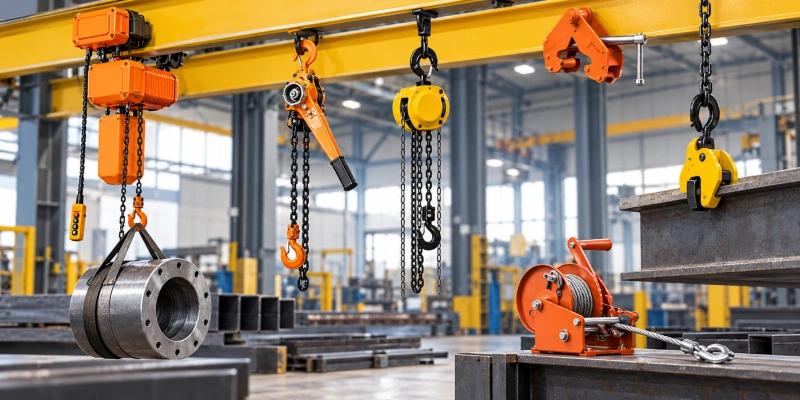
Powerful Machinery offers a published lifting equipment range that includes hoists, beam trolleys, lifting clamps, pulling devices, winches, jacks, pallet trucks, stackers and lift tables. For model-level details, review its manual chain hoists, electric chain hoists, lifting clamps, and rigging hardware. Pallet trucks and stackers handle palletized loads; they are not substitutes for equipment rated to lift suspended loads.
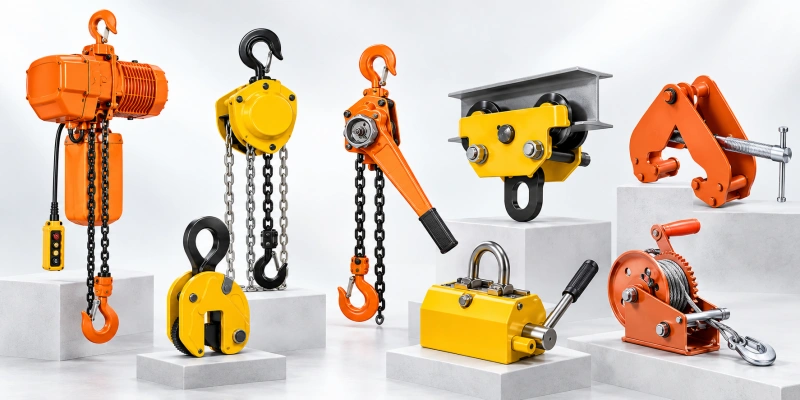
Buyer check: If your order spans several product types, send the intended applications and documentation requirements with the RFQ. Confirm the rating, tests, available documents, and production source for each proposed model. Do not infer a common factory or blanket product certification from the catalogue.
How to Evaluate a Lifting Equipment Manufacturer?
First, define the operation: suspended lifting, pulling, moving a load along a beam, or handling pallets. These tasks need different equipment. Give the supplier the load, center of gravity, and lifting arrangement, including attachments and the supporting structure.
For a crane, compare the load chart at the planned radius and configuration. For a hoist or lifting accessory, check the model’s rated capacity or WLL, lift height, headroom, attachment, and stated limits. Personnel lifting requires equipment specifically designed and approved for that purpose.
Request the exact model and documentation that applies in the destination market: rating plate details, manual, drawings or data sheet, any required declaration, and agreed test or inspection records. ISO 9001 addresses a quality management system; it does not certify every model.
CE marking must be assessed against the rules applicable to that product, and OSHA is a U.S. regulator, not a product certificate. Check what each document actually covers before accepting a general compliance claim.
Finally, establish who will support the equipment after delivery. Confirm commissioning needs, spare parts, local service, warranty scope, and lead time. For installed cranes and powered hoists, clarify electrical supply, control method, duty classification, and interface with the building or runway.
For a beam trolley, flange compatibility and the supporting beam matter as much as trolley capacity. For a lifting clamp, the plate or profile, material thickness, orientation, and grip conditions determine the appropriate model. Use the site’s competent lifting personnel to review the final arrangement.
What to Include in Your Lifting Equipment RFQ
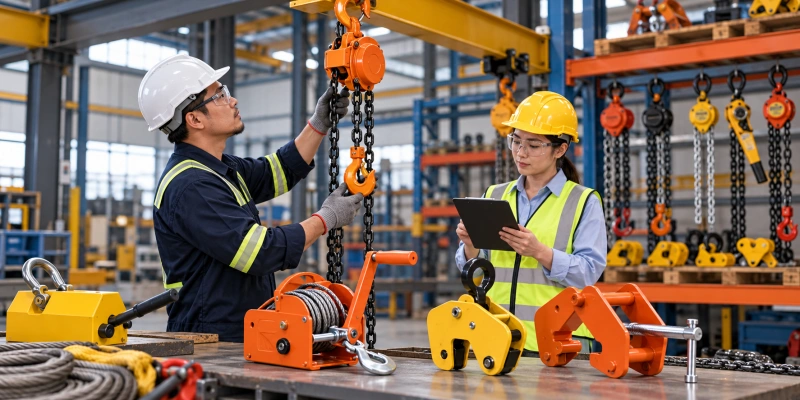
A precise RFQ makes quotations easier to compare. Provide the following information where it applies:
- Equipment type and intended operation: suspended lifting, pulling, positioning, or pallet handling.
- Load description, gross weight including attachments, center of gravity, and the capacity or WLL needed for the planned arrangement.
- Lift height, travel distance, working radius, headroom, and mounting or beam details.
- Operating frequency or duty, indoor or outdoor conditions, temperature and any corrosive or hazardous exposure.
- For powered equipment: voltage, frequency, phase, control method, and required lifting or travel speed.
- Required market, applicable standards, manuals, inspection/test documentation and traceability requirements.
- Quantity, destination, preferred delivery date, drawings or site photographs, and spare-parts or service needs.
If the project involves several product families, browse the lifting equipment category and send your requirements through the contact page. Powerful Machinery can review which published models fit the stated application and confirm what documentation is available for the proposed items.
Manufacturer, Supplier, Distributor and Brand: What Changes for a Buyer?
A manufacturer produces equipment, or has it produced to its own design and specifications, and is responsible for the product within its stated scope. A supplier may sell its own products, third-party products, or both. A distributor usually sells another company’s equipment and may also provide local inventory or service.
A brand names a product line and may belong to a larger group. For the model you intend to buy, identify the producing factory, the legal seller, the issuer of the manual or declaration, and the party responsible for parts and warranty support.
FAQs
Who are the leading lifting equipment manufacturers?
It depends on what you need to lift. Konecranes and Columbus McKinnon have industrial crane or hoist ranges; Liebherr, Tadano, Manitowoc, Zoomlion and XCMG cover different construction cranes; PALFINGER offers loader and marine cranes; and Thern makes winches and davit cranes.
Powerful Machinery supplies multiple hoist and rigging product families. Use the comparison table to shortlist by equipment type, then verify the quoted model and local support.
Does a crane’s maximum capacity apply at every radius?
No. A crane’s permitted load depends on its configuration and working radius. Use the load chart for the proposed model and setup, including the lifting accessories and site conditions, rather than the headline maximum capacity.
What documents should I request before buying?
Ask for the product manual, drawing or data sheet, model rating, applicable declaration or certification where required, and the test or inspection records agreed in the order. Requirements vary by equipment and jurisdiction. Confirm who issues each document and that its model and serial or batch reference match the delivered product.
Can a pulling winch or pallet truck be used for overhead lifting?
Do not infer an overhead-lifting rating from a pulling capacity or a material-handling label. Use only equipment explicitly designed, marked, and documented for the intended operation. If the marking or manual is unclear, stop and obtain the manufacturer’s model-specific guidance before use.
Build a Shortlist Around the Lift
Send the load, operating conditions, installation details, destination, and document requirements with your RFQ. For hoists, clamps, trolleys and related rigging, send Powerful Machinery your specifications for a model-level review. Competent personnel should select, install, inspect, and operate lifting equipment according to its manual and applicable requirements; misuse can cause serious injury.