A manual hoist inspection should answer one practical question before lifting begins: Is this specific hoist in a condition that permits use in accordance with the manufacturer’s instructions, site procedures, and the requirements that apply where it is operated? This guide covers hand chain hoists, often called chain blocks, and lever hoists.
It does not cover electric, pneumatic, or wire rope hoists. If you are comparing equipment types before purchase, see our manual hoist range.
An inspection does not authorize repair. If you find damage, missing identification, abnormal operation, or a condition you cannot evaluate, remove the hoist from service, identify it clearly to prevent unintended use, and refer it to the person responsible for technical assessment. Never open the hoist, adjust the brake, or substitute parts based on a general web checklist.
Know Which Manual Hoist You Are Inspecting
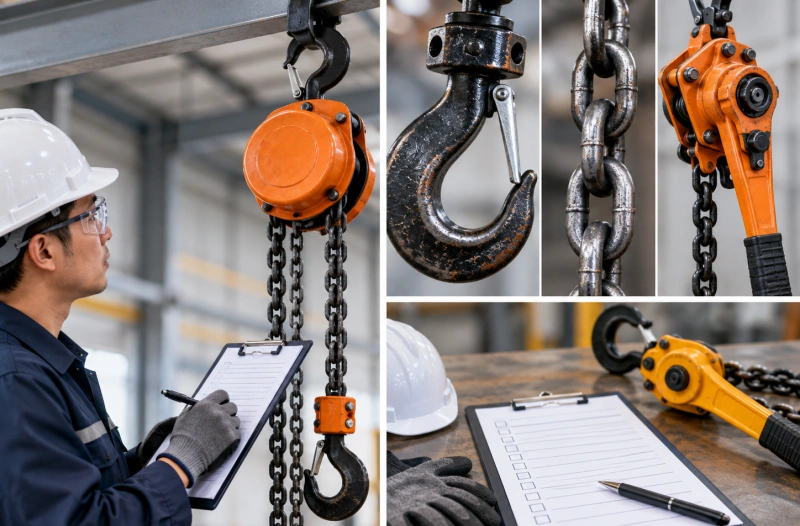
Start by identifying the hoist type, model, serial or asset number, rated capacity, and applicable manufacturer’s instructions. A hand chain hoist is operated by pulling a hand chain to raise or lower the load chain. A lever hoist uses a handle and direction selector and may include a free-chain function. The two types share some inspection points, but their controls and mechanisms differ.
For component-level checks, use the dedicated chain block inspection checklist or lever hoist inspection checklist. This broad guide explains the inspection decisions common to both types.
Set the Inspection Scope and Frequency
The required inspection is not the same in every situation. An operator’s pre-use check looks for obvious damage and abnormal operation. A more detailed inspection may require measurements, written records, or access to components that an operator should not open. Additional inspection may also be required after long-term storage, an incident, suspected overloading, unusual service, alteration, or repair.
Determine the inspection interval and responsible person based on the manufacturer’s instructions for the exact hoist, service severity, operating environment, equipment history, site risk assessment, and applicable regulations or standards.
Shorten the interval when service is heavy or conditions are corrosive, abrasive, wet, hot, or otherwise severe. Do not copy a monthly or annual interval from another model and treat it as universally applicable.
Prepare for a Safe Inspection
- Ensure no load is suspended from the hoist and establish a controlled inspection area before beginning the visual check.
- Confirm that the suspension point and hoist can be accessed without placing the inspector beneath a suspended load or within pinch-point zones.
- Obtain the manufacturer’s manual, previous inspection record, and any site-specific acceptance criteria for the exact unit.
- Clean only enough loose surface contamination to expose the components for inspection. Do not use any cleaning method or chemical that the manufacturer has not approved.
Check Identification and Rated Capacity
Verify that the model or asset identity and rated capacity are legible and correspond to the inspection record. Read all operating instructions and warning markings. If the unit cannot be positively identified, its rated capacity is unknown, or a required warning marking is missing, do not infer the rating from the hoist size or chain diameter. Isolate the unit until the responsible person confirms the correct identification and disposition.
Inspect the Suspension, Body, Hooks, and Latches
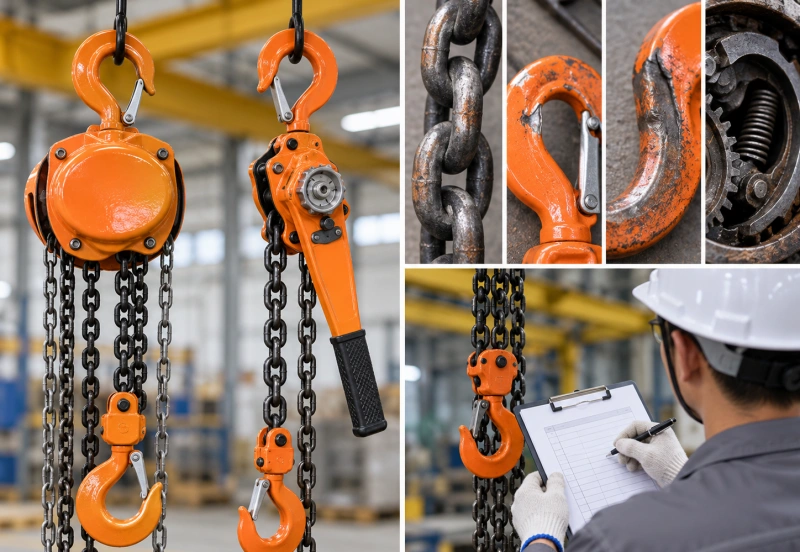
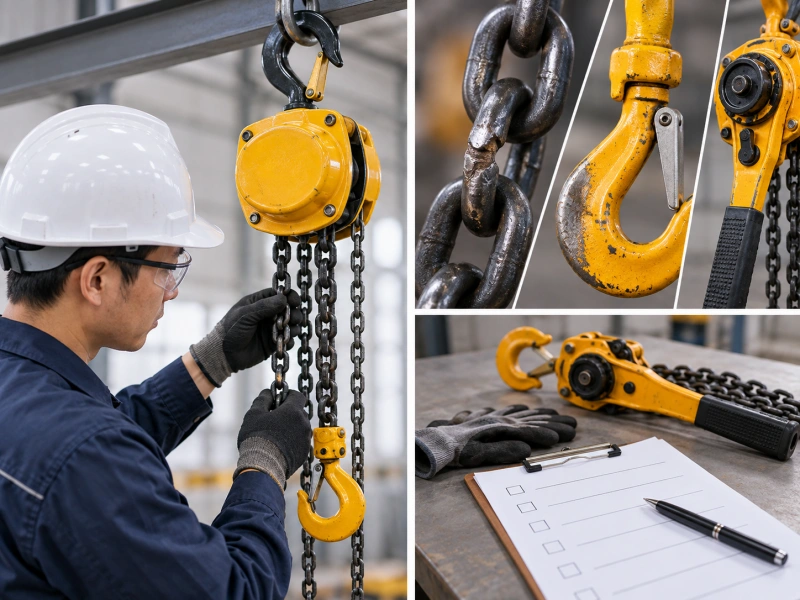
Inspect the top suspension, body, covers, fasteners, hook blocks, and load hook. Remove the unit from service and escalate it for assessment if you find cracks, obvious deformation, severe corrosion, heat damage, missing or loose structural fasteners, an insecure suspension, or evidence that the body has been opened or modified without authorization.
Check each hook for cracks, twist, excessive throat opening, wear, or other deformation, and confirm that any latch moves freely and closes as designed. A latch is not a substitute for proper load seating.
Use the manufacturer’s limits and approved measuring method when a dimension must be checked. The chain block components guide can help users identify external components, but the exact manufacturer’s instructions govern acceptance and discard decisions.
Inspect the Load Chain and Attachments
Examine the accessible load chain through its working length. Look for twists, kinks, gouges, nicks, corrosion, heat damage, links showing visible elongation or deformation, weld damage, interlink wear, contamination that prevents inspection, and incorrect reeving.
Check the chain end attachment and lower block. Do not straighten, weld, grind, or locally replace a load-bearing chain link. If measurement is required, measure the specified number of links using the prescribed method and compare the result with the limit given for that model.
Check the Operating System for the Hoist Type
On a hand chain hoist, inspect the hand chain for damage, tangles, and correct seating, then confirm that it moves without binding. On a lever hoist, inspect the handle, direction selector, retaining hardware, and any free-chain control. A selector that does not engage positively, an unintended free-chain condition, a bent handle, or an improvised handle extension is a reason to remove the hoist from service for assessment.
For operating steps once the hoist has passed inspection, see our manual hoist use guide.
Perform Only the Permitted Functional Check
With the hoist correctly suspended and unloaded, operate it through sufficient travel to confirm smooth chain movement, correct control response, and no abnormal noise, catching, or binding. Follow the manufacturer’s procedure for any brake or holding check.
If a controlled-load check is required, it must be planned and performed by authorized personnel in accordance with the applicable instructions. Do not derive a test load, test percentage, or return-to-service procedure from a general article.
Stop-Use Conditions
Remove the hoist from service when any of the following is found or suspected:
- Missing or unreadable rated-capacity or identification information required to control the unit.
- Cracked, twisted, excessively opened, severely worn, or otherwise deformed hooks; a latch that does not function as designed.
- Twisted, kinked, gouged, corroded, heat-damaged, visibly elongated, incorrectly reeved, or otherwise damaged load chain.
- An insecure suspension, cracked or deformed body, missing structural fastener, unauthorized modification, or evidence of impact or overloading.
- Slipping, load drift, binding, jamming, abnormal noise, inconsistent control response, or a lever selector that does not engage correctly.
- Any condition the inspector cannot compare with an applicable limit or manufacturer’s instruction.
Tag or otherwise identify the unit to prevent unintended use. Record the finding and route the hoist to a qualified person, the manufacturer, or an authorized repair provider. Cleaning, lubrication, and preventive care belong in the applicable maintenance process; component repair and replacement belong in a controlled repair process.
For hand chain hoists, see the chain block maintenance guide and chain block repair guidance. Lever hoist repair questions should be routed through the lever chain hoist repair page and the exact model documentation.
Record the Inspection and Disposition
Use a record that links each finding to one identifiable hoist. At minimum, record the inspection date, location, model, serial or asset number, rated capacity, hoist type, service conditions, inspection scope, items checked, measurements where required, defects found, photographs where useful, the inspector’s identity, the disposition, and any work-order or quarantine reference. Record who authorized return to service after corrective action.
A simple pass/fail mark is not enough when a condition requires monitoring. Describe the defect location, what was observed, and the acceptance criterion or source used. This makes subsequent inspections comparable and helps prevent a repair record from becoming separated from the affected unit.
Inspection Sequence at a Glance
| Stage | Question | Action If Uncertain or Failed |
| 1 — Identify | Can the exact hoist and rated capacity be confirmed? | Isolate; do not infer capacity. |
| 2 — Scope | Are the correct manufacturer’s instructions, authorized role, and inspection level available? | Pause and obtain the controlling procedure. |
| 3 — Visual | Are the suspension, body, hooks, chain, and controls free of disqualifying conditions? | Remove from service and record the finding. |
| 4 — Functional | Does the permitted check show smooth, correct operation? | Stop; do not continue cycling the hoist to diagnose it. |
| 5 — Decide | Does every item meet the applicable acceptance criteria? | Quarantine and escalate. |
| 6 — Record | Can the decision be traced to the unit, inspector, and disposition? | Complete the record before release. |
Standards and Regional Requirements
The applicable framework depends on the product and the country of use. In the United States, ASME B30.16 includes provisions for hand chain-operated overhead hoists, while ASME B30.21 applies to specified lever hoists. In European markets, BS EN 13157 addresses hazards, safety measures, verification, and information for use for several hand-powered lifting products.
These references do not replace national law, employer duties, or the manufacturer’s instructions for the exact model.
FAQ
How Often Should a Manual Hoist Be Inspected?
Check the exact manufacturer’s instructions and the requirements that apply at the place of use. The interval should reflect service severity, environment, history, and risk. A pre-use check and a documented detailed inspection are different activities, and one fixed calendar interval is not appropriate for every hoist.
Can an Operator Repair a Defect Found During Inspection?
Finding a defect does not authorize repair. The operator should stop use, isolate the hoist, and report the condition. Repair, testing, and return to service must follow the manufacturer’s procedure and the site’s authorization rules.
Can a Manual Hoist Be Used If the Capacity Marking Is Unreadable?
Do not guess the rated capacity. Isolate the unit until the responsible person can establish its identity and restore the required marking under the applicable procedure.
Should a Hoist Be Load Tested During Every Inspection?
No universal rule requires a generic load test during every inspection. Testing requirements depend on the hoist, its condition and history, any repair or alteration, the manufacturer’s instructions, and applicable requirements. Only authorized personnel should perform a required test under a controlled procedure.
What Should Happen After a Manual Hoist Fails Inspection?
Remove it from service, prevent unintended use, record the defect, and route it for qualified assessment. Return it to service only after the required corrective action, examination, and testing have been completed and authorized.
Need help identifying a manual hoist or locating the correct product documentation? Contact Powerful Machinery with the model, serial number, rated capacity, photographs, and a description of the operating environment.