
Manual Beam Trolleys for Hoist Travel
Powerful Machinery supplies manual beam trolleys for moving suspended hoists along a compatible beam. The current range includes VP and AP plain push trolleys, plus VG and AG hand-geared trolleys. Catalogue capacities run from 0.5 to 10 metric tons for the plain series and from 1 to 10 metric tons for the geared series, depending on the model.
A trolley provides horizontal travel; it does not lift the load. Model selection must account for the complete suspended weight, beam geometry, available headroom, travel method, operating environment, and the connection between the trolley and hoist.
Compare Manual Trolley Types
| Selection point | Plain push trolley | Hand-geared trolley |
|---|---|---|
| Travel method | The operator pushes or pulls the suspended assembly. | The operator pulls a hand chain connected to the trolley drive. |
| Typical use | Short, clear travel paths where direct movement can be controlled from a safe position. | Applications requiring more deliberate positioning or where direct pushing is impractical. |
| Catalogue series | VP and AP | VG and AG |
| Published capacity range | 0.5–10 t, depending on model | 1–10 t, depending on model |
| Additional selection input | Push access and travel-path clearance | Required hand-chain drop and operating access |
Review the VP and AP plain trolley series when simple push travel suits the job. For hand-chain travel, compare the VG and AG geared trolley series. The detailed product pages should contain the current model drawings and model-level specifications.
Manual Trolley Series Overview
The ranges below summarize the current catalogue. They help narrow the product family, but they do not approve a model for a specific beam. Individual values vary by model.
| Series | Travel type | Capacity range (t) | Catalogue W range (mm) | Catalogue H range (mm) | Minimum revolving radius range | Net weight range (kg) | Detailed page |
|---|---|---|---|---|---|---|---|
| VP | Plain push | 0.5–10 | 75–175 | 100–450 | 900 mm to not specified | 5.5–43 | Plain trolley specifications |
| AP | Plain push | 0.5–10 | 75–175 | 100–450 | 900 mm to not specified | 7.8–87 | Plain trolley specifications |
| VG | Hand geared | 1–10 | 75–175 | 125–450 | 1300 mm to not specified | 8.5–45 | Geared trolley specifications |
| AG | Hand geared | 1–10 | 75–175 | 125–450 | 1300 mm to not specified | 15–89 | Geared trolley specifications |
Catalogue note: W and H are drawing labels. Do not treat them as a complete beam-approval rule without the dimensional key and the latest controlled drawing.
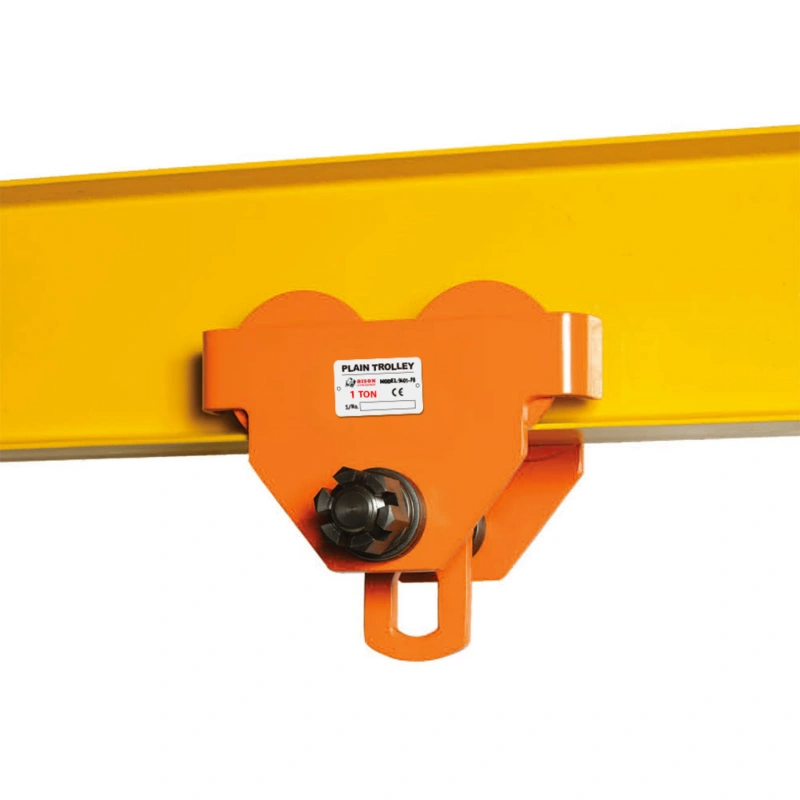
Plain Push Trolleys
A plain trolley is moved by pushing or pulling the suspended load. It is usually considered where travel distances are short, the route is unobstructed and the operator can control the movement from a safe position. Review our manual plain trolley range when a simple travel mechanism suits the application.
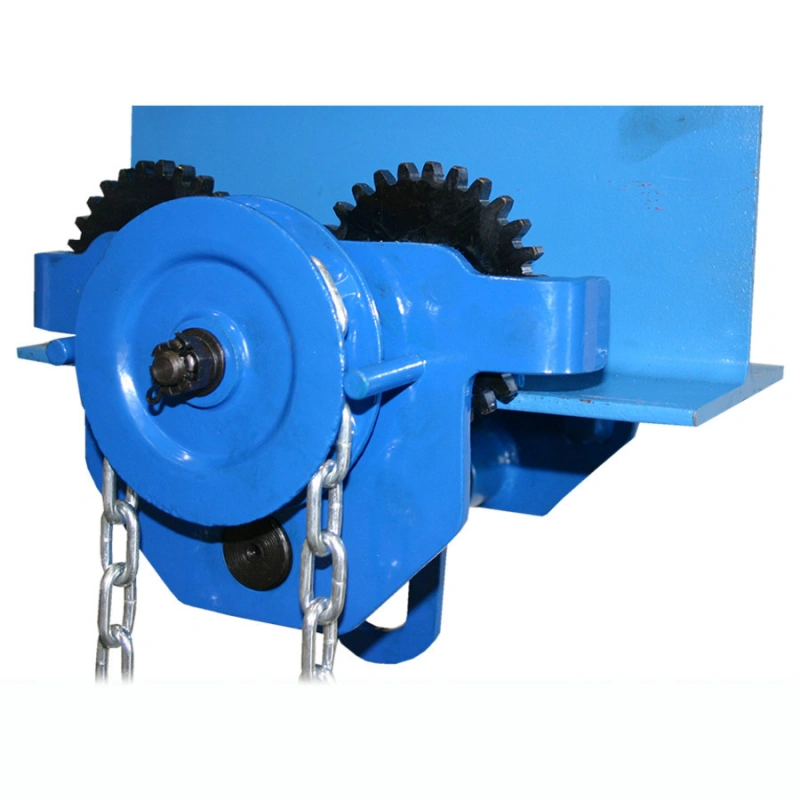
Hand-Geared Trolleys
A geared trolley uses a hand chain to turn the trolley wheels. This can provide more deliberate positioning when the load is heavy, the beam is higher or direct pushing is impractical. See the manual geared trolley range for geared-travel configurations.
How to Select a Manual Beam Trolley
1. Calculate the total suspended load
Include the lifted item, below-the-hook rigging, hook block, hoist, and any other component carried by the trolley. Do not select the trolley from the lifted load alone.
2. Provide a dimensioned beam drawing
Beam flange width alone is not enough. Confirm the beam profile, flange width and thickness, flange-face shape, track alignment, end stops and any curve. Wheel profile, side clearance, and the trolley adjustment arrangement must match the proposed beam.
3. Choose the travel method
Use push travel only where the operator can control the suspended assembly along a short, unobstructed route. Choose geared travel where a hand-chain drive provides a more suitable operating position or degree of control. For a focused decision guide, read the plain trolley vs geared trolley comparison.
4. Confirm the hoist connection and headroom
Capacity alone does not establish compatibility. Send the hoist model, suspension type and connection dimensions. Powerful Machinery supplies chain blocks and lever hoists, but the exact trolley-and-hoist combination still requires written confirmation.
5. Define the operating environment
State whether the trolley will operate indoors or outdoors and identify dust, moisture, corrosion, unusual temperatures, or other site conditions. Finish, materials, lubrication and inspection requirements must be agreed for the actual application.
How to Evaluate a Manual Trolley Manufacturer?
Compare suppliers using evidence tied to the quoted model. A long product list or a general standards statement does not prove that a trolley fits the beam or that the required documents will be supplied.
| Evaluation area | What to request | Why it matters |
|---|---|---|
| Product scope | Clear distinction between plain and geared families, current model list and controlled specifications | Prevents selection from obsolete or duplicate product pages |
| Beam fit | Approved drawing, adjustment method, wheel/profile information and written dimensional review | Capacity and flange width alone do not prove compatibility |
| Load and test evidence | Rated capacity identification and any required inspection or test record for the quoted model | Keeps technical claims tied to the supplied trolley |
| Traceability | Nameplate sample, model/batch identification and document list | Supports purchasing and incoming inspection |
| OEM changes | Written confirmation of branding, colour, packaging and any technical change | Separates cosmetic requests from engineering changes |
| Delivery and support | Quoted lead time, packaging plan, spare-parts scope and responsible contact | Replaces general delivery promises with order-specific commitments |
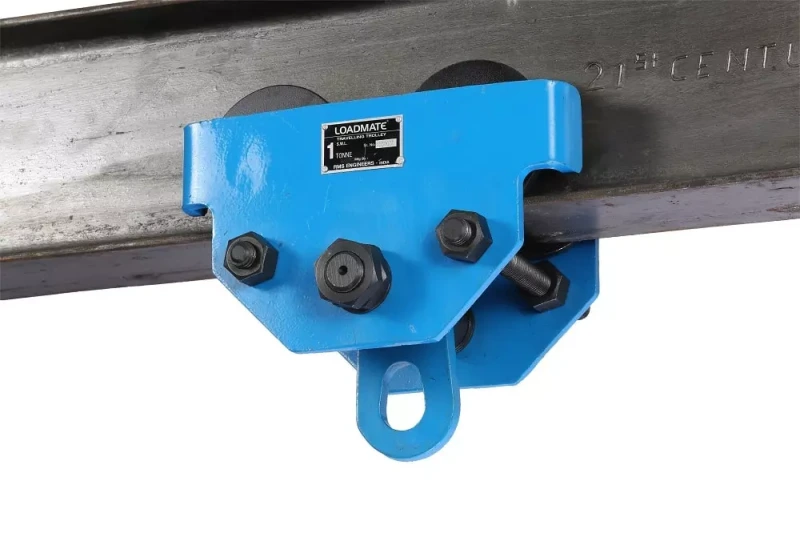
Manual Trolley Model Families
The current Powerful Machinery catalogue lists four manual trolley series: VP and AP plain trolleys, plus VG and AG geared trolleys. Published catalogue capacities span 0.5 to 10 metric tons for the plain series and 1 to 10 metric tons for the geared series, depending on the model. The series are not interchangeable: beam fit, dimensions, turning radius and net weight vary by model.
Use the model table on this page as a first comparison only. Final selection must be checked against the latest approved drawing and quotation. In particular, confirm the beam flange width and thickness, wheel profile, adjustment arrangement, minimum curve radius where applicable, and the connection between trolley and hoist.
| Model | Series | Travel | Capacity (t) | Beam W Min (mm) | Beam W Max (mm) | Beam H Min (mm) | Beam H Max (mm) | Min. Radius (mm) | Net Weight (kg) |
|---|---|---|---|---|---|---|---|---|---|
| VP005 | VP | Plain | 0.5 | 75 | 125 | 100 | 150 | 900 | 5.5 |
| VP010 | VP | Plain | 1 | 75 | 125 | 125 | 250 | 1300 | 7.5 |
| VP020 | VP | Plain | 2 | 100 | 150 | 150 | 400 | 1500 | 11.2 |
| VP030 | VP | Plain | 3 | 100 | 150 | 180 | 400 | 2000 | 17 |
| VP050 | VP | Plain | 5 | 125 | 175 | 250 | 450 | 2600 | 30.5 |
| VP100 | VP | Plain | 10 | 150 | 175 | 250 | 450 | ∞ | 43 |
| VG010 | VG | Geared | 1 | 75 | 125 | 125 | 250 | 1300 | 8.5 |
| VG020 | VG | Geared | 2 | 100 | 150 | 150 | 400 | 1500 | 12.2 |
| VG030 | VG | Geared | 3 | 100 | 150 | 180 | 400 | 2000 | 18 |
| VG050 | VG | Geared | 5 | 125 | 175 | 250 | 450 | 2600 | 31.5 |
| VG100 | VG | Geared | 10 | 150 | 175 | 250 | 450 | ∞ | 45 |
| AP005 | AP | Plain | 0.5 | 75 | 125 | 100 | 150 | 900 | 7.8 |
| AP010 | AP | Plain | 1 | 75 | 125 | 125 | 250 | 1300 | 14 |
| AP020 | AP | Plain | 2 | 100 | 150 | 150 | 400 | 1500 | 22 |
| AP030 | AP | Plain | 3 | 100 | 150 | 180 | 400 | 2000 | 35 |
| AP050 | AP | Plain | 5 | 125 | 175 | 250 | 450 | 2600 | 47 |
| AP100 | AP | Plain | 10 | 150 | 175 | 250 | 450 | ∞ | 87 |
| AG Series — Codes Pending Confirmation | AG | Geared | 1–10 | 75 | 175 | 125 | 450 | 900–∞ | 15–89 |
Information Needed to Confirm Beam Fit
Beam width alone is not enough to approve a trolley. Provide the following information with your enquiry:
- Beam profile or section designation
- Flange width and flange thickness
- Tapered or parallel flange face
- Straight beam or curved track, including curve radius
- Total suspended load
- Hoist type and connection dimensions
- Required travel distance and frequency of use
- Available headroom and surrounding clearances
- Indoor, outdoor, corrosive, dusty or high-temperature conditions
If the beam section is uncertain, send a dimensioned drawing or clear photographs. Our team can compare the information with the selected model, but approval should be based on documented dimensions rather than visual similarity.
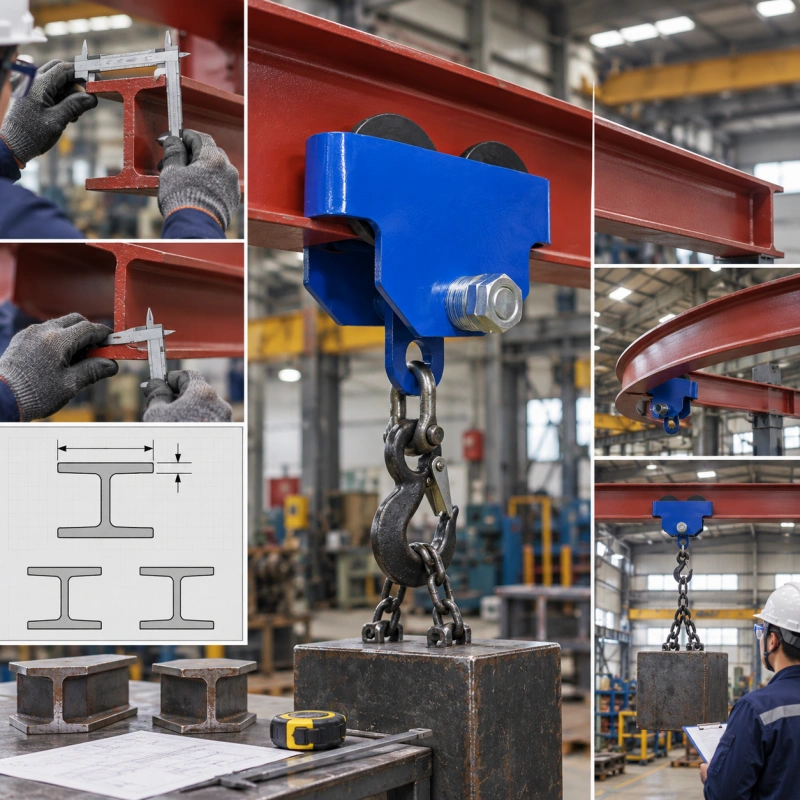
What to Verify Before Ordering
Every quotation should identify the selected model and the technical basis for selection. Check these points before issuing a purchase order:
- Rated capacity and model code
- Compatible beam range and any spacer arrangement
- Trolley type: plain push or hand geared
- Hand-chain drop for geared models
- Hoist suspension connection
- Overall and clearance dimensions
- Finish, marking and nameplate requirements
- Quantity, packaging and shipping marks
- Required drawings, inspection records or other documents
Do not rely on a generic statement such as “fits standard beams.” Beam sections differ by market and project. Written dimensional confirmation reduces installation delays and helps keep the trolley within its intended operating conditions.

OEM and Project Supply
For distributors, equipment builders and project buyers, Powerful Machinery can review repeat-order and OEM requirements alongside the technical specification. State the branding, colour, nameplate, packaging, documentation and batch-identification requirements at the enquiry stage. Availability and minimum quantities depend on the model and requested changes.
For mixed lifting-equipment orders, include the related lifting equipment list so compatible items can be reviewed together. Custom branding or packaging does not change the need for model-level technical approval.
Quality Evidence for Purchase Review
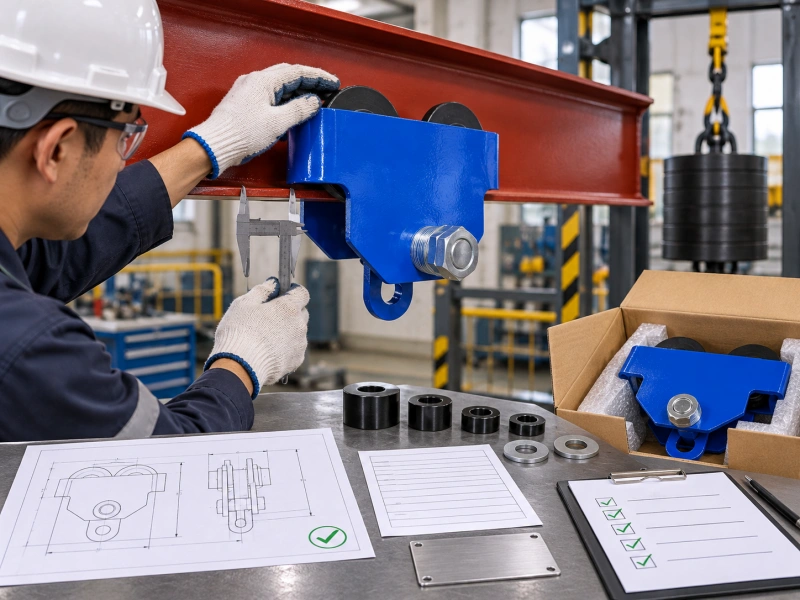
Ask for evidence that relates to the trolley being quoted, rather than relying on general factory language. Useful review items may include an approved drawing, model-specific specification, nameplate sample, dimensional inspection record, load-test documentation where applicable, and photographs of the actual product and packaging. The exact document package must be agreed before order confirmation.
Incoming inspection should verify model identification, visible condition, wheel movement, adjustment components, and the supplied documents. Installation and pre-use checks must follow the approved instructions and the requirements that apply at the place of use.
Information to Include in Your RFQ
- Total suspended load, including the hoist and rigging
- Required trolley type: plain push or hand geared
- Beam profile and dimensioned drawing
- Straight or curved travel path and the required radius
- Hoist model, suspension type and connection dimensions
- Available headroom, surrounding clearance and travel distance
- Operating frequency and site environment
- Required hand-chain drop for a geared trolley
- Quantity, finish, branding, nameplate, packaging and shipping marks
- Required drawings, inspection records, test documents or other purchase documentation
State which requirements are mandatory. Availability, minimum order quantity and document scope depend on the selected model and requested changes.
Installation and Pre-Use Review
The supporting beam must be suitable for the imposed loads, and the trolley must be adjusted and installed to the approved instructions. Check wheel seating, operating clearances, adjustment parts, locking devices, suspension connection, end stops and the full travel path before service.
Do not use a trolley with unidentified capacity, damaged wheels or side plates, loose or missing parts, abnormal tracking, or a beam outside the approved range. If the application changes after selection, obtain a new review. The beam trolley installation guide provides an overview; the controlled instructions for the selected model remain authoritative.
If the application requires powered horizontal travel instead of a manual trolley, review an electric hoist with trolley as a separate system category.
Manual Trolley FAQ
What is a manual trolley?
A manual trolley carries a suspended hoist along a beam without an electric travel motor. A plain trolley moves by push or pull force. A geared trolley uses a hand chain to drive trolley travel.
Does a manual trolley lift the load?
No. The trolley provides horizontal travel. The attached hoist performs the lifting.
Can I choose a trolley by tonnage alone?
No. Rated capacity, total suspended load, beam geometry, wheel/profile fit, clearances, curve radius, hoist connection and operating conditions must all be reviewed.
Can a manual trolley run on a curved beam?
Only when the selected model and complete track arrangement are approved for the proposed radius. Where the catalogue does not specify a minimum radius, do not assume curved-track suitability.
What documents should I request from a trolley supplier?
Start with the approved drawing, model-specific specification, nameplate or identification details and the agreed inspection or test records. The exact package must be confirmed in the quotation and purchase order.
Are all manual trolleys compatible with all chain or lever hoists?
No. The suspension connection, capacity, headroom, and dimensions must match the exact combination. Confirm the trolley and hoist together before ordering.
Request a Manual Trolley Quotation
Send the total suspended load, beam drawing, travel method, hoist connection, headroom, environment, quantity, and document requirements. Powerful Machinery will use the information to identify the appropriate product family and the model details that still require confirmation.