When a buyer asks for certified lifting shackles, the term “certified” needs a defined scope. It may refer to conformity with a specified product standard, a manufacturer declaration, a test record, material traceability documentation, or independent inspection. These are different forms of evidence. A shackle marking alone does not identify which documents were issued for that item or batch.
Start with the lifting application and required specification. Then compare the shackle’s markings, exact model data, and document package with the purchase order. If you are still choosing between body and pin designs, use the separate types of shackles guide. This article focuses on verifying what is being supplied rather than repeating that selection guide.
What Does “Certified Lifting Shackle” Mean?
There is no single universal certificate that makes every shackle suitable for every lift or destination. State the product specification and standard edition required for the job, together with the proof, inspection, or traceability records the buyer must receive. The supplier should then confirm that the exact shackle model and order can meet that scope.
A quality management system certificate describes a manufacturer’s management system. It does not establish the working load limit (WLL) or conformity of each shackle. A test report applies to the test and sample or unit identified in that report; it is not proof that every shackle in a shipment was individually tested unless that scope is stated.
A certificate of conformity should identify the relevant product and declared specification.
Standards and workplace rules serve different purposes. ASME B30.26 addresses detachable rigging hardware used in load handling, including shackles. OSHA rules govern covered workplaces; OSHA does not issue a general “OSHA-certified shackle” designation.
For U.S. construction work, 29 CFR 1926.251 requires the manufacturer-prescribed WLL to be indicated by permanently affixed and legible identification markings and prohibits use above rated capacity. Requirements elsewhere depend on the application and jurisdiction.
Read the Markings Before Reading the Certificate
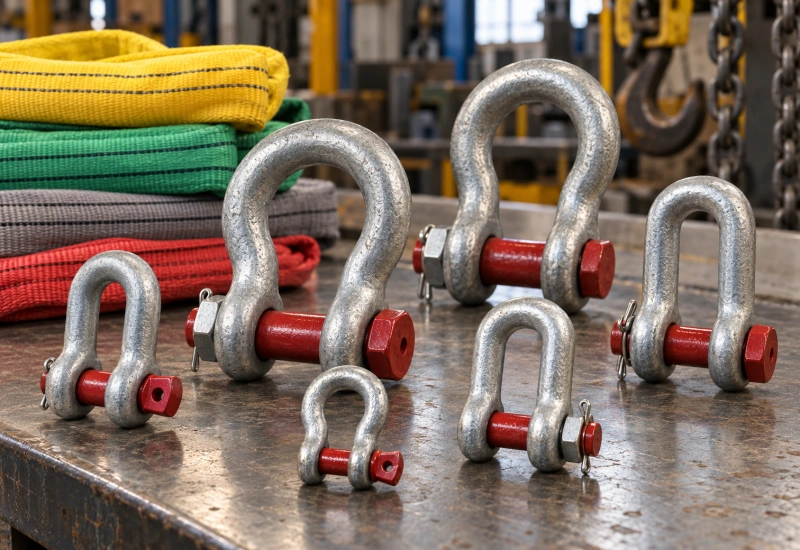
Check that the physical item has legible identification and a WLL that matches the product data. Confirm the manufacturer or brand identification, size or model designation, and any other markings required by the applicable product specification. The exact marking set varies; do not treat a color, finish, or familiar body shape as proof of a rating or standard.
Compare the body and pin with the supplied drawing or specification. A replacement pin from another product can turn an apparently familiar shackle into an unverified assembly. If the body or pin marking is unclear, the supplier should resolve the product identity before the item is approved for use. The shackle inspection checklist covers physical condition and removal-from-service criteria in more detail.
Match Documents to the Exact Product and Order
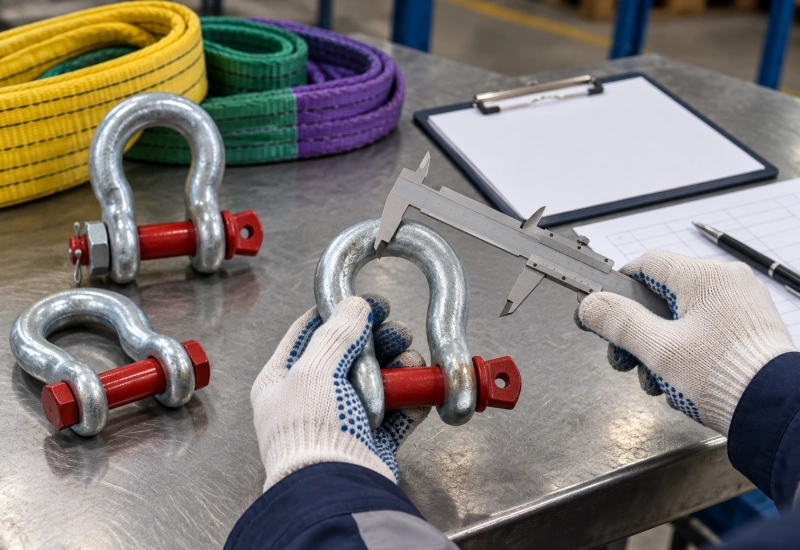
A useful document package can link the purchase order, product designation, size, WLL, production lot or other traceability reference, and inspection or test result. Requirements depend on the shackle, destination, and contract. Request the documents before ordering, especially if a customer or project inspector will review them before release.
| Document or Evidence | What to Verify |
| Product data or drawing | Exact model, body/pin design, dimensions, WLL, material and finish; applicable conditions and restrictions. |
| Declaration or certificate of conformity | Product and order identification, cited specification and edition, issuer, scope, and date. |
| Material record | Material identity, heat or batch reference, and correspondence with delivered parts. |
| Proof-load or other test report | Test method, load or acceptance criterion, sample or unit identification, results, and test scope. |
| Third-party inspection record, if required | Inspector, agreed hold points, scope, sampling, findings, and release identification. |
Not every order requires every document in this table. A statement that a “certificate is available” is incomplete unless you know which certificate, for which product, and under which order conditions. Confirm whether testing is by design type, production sample, batch, or individual unit. If individual-unit testing is required, state it explicitly in the RFQ and agree on the record format.
Product Standards Need a Model-Level Check
A standard title is a starting point, not a blanket claim for an entire catalog. For example, EN 13889 describes forged Grade 6 Dee and bow shackles for general lifting within its defined scope, including threaded pins. It should not be assigned automatically to a different model, material, rating range, or pin arrangement. Ask the supplier to identify the actual standard, edition, and product scope claimed for the offered shackle.
The same care applies to ASME B30.26: referencing a rigging hardware standard is not the same as holding a product certificate for a particular shipment. Ask which provisions and documents are relevant to the intended application, and have any claimed conformity checked against the exact shackle. Avoid broad statements such as “meets all international standards.”
Verify WLL and Service Conditions
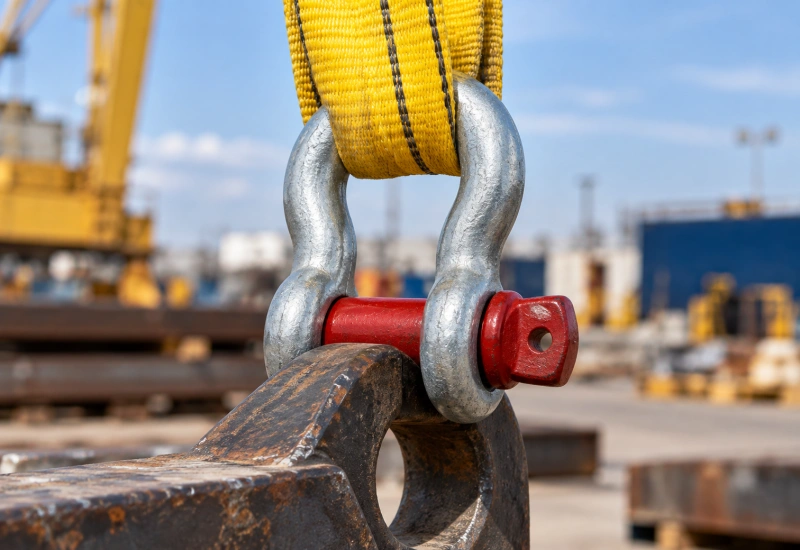
The marked WLL and product instructions should support the actual load path. Confirm body and pin fit, intended loading direction, connection clearance, and mating sling or lug dimensions. Side loading or other non-axial arrangements must be permitted by the exact design and rated appropriately by its manufacturer; do not transfer an angle-reduction factor from another brand or model.
For marine, corrosive, elevated-temperature, or other demanding service, request the material and finish specification for the selected model and any relevant environmental limits. Stainless steel or galvanizing can address corrosion exposure, but neither alone establishes a lifting rating or service approval.
The Powerful Machinery shackles range provides starting options for a quotation; confirm current model data and documents before approval.
A Buyer Verification Sequence
- Write the application: required WLL, load direction, service environment, mating components, and destination market.
- Name the product: body and pin type, size, model or drawing, finish, and quantity.
- State the basis: required product standard or customer specification, including the edition where relevant.
- List the documents: declaration, material and test records, traceability records, and third-party inspection only where required.
- Before release, compare the markings and supplied documents with the approved order and the physical items. Resolve any mismatch with the supplier.
For physical dimensions, the guide to measuring a shackle can help you define what the supplier needs to confirm. If you require a custom drawing or marking program, include it at the start of the RFQ so the proposed design, rating, and validation scope can be reviewed.
FAQs
Does a WLL Stamp Mean the Shackle Is Certified?
A legible WLL is important identification, but it is not the complete documentation package. Verify the marked item against its product data and request the declaration, test, or traceability records specified by your project.
Does Every Shackle Need an Individual Proof-Test Certificate?
The answer depends on the applicable product specification and purchase requirements. Do not assume that each unit was proof-tested based on a general statement about testing. Define whether you require type, sample, batch, or individual-unit testing and specify what record must identify the units covered.
Is an ISO 9001 Certificate Enough to Approve a Lifting Shackle?
No. ISO 9001 concerns the organization’s quality management system. You still need the correct product designation, WLL, markings, and any product-specific evidence required by the application and purchase order.
Can I Specify EN 13889 for Every Shackle Design?
No. Its scope is defined. Check the exact design and current edition before citing it in the purchase specification; another design may require a different basis for assessment.
What Should I Include in a Certified Shackle RFQ?
State the WLL, model or drawing, size, body and pin type, material and finish, intended loading, destination, applicable standard and edition, marking, traceability, and required test or inspection documents. Include quantity and delivery details so the supplier can confirm what can be supplied with the order.
Request Product and Documentation Confirmation
Send Powerful Machinery the lifting application and document package your customer requires. The team can review available lifting and rigging shackles and confirm the exact model, rating, markings, and records offered in the quotation. Request written confirmation of any testing or third-party inspection requirement before production.