You rely on rigging hooks every time you move heavy loads in industrial environments. These essential components form the backbone of safe and efficient rigging operations.
Many types of hooks exist, including clevis, swivel, sling, eye, grab, sorting, J-hooks, barrel, specialty, slip, self-closing, self-locking, automatic, and foundry hooks.
Choosing the correct rigging hook means matching the hook to the load, sling or chain assembly, upper connection, working load limit (WLL), and the way the load will move during the lift. Powerful Machinery supplies forged lifting hooks for chain slings, wire-rope assemblies, hoists, and material-handling systems, including Grade 80 and Grade 100 configurations for OEM, wholesale, and project requirements.
Key Takeaways
Select the right rigging hook for your specific lifting task to enhance safety and efficiency.
Regularly inspect your rigging hooks for wear and damage to prevent accidents and ensure compliance.
Understand the different types of rigging hooks and their applications to improve load handling.
- Check the model-specific WLL, chain size or sling connection, grade, throat opening, and manufacturer instructions before use. A hook that physically fits is not automatically compatible.
- Do not assume every swivel hook can rotate under load. Positioning swivels and bearing swivels serve different purposes.
- A safety latch helps retain a slack sling or connection in the hook; it is not a load-bearing component and does not increase WLL.
Rigging Hooks for Material Handling: Overview
What Are Rigging Hooks?
You use rigging hooks for material handling every time you need to lift, move, or secure heavy objects. These hooks serve as the connection point between your lifting equipment and the load. You find them in many industries, including construction, manufacturing, and transportation.
Rigging hooks for material handling come in different shapes and sizes, each designed for a specific task. Some hooks attach directly to chains or slings, while others feature locking mechanisms for added safety.
When you choose rigging hooks for material handling, you gain several important benefits:
You secure heavy loads with confidence.
You maintain safety during every stage of material handling.
You match the right hook to the right job, improving efficiency and reducing risk.
You rely on these hooks to keep your lifting operations smooth and safe. Their design and construction help you handle even the toughest jobs with ease.
Depending on the design, a rigging hook may be part of chain sling assemblies, wire-rope slings, synthetic slings, hoists, or crane systems. For lifting service, use the manufacturer’s marked or documented WLL and load the hook in its intended bearing area, normally the bowl or saddle.
Why Are They Critical in Lifting Operations?
Rigging hooks for material handling play a vital role in lifting operations. You depend on them to connect your lifting gear to the load securely. Without the right hook, you risk accidents, dropped loads, or equipment failure. Modern rigging hooks for material handling offer advanced features that boost safety and reliability.
The hook is also one of the points where compatibility matters most. The upper connection, throat opening, retention method, chain or sling interface, and WLL all need to work as one rated system.
You benefit from these advancements in several ways:
You enhance safety for your team and your workplace.
You increase efficiency by reducing downtime and streamlining handling.
You improve reliability, knowing your equipment meets strict safety standards.
You support compliance with industry regulations and best practices.
Tip: Always select certified rigging hooks for material handling to ensure your lifting operations meet safety requirements and deliver consistent performance.
Types of Rigging Hooks for Material Handling
When you handle heavy loads, you need to understand the different types of rigging hooks available. Each type offers unique features and advantages for specific rigging tasks.
Powerful Machinery provides a full range of high-strength hooks, including the Eye Grab Hook H323/A323, Clevis Slip Hook H331/A331, and Clevis Grab Hook H330/A330. These hooks are engineered for durability, safety, and compatibility with Grade 80 and Grade 100 chains and slings.
A useful way to compare rigging hook types is to separate the upper connection from the hook’s function. Eye, clevis, and swivel describe how the hook connects at the top; grab, slip/sling, self-locking, sorting, and foundry describe how the hook engages or retains the load.
Eye Hooks

Eye hooks feature a closed loop, or “eye,” at the top. This design allows you to create permanent or semi-permanent connections with chains, wire ropes, or slings. You often use eye hooks in fixed lifting applications where you need a secure attachment point.
Closed eye provides a strong, stable connection.
Ideal for use with slings and chain assemblies.
Reduces the risk of accidental disengagement during lifting.
Powerful Machinery’s Eye Grab Hook H323/A323 delivers exceptional strength and reliability. The forged steel construction and corrosion-resistant finish ensure long service life, even in harsh environments.
Note: Eye hooks are best when you need a fixed connection that will not rotate or shift during lifting.
The eye normally connects through a compatible coupling link, shackle, wire-rope termination, or other approved connector rather than directly around an alloy chain link. Check the eye dimensions, connector fit, and hook WLL as one assembly. See Powerful Machinery’s lifting eye hooks for a product-specific example.
Clevis Hooks
Clevis hooks have a U-shaped attachment point secured with a pin. This design lets you quickly connect and disconnect the hook from chains or slings. You find clevis hooks in many rigging and lifting applications, especially where you need flexibility.
Easy to attach and remove from chain links.
Commonly used in chain sling assemblies and load securement.
The Clevis Grab Hook H330/A330 and Clevis Slip Hook H331/A331 from Powerful Machinery offer secure locking mechanisms and high strength. You can trust these hooks for demanding lifting hook applications.
For a direct chain connection, chain diameter, chain grade, clevis width, pin diameter, and the hook rating must be compatible. A pin that passes through a link is not proof that the hook and chain are correctly matched. Review chain sling components and the relevant product WLL before assembly.
Swivel Hooks
Swivel hooks help align the hook with the pick point and can reduce unwanted twist during setup. The important distinction is whether the swivel is designed only for positioning before the lift or is specifically engineered to rotate while loaded.
- A positioning swivel may be turned to orient the hook before load is applied, but rotation under load may not be permitted.
A bearing swivel is specifically designed to rotate under load within the manufacturer’s rated conditions.
Never decide loaded-rotation capability from appearance alone.
Swivel hooks are essential when you need to move loads that may rotate or shift during lifting. You maintain control and reduce wear on your rigging equipment.
Compare Powerful Machinery’s swivel hook configurations by connection type, WLL, and whether rotation is required only for alignment or while the load is suspended.
Grab Hooks
Grab hooks have a narrow throat designed to “grab” a link of chain. You use grab hooks to shorten, hold, or secure a length of chain in rigging assemblies.
Perfect for chain sling assemblies and rigging.
Essential for towing, recovery, and load securing.
Used in material handling to stabilize and anchor loads.
Powerful Machinery’s Eye Grab Hook H323/A323 and Clevis Grab Hook H330/A330 provide high strength and precise fit for chain links. You benefit from secure connections and reliable performance in every lift.
Capacity treatment varies by grab-hook design and shortening arrangement. Some configurations can reduce the effective rating of a chain assembly, while certain cradle-style hooks are designed to preserve the chain rating when used as specified. Use the manufacturer’s WLL data rather than applying one universal percentage. See grab hooks for chain-compatible options.
Slip Hooks
Slip hooks feature a wider throat opening, making them easy to attach to various lifting points. Many slip hooks include a safety latch for added security.
A wider throat makes connection to suitable lifting points, shackles, or sling hardware easier.
A latch helps keep slack rigging from coming out of the throat; it does not carry the load or increase WLL.
Because “slip hook” also appears in transport and towing hardware, confirm that the exact model is rated for the intended lifting or securement application.
You use slip hooks in load securement, towing, and lifting applications where you need flexibility and safety. The Clevis Slip Hook H331/A331 from Powerful Machinery combines strength with user-friendly features.
See Powerful Machinery’s slip hook options for application-specific configurations.
Sling Hooks
Sling hooks are designed specifically for use with slings. You use them to connect slings to loads or lifting devices. Sling hooks often include safety latches to prevent accidental disengagement.
Compatible with wire rope, chain, and synthetic slings.
Secure connection for lifting heavy loads.
Available in various sizes and configurations.
You rely on sling hooks for safe and efficient lifting in construction, manufacturing, and transportation. Powerful Machinery offers sling hooks that meet strict industry standards for strength and durability.
When selecting a sling hook, confirm that the load can seat in the bowl without crowding the throat or forcing pressure onto the latch.
Self-Locking Hooks
Self-locking hooks provide an automatic locking mechanism that engages when you apply a load. This feature prevents the hook from opening during lifting, enhancing safety.
Automatic locking ensures positive engagement.
Secondary safety catch adds extra protection.
Prevents accidental release of loads.
The self-locking hook’s design means you cannot open it while under load. You reduce the risk of accidents and improve safety in critical lifting operations.
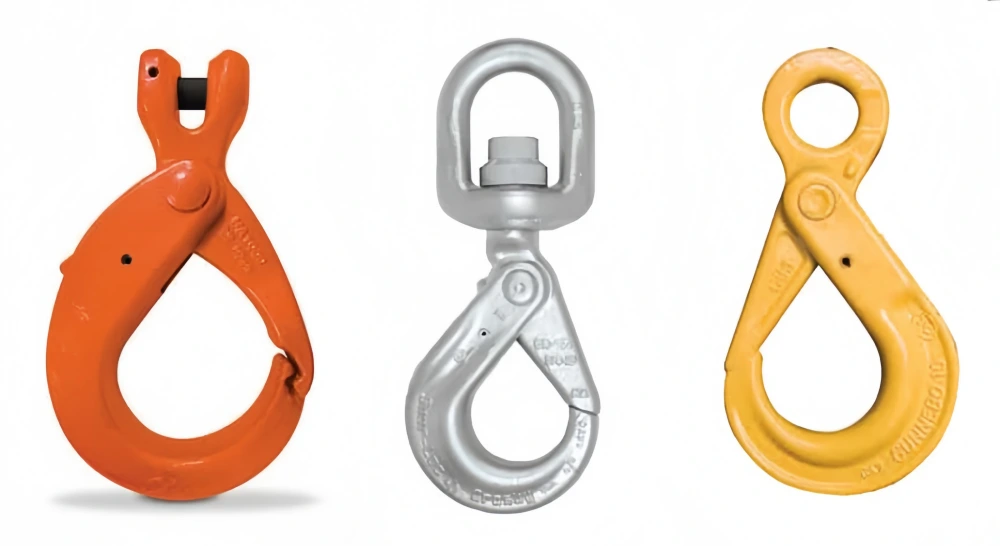
Self-locking describes the retention mechanism, not the upper connection. Eye, clevis, swivel, and shank self-locking hooks are available. Compare self-locking hook configurations with the sling, chain grade, connection, and WLL required by the lift.
Sorting Hooks
Sorting hooks have a unique shape that helps you sort, move, or organize materials quickly. You use sorting hooks in warehouses, shipping yards, and manufacturing plants.
Streamlined design for easy handling of loose materials.
Useful for separating and moving items in bulk.
Often used with slings and chains for efficient material flow.
Sorting hooks help you increase productivity and maintain order in busy work environments.
Because many sorting hooks are open-throat designs, they are application-specific rather than a general substitute for a latched sling hook. Confirm the permitted loading direction, contact area, and WLL for the exact model.
Foundry Hooks
Foundry hooks are built for extreme strength and durability. You use them in foundries, construction sites, and heavy manufacturing.
Wide, open throat accommodates large trunnions, castings, oversized lifting points, and other connections that may not fit a standard sling hook.
Open-throat geometry requires the lift plan to control slack and disengagement risk.
Selection still depends on load geometry, permitted loading direction, and the model-specific WLL.
You choose foundry hooks when you need maximum strength and reliability. Powerful Machinery’s foundry hooks meet the highest standards for safety and performance.
For a practical comparison of open-throat designs, see foundry hook vs. slip hook.
Tip: Always match the type of rigging hook to your specific application. The right choice ensures strength, safety, and efficiency in every lift.
By understanding the different types of rigging hooks, you can select the best option for your rigging needs. Powerful Machinery’s certified hooks deliver the strength, durability, and versatility required for today’s demanding material handling environments.
Common Applications of Rigging Hooks
Lifting and Hoisting
You rely on rigging hooks for safe and efficient lifting operations. These hooks serve as the primary connection between your lifting equipment and the load. You see them in action during overhead lifting, where you must move heavy objects with precision. Industries that use rigging hooks for lifting and hoisting include:
Construction
Manufacturing
Shipbuilding
Offshore industries
Forestry
Logging
Salvage operations
You choose the right hook to match your lifting applications and ensure every load-lifting task meets safety standards. Overhead lifting requires hooks that can handle dynamic forces and maintain secure connections. You protect your team and equipment by selecting certified hooks for all lifting operations.
For project-specific context, see Powerful Machinery’s construction and infrastructure lifting applications.
Load Securement and Towing
You use rigging hooks to secure loads during transport and towing. These hooks prevent shifting and accidental release, which keeps your cargo safe. The most common types of load securement and towing include:
Transport/towing hardware and overhead-lifting hardware should not be treated as interchangeable. Grade, marking, design, and WLL requirements vary by application. If the job involves overhead lifting, use a hook and chain assembly specifically rated for lifting; if the job is cargo securement, use components rated for that securement system.
You select the appropriate hook based on the weight and type of load. For overhead lifting, you always check the working load limit and ensure the hook matches your rigging applications.
Specialized Uses in Construction, Marine, and More
You encounter unique rigging requirements in specialized environments. In construction, you use hooks for lifting beams, panels, and machinery. Marine applications demand hooks with corrosion-resistant coatings and materials. These hooks withstand harsh saltwater conditions and provide long service life.
You also find rigging hooks in mining, logging, and excavation, where heavy-duty application is essential.
Note: You must match the hook’s material and finish to the environment. Marine settings require extra protection against corrosion, while construction sites focus on strength and durability.
You improve safety and efficiency by choosing hooks designed for your specific rigging applications. Overhead lifting in challenging environments demands reliable, certified hardware.
For corrosive or marine service, also confirm the base material, finish, temperature limits, maintenance requirements, and any rating restrictions for the exact hook rather than relying on coating alone.
Most Common Rigging Hooks in Practice
Which Type of Rigging Hook Is the Most Common?
You encounter several rigging hooks in daily industrial practice. Each type serves a unique purpose and helps you achieve safe and efficient lifting. The most common hooks include:
There is no single rigging hook that is most common in every lifting system. Standard eye or clevis sling hooks with latches are among the most frequently encountered choices on chain sling assemblies because they are simple, familiar, and available in many capacities.
Swivel hooks become more common where alignment is difficult, self-locking hooks where positive retention is a priority, and grab hooks where chain length must be adjusted. Foundry and sorting hooks remain more specialized.
Tip: Always match the hook type to your lifting application. The right hook improves safety and efficiency in every rigging operation.
Factors Influencing Selection
You must consider several factors when selecting the best rigging hook for your task. These factors ensure you choose the safest and most effective option for your lifting needs:
Load capacity: You check the working load limit to match the hook with the weight of your load.
Material compatibility: You ensure the hook material works with your chain, sling, or rope.
Environmental conditions: You select hooks with corrosion-resistant finishes for outdoor or marine lifting.
Specific application: You match the hook design to the lifting method and load type.
Connection type: You decide if you need a permanent or quick-release connection for your rigging setup.
Industry requirements: You follow industry standards and regulations for every lifting operation.
You improve safety and extend equipment life when you evaluate these factors before every rigging job.
Also confirm whether a swivel must rotate while loaded, whether the application calls for a standard latch or positive self-locking mechanism, and whether the load geometry allows the hook to seat fully in the bowl.
Rigging Hooks Safety and Standards
OSHA and ASME Requirements
In the United States, hook requirements depend on the equipment and application. OSHA 29 CFR 1910.184 applies to slings used for material handling and includes requirements for alloy steel chain sling attachments and removal criteria for sling hooks.
For hooks covered by that rule, cracked hooks, hooks opened more than 15% of the normal throat opening, or hooks twisted more than 10 degrees from the plane of the unbent hook must be removed from service.
ASME B30.10-2024 is the current U.S. consensus standard dedicated to hooks used with B30 equipment. Manufacturer instructions and the applicable equipment standard remain essential because inspection and use criteria can vary by hook type and service.
Safety Latch Importance
A safety latch helps retain a sling, shackle, or lifting point in the throat when the rigging becomes slack or shifts during handling. It is a retention device—not a structural member—and it should not be used to support the load or to compensate for poor hook engagement.
A missing latch does not mean the same thing on every hook. Some specialty foundry or sorting hooks are designed as open-throat hooks, while many sling and hoist hooks are intended to be used with a functioning latch. If a latch is bent, broken, or missing, follow the hook manufacturer’s instructions and the applicable standard before returning the hook to service. Read more about safety latches on lifting hooks.
Preventing Accidents and Ensuring Compliance
You can prevent most rigging accidents by following proven strategies. The table below outlines the best practices for safety and compliance:
Strategy | Description |
|---|---|
Risk Assessment and Planning | Identify hazards and set clear safety protocols before each job. |
Specialized Rigging Training | Train your team on safe lifting techniques and emergency procedures. |
Routine Equipment Inspections | Check and maintain all hooks and slings to catch problems early. |
Load Capacity and Stability Control | Keep loads within safe limits and secure them properly to maintain a strong safety factor. |
Clear Communication and Signals | Use standard signals and communication to avoid misunderstandings during lifting. |
You build a culture of safety by combining these strategies with regular inspections and proper use of safety latch hooks. You protect your people, your equipment, and your reputation every time you lift.
Seat the load in the bowl of the hook and avoid tip, side, or back loading unless the hook is specifically designed and rated for that loading condition. Avoid shock loading and unauthorized welding, heating, bending, or grinding.
Working Load Limits and Capacity
Understanding WLL and Minimum Breaking Strength
You must understand working load limits before you start any lifting operation. The working load limit, or WLL, tells you the maximum load a rigging hook can safely handle. Manufacturers determine WLL using several factors:
Material strength: The hook’s tensile and yield strength set the foundation for its capacity.
Design factors: The shape and size of the hook affect how much weight it can support. Safety factors are built in to account for dynamic loads.
Testing: Each hook goes through static and dynamic tests to confirm it meets the required standards.
Safety factors: Manufacturers apply extra safety margins to the calculated WLL for added protection.
You should always check the safe working load marked on your hook. Never exceed this value. The minimum breaking strength is higher than the WLL, but you must not use it as your lifting guideline.
WLL is the working rating used for selection. Minimum breaking strength (MBS) is a test or design value associated with failure and is not a substitute for WLL. Do not calculate a hook’s allowable load from a generic safety-factor formula; use the model-specific manufacturer rating and the rating of the complete sling or rigging assembly.
How Are Rigging Hooks Sized and Rated?
Rigging hooks are not selected by physical hook size alone. Buyers typically match the hook by WLL, compatible chain diameter or sling connection, material grade, throat opening, upper connection, and the required application. For clevis and grab hooks, chain size and grade are especially important; for eye hooks, the eye and connector dimensions must also be compatible.
When comparing Grade 80 hooks and Grade 100 hooks, use the WLL table for the exact manufacturer and model rather than assuming that every Grade 100 hook has the same percentage increase over every Grade 80 hook. The Grade 80 vs. Grade 100 chain guide provides additional context for chain selection.
WLL Reductions and Tip Loading
You reduce the hook’s capacity if you do not load it correctly. Tip loading happens when you place the load on the tip of the hook instead of the bowl. This practice can lower hook capacities and increase the risk of failure. Always center the load in the bowl of the hook.
Avoid side loading or shock loading, as these actions can also reduce the safe working load. You protect your team and equipment by following proper loading techniques.
Unless the manufacturer specifically rates a hook for another loading direction, seat the load in the intended bowl or saddle. Tip, side, and back loading can invalidate the normal rating or require model-specific reductions.
Manufacturer Guidelines
You must follow manufacturer guidelines to ensure safe lifting. Leading manufacturers provide clear rules for using rigging hooks:
Rule | Description |
|---|---|
1 | Use Trained and Qualified Personnel: Only trained individuals should perform rigging. |
2 | Inspect Equipment and the Environment: Check all hardware for wear and assess the environment for safety. |
3 | Check Load Balance and Stability: Make sure the load is balanced and stable before lifting. |
4 | Maintain Clear Communication: Coordinate with your team for safe lifting operations. |
You improve safety and extend the life of your rigging hooks by following these guidelines. Always consult the manufacturer’s instructions for specific details about your equipment.
Selecting Rigging Hooks: Criteria and Powerful Machinery Solutions
Application and Load Characteristics
You must start by understanding your application and the characteristics of your load. Each lifting scenario presents unique challenges. You need to know the exact weight and center of gravity before you select a rigging hook. Consider these factors:
Type of load: Is it bulky, irregular, or compact?
Weight: Always verify that the working load limit (WLL) of your hook matches or exceeds the total load.
Frequency of use: Permanent setups may require different hardware than temporary lifting jobs.
Inspection and maintenance: Regular checks help you spot wear or damage early.
You improve safety and efficiency when you match the hook to your lifting and rigging needs.
Material, Grade, and Compatibility
Powerful Machinery’s hooks are engineered for compatibility with both Grade 80 and Grade 100 chains. This ensures you get the right fit and strength for every rigging application.
Grade alone does not establish the WLL of every hook. Compare the exact model, chain size, connection, manufacturer WLL, and assembly rating. Do not mix Grade 80 and Grade 100 components based on color or appearance alone.
Environmental Considerations
You must consider the environment where you use your rigging hooks. Moisture, temperature extremes, chemicals, UV radiation, and abrasive conditions all impact hook longevity and performance. The table below outlines common environmental factors:
| Environmental Factor | Impact on Rigging Hooks |
| Moisture | Causes corrosion, weakening the structural integrity of hooks. |
| Temperature Extremes | Affects performance; high heat can weaken materials. |
| Chemical Exposure | Can attack material or coating; follow manufacturer guidance. |
| Abrasive Environments | Increases wear due to friction with rough surfaces. |
You extend the life of your lifting equipment by choosing hooks with corrosion-resistant finishes and robust construction.
Why Choose Powerful Machinery Hooks?
Powerful Machinery supplies forged hook configurations for industrial lifting and material handling, with product-specific WLL, grade, finish, dimensional, testing, and documentation options depending on the model and project requirement. You benefit from:
Grade 80 and Grade 100 hook families for compatible chain systems.
Eye, clevis, swivel, grab, slip/sling, and self-locking configurations.
Multiple WLL and connection options for standard and project-specific assemblies.
OEM, wholesale, and documentation support based on the selected product and order requirements.
You can trust Powerful Machinery to deliver reliable, high-performance solutions for every load and lifting operation.
Maintenance and Inspection Best Practices
Regular Inspection Procedures
You must inspect your rigging hooks regularly to ensure safety and performance. Start with an initial inspection when you receive new hardware. Check for compliance with industry standards and look for any defects.
Inspection frequency depends on the hook, sling or equipment type, severity of service, applicable standard, manufacturer instructions, and site procedure.
Frequent visual checks should look for obvious damage before use, while periodic inspections should be scheduled at the interval required for the equipment and service. For a more detailed defect checklist, see the crane hook inspection guide and inspection frequency for slings and rigging hardware.
Inspection Type | Frequency/Details |
|---|---|
Initial Inspection | Upon receiving rigging hardware, check for compliance with industry standards. |
Daily/Frequent Inspection | Recommended daily or before each shift; visual checks for defects and damages. |
Periodic Inspection | Required every 12 months; more frequent for severe conditions or heavy use. |
Monthly or quarterly for special services or harsh environments. |
Tip: Consistent inspections help you catch problems early and prevent accidents.
Safety Latch and Hook Replacement
Where the hook design requires a latch, confirm that the latch is present, moves freely, closes correctly, and is not bent or damaged. A damaged latch does not automatically mean the hook body is scrap, but the hook should not be returned to service until it has been evaluated and repaired or replaced in accordance with the manufacturer’s instructions and the applicable standard.
Signs of Wear and When to Replace
You must know when to retire a rigging hook. Look for these common signs:
Cracks, nicks, gouges, severe corrosion, heat damage, or other surface defects.
Throat opening, twist, bending, or deformation beyond the applicable manufacturer or standard limit.
Wear in the bowl, eye, clevis pin, swivel, or other load-bearing area beyond the permitted limit.
- A latch or locking mechanism that does not operate correctly where the design requires it.
- Missing or illegible identification when the hook can no longer be reliably matched to its WLL and specification.
Inspect the entire sling assembly as well as the hook; a serviceable hook does not make a damaged chain, wire-rope sling, synthetic sling, or connector safe to use.
Recordkeeping and Compliance
You must keep accurate records to meet safety standards and support compliance. Good recordkeeping helps you track inspections, repairs, and replacements. Use the table below to organize your documentation:
Recordkeeping Requirement | Description |
|---|---|
Inspection Dates | Logs of all periodic inspections must be kept. |
Rigging Identifications | Serial numbers or asset tags should be recorded. |
Inspector Credentials | Document who performed the inspection. |
Inspection Findings | List any defects, damage, or concerns noted. |
Actions Taken | Record any equipment that was removed, repaired, or replaced. |
Keeping detailed records protects your team and ensures you meet industry regulations.
Staying Updated on Rigging Hooks and Industry Advancements
Importance of Ongoing Education
You work in an industry where safety and efficiency depend on your knowledge. Rigging hook technology changes quickly. New standards and materials appear every year. You must stay informed to keep your team safe and your operations compliant.
You see advancements in load testing standards. These updates help you prevent accidents and reduce downtime. Marking and labeling guidelines now offer better clarity.
You identify the right hook for each job with less confusion. Synthetic rigging materials have become lighter and more durable. You benefit from easier handling and improved performance.
Staying current with these changes helps you avoid costly mistakes and ensures your equipment meets the latest safety requirements.
You should attend training sessions and workshops. You can also join industry associations. These steps help you learn about new regulations and best practices. You set a strong example for your team when you invest in ongoing education.
Advancement Type | Description |
|---|---|
Load Testing Standards | New compliance requirements help prevent accidents and reduce downtime, ensuring workforce safety. |
Marking and Labeling Guidelines | Enhanced clarity in labeling improves safety and efficiency in rigging operations. |
Synthetic Rigging Materials | Adoption of lighter, more durable materials aligns with modern safety standards and improves performance. |
Resources for Further Information
You have many resources to help you stay updated. Industry publications and technical bulletins provide valuable insights. You can subscribe to newsletters from organizations like ASME and OSHA. These sources keep you informed about new standards and safety alerts.
You should also visit manufacturer websites. Powerful Machinery’s official site offers detailed product specifications, safety updates, and technical guides. You find answers to common questions and learn about the latest innovations.
Recommended resources:
ASME and OSHA official websites
Powerful Machinery’s resource center: https://qdpowerful.com/
Industry trade shows and webinars
Professional training courses
You improve your skills and protect your workplace when you use these resources regularly.
You make better decisions and maintain a safer environment by staying informed. Your commitment to learning sets you apart as a leader in rigging safety.
Conclusion
You improve safety and efficiency when you understand rigging hook types and select the right equipment. Regular inspection and maintenance protect your team and your investment. Powerful Machinery stands behind every product with certified quality and expert support.
Review your current rigging practices today. For trusted advice and certified hooks, consult Powerful Machinery.
Choose the right hook.
Inspect regularly.
Trust Powerful Machinery for your lifting needs.
When specifying a hook for a new assembly or RFQ, send the required WLL, chain size and grade, upper connection, hook type, applicable standard or documentation requirement, finish, quantity, and destination. This makes it easier to match the correct product rather than selecting by appearance alone.
FAQ
What is the difference between a grab hook and a slip hook?
You use a grab hook to hold a chain in place without slipping. A slip hook has a wider throat and allows the chain or sling to move freely. Choose based on your load control needs.
How often should you inspect rigging hooks?
Inspect hooks at the frequency required by the applicable equipment or sling standard, manufacturer instructions, service severity, and site procedure. Frequent visual checks and documented periodic inspections serve different purposes, so avoid using one fixed interval for every hook and application.
Can you use Powerful Machinery hooks in marine environments?
Some Powerful Machinery hook configurations can be supplied with finishes suitable for outdoor or corrosive service, but marine suitability depends on the exact material, coating, temperature, maintenance plan, and product rating. Confirm the model and service environment before specification.
How do you know when to replace a rigging hook?
Look for cracks, deformation, worn latches, or missing identification tags. If you see any of these signs, replace the hook immediately to maintain safety.
What is the difference between Grade 80 and Grade 100 rigging hooks?
Grade 80 and Grade 100 refer to alloy strength classes used in lifting-chain systems, but the exact WLL depends on the hook model and compatible chain size. Grade 100 systems often provide higher capacity for a given nominal chain size, but you should compare the manufacturer’s WLL tables and assembly rating rather than applying one universal percentage.
Why do some rigging hooks have safety latches?
A safety latch helps retain slack rigging in the hook throat during handling. It does not carry the load and does not increase the hook’s WLL. Some specialty open-throat hooks are intentionally designed without a conventional latch, so the requirement depends on the hook design, equipment, application, manufacturer instructions, and applicable standard.
Can a swivel rigging hook rotate under load?
Only if the specific swivel hook is designed and rated for loaded rotation. Some swivel hooks are positioning devices that should be oriented before the load is applied, while bearing-equipped models may permit rotation under load within their rated conditions. Check the manufacturer’s instructions for the exact model.