The Short Answer
A plain (non-shouldered) lifting eye bolt is intended for a straight, in-line pull along the axis of the bolt. It must not be used for angular or side loading. The eye bolt must also be rated for lifting, correctly installed, and used within the working load limit (WLL) specified for that exact product.
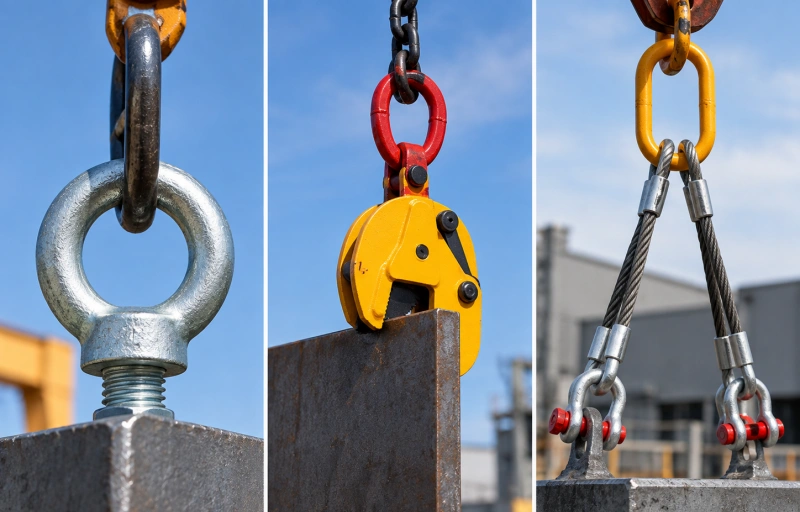
This is a narrow selection question. Other rigging hardware may be used in a vertical lifting system, but slings, shackles, clamps, and lifting points do not become interchangeable simply because the load moves vertically. Each component must be selected for its own function, loading direction, and connection geometry.
What Does a Vertical Pull Mean?
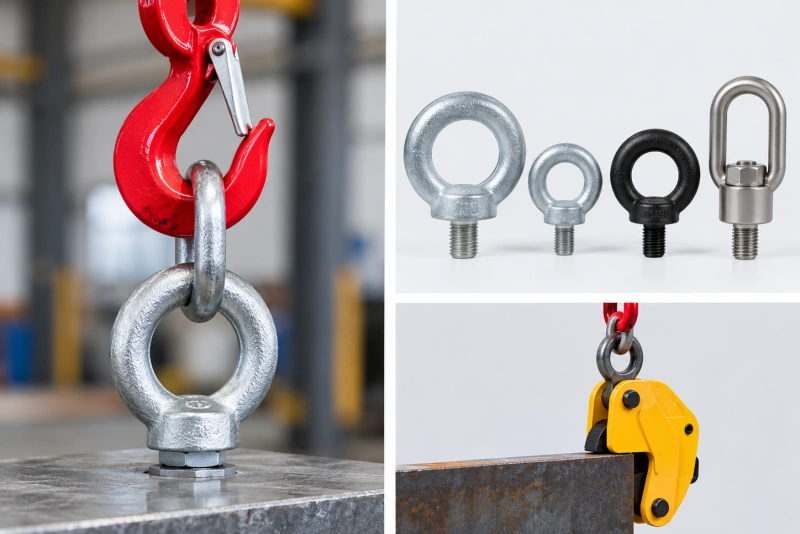
For an eye bolt, a vertical pull means an axial, in-line load acting along the threaded shank. The load should not pull sideways across the eye or create an angular force on the shank. If the sling leg moves away from the bolt axis, the loading is no longer a simple in-line pull.
The distinction matters because an eye bolt is rated for defined loading directions and installation conditions. Side loading introduces bending in addition to tension. A plain eye bolt has no load-bearing shoulder beneath the eye, so it should remain within the manufacturer’s specified in-line loading conditions.
Why Non-Shouldered Eye Bolts Are Limited to In-Line Pulls?
A non-shouldered eye bolt has an eye and threaded shank but no load-bearing shoulder beneath the eye. Under a correctly aligned pull, the primary load acts along the shank. Under an angled pull, the shank can be subjected to bending that the product was not designed or rated to carry.
Use a non-shouldered eye bolt only when all of the following are true:
- The manufacturer identifies the eye bolt as rated for lifting.
- The pull remains in line with the bolt axis.
- The WLL is adequate for the planned load and configuration.
- The thread form, thread engagement, and receiving material meet the installation instructions.
- The eye is aligned with the load path, and the attached hardware fits without binding, crowding, or point loading.
- The eye bolt passes the required pre-use inspection.
Bent-wire screw eyes, open eyes, and unmarked general-purpose fasteners should not be assumed suitable for overhead lifting. A similar shape does not establish a WLL or confirm that the item is approved for lifting.
Non-Shouldered vs Shouldered Eye Bolts and Swivel Hoist Rings
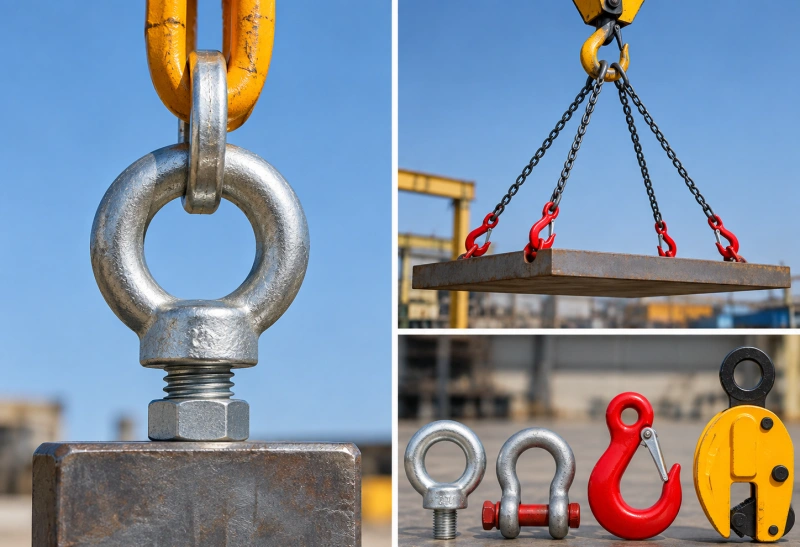
| Hardware | Typical Load Direction | Critical Limitation |
| Plain (non-shouldered) lifting eye bolt | In-line pull only | Do not use for angular or side loading. |
| Shouldered eye bolt | In-line and permitted angular loading when the exact product allows it | The shoulder must seat correctly; angular WLL and alignment requirements are product-specific. |
| Machinery eye bolt | Depends on its design and installation | Follow the manufacturer’s angle, thread-engagement and seating instructions. |
| Swivel hoist ring or rotating lifting point | Designed to align with permitted multi-directional loading | WLL, bolt torque, rotation, pivot range and installation still depend on the exact model. |
For a wider comparison of eye bolt designs, read the guide to types of eye bolts. Do not convert a non-shouldered eye bolt into an angular lifting point by adding washers, spacers, or an improvised fitting.
When a Vertical Lifting Clamp Is the Correct Tool?
Vertical lifting clamps are designed for specific plate-handling applications in which the plate is lifted in the orientation and gripping range defined for the clamp. They are not a universal solution for every vertical lifting task.
Before using a clamp, confirm the material, plate thickness, WLL, lifting orientation, any specified minimum load, surface condition, jaw or cam condition, and restrictions on hardness or coatings. Follow the instructions for the exact clamp model. A horizontal plate clamp, beam clamp, or general gripping device should not be substituted merely because it can attach to the load.
How Slings and Shackles Fit into a Vertical Lift?
Lifting slings support or connect the load in a defined hitch or leg configuration. Shackles join compatible components in the load path. Both may be part of a vertical lifting arrangement, but neither has a universal capacity simply because the load path is vertical.
Sling capacity depends on sling type, hitch, angle, leg count, edge contact, and environmental conditions. Shackle suitability depends on WLL, pin security, connection geometry, and loading direction. Select the complete arrangement from current product data rather than applying a generic capacity taken from another sling or shackle.
How to Confirm the Hardware Is Suitable?
Identify the Load and Direction
Verify the load weight, center of gravity, and intended lifting points. Confirm whether the pull will remain aligned or whether the load can tilt, rotate, or shift as tension is applied. A lift that begins with an in-line pull can develop angular loading if the center of gravity is not below the connection.
Check Product Identification and WLL
Use the identification markings and current manufacturer data for the exact hardware. Do not derive a lifting WLL from diameter, appearance, or minimum breaking load unless an approved product specification explicitly provides that relationship.
Verify Installation
Confirm the thread size and form, minimum thread engagement, receiving material, seating surface, nut or tapped-hole arrangement, alignment, and any required tightening torque. The supporting structure must also be capable of carrying and transferring the applied load.
Confirm Connection Fit
The sling hook, shackle, or other connector must fit the eye without crowding, edge loading, or binding. The connection should allow the applied force to act within the permitted plane and direction.
Inspect Before Use
Check for missing identification, bent or elongated eyes, damaged threads, cracks, wear, corrosion, deformation, or an installation that does not seat as required. Remove questionable hardware from service. The rigging hardware inspection guide covers broader inspection principles and removal-from-service criteria.
Common Mistakes to Avoid
| Mistake | Why It Is Unsafe | Correct Approach |
| Using a regular eye bolt for an angled pull | The shank can be exposed to unintended bending. | Use an engineered lifting point approved for the actual direction. |
| Assuming every eye-shaped fastener is rated for lifting | General-purpose or bent-wire eyes may have no lifting WLL. | Use positive product identification and lifting data. |
| Choosing only by diameter | Material, manufacturing method, thread, installation, and rating also control suitability. | Use the exact product specification. |
| Allowing the load to tilt after tension is applied | A planned in-line pull can become angular. | Assess the center of gravity and complete load path. |
| Using a generic sling or clamp capacity table | Ratings do not transfer across products and configurations. | Use current manufacturer data for the exact arrangement. |
FAQ
Which Eye Bolt Is Designed for Vertical Pulls Only?
A plain (non-shouldered) lifting eye bolt is intended for in-line loading only. It should not be used for angular or side loading.
Can a Shouldered Eye Bolt Be Used for a Vertical Pull?
Yes. A shouldered eye bolt may be used for an in-line pull when properly installed. Some designs also permit angular loading at reduced capacity, but the exact product instructions and rating table govern its use.
Is a Swivel Hoist Ring Only for Angled Pulls?
No. A swivel hoist ring may be used for permitted in-line or angular loading when installed and loaded as the manufacturer specifies. Its ability to pivot or swivel does not eliminate WLL, tightening torque, alignment, or inspection requirements.
Can a Horizontal Lifting Clamp Be Used for a Vertical Plate Lift?
Do not assume it can. Use a clamp specifically approved for the plate orientation and lifting method. Clamp names, jaw designs, and permitted loading directions vary, so the instructions for the exact model govern the application.
Can Slings and Shackles Be Used in a Vertical Pull?
They can form part of a vertical lifting arrangement when each item is correctly rated, configured, and connected. Their suitability does not change the restriction that a non-shouldered eye bolt must remain in line with its axis.
Conclusion
For the exact question, the clearest answer is a plain (non-shouldered) lifting eye bolt: it is intended for a straight, in-line pull and not for side or angular loading. A shouldered eye bolt, swivel hoist ring, or vertical lifting clamp may be the correct alternative when the load direction or application requires it, but only within the limits of the exact product.
Verify the load, direction, WLL, installation, and connection geometry before use. If the pull cannot remain aligned with the eye bolt axis, stop and select a lifting point designed and rated for the actual load direction.