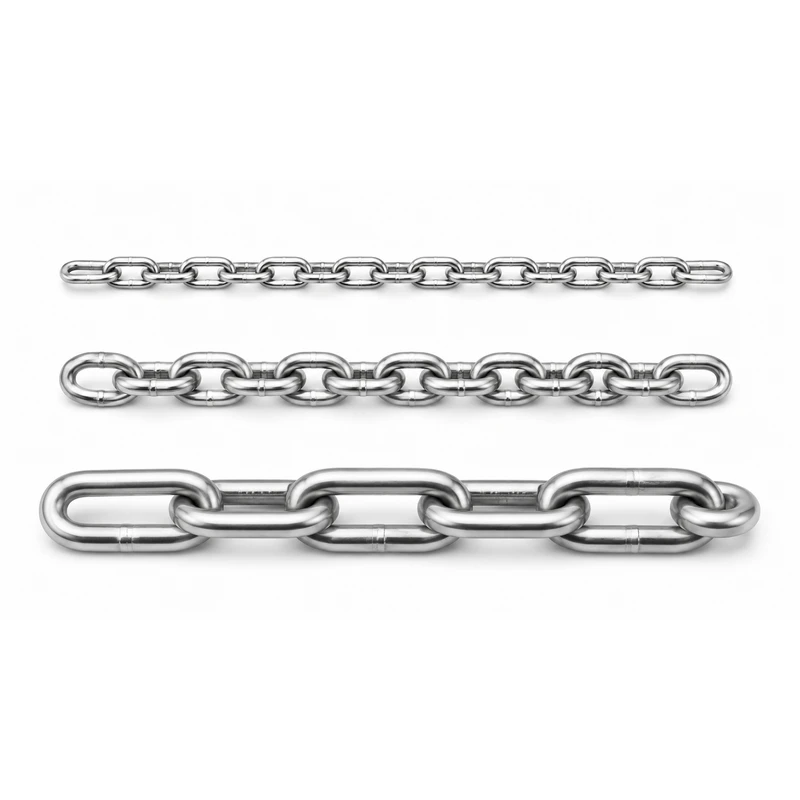
The two main types of chain binders are lever binders and ratchet binders. Both remove slack and apply tension to a rated transport chain, but they do it differently. A lever binder closes with an over-center handle movement. A ratchet binder uses repeated handle strokes to move a threaded mechanism in smaller increments.
Neither style is automatically the right choice for every load. Start with the chain, required working load limit (WLL), tie-down arrangement, and applicable rules. Then compare take-up, handle movement, working clearance, hook fit, inspection needs, and the operator’s approved procedure. If you need the basic terminology first, read what a chain binder is.
Short answer: Choose a ratchet binder when progressive adjustment and a controlled handle stroke fit the job. Choose a lever binder when rapid over-center operation, mechanical simplicity, and adequate handle clearance suit the procedure. In both cases, the exact model—not the binder type alone—determines WLL and chain compatibility.
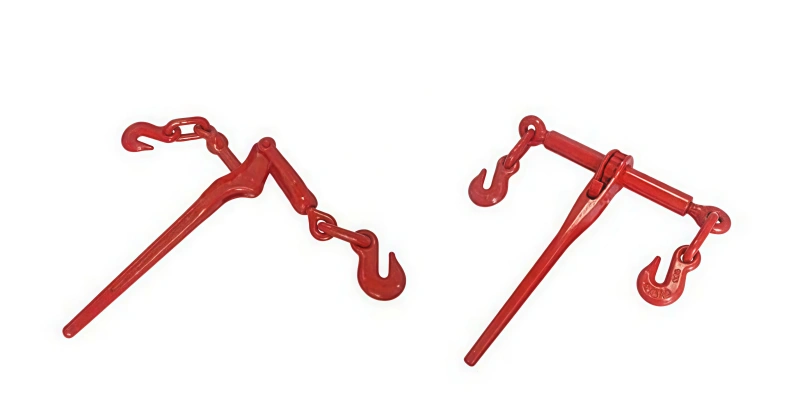
Lever vs Ratchet Chain Binder: Quick Comparison
| Selection point | Lever binder | Ratchet binder |
| How it tensions | One over-center lever movement closes the binder. | Repeated handle strokes advance a ratchet-and-thread mechanism. |
| Adjustment | Fast closure, with adjustment governed by the model and chain connection. | Progressive adjustment in smaller increments. |
| Working space | Needs a clear path for the full handle movement and controlled release. | Needs room for repeated handle strokes and the binder body. |
| Stored-energy concern | The handle can move forcefully during operation or release; follow the model procedure and keep clear. | The mechanism changes the release behavior, but the tensioned system still stores energy and requires a controlled procedure. |
| Maintenance focus | Inspect hooks, links, handle, pivots, body and markings. | Type alone does not establish WLL, compatible chain, legal suitability, or safe-use method. |
| Selection strength | Speed and a simple mechanism. | Progressive take-up and adjustment. |
| What it does not tell you | Type alone does not establish WLL, compatible chain, legal suitability or safe-use method. | Type alone does not establish WLL, compatible chain, legal suitability or safe-use method. |
1. Lever Chain Binders
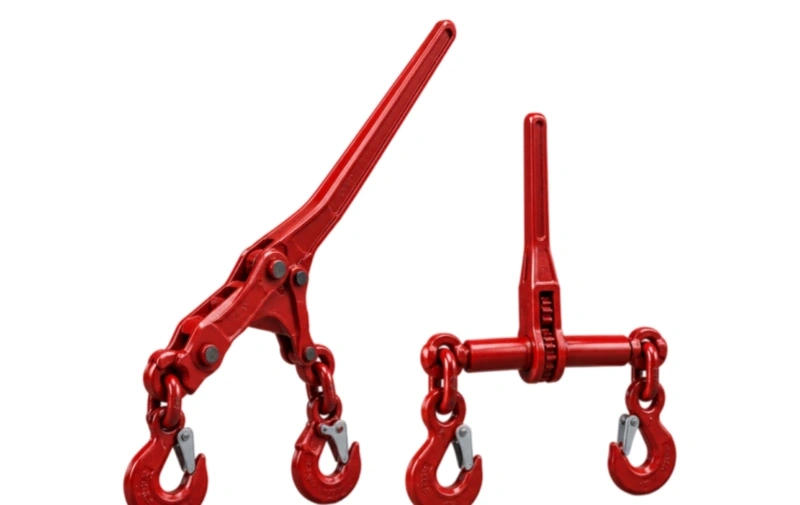
A lever chain binder uses an over-center mechanism. After the hooks are connected to compatible chain links, the handle moves through its designed path to shorten the binder and tension the tie-down. The direct action makes the mechanism quick, but it also means the operator needs suitable footing, working clearance, and an approved release method.
The L-150 lever load binder is Powerful Machinery’s catalogue example. The uploaded catalogue lists four chain-size groups from 1/4–5/16 in. through 1/2–5/8 in., with published WLLs from 2,200 to 13,000 lb and handles from 11.42 to 21 in. These figures describe the listed family; confirm the selected size, markings, dimensions, and current controlled specification before use.
When a Lever Binder May Fit?
- The procedure favors rapid application and release.
- The operator has enough clearance for the full handle path.
- A mechanically simple design fits the fleet’s inspection and maintenance program.
- The selected model matches the chain size, chain grade, required WLL, hook fit, and take-up need.
- Trained operators can keep clear of the handle and stored-energy path.
2. Ratchet Chain Binders
A ratchet chain binder uses a handle, pawl, and threaded take-up mechanism. Repeated handle strokes shorten or lengthen the binder in increments. This gives the operator progressive adjustment, but the additional moving parts must remain identifiable, clean, and maintained in line with the model instructions.
The L-140 ratchet load binder is the standard inch-size catalogue family. It covers chain-size groups from 1/4–5/16 in. through 1/2–5/8 in. The catalogue and the current category page disagree on the WLL of the smallest group, so that value must be confirmed against the approved specification before it is published or used for selection.
When a Ratchet Binder May Fit?
- Progressive tension adjustment is important.
- The available space supports repeated handle strokes.
- The maintenance program covers threads, pawl, pivots, hooks, and markings.
- The required take-up falls within the selected model’s published range.
- The selected model matches the complete chain-and-binder system.
Is an EN12195-3 Binder a Third Type?
Not in terms of the basic mechanism. Powerful Machinery’s catalogue includes a European EN12195-3 ratchet-type load binder series, so it remains a ratchet binder. The designation identifies a separate catalogue family and market specification rather than a third way of tensioning chain.
The catalogue lists 8, 10, 13 and 16 mm sizes, WLLs of 4.0, 6.3, 10.0 and 16.0 tonnes, and take-up values from 150 to 165 mm. Treat these as catalogue values for that family, not as a universal ratchet-binder range. Before ordering, confirm the precise model, applicable edition, required markings, supporting documents, chain compatibility, and destination-market rules.
How to Choose a Chain Binder?
The useful question is not “Which binder is best?” It is “Which rated binder fits this chain, this tie-down arrangement, and this operating procedure?” Work through the following checks before comparing price or availability.
1. Identify the Chain
Record the chain diameter, grade or standard, WLL, and link geometry from legible markings and documentation. Do not identify a chain from color or diameter alone. The binder hook must seat correctly in the intended link without forced engagement or side loading. Powerful Machinery also lists Grade 80 long-link lashing chain for relevant lashing applications, but compatibility still has to be confirmed for the exact chain and binder.
2. Determine the Required System WLL
Evaluate the complete tiedown rather than the binder in isolation. In the United States, 49 CFR 393.108 states that the WLL of a tiedown, connector, or attachment mechanism is limited by its lowest-rated component or anchor point. The required aggregate WLL and number of tiedowns also depend on the cargo and applicable securement rules. Other jurisdictions may use different calculations or standards.
3. Compare Take-Up and Dimensions
Take-up is the amount of slack the binder can remove through its working range. Too little take-up may leave the chain loose; an unsuitable starting position can also leave the mechanism outside its intended operating range. Compare the model’s take-up, open and closed dimensions, hook reach, and chain attachment position. If the specification table does not identify take-up clearly, ask the supplier to confirm it rather than deriving a purchasing decision from a diagram alone.
4. Check Handle Length and Clearance
Measure the available space beside the cargo, trailer edge, tires, guards, and nearby tie-downs. A lever binder needs a clear over-center handle path. A ratchet binder needs room for repeated strokes. Handle length affects the operating envelope, but it is not permission to add an extension. Never use an improvised cheater bar unless the manufacturer’s instructions expressly permit the exact accessory and method.
5. Consider Frequency, Maintenance and Operator Procedure
Frequent-use fleets may prefer progressive ratchet adjustment, while another operation may value the speed and simplicity of a lever mechanism. That is an operating choice, not a universal safety ranking. Compare training, inspection capability, maintenance access, weather exposure, storage, and the site’s written procedure.
6. Confirm the Destination Market and Required Documents
Tell the supplier where the binder will be used and which standard, marking, certificate, test report or traceability document the buyer requires. A catalogue heading does not by itself prove that every size, finish or production batch carries the same approval. Put document requirements in the RFQ and approved purchase specification.
7. Check the Complete Securement Arrangement
Confirm the anchor points, hooks, connectors, edge protection, blocking and load geometry. A correctly rated binder cannot compensate for an unsuitable anchor, unidentified chain, damaged component, or inadequate number of tiedowns. Use cargo-control equipment only for its intended purpose; these load binders are not overhead lifting devices.
Catalogue Family Snapshot
| Catalogue family | Mechanism | Published size scope | Selection note |
| L-150 | Lever | 1/4–5/16 to 1/2–5/8 in. | Confirm WLL, handle path, hook fit, and current drawing. |
| L-140 | Ratchet | 1/4–5/16 to 1/2–5/8 in. | Resolve the smallest-size WLL conflict before publication or use. |
| EN12195-3 series | Ratchet | 8, 10, 13 and 16 mm | Catalogue lists 150–165 mm take-up; confirm model documents and market requirements. |
For a fuller product comparison, review the Powerful Machinery load binder range. The commercial page should carry detailed current specifications; this article should remain the type-and-selection guide.
Safe Use Starts After Selection
Selecting the correct mechanism is only the first step. Before each use, identify the binder and chain, inspect the components, confirm the tie-down route, and keep people clear of the tensioned system. Tightening, rechecking, and releasing must follow the instructions for the selected model and the rules that apply to the operation. The complete procedure belongs in the guide on how to use a load binder safely.
If webbing may be a better fit for the cargo surface or duty, compare a load binder vs ratchet strap rather than treating strap devices as additional chain binder types.
What to Include in a Chain Binder RFQ
A useful enquiry gives the supplier enough information to check compatibility instead of guessing from a product photo. Include:
- Binder mechanism or preferred family: lever, ratchet, L-150, L-140, EN12195-3 series, or “recommend a model”.
- Chain diameter, grade or standard, WLL, link dimensions, and current markings.
- Required binder WLL and the governing securement calculation or specification.
- Required take-up, open/closed envelope, handle-clearance limit, and hook geometry.
- Quantity, destination market, requested delivery date, and replacement or new-system status.
- Finish, private marking, packaging, inspection, test, and documentation requirements.
- Clear photos of the existing chain, binder markings, hooks, and anchor points when matching a replacement.
Once these details are available, send your chain and binder specification for model review and quotation. Final suitability must be confirmed in the approved specification for the complete tie-down system.
FAQ
What are the two main types of chain binders?
The two main mechanisms are lever and ratchet. A lever binder closes through an over-center handle movement. A ratchet binder advances a threaded mechanism through repeated strokes. Specialty product families may use different hooks, dimensions, or standards while retaining one of these operating principles.
Which is better: a ratchet binder or a lever binder?
Neither is universally better. Ratchet binders provide progressive adjustment. Lever binders offer rapid operation and a simple mechanism. Choose the exact model by chain compatibility, WLL, take-up, operating clearance, maintenance program, operator training, and applicable rules.
Does a ratchet binder have a higher WLL than a lever binder?
Not necessarily. WLL is model-specific. In the uploaded Powerful Machinery catalogue, some corresponding L-140 and L-150 sizes share the same WLL, while others differ. Read the approved rating for the exact binder and use the lowest rating in the complete tiedown.
Can I choose a binder from chain diameter alone?
No. Diameter is only one input. Confirm chain grade or standard, WLL, link fit, binder rating, take-up, dimensions, hook seating, and the complete securement arrangement. If the chain cannot be identified, do not guess from appearance.
Are chain binders used for overhead lifting?
No. The binder families discussed here are cargo-securement devices. Do not use them to hoist or suspend a load. Select equipment designed, rated, and documented for lifting when overhead lifting is required.